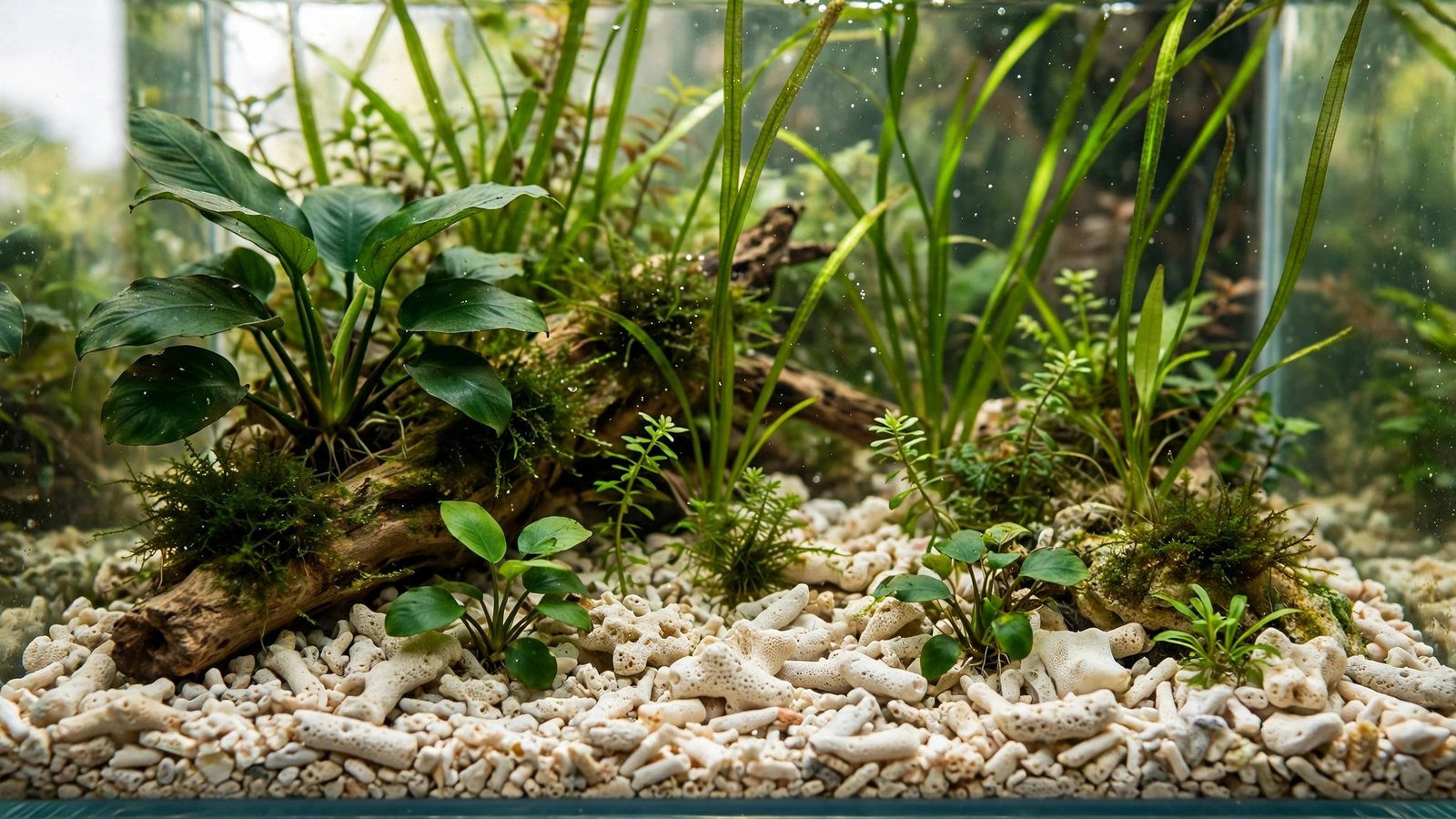
Your tap water reads 0 dKH, your pH crashes overnight, and your shrimp keep dying for no visible reason. Before you tear the tank apart, consider this: a crushed coral planted tank setup can be as simple as a bag of coral tucked in your filter, slowly raising and stabilizing KH with almost no effort. It sounds too simple — which is why keepers argue about it, and why it deserves a clear-eyed look.
Crushed coral is calcium carbonate (aragonite) that dissolves in acidic water, releasing calcium and carbonate ions that push up GH, KH, and pH. It belongs to the family of buffering substrates that hold pH and KH steady over months — but unlike active aquasoils, it buffers upward, not downward. Whether that helps or hurts your tank depends entirely on your starting water.
What crushed coral actually does in your water
When tank water drops below about pH 7.0, the coral's aragonite dissolves, releasing calcium and carbonate ions. Carbonate becomes bicarbonate in water — exactly what your KH test kit measures, and the buffering capacity that stops pH swings.
The effects are predictable: KH rises, stabilizing and usually lifting pH; GH rises from the dissolved calcium, which shrimp, snails, and plants need. Very soft water drifts toward roughly pH 7.4–7.8. Because dissolution stalls as pH climbs past 7.5, the system is partially self-regulating — you won't wake up to pH 9 from a media bag.
Surface area and flow decide how hard it works: finer pieces dissolve faster, and a bag in a high-flow filter compartment outperforms a thin layer sitting under stagnant substrate.
When a crushed coral planted tank makes sense
Most planted tanks don't need it. Coral earns its place in four situations:
- Very soft tap water (0–1 dKH). Every water change injects zero-buffer water, and nitrification steadily eats what KH remains. A coral bag is standing insurance against the overnight pH crash that wipes livestock.
- Aquasoil exhausting its buffer. Active soils hold pH low for 6–12 months, then fade. Coral can smooth the transition — but see the warning below before combining them.
- Shrimp and snail tanks. Neocaridina shrimp and nerites need calcium for shells and molts. If GH sits at 2–3 dGH, a coral bag supplies it continuously.
- Fish that prefer harder water. Livebearers and rainbowfish do best at pH 7.2–7.8. Here the coral isn't a crutch — it's the substrate doing its job, much like choosing an inert bed over the aquarium soil vs gravel tradeoff.
If your tap already reads 3+ dKH with stable pH, coral buys you nothing and can push pH past what soft-water plants prefer.
How much crushed coral to use
The rule of thumb is about 1 lb per 10 gallons as a starting dose — emphasis on starting. The protocol: start low, test, adjust. Full stabilization takes 1–3 weeks; rinse the coral first, since dust clouds water and dissolves in an uncontrolled burst.
| Tank size | Start with | Next step |
|---|---|---|
| 5–10 gal | ½–1 lb | Add ¼ lb if KH slips under 2 |
| 20 gal | 2 lb | ½ lb increments if pH won't hold |
| 40 gal | 4 lb | Split across two filter compartments |
| 75+ gal | 6–8 lb | Monitor flow through the bag |
A tank running nutrient-rich aquasoil at pH 6.4 may need the higher end before KH holds.
The dosing section needs a buyable bag; established aragonite brand: a bag of crushed coral like CaribSea's ★4.7.
Media bag in the filter vs. buried substrate layer
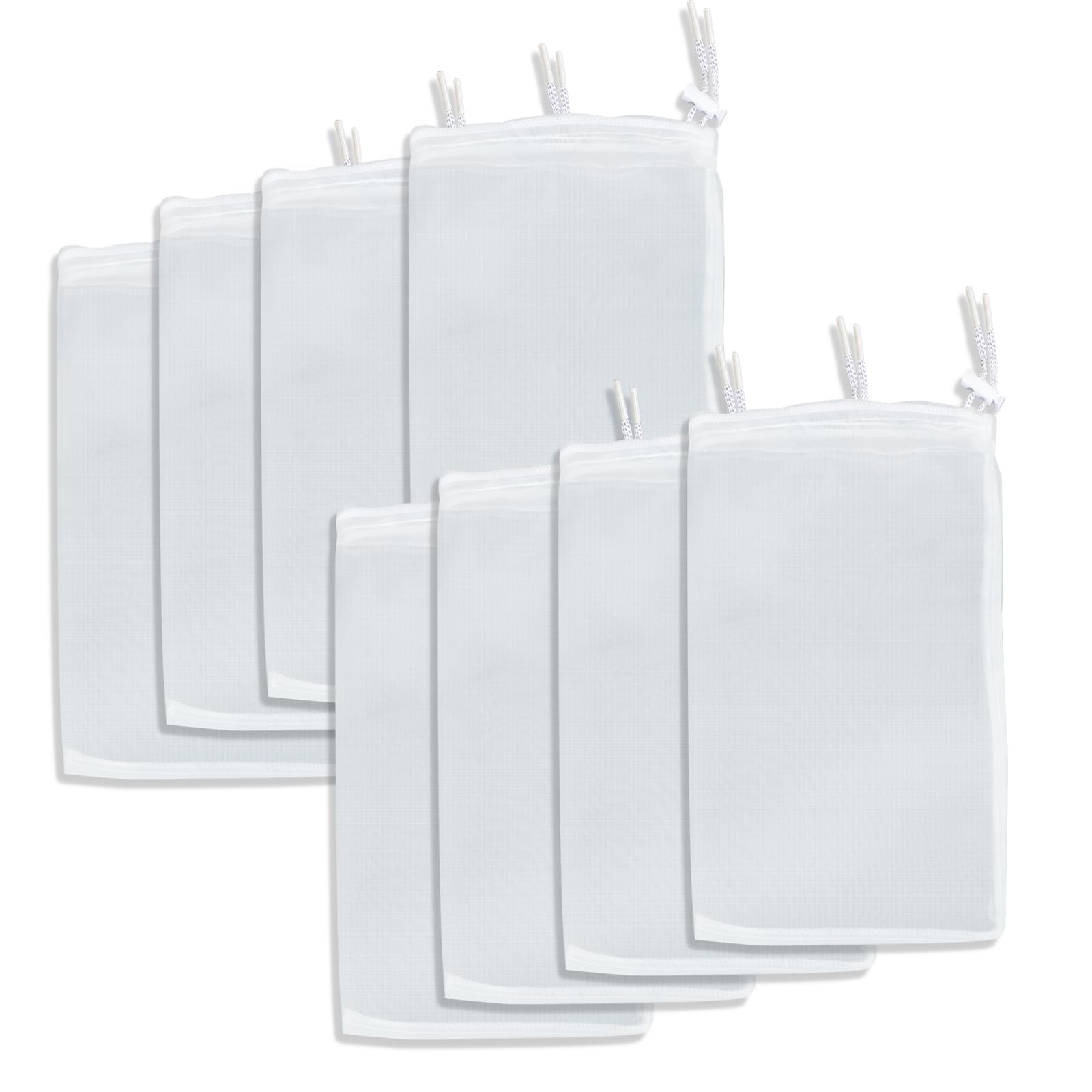
For nearly every planted tank, the media bag wins. Put rinsed coral in a fine mesh bag in a filter compartment with good flow — after the mechanical media. Loose coral is visible, migrates upward, and blocks carpet roots; adjusting the dose means excavating the scape instead of pulling a bag. The one exception is a filterless setup, where a thin layer under sand over aquasoil works — but commits you to that dose for the life of the tank. If you're weighing substrates more broadly, see our aquarium sand for planted tanks comparison.
 ★4.8
Pawfly Filter Media Bags
Check Price on Amazon ★4.8The risks: pH creep, aquasoil wars, and algae
pH creep. Coral drifts pH toward 7.4–7.8. Classic soft-water plants (toninas, many crypts) and Caridina shrimp want acidic water below pH 7. If your tank thrives at pH 6.6, adding coral "for safety" degrades the conditions your livestock chose you for. Coral fixes unstable water; it shouldn't replace stable water.
Fighting your aquasoil. Active soils buffer pH down while coral pushes it up. Together they spend their capacity battling each other instead of stabilizing the tank — both exhaust faster. Let the soil do its job first; add coral only once its buffer is clearly spent.
Instability invites algae. Fluctuating KH means fluctuating CO₂ availability, and unstable CO₂ is a fast track to hair algae and staghorn. Change the dose in increments and never chase the number daily — a steady 2 dKH beats a bouncing 4 dKH.
Crushed coral vs. aragonite sand vs. baking soda
| Crushed coral | Aragonite sand | Baking soda | |
|---|---|---|---|
| Adds | KH + GH (calcium) | KH + GH (calcium) | KH only (sodium) |
| Speed | Gradual, self-limiting | Gradual, more surface area | Instant |
| Control | Add/remove the bag | Only by rescaping | Precise per water change |
| Best for | Filter-bag buffering, shrimp tanks | Hard-water biotope substrate | Emergency KH fixes |
Baking soda fixes KH now but adds sodium, zero GH, and every water change resets the clock. Aragonite sand is the same mineral in finer form — good as a substrate, bad in a filter bag. One caveat: coral supplies no magnesium, so long-term users should add a magnesium-containing GH booster. For deeper chemistry, Rooted Tank's hardness guide and FishLab's KH guide are solid references.
Frequently Asked Questions
Will crushed coral hurt my aquarium plants?
For most community plants — swords, anubias, java fern, stem plants — no; the modest KH/GH rise sits well within their tolerance. It becomes a problem only for soft-water specialists like toninas and some eriocaulons that want genuinely acidic, low-mineral water. Match the buffer to your livestock, not the other way around.
How fast does crushed coral raise pH and KH?
Gradually — measurable KH movement within days, a stable plateau in 1–3 weeks. Rinsed coral in a high-flow filter bag works fastest. The rise is self-limiting: dissolution slows sharply above pH 7.5, so it won't overshoot the way overdosed chemical buffers can.
Can I use crushed coral with aquasoil?
Not at the same time, ideally. Fresh aquasoil buffers pH down while coral pushes it up, so they burn through each other's capacity. Let the soil do its job first; once its buffer is exhausted (typically 6–12 months), coral can take over stabilizing if your water still needs it.
How often should I replace the crushed coral?
When your KH trend starts falling despite a stable routine — usually every 6–18 months. The bag's output fades as the outer surfaces dissolve away. Replace about half the bag at a time, since fresh surfaces dissolve fast in their first days and a half-swap keeps the transition gentle.
Crushed coral vs. aragonite sand — which is better?
Same mineral, different grain size. Crushed coral suits a filter bag: easy to adjust, high flow, simple to remove. Aragonite sand suits a hard-water substrate bed but compacts in bags and is miserable to remove from a scape. Pick based on where the buffer needs to live.
The bottom line
Crushed coral is a slow, forgiving buffer for soft-water planted tanks — nothing more exotic than that. Use it when KH won't hold: 0–1 dKH tap water, fading aquasoil, or invertebrates that need calcium. Start with a modest bag in the filter, test your way to a stable 2–4 dKH, and leave it alone. The best buffering is the kind you stop thinking about — and the way you get there is testing, not guessing.