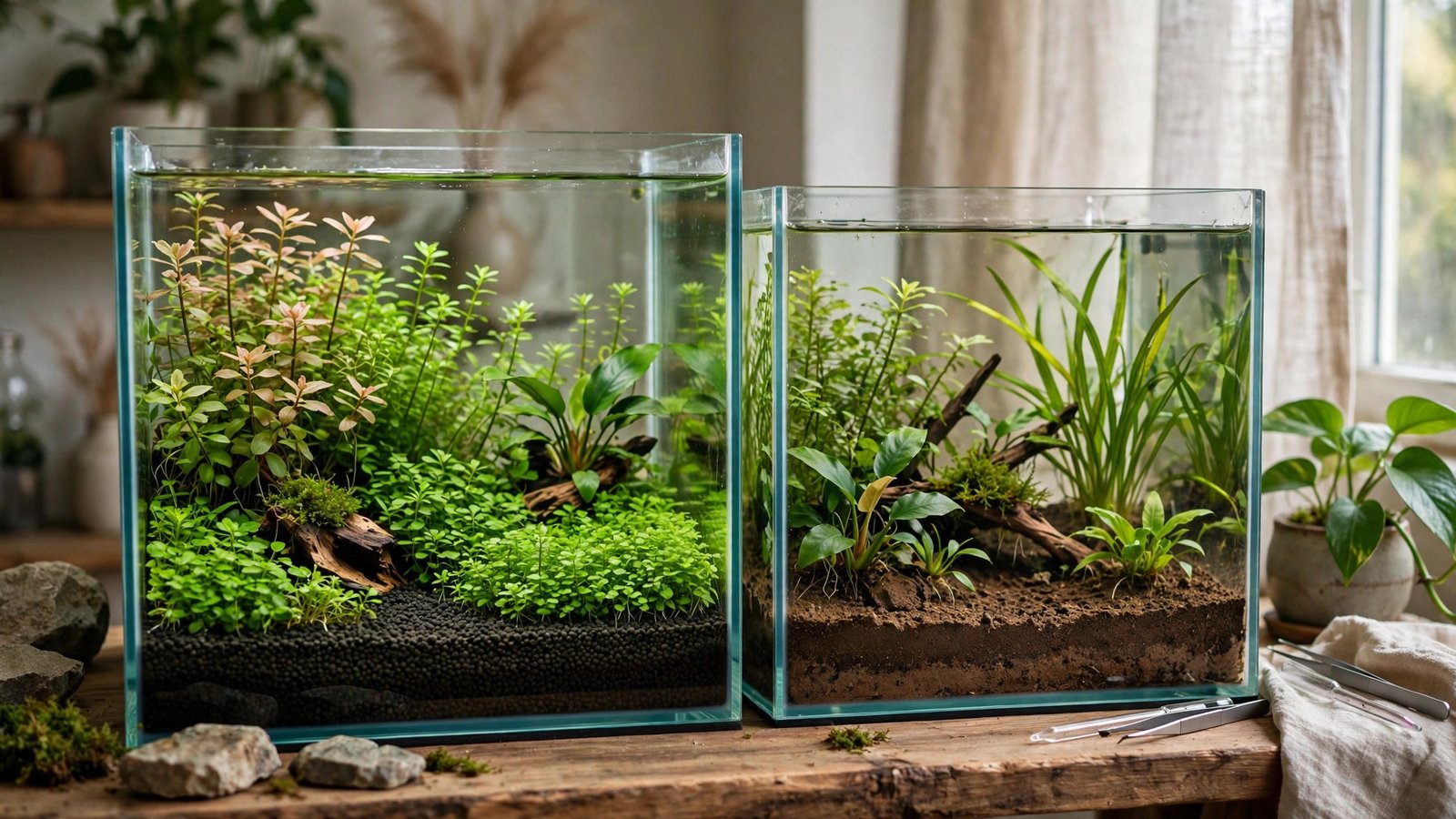
Set up a planted tank and within a week someone will tell you you're doing it wrong. The loudest substrate-aisle argument is aquasoil vs dirt planted tank — a $70 bag of baked volcanic granules against a $7 bag of garden-center soil capped with sand. Both grow plants beautifully. What actually matters is which one's trade-offs you can live with. If you lean toward dirt, read our step-by-step dirted tank build after this.
| Factor | Aquasoil (commercial) | Dirted tank (soil + cap) |
|---|---|---|
| Upfront cost (20 gal) | $60–80 (two 9 L bags) | $15–25 (organic soil + sand cap) |
| Nutrient longevity | Strong 6–12 months, then root tabs | Strong 1–2 years, then root tabs |
| CEC & buffering | High CEC; lowers pH/KH | Moderate CEC; no pH buffering |
| Ammonia leach | 2–6 weeks; needs frequent water changes | 1–3 weeks if not mineralized; cap contains it |
| Aesthetics | Uniform dark granules, clean look | Depends on your cap choice |
| Rescape ease | Easy — granules stay put | Messy — soil drifts into the cap |
| Beginner forgiveness | High (recipe is pre-made), cycle discipline required | Medium (soil choice and cap depth matter) |
Aquasoil vs Dirt Planted Tank: The Honest Head-to-Head
These are not two versions of the same thing. Aquasoil is an engineered product: baked clay granules pre-loaded with nutrients, designed to buffer water and feed roots out of the bag. A dirted tank is a construction project: a soil layer you choose yourself, capped with sand to keep it in place. The debate gets heated because each side assumes the other doesn't work. It does — first-year growth is excellent under either.
Upfront Cost: A Gallon-by-Gallon Breakdown
Cost is dirt's home turf, and it's not close. Aquasoil runs about $3–4 per liter; a standard 20-gallon needs roughly 18 liters for a 2–3 inch layer, which means two 9-liter bags at $30–40 each — $60–80. A 40-gallon with a deep scape can want $120+ in soil. The honest buying advice: the 9-liter bag is the standard unit, and a 20-gallon needs two.
A dirted build is roughly a tenth of that. Plain organic potting soil (no slow-release fertilizers, no perlite, no manure) costs $5–8, and a 20-gallon needs half a bag. Pool filter sand for the 1–1.5 inch cap adds $5–10. Total: $15–25. For dirt, buy plain organic potting soil plus pool filter sand — nothing with moisture-control crystals or fertilizer prills. If you want to compare brands first, we've compared the leading aquasoils head to head.
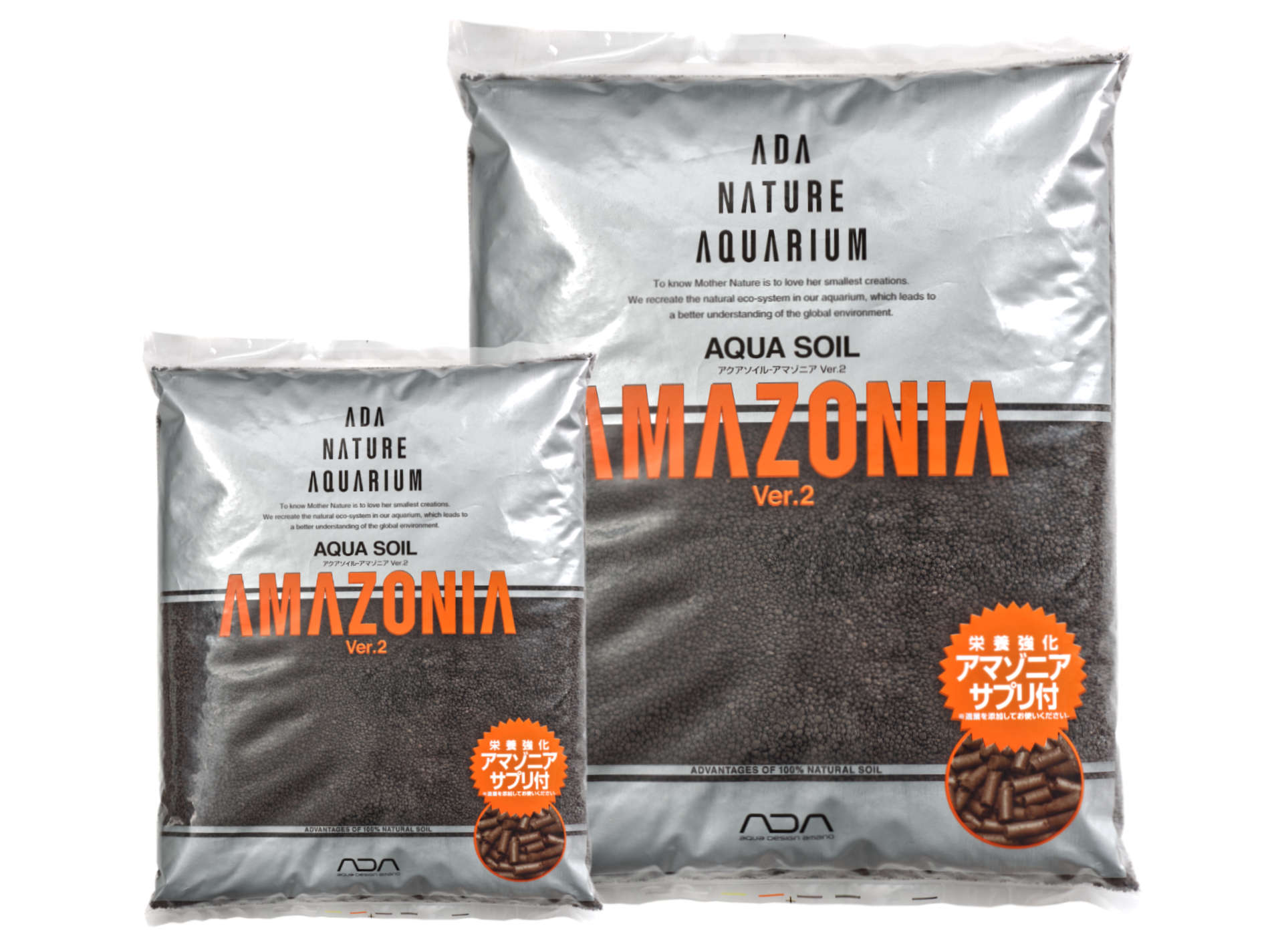 ★4.7
ADA Aqua Soil Amazonia Ver 2
Check Price on Amazon ★4.7Nutrient Longevity, CEC, and Buffering
Aquasoil arrives loaded with nutrients baked into the granules, but they're finite. Expect strong growth for 6–12 months before output visibly slows and root tabs take over. A rich organic soil layer lasts longer as a nutrient engine — typically 1–2 years — because soil is simply denser in organic matter.
Where aquasoil wins decisively is chemistry, not nutrition. Its high cation exchange capacity (CEC) holds nutrients for roots, and it actively buffers pH and KH downward — something soft-water fish and Caridina shrimp love. Dirt has moderate CEC but does not buffer pH; your chemistry is whatever your tap provides. When aquasoil's nutrients run out, our aquasoil exhaustion guide covers recharging versus replacing.
Ammonia Leach and the Cycling Period
Both substrates leach ammonia when new, and this is where most failures happen. Aquasoil releases a spike for 2–6 weeks — strong enough to cycle a tank and strong enough to kill livestock. Tropica's own soil guidance recommends 25–50% water changes at least twice a week for the first four weeks, and that schedule is not optional.
Fresh potting soil can do the same for 1–3 weeks as organic matter decomposes — which is why mineralizing (repeatedly soaking and drying the soil first) exists. Budget 2–4 weeks of fishless cycling for either substrate and test ammonia before anything living goes in. Our walkthrough of cycling through aquasoil ammonia leach applies almost verbatim to new dirt.
Aesthetics, Rescapes, and Beginner Forgiveness
Aquasoil looks identical in every tank: uniform dark granules, clean and professional out of the bag. A dirted tank's looks depend entirely on your cap. But the bigger practical difference is rescapes. Aquasoil granules hold their shape when you uproot plants — a little dust, not a disaster. Pull plants through a sand cap and soil drifts up with the roots. If you rearrange often, aquasoil pays for itself in avoided frustration.
Beginner forgiveness cuts both ways. Aquasoil's recipe is pre-made — no wrong-soil risk — but you must respect the cycling schedule. Dirt demands two judgment calls: the right soil (plain organic, nothing slow-release) and a cap at least 1–1.5 inches deep. Get them right and the tank runs itself; get them wrong and you'll fight cloudy water for months. Soil choice is the whole battle — see our mineralized soil vs potting mix comparison, and our guide to capping with sand for the thickness that prevents mixing.
The Verdict: Which Keeper Should Choose Which
Choose aquasoil if you rescape often, keep soft-water or Caridina livestock that benefits from buffered pH, want a guaranteed clean look, or want the substrate decision made for you. The premium is real, but so is the polish.
Choose dirt if you're building on a budget, running low-tech tanks, like a tank you can mostly leave alone for two years, or stocking multiple large tanks where aquasoil would cost more than the stand. The trade-off is commitment — plan the layout, set it up right, and resist rearranging.
The tanks that fail fail on cycling, lighting, or stocking — not on which bag was under the sand. For the wider landscape beyond these two, see our comparison of the seven best substrates for planted tanks.
Frequently Asked Questions
Can you mix aquasoil and dirt in the same tank?
You can, but cap the dirt first and treat aquasoil as a separate zone rather than blending them. A common setup is dirt under sand in planting areas with aquasoil in mesh bags for extra buffering. Mixing them loose defeats the dirt's cap and muddies aquasoil's clean texture, so keep the layers intentional.
How long does aquasoil last compared to a dirted tank?
Aquasoil's built-in nutrients last roughly 6–12 months of strong growth; a rich dirt layer lasts about 1–2 years. The physical granules of aquasoil hold shape for 2–3 years before crumbling. After nutrients fade, both substrates rely on root tabs for heavy feeders — the substrate then serves mainly as a CEC reservoir and planting medium.
Does a dirted tank need a longer cycle than aquasoil?
Usually not. Fresh potting soil leaches ammonia for about 1–3 weeks; aquasoil typically leaches for 2–6 weeks. Mineralized soil can be near ammonia-free from day one. Either way, cycle fishless and test ammonia and nitrite before stocking — a dirted tank is not an exception to the nitrogen cycle, and adding fish early is the most common way these tanks go wrong.
Can I cap aquasoil with sand like a dirted tank?
Yes — a 1-inch sand cap over aquasoil gives a dirted-tank look while keeping the aquasoil's nutrients and buffering. Expect some grains to migrate upward over time, so plan a light cap refresh yearly. The cap also traps dust during water changes, keeping the water clearer in the first month.
Which is better for a low-tech beginner tank?
Dirt wins on budget and long-term feeding without CO2, provided you commit to the right soil and a deep cap and then leave the tank alone. Aquasoil wins if you'd rather skip soil research entirely and pay for a ready-made recipe — but its ammonia leach still demands disciplined water changes for the first month, so it isn't effort-free either.
Bottom line: buy aquasoil for polish and flexibility, build dirt for budget and longevity. Respect the cycle, cap generously, and your plants will never know the difference.