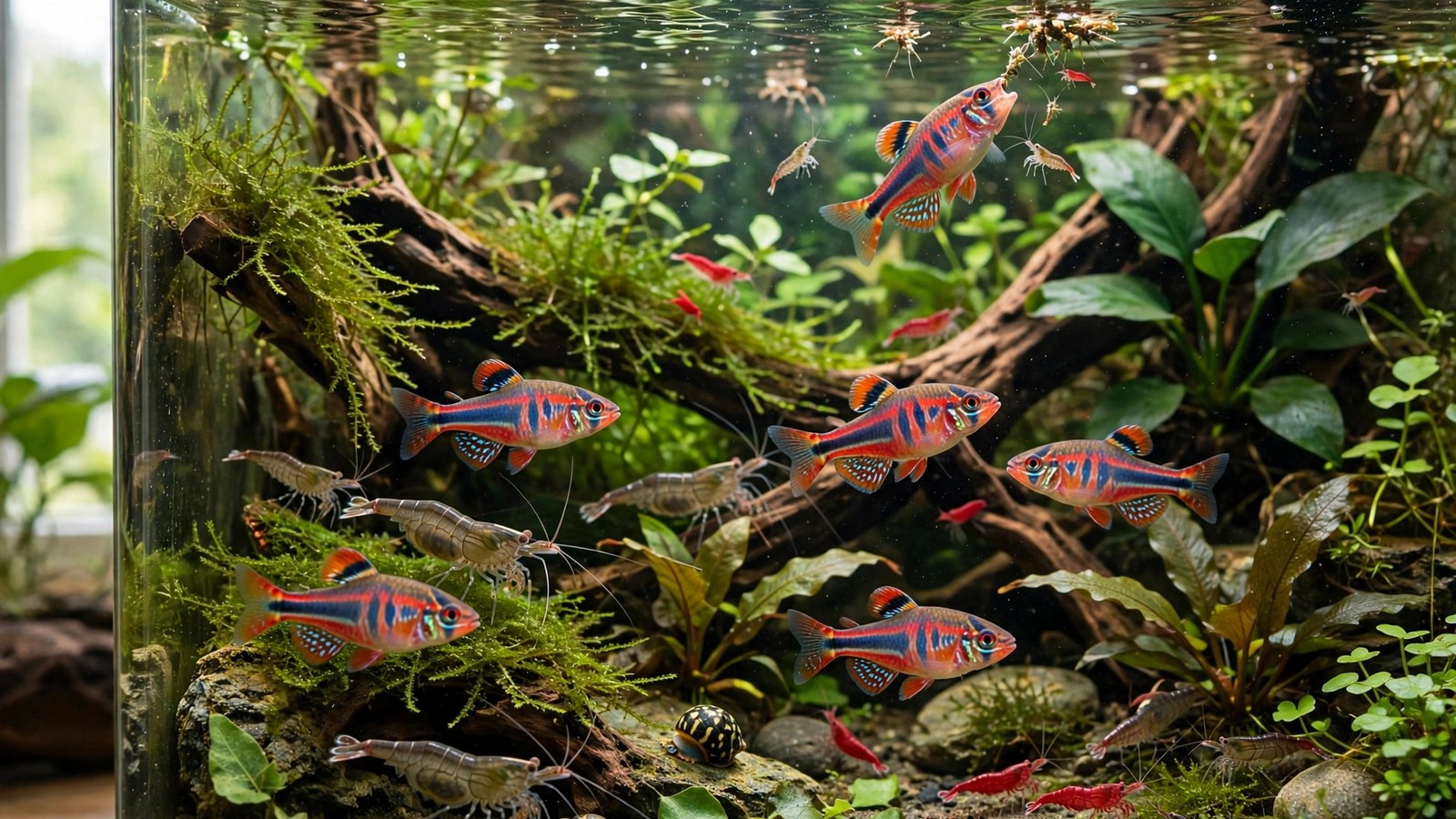
Most scarlet badis keepers hit the same wall within a week: a gorgeous male Dario dario, flaring scarlet and cobalt in the plant thickets, that spits out every flake and pellet that drifts past. This micropredator is a live-food specialist by nature, and that single fact shapes everything about a scarlet badis planted tank — from the microfauna your substrate breeds to the tank mates you can safely keep.
If you are still choosing the look and layout of your aquarium, start with our roundup of the best schooling fish for planted tanks to see where a scarlet badis fits in the bigger picture — and if you are working with a small footprint, these nano planted tank ideas show layouts that suit territorial micro fish perfectly.
Your Scarlet Badis Planted Tank: The 10-Gallon Sweet Spot
In the wild, Dario dario hunts tiny invertebrates in shallow, slow-moving streams in West Bengal and Assam, India. A good setup replicates that riverbank: warm, soft, gently shaded water threading through dense plant thickets. The tank needs structure, not exotic equipment. Give a male his own clearly defined territory and he settles in, colors up, and spends his days patrolling rather than hiding.
For a single male, 5 gallons can work if it is planted to the glass, but 10 gallons is the sweet spot: room for the male's territory plus retreat space for two to three females, cutting the stress behind dull colors and hiding. Use a gentle sponge filter or baffled hang-on-back — low flow suits the fish, and the sponge breeds microfauna they graze on. Keep a tight lid; spooked badis can launch through surprisingly small gaps. For cycling and maintenance, see our guide to planted tank water parameters.
| Parameter | Target range | Why it matters for badis |
|---|---|---|
| Temperature | 72–79°F (22–26°C) | Above 76°F they burn energy faster — feed more often |
| pH | 6.0–7.5 | Mirror wild soft-water streams; stability beats exact numbers |
| Hardness | 2–10 dGH | Soft to moderately soft keeps fins and gills healthy |
| Water changes | 25% weekly | They notice nitrate buildup — keep it under 20 ppm |
| Lighting | Medium, 6–8 hours | Supports plants; floating cover cuts stress |
 ★4.6
Pawfly 4" Aquarium Shrimp Net
Check Price on Amazon ★4.6Aquascaping: Plants, Thickets, and Broken Sightlines
The difference between a scarlet badis that glows and one you never see is sightlines. Males are territorial; in an open tank a male claims the whole aquarium and harasses everything in it, while in a tank broken into visual compartments he picks one corner thicket and defends just that. Pack the tank so he cannot see wall to wall — stem clusters, a driftwood arch, a moss patch — and aggression drops to harmless display flaring.
Layer in three zones: tall stems (rotala, ludwigia, hygrophila) at the back and sides for visual walls; bushy anchors mid-ground — Java fern on wood, anubias on stone, a fist-sized clump of Java moss or pearl weed as a vanishing spot; low crypts or dwarf sagittaria up front, plus catappa or oak leaf litter that feeds infusoria colonies. A kuhli loach planted tank uses the same litter-and-thicket technique.
Feeding: Solving the Dry-Food Problem
Plan the food strategy before the fish arrives. Most scarlet badis will never eat flake or pellet food — they are ambush predators that strike at movement, and a motionless flake does not register as food. The dependable core diet is frozen: daphnia, baby brine shrimp, and finely chopped bloodworm. Thaw a pea-sized portion in tank water, draw it into a pipette, and squirt it near — not at — the fish so the food drifts and twitches in the current. Feed small amounts twice a day; a badis's stomach is about the size of its eye, and uneaten frozen food fouls a nano tank fast.
Live cultures are the gold standard: grindal worms, microworms, newly hatched baby brine shrimp, and white worms trigger the strike reflex reliably and condition females for breeding. Some keepers train juveniles onto crushed freeze-dried foods mixed with live daphnia, but treat that as a bonus, not the plan. The Seriously Fish species profile for Dario dario confirms their natural diet of small aquatic invertebrates — dry-food refusal is instinct, not stubbornness. And since frozen feeding is messy, a 10-gallon with weekly 25% water changes stays stable far more easily than a 5-gallon on the same schedule.
Tank Mates: Peaceful, Non-Nippy, and Shrimp-Safe-ish Only
Scarlet badis shine as the centerpiece of a species tank, but they can share with the right companions: nothing that nips fins, nothing fast and boisterous that outcompetes them at feeding time, and nothing small enough to be eaten. Peaceful micro rasboras, ember tetras, and celestial pearl danios work well because they occupy different water levels and ignore the badis entirely. Pygmy corydoras and otocinclus make fine bottom company too.
Never house a badis with a betta — the betta will bully it relentlessly — but a planted betta tank setup follows similar stocking principles worth studying, as does a planted rasbora tank setup for peaceful dither fish. And the caution in whether a betta can live with shrimp applies doubly to a dedicated micropredator like the badis.
Male–Female Ratios and Breeding
Sexing is easy: males blaze scarlet with iridescent blue bars and extended fins; females stay small, silvery-gold, and unmarked. Stores mostly stock males, so ask yours to order females specifically. Aim for one male with two to three females in a 10-gallon — two males in anything under 20 gallons will fight, sometimes fatally. Spawning happens spontaneously in well-fed tanks: the male claims a thicket, eggs scatter among fine-leaved plants, and parents will eat the fry, so move the spawning mop to a separate container.
Frequently Asked Questions
Will scarlet badis eat flakes or pellets?
Almost never. They are movement-triggered micropredators and typically ignore anything that does not twitch or drift. Feed frozen daphnia, baby brine shrimp, and chopped bloodworm twice daily, and culture live foods like grindal worms or microworms for the best color.
What size tank does a scarlet badis need?
A lone male can live in a densely planted 5-gallon, but 10 gallons is the practical minimum for a group — one male with two to three females. The extra footprint gives the male a defensible territory and females room to retreat, preventing the stress that causes washed-out color.
Can scarlet badis live with cherry shrimp?
Adults are usually ignored, but newborn shrimplets will be hunted relentlessly, so a breeding colony will slowly decline. If shrimp breeding matters to you, keep the colony in its own tank. A few adult shrimp as cleanup crew alongside one male badis generally works fine.
How many scarlet badis can I keep together?
One male per tank under 20 gallons — two males will fight, sometimes fatally. Pair the male with two to three females so his courtship attention spreads out. In 20 gallons or more, two males can work only if the aquascape blocks all sightlines between territories.
Do scarlet badis need a heater?
In most homes, yes — a small adjustable 25–50 watt heater keeps them in their 72–79°F comfort zone. Swings below 70°F suppress appetite and immunity, and temperature stability matters more for a feeding-sensitive fish than for hardier community species.
Bringing It All Together
A scarlet badis planted tank rewards the keeper who respects what the fish is: a tiny, brilliant hunter that wants thick cover, gentle water, and moving food. Nail the feeding routine, plant until you cannot see across the tank, and stock one confident male with a small harem.