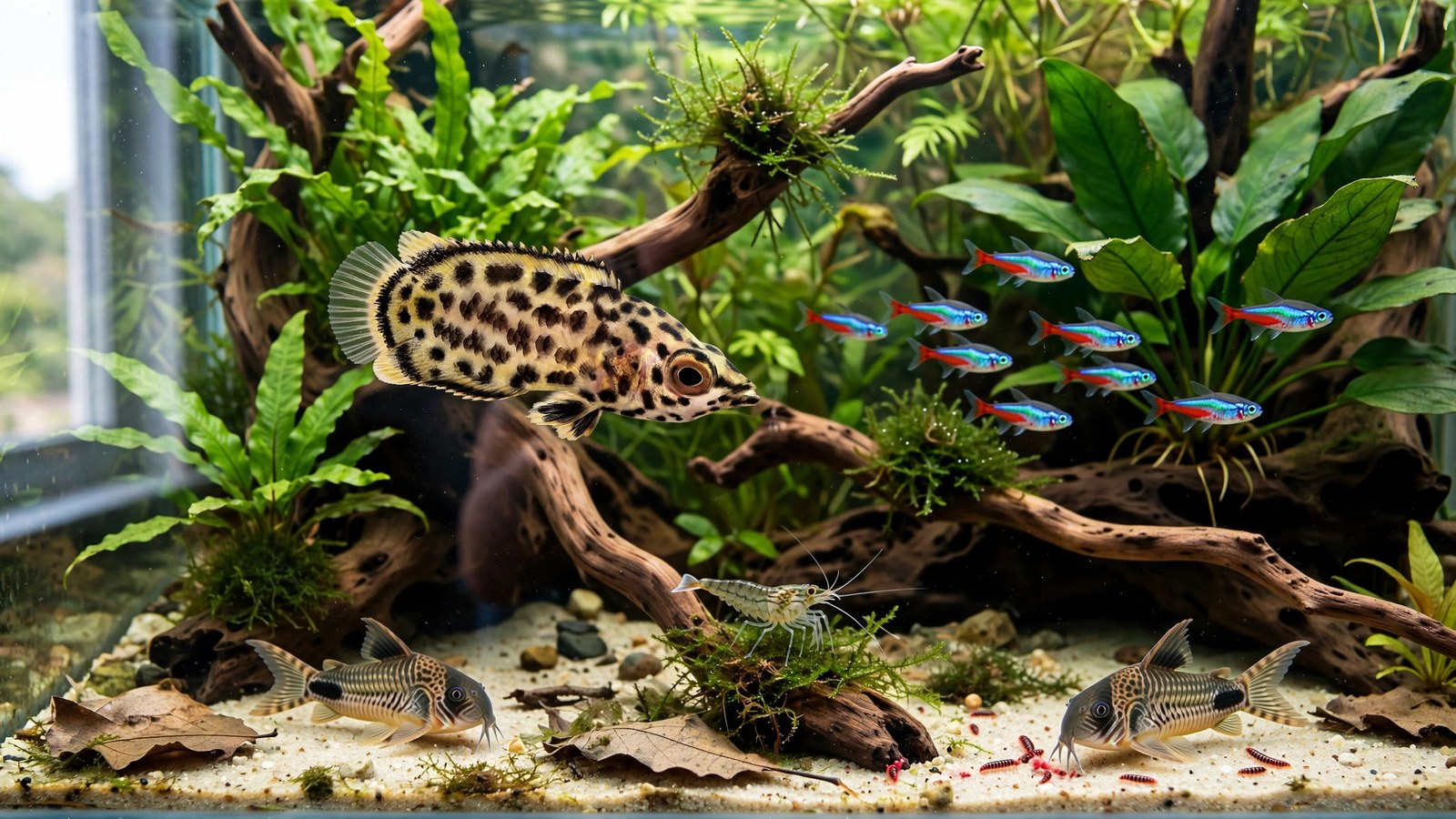
Picture a dead leaf drifting among the plants — except it has eyes, and it is watching your tetras. The leopard bushfish hunts by becoming scenery: it hangs motionless in the foliage, spotted brown-on-gold, then lunges with a mouth that opens like a trapdoor. For a leopard bushfish planted tank, the plants are not décor — they are the fish's hunting gear, its security blanket, and its only chance at a calm life.
Can a leopard bushfish live in a planted tank? Yes — it thrives in a densely planted 50–55 gallon tank. This leaf-mimicking Congo Basin ambush predator (Ctenopoma acutirostre) needs thick plant cover, dim lighting with floating plants, and tank mates too large to swallow. Unique fact: its extendable mouth lets adults swallow fish up to roughly one-third of their own body length.
Leopard Bushfish Planted Tank: The Core Setup
Start with footprint, not volume. This fish reaches 12–15 cm in most aquariums (up to 20 cm) and patrols a wide home range, so a tank 100–120 cm long matters more than raw gallons. Fifty-five gallons is the minimum for one fish; pairs or trios need 75+ with extra structure.
Your lid is the single most important piece of equipment. Leopard bushfish are notorious jumpers — a startled fish can clear an open top, and this species startles easily when tank lights snap on. A glass canopy with no gaps around filter hoses is non-negotiable. See this fish-first guide to aquarium plants for how plant choice interacts with lids and light.
| Parameter | Target range | Notes |
|---|---|---|
| Tank size | 50–55 gal minimum, 100–120 cm long | 75+ gal for groups of 3+ |
| Temperature | 73–82°F (23–28°C) | Stable; no swings |
| pH | 6.0–7.5 | Slightly acidic ideal |
| Hardness | 5–12 °dGH | Soft to moderately hard |
| Lighting | Low to moderate | Dimmed by floating plants |
| Filtration | Canister or strong HOB | Moderate flow; baffle outputs |
| Lid | Tight glass canopy | Jump-proof, no gaps |
Filter with a canister rated for the tank at moderate flow, baffled at the output — the bushfish comes from slow Congo Basin streams and should not be blasted off its hunting perch.
Why Plants Are Non-Negotiable for This Fish
Most planted-tank fish appreciate plants. The leopard bushfish requires them the way a cat requires claws. It stations itself among stems, tilts its spotted body, and waits. In a bare or bright tank it hides constantly, colors wash out, and it may stop feeding. Dense planting converts a nervous refugee into a confident hunter.
Build the aquascape in layers. Tall background stems and root-like driftwood create the vertical ambush perches it hunts from; midground broad-leaf plants give it staging points. And the surface layer matters most: a raft of floating aquarium plants such as frogbit or water sprite dims the overhead light, which this crepuscular fish reads as safety. Seriously Fish's species profile for Ctenopoma acutirostre recommends exactly this: dim light, surface vegetation, submerged cover, and leaf litter.
Choose hardy, low-light plants — Anubias, Java fern, Cryptocoryne, and floating species all thrive under the dimmed lighting the fish wants.
 ★4.2
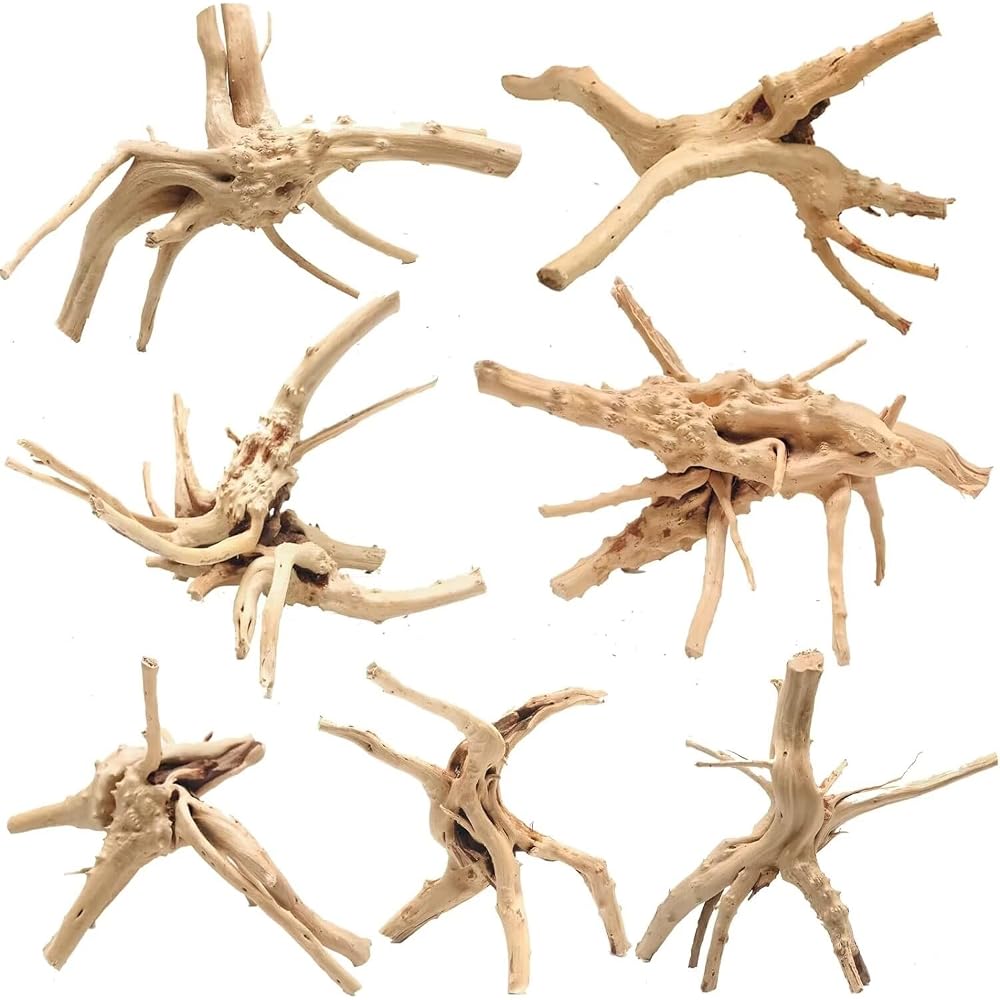
Hamiledyi Natural Spider Wood Driftwood
Check Price on Amazon ★4.2Tank Mates: Big Enough or Off the Menu
The rule is simple: if it fits in the mouth, it is food. The leopard bushfish's jaws extend dramatically, so that means roughly anything under one-third of its body length. Small tetras, guppies, endlers, and shrimp are appetizers, not companions. Congo tetras, at 6–8 cm and deep-bodied, share the same Congo waters and are large enough to be ignored — a natural pairing.
| Good tank mates | Why they work |
|---|---|
| Congo tetras (school of 8+) | Congo Basin natives, too deep-bodied to be eaten |
| Medium gouramis (pearl, moonlight) | Large, calm, share upper/mid water |
| Snowball plecos, bristlenose | Armored bottom dwellers; see our snowball pleco planted tank guide |
| Banjo catfish | Buried ambush specialist; see the banjo catfish setup guide |
| African butterflyfish (single) | Same temperament; see the african butterflyfish planted tank guide |
Keep it single unless you can do a proper group. Two bushfish often means one bully and one victim; one fish, or three or more with enough territory, is the working formula. Avoid boisterous fin-nippers and large aggressive cichlids. For a ready-made biotope template, our Congo tetra planted tank setup pairs naturally with this community.
Feeding a Carnivore That Hunts by Ambush
Leopard bushfish are carnivores with strong preferences: frozen bloodworms, krill, tubifex, chopped prawn, and ghost shrimp. They usually refuse flakes at first, but most can be weaned onto quality carnivore pellets over weeks by mixing soaked pellets with bloodworms and reducing the live food gradually.
Feed in the evening, under dim light, two to three times a week for adults. Drop food near its usual hunting perch; a bushfish that must cross open water to eat is a stressed bushfish. A few ghost shrimp a month double as enrichment — the stalking sequence is the single best show this fish offers.
Skip feeder fish entirely. They carry disease, are nutritionally poor, and this species does not need them. Frozen foods plus pellets cover every need — see aqua-fish.net's leopard bushfish care page for the full accepted food range.
Day-to-Day Behavior and Long-Term Care
Expect to barely see it for the first two weeks. New leopard bushfish wedge themselves behind wood and emerge only at dusk — normal. Do not rearrange the tank; every disruption resets the settling clock. Once comfortable: motionless among plants by day, slow-stalking at dusk.
Do not confuse it with the South American leaf fish (Monocirrhus polyacanthus). Both hunt by leaf mimicry, but the bushfish is a Congo labyrinth fish while the leaf fish is a South American cichlid relative. Check the store label for Ctenopoma acutirostre — and note these fish live 10+ years, so a 55-gallon setup is a decade-long commitment of weekly 30% water changes and a lid you check at every feeding.
Frequently Asked Questions
How big does a leopard bushfish get?
Most reach 12–15 cm (5–6 inches) in home aquariums, with exceptional specimens hitting 20 cm. That size and their need for hunting territory is why a 100–120 cm tank of 50–55 gallons is the minimum, and why bigger tanks grow bolder, more visible fish.
Can a leopard bushfish live with community fish?
Only with community fish too large to eat — roughly over one-third of its body length. Congo tetras, medium gouramis, and armored bottom dwellers like bristlenose plecos work well. Neon tetras, guppies, and small rasboras will be eaten at night when you are not watching.
Do leopard bushfish need live food?
No. They thrive on frozen bloodworms, krill, and tubifex, and most wean onto quality carnivore pellets within a few weeks. Live feeder fish are unnecessary and introduce disease risk, so frozen foods plus pellets are the safer, complete staple food.
Why does my leopard bushfish hide all the time?
Constant hiding almost always means the tank is too open or too bright. This fish feels safe only with dense plant cover, floating plants dimming the light, and broken sight lines. Add thick planting, check that the lights are not too intense, and allow two weeks to settle.
Are leopard bushfish jumpers?
Yes, notoriously so. A tight-fitting glass canopy with no gaps is mandatory — they jump when startled, often when lights switch on suddenly. A dimmer on a timer plus floating plants softening the light transition greatly reduces the startle response.
The Leaf That Hunts
A leopard bushfish planted tank is one of the most rewarding oddball setups — but only if you respect what the fish is: a Congo Basin ambush predator that wears plants like camouflage. Give it 55 gallons, a locked-down lid, dim water filtered through floating plants, and tank mates it cannot swallow, and you get a decade of dusk-time hunting. The plants are not the backdrop. They are the whole point.