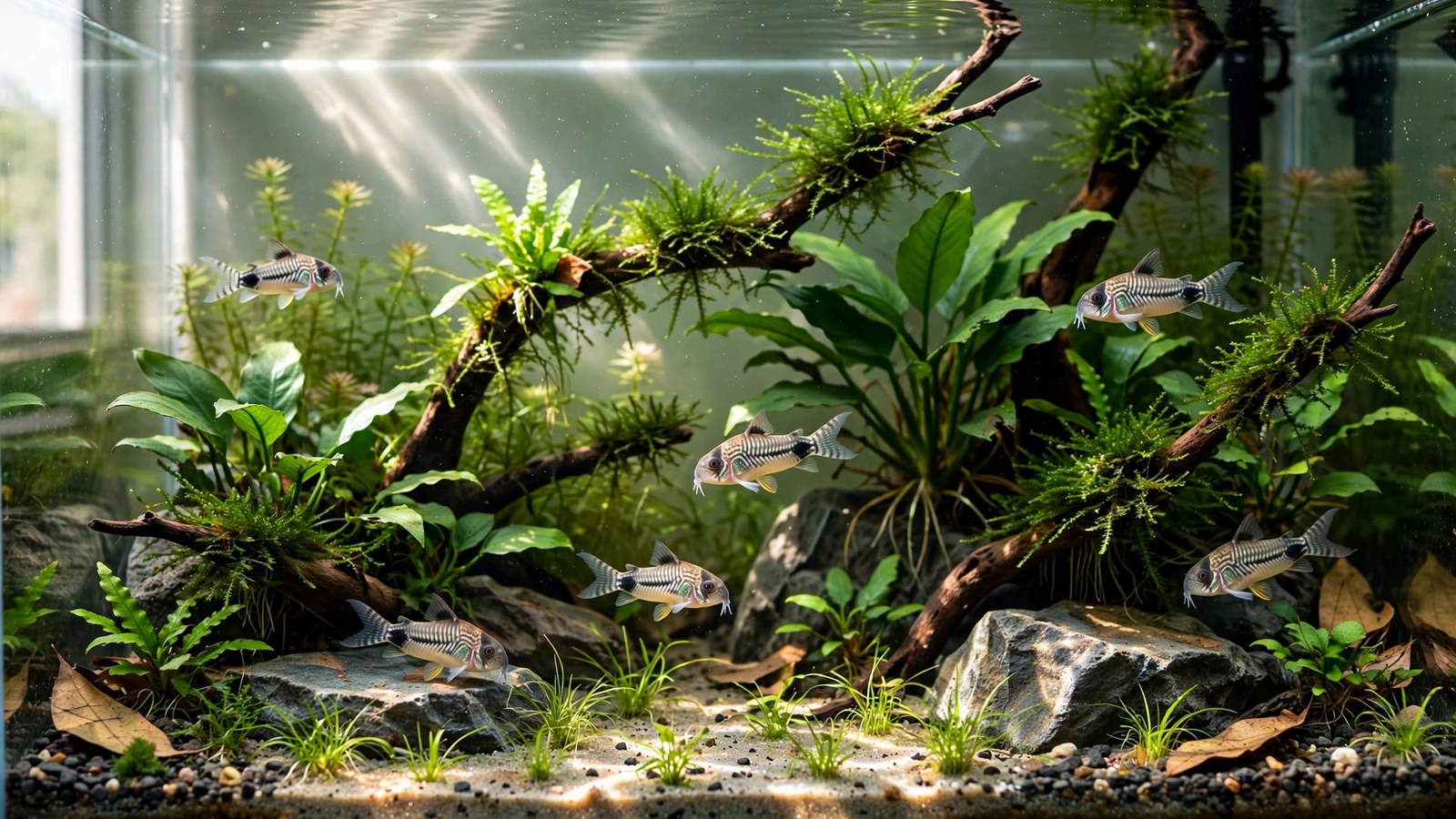
Most cories hug the bottom like tiny armored hoovers. The salt-and-pepper cory breaks the mold — Corydoras habrosus regularly darts into open midwater, shoaling with the energy of a tetra twice its size. That changes how you build a habrosus cory planted tank: open sand foraging lanes framed by plants — pick species that handle curious bottom-dwellers with our complete guide to aquarium plants for fish tanks — for one of the liveliest nano displays in the hobby.
Quick answer: Set up a 10–20 gallon tank with fine sand 1–1.5 inches deep, 22–26°C water at pH 6.5–7.8, and a shoal of 8 or more. Plant carpets and stems around — not across — open sand foraging zones, where the fish root with barbels and sift food through their gills. Key fact: adults reach only 1.4 inches (3.5 cm), yet need a 60 × 30 cm footprint to shoal properly. The species is now classified as Hoplisoma habrosum in the Seriously Fish profile.
The habrosus cory planted tank blueprint: sand first, plants second
Build this tank the way the fish lives: open sand first, decoration second. Lay 1–1.5 inches of fine, smooth aquarium sand across the front two-thirds of the tank, sloped slightly higher at the back so debris rolls forward for easy siphoning. Rinse the sand before adding it; clouding irritates new fish's barbels.
Keep two or three wide "foraging lanes" of bare sand running from front glass to mid-tank. These are the shoal's stage: they fan out, nose down, sifting. Plant everything else around the lanes — carpets along the edges, stems and rosettes in the back third. If you are unsure which sand suits delicate barbels, read our guide on choosing a barbel-safe substrate before you fill the tank.
Hardscape stays minimal: one or two smooth driftwood pieces at the back, with low rounded pebbles marking lane edges. Avoid jagged rock at sand level — a startled shoal's fright reflex sends them scattering, and sharp edges injure barbels.
Water parameters that keep a shoal healthy
Habrosus tolerate a wide range of water, but they reward stability with years of life. They thrive at room temperature in most homes and dislike heat.
| Parameter | Target | Notes |
|---|---|---|
| Temperature | 22–26°C (72–79°F) | Cool-tolerant; avoid long spells above 27°C |
| pH | 6.5–7.8 | Stable matters more than exact value |
| Hardness | 2–10 dGH | Soft to moderately hard |
| Ammonia / nitrite | 0 ppm | Non-negotiable; they are sensitive to poor cycling |
| Nitrate | < 20 ppm | Plant heavily to help hold it down |
| Water changes | 25–30% weekly | Clean substrate, siphon the foraging lanes |
Cycle the tank fully first — small cories are sensitive to new-tank ammonia, and barbel erosion is often the first sign of a dirty substrate. Add all 8+ at once, and dribble-acclimate since shop water is usually harder than a planted tank's.
Shoal size and the midwater show
This is where habrosus earn their reputation. In groups of 10–12 with open swimming room above the sand, they do something most cories rarely attempt: they leave the bottom, shoaling midwater in synchronized bursts — behavior noted in the wild, where they mix with small silver characins. Drop below 6 fish and that show vanishes; you get nervous hiders instead. Size them honestly: males top out near 1 inch, females around 1.4 inches (3.5 cm). For a cory that lives almost entirely in midwater, see the pygmy cory planted tank setup.
Feeding: tiny fish, serious appetites
Forget the "cleanup crew" myth. Habrosus are omnivores that need deliberate feeding once or twice a day — sinking micro pellets, crushed cory wafers, and frozen daphnia or baby brine shrimp. Offer only what disappears in about two minutes; leftovers rot in the sand and foul the zone your fish root in. They also tackle larger morsels than their mouths suggest, worrying at a full wafer together — so vary the diet, with frozen foods two or three times a week.
Tank mates: peaceful and bite-sized
Habrosus are genuinely peaceful — too small to bother anyone, and small enough to be food for anything big. Good company includes cherry shrimp (full colonies coexist; cories are too small to hunt adult shrimp, though shrimplets need moss cover), ember tetras, chili rasboras, and pencilfish, which share their native waters. For shrimp-keeping specifics, see our planted shrimp tank setup guide.
Skip nippy barbs, bettas, dwarf gouramis, and anything with a mouth bigger than a pea. Do not confuse them with peppered cory (Corydoras paleatus), which grows two to three times larger — a mix-up that ends with habrosus being outcompeted at feeding time.
Planting plan: carpets at the lane edges
The planting goal is a frame, not a lawn: sand lanes in the foreground, low carpets hugging their edges, midground rosettes, and a soft background wall. Habrosus nudge at roots constantly, so newly planted stems need a week or two of deep planting to anchor.
| Zone | Plants | Why it works |
|---|---|---|
| Lane edges (foreground) | Eleocharis parvula, Marsilea hirsuta | Low carpets that define lanes without swallowing them |
| Midground | Cryptocoryne wendtii, Anubias nana on wood | Sturdy, root-proof cover near the foraging zones |
| Background | Java fern, Vallisneria nana | Soft walls that keep the shoal feeling sheltered |
| Surface | Salvinia or frogbit | Dappled light calms a shy new shoal |
Light the tank moderately — enough for the carpets, not so much that algae films the sand. A dimmer plus floating plants hits the sweet spot.
Frequently Asked Questions
Can habrosus cory live on gravel?
No — fine sand is mandatory. Habrosus feed by rooting with their barbels and sifting sand through their gills; gravel erodes barbels and blocks that behavior entirely. Barbel loss is often permanent and leads to starvation. Use smooth aquarium sand 1–1.5 inches deep, rinsed before filling.
How many habrosus cory should I keep together?
Keep 8 at minimum, with 10–12 ideal for a 10–20 gallon tank. Smaller groups stay stressed and hide; the species' signature midwater shoaling only appears in confident groups. Add the entire shoal at once rather than building it up over weeks.
Are habrosus cory safe with shrimp?
Yes — one of the safest cories for shrimp tanks. Adults cannot eat adult cherry shrimp, and full colonies thrive alongside them. Like all fish, they may pick off a few newborn shrimplets, so moss and plants give babies cover. Avoid large predatory shrimp species instead.
Do habrosus cory eat algae or clean the tank?
No. They are omnivorous bottom-feeders, not algae eaters, and they will starve if expected to "clean" the tank. Feed sinking micro pellets, crushed wafers, and frozen foods daily. Their foraging does stir the top of the sand, which helps prevent anaerobic pockets — a bonus, not a job.
Why are my habrosus cories hiding all the time?
Hiding almost always means the shoal is too small, the tank is too bright and open, or a tank mate is harassing them. Increase the group to 10+, add floating plants for dappled shade, and confirm flow is gentle. New arrivals need a week or two to settle — consistent feeding in one spot builds confidence fast.
Bringing it together
A habrosus cory planted tank rewards the aquarist who designs for the fish: honest sand, open lanes, a full shoal, and plants that frame the action. Get those right and a handful of one-inch catfish will give you the most animated corner of your fish room. For a larger, bolder bottom dweller using the same principles, see the panda cory planted tank setup. Species details verified against the Seriously Fish profile for Corydoras habrosus (35 mm maximum size, fine sand recommended).