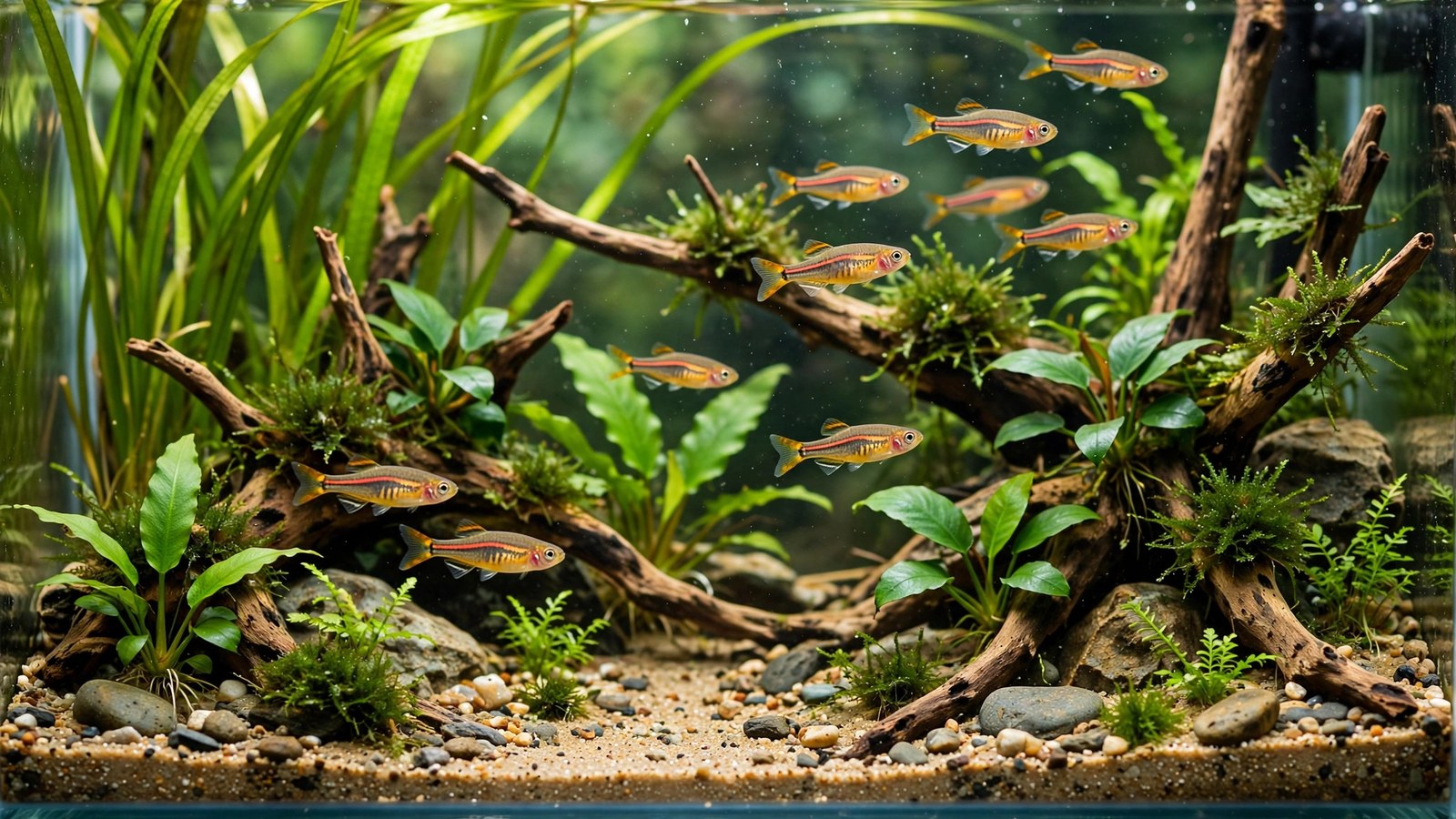
The heater is the last thing this danio needs. The glowlight danio — Danio choprae, a tiny Burmese cyprinid — thrives in water most aquarists would call too cold: 18–20 °C (64–68 °F), the cool, flowing streams of northern Myanmar. Give it that, an open swimming lane down the middle of the tank, and a school of eight or more, and its glowing orange-gold stripe burns brighter than any warm tropical setup could coax out of it.
In short: a glowlight danio planted tank recreates a cool, gently flowing Myanmar stream — 18–20 °C water, a 20-gallon-long footprint, a school of 8–10+ fish, plants hugging the sides and back while the middle stays open, and dimmed light over fine-leaved greenery. Key fact: this is Danio choprae, not the glowlight tetra — a cool-water danio that colors up best in water a good 5 °C cooler than a standard tropical community.
A Danio, Not a Tetra
The name causes the hobby's most persistent mix-up, so settle it once: the glowlight danio is not the glowlight tetra. The tetra (Hemigrammus erythrozonus) is a South American characin from Guyana. The danio (Danio choprae) is an Asian cyprinid from Myanmar. Different fish, different continent, different care — and keeping them at the same temperature is the mistake that dulls half the danios in the hobby.
A thin, luminous orange-gold stripe runs the full length of the body against a bronze-olive back and pale belly. At barely 4 cm, a school of ten looks like tiny lanterns drifting through the plants.
Cool Water: The Non-Negotiable Parameter
Everything starts with temperature. In northern Myanmar's hill-country streams, the water rarely climbs past the low twenties. Hold 18–20 °C and the fish stay active, bold, and brilliantly colored. Push it to 24–26 °C and you get washed-out stripes, restless fish, and shorter lifespans.
| Parameter | Target | Why it matters |
|---|---|---|
| Temperature | 18–20 °C (64–68 °F) | The color trigger — cool water keeps the stripe glowing |
| pH | 6.0–7.5 | Slightly soft to neutral, matching Myanmar streams |
| Hardness | 5–15 dGH | Adaptable; avoid extremes |
| Nitrates | <20 ppm | Plant uptake + 25–30% weekly water change |
| Turnover | 5–8× tank volume/hour | Moderate current without blasting the plants |
Practical bonus: many homes sit naturally at 18–20 °C, so you may need no heater at all — just a reliable thermometer and a clip-on fan for summer heat waves. This fish-first guide to aquarium plants for fish tanks suits exactly this mindset.
The Myanmar Stream Layout: Edges Planted, Middle Open
This layout breaks from the typical planted show tank: a glowlight danio tank is a swimming tank first. These fish evolved for open riffles and spend the day cruising, chasing, and displaying. Fill the middle with plants and the school fragments — and the synchronized lantern-glide disappears.
Plant the edges. Run dense stems and fine-leaved plants along the back and side panes, leaving the middle third as a clear lane from front to back. A curtain of fine stems like Cabomba or Myriophyllum on the sides, Cryptocoryne at the back corners, and a fine foreground carpet give shy fish cover while the central column stays open. This open-lane approach is the core idea behind lightly planted, open-lane layouts, and dim light suits these plants fine, as any low-tech planted tank setup shows.
Flow placement completes the illusion. Mount a spray bar horizontally along one short end, angled slightly down, so the current runs the tank's length and returns softly along the substrate — a gentle river, not a vortex. A small powerhead at the opposite end, aimed along the back wall, closes the loop. A hillstream loach stream-tank build pushes the same lengthwise-current trick one notch stronger.
Your glowlight danio tank: specs and stocking
Footprint beats volume here. A 20-gallon long (76 × 30 cm) gives ten fish the runway they need; a tall 20 won't. Scale the school with the tank — a 30- or 40-gallon long holds 15–20, and a big bold school is spectacular. Stock tank mates that genuinely tolerate 18–20 °C.
| Tank mate | School size | Notes |
|---|---|---|
| White cloud mountain minnow | 8+ | Classic cool-water partner; shares the same lanes |
| Hillstream loach | 1–3 | Loves the flow; grazes glass and stones |
| Rosy barb | 6+ | Peaceful at 20 °C; adds a larger accent |
| Amano shrimp | 6–10 | Algae crew, unbothered by danios |
| Cherry shrimp | 10+ | Breeds at 20 °C; plant cover guards shrimplets |
Skip anything that needs warmth — cardinals, rams, discus — and anything nippy toward a 4 cm fish. This roundup of the best schooling fish for planted tanks helps you compare species that share both the temperature range and the open-water style.
Feeding a Micro-Predator
Feed little and often: twice daily, only what the school clears in about 90 seconds. Micro-pellets or crushed flake form the base; the color payoff comes from frozen or live baby brine, daphnia, and microworms two or three times a week — the stripe intensifies within a fortnight.
Frequently Asked Questions
Is the glowlight danio the same as the glowlight tetra?
No — they're entirely different fish. The glowlight danio (Danio choprae) is an Asian cyprinid from Myanmar that prefers cool 18–20 °C water. The glowlight tetra (Hemigrammus erythrozonus) is a South American characin from Guyana that needs warm 24–26 °C water. Shops sometimes use the names loosely, so check the Latin name on the tank label before you buy.
Can I keep glowlight danios in a normal tropical tank at 24–26 °C?
They'll survive it, but you shouldn't — the stripe fades, the fish stay restless, and warm water holds less oxygen while pushing their metabolism too fast. These are cool-water fish built for 18–20 °C streams. If your setup runs a steady 24 °C or warmer for tropical tank mates, pick a different danio or tetra rather than forcing this one into the wrong climate.
How many glowlight danios should I keep together?
Eight is the practical minimum and ten to twelve is the sweet spot in a 20-gallon long. Smaller groups turn skittish and scatter, which kills the whole point of the setup — the tight, synchronized schooling display. In larger tanks, schools of 15–20 are spectacular and actually reduce individual stress, since each fish spends less energy watching for threats.
What plants work best in a cool-water glowlight danio tank?
Fine-leaved, low-to-medium-light plants along the tank edges: Cabomba, Myriophyllum, and Ceratophyllum for the side curtains; Cryptocoryne wendtii for the back corners; and an easy moss or fine carpet for the foreground. Keep the middle third open as a swimming lane. Nearly all of these thrive at 18–20 °C with no CO2 injection.
Do glowlight danios need strong water flow?
Moderate, not strong — think gentle stream, not rapids. Aim for 5–8× tank volume per hour, directed lengthwise with a spray bar or small powerhead so there's a smooth current to swim against and calm pockets near the planted edges. Too much flow exhausts the fish and flattens the plants; too little, and you lose the stream behavior that makes this species so engaging to watch.
Bringing the Stream Home
A glowlight danio tank rewards restraint: cool water, a long open lane, plants kept to the edges, and one generous school doing what danios do. It's among the cheapest showcase setups — no heater to run, no CO2 rig needed — and one of the most alive. For species-level detail, see the Seriously Fish species profile for Danio choprae and FishBase's Danio choprae summary for the taxonomic record and size data.