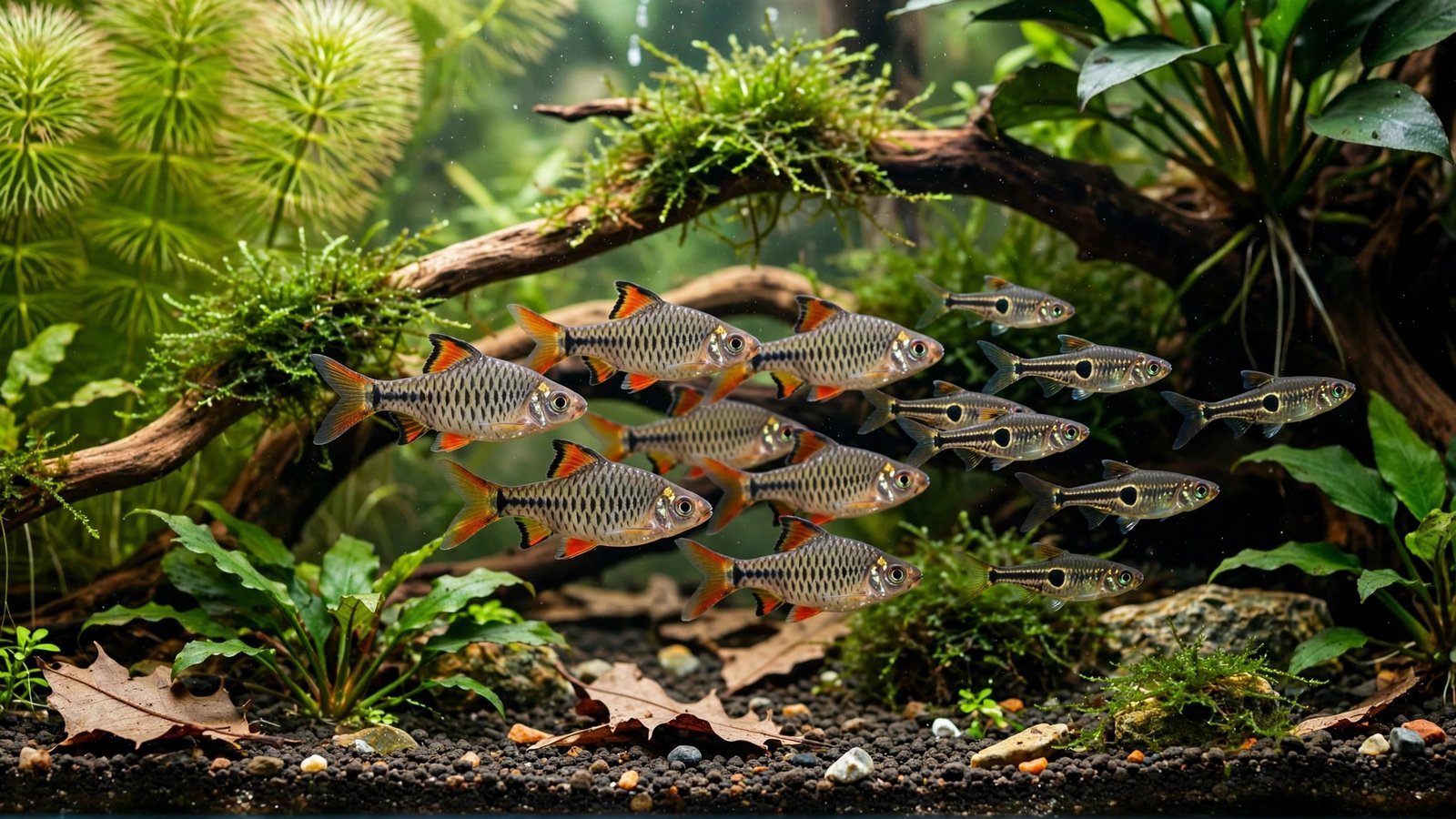
The checker barbs at the shop look like a mistake. Pale silver, a faint row of blotches, fins whose red rims might be stress or might be nothing — they sit there while neon tetras glitter in the next tank. Take six home, give them plants and two quiet weeks, and the black spots sharpen, the dorsal fin flushes crimson, and males start sparring in slow circle dances. If you have been overlooking this schooler, you have been missing one of the best-value peaceful barbs — and a checker barb planted tank is the stage it was built for. (Sold for decades as Puntius oligolepis, then Pethia oligolepis; the current name is Oliotius oligolepis.)
What a Checker Barb Planted Tank Needs
Checker barbs live in slow streams and ponds across Southeast Asia — still water, dappled shade, thick vegetation. Recreate that bargain: planted cover at the back and sides, a clear swimming lane down the middle, calm water.
Start with a 20-gallon long rather than a tall cube. The extra footprint gives a six-fish school the lateral swimming room they actually use, and it fits a lightly planted aquarium setup approach: forgiving, low-tech, and cheap to stock. A sponge filter or a gentle hang-on-back on low flow is ideal — checker barbs dislike strong current.
Substrate can be simple. Checker barbs are mid-water fish that rarely nose at the bottom, so any plant-friendly substrate works; a dirted tank setup with capped soil gives heavy root feeders like crypts and swords exactly the shelter these fish need.
Water Parameters: Cool Beats Tropical
This is the single biggest mistake keepers make: treating checker barbs like tiger barbs. Their range runs noticeably cooler, and they are most colorful and longest-lived in the lower half of the tropical range. That rules out a few tankmates but pairs beautifully with white cloud minnows and danios, or the hardier cousin in the gold barb planted tank guide.
| Parameter | Ideal range | Notes |
|---|---|---|
| Temperature | 18–24°C (64–75°F) | Most colorful at 20–22°C; usually needs no heater |
| pH | 6.0–7.5 | Adaptable; breed in slightly soft, neutral water |
| Hardness | 4–12 dGH | Handles moderate hardness well |
| Ammonia/nitrite | 0 ppm | Cycle the tank before adding the school |
| Nitrate | <20 ppm | Plants + 25–30% weekly changes keep this easy |
School Size and Behavior
Unlike their notorious cousins, they do not fin-nip or harass tankmates, and a well-planted 20-gallon can host them alongside shrimp, snails, and other small community fish. But "peaceful" does not mean "solitary" — the school is where the behavior lives.
At six, the fish relax and start displaying. At eight to ten, you get the full show: males flashing red-edged fins in slow circle dances, the school tightening and wheeling when startled, then spreading back through the plants. Below six, they stay pale and hidden — the drab shop look becomes permanent.
Keep a 2:1 female-to-male ratio if you can pick. Males are slimmer with brighter red fin margins; females rounder and paler. Two females per male spreads male attention and keeps courtship frequent without wearing on any one female.
Planting the Tank: Dense Edges, Open Middle
The checker's ideal layout mirrors how it uses cover: dense stands at the back and sides, a clear lane for the school to cruise. A fully stuffed jungle gives the fish nowhere to display; a bare tank with two stems makes them permanently nervous. Aim for roughly 50–60% planted volume with the center swimming lane kept open.
- Background: tall stems or valisneria along the back glass create the shaded edges barbs hug.
- Midground: crypts and java fern on wood give the school broken sight-lines to retreat through.
- Foreground: keep it low (dwarf sagittaria or moss) so the open lane reads as open.
- Floaters: frogbit or salvinia to diffuse overhead light into dappled shade.
This is a fish that rewards a low-tech planted tank setup: medium light, no injected CO2 required, and all the plants listed above grow in that envelope. If your lighting is stronger than the plants want, floaters are the cheapest way to tune it down.
Feeding: Easy Omnivores With a Secret
Micro-pellets or quality flakes work as the staple; the color comes from frozen foods. Feed small portions twice daily. A planted tank is a natural snack bar — biofilm on leaves and tiny copepods in the moss are genuine supplemental food.
Breeding: The Novice-Breeder Angle
A conditioned pair or trio will often spawn on their own among fine-leaved plants like java moss or spawning mops. For a deliberate attempt, move a conditioned pair into a 10-gallon breeding tank with a bare floor (eggs fall out of reach), a clump of moss, and water at 22–24°C.
Spawning happens at first light; remove the parents the same morning, as they eat the eggs. Eggs hatch in 24–36 hours at 24°C; fry hang on the glass, then go free-swimming in 3–4 days on infusoria or liquid fry food, graduating to baby brine shrimp within a week. A single spawn can produce a hundred fry — the planted home tank's moss makes a forgiving nursery. For a comparison with a fellow peaceful schooler, see the planted cherry barb tank setup guide.
Frequently Asked Questions
Are checker barbs really peaceful, or will they nip like tiger barbs?
They are genuinely peaceful. Checker barbs lack the fin-nipping drive of tiger barbs and can live with shrimp, snails, and other small community fish. The only rough-looking behavior is males circling each other in slow displays — courtship, not aggression, and it never damages fins.
Why do my checker barbs still look drab weeks after I bought them?
Drab color has three usual causes: a school smaller than six, warm water above 25°C, or a flake-only diet. Keep eight or more at 20–22°C with frozen daphnia or brine shrimp several times a week, and most fish color up within two to three weeks.
Can checker barbs live in an unheated tank?
Yes, in most homes. Their 18–24°C range means an indoor tank without a heater stays in bounds year-round in temperate climates. If the room drops below 18°C in winter, add a small heater set to 20°C. Pair them with tankmates and plants that also prefer the cool side.
How do checker barbs breed, and how hard is it?
They are egg-scatterers and one of the easiest barbs to breed. Condition a pair with frozen foods, place them over a bare floor with java moss or a spawning mop at 22–24°C, and they typically spawn at dawn. Remove the parents; eggs hatch in 24–36 hours, and fry take infusoria, then baby brine shrimp, once free-swimming.
What is the difference between checker barbs, tiger barbs, and gold barbs?
Checker barbs are the peaceful option: calm, shrimp-safe, and happy at cooler temperatures. Tiger barbs are active and nippy, needing larger schools to spread aggression. Gold barbs sit between — hardy and bold but generally peaceful. For a calm planted community, checker or gold barbs are the safer choices.
Is the Checker Barb Right for Your Tank?
If you want a barb that behaves like a tetra — peaceful, schooling, plant-friendly — but colors up like a fish twice its price, set the tank cool, plant the edges thick, keep the school at eight, and feed like you mean it.
Species references: the Seriously Fish species profile documents the taxonomy and wild parameters, and FishBase carries the current classification.