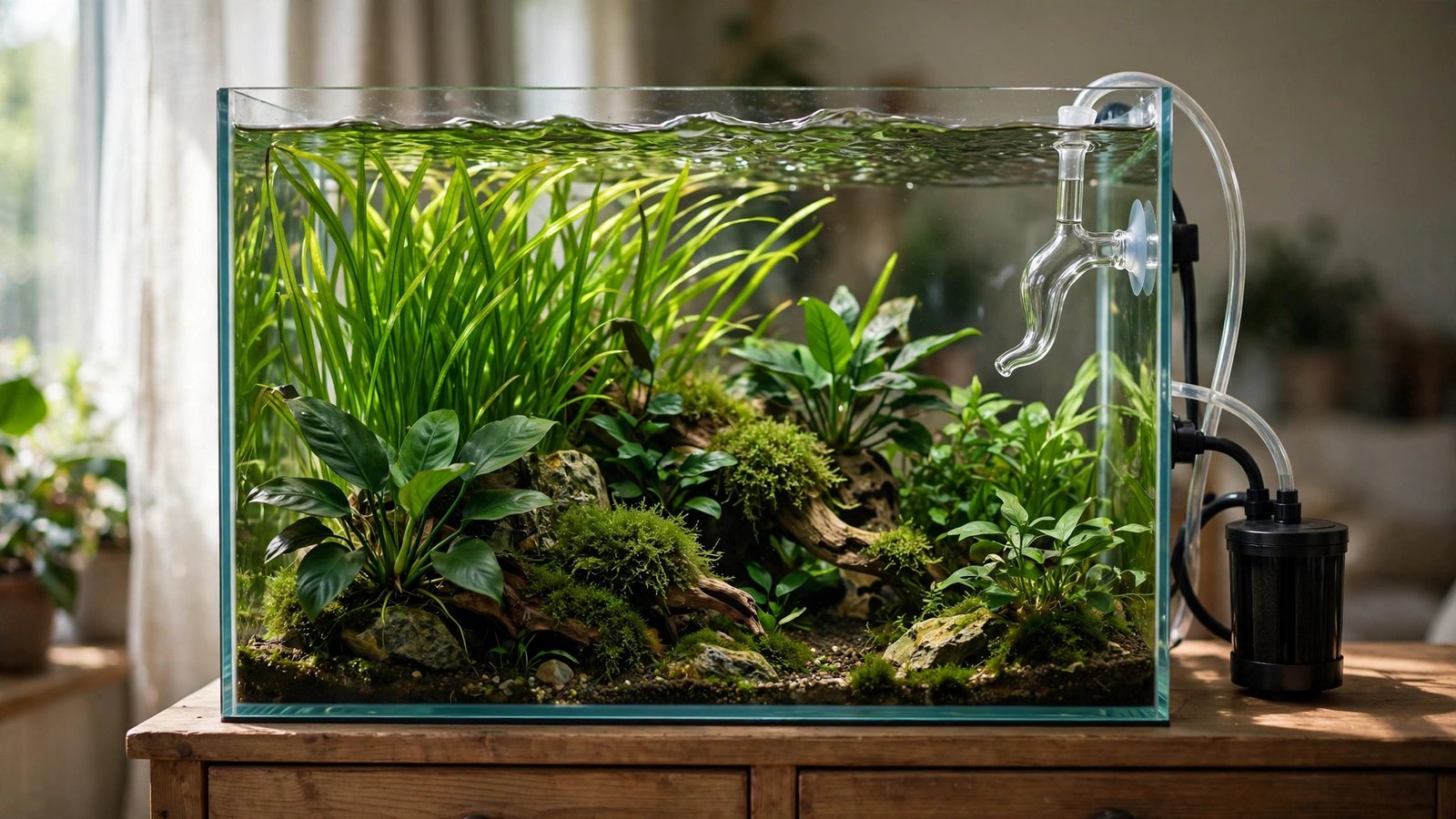
The most common filter mistake in nano aquascaping isn't buying too little filtration — it's buying a canister rated for a 30-gallon tank and turning your carefully laid-out 10-gallon into a washing machine. Most "small" canisters are still built for 20–30 gallons, and the flow that keeps a big tank clean will flatten a carpet of Eleocharis and pin your tetras against the glass. The right nano canister is a different animal: low, controllable flow, a small footprint, and enough media capacity to keep a planted tank stable between water changes.
Short answer: the best nano canister filter for a 10 gallon planted tank is the OASE FiltoSmart 60 — 80 GPH of genuinely quiet flow in a 5.9″-tall body, self-priming, with a split media chamber that fits real bio-media instead of token cartridges. It is sized exactly for the 10-gallon sweet spot instead of being a detuned 30-gallon filter. On a tighter budget, the Finnex PX-360 gives you 95 GPH and real media trays for far less money.
Why a canister filter earns its place on a 10-gallon planted tank
Hang-on-back filters dominate the 10-gallon world because they're cheap and easy. But they have three weaknesses that matter more in a planted tank. First, their media chambers are tiny — you're filtering with a sponge the size of a deck of cards, so there's little room for beneficial bacteria to colonize and the media clogs fast. Second, the intake and outflow both live inside the tank, which eats into a display that's only 20 inches long. Third, a HOB's waterfall outflow creates a point of turbulence that scatters CO2 and drives stem plants sideways.
A canister moves all of that hardware into the cabinet or onto the back glass. You get a media volume measured in liters instead of cubic inches, an intake you can hide behind hardscape, and an outflow — spray bar or lily pipe — that you can aim exactly where you want gentle circulation. For CO2-injected setups, that's a real advantage: a sealed canister loop with an inline diffuser dissolves CO2 with almost no surface agitation, where a HOB's waterfall would gas most of it off. If you want the deep background on canister sizing and media stacking, our canister filters for planted tanks guide covers the full picture.
What to look for in a nano canister (the checklist that matters)
Controllable flow beats raw GPH. On a 10-gallon, a filter's ability to turn down matters more than how hard it can push. Look for a spray bar, a flow-adjustment valve, or at least hose barbs you can attach a ball valve to. A filter with no flow control is a gamble on a nano tank.
Real media capacity. A basket or tray you can fill with ceramic rings or matrix is worth more than a proprietary cartridge you'll have to replace forever. As one veteran fishlore thread puts it, volume of media — not GPH — is what separates good filtration from a noisy pump.
Easy priming. You'll open this filter every couple of months. Self-priming (a button or auto-siphon) turns a 10-minute wrestling match into a 2-minute job. Fill-to-prime designs are fine, but self-priming is the feature you'll appreciate on cleaning day.
Footprint and noise. A nano canister should be roughly the size of a large coffee mug and quiet enough to sit on your desk. Anything over 40 dB in a bedroom or office is a regret waiting to happen.
Lily-pipe compatibility. Standard 12/16 mm or 9/12 mm hoses let you swap the stock pipes for glass lily pipes later — the single biggest visual upgrade in nano aquascaping.
The 4 best nano canister filters for a 10-gallon planted tank
| Filter | Rated flow | Rated for | Priming | Standout |
|---|---|---|---|---|
| OASE FiltoSmart 60 | 80 GPH | Up to 60 L (16 gal) | Self-priming | Whisper-quiet, 3-year warranty |
| Finnex PX-360 | 95 GPH | Up to 25 gal | Self-priming | Two real media trays, spray bar included |
| Zoo Med Nano 10 | 80 GPH | 2–10 gal | Fill-to-prime | Budget 3-stage filtration |
| SunSun HW-603B | 106 GPH | Up to 30 gal | Self-priming | Big 3-stage chamber, lily-pipe friendly |
OASE FiltoSmart 60 — best overall
If you only look at one filter, make it this one. The FiltoSmart 60 is one of the few canisters genuinely engineered for small aquariums rather than shrunk down from a big-tank line: 80 GPH through a split media chamber, a body just 5.9 × 3.5 × 6.5 inches, and 4 watts of power draw. It self-primes at startup and after cleaning, ships with media, hoses, spray bar and diffuser, and runs essentially silent — nano-tank specialists report running it on 12-gallon setups for a year without issues. OASE's German engineering with Italian manufacturing backs it with a 3-year warranty, which is rare at this size and price tier. An optional hang-on bracket (sold separately) lets you clip it to the tank's side or back if you have no cabinet, which is a thoughtful touch for rimless nano displays. For a 10-gallon planted tank, this is the filter that gets flow, noise, and footprint right with no modifications needed.
Finnex PX-360 — best value
The Finnex PX-360 is the hobbyist favorite that proves a budget nano canister doesn't have to be a toy. Rated at 95 GPH for tanks up to 25 gallons, it packs two individual media trays — one loaded with ceramic rings, the other with sponge and a carbon floss pad — into a body that weighs just 3.5 pounds. It can hang on the back of the tank like an HOB or sit on the stand, and it includes both a spray bar and a nozzle. Swap the stock carbon cartridge for your own media (many owners drop in a bag of Purigen) and you have a quiet, vacuum-tight canister with genuinely customizable filtration — the most filter per dollar in the nano category.
Zoo Med Nano 10 — best budget
The Nano 10 is the simplest way into canister filtration: 80 GPH rated for 2–10 gallons, with a three-stage media stack (sponge, carbon bag, ceramic rings) that covers mechanical, chemical, and biological filtration in one unit. Priming is as simple as opening the cap, filling the canister with tank water, and closing it — no mouth-siphoning, no airlocks. It includes a spray bar and is compact enough to disappear behind the tank. There's no flow adjustment, so this is the pick for lightly stocked planted setups where you'll use the spray bar pointed at the glass to diffuse the current. If your 10-gallon is a low-tech, lightly stocked scape, the Nano 10 gives you canister-grade media volume for HOB money.
SunSun HW-603B — the budget workhorse (honorable mention)
Rated at 106 GPH for tanks up to 30 gallons, the HW-603B is the strongest flow on this list — and that's both its strength and its warning label. On a 10-gallon it will need taming (see below), but it brings a spacious three-stage chamber with sponges of different porosity that you can partially replace with ceramic bio-media, and its stock inlet/outlet hardware swaps easily for glass lily pipes, which is exactly the upgrade nano aquascapers want. SunSun's reputation is inexpensive-but-decent: the filters are not as refined as OASE's, but the seller ecosystem is known for sending free replacement parts when something breaks. Consider it when you want maximum media capacity per dollar and don't mind dialing the flow down.
Taming the flow: the single biggest nano-canister skill
Even the right filter can overwhelm a 10-gallon if the outflow hits your plants like a fire hose. Three fixes, in order of effectiveness:
- Aim a spray bar along the back glass. A spray bar spreads the outflow across a line instead of a jet, and bouncing it off the back glass bleeds off most of the energy before the current reaches your stems.
- Switch to a lily pipe. A lily pipe's flared outflow creates a wide, gentle gyre instead of a focused stream — and it's the cleanest-looking option for a display tank. Glass pipes turn canister plumbing from an eyesore into a design feature.
- Add a ball valve on the outflow. Restricting the outlet (never the inlet — starving the pump causes cavitation) is the simplest way to dial a strong filter down. A $5 valve from the hardware store beats buying a second filter.
The GPH rating trap: why printed flow numbers lie
Manufacturers rate flow with an empty canister and zero head height — a laboratory number, not a tank number. Once you load media, add a meter of hose, and lift water from the cabinet to the tank rim, real-world flow typically drops to 50–70% of the printed GPH. That means an 80 GPH nano canister actually moves around 45–55 gallons per hour in your 10-gallon, which is exactly the gentle 5× turnover planted tanks thrive on. This is why a filter "rated for 30 gallons" with 150+ GPH is a bad idea for a 10-gallon: its real flow is still far too much, and no amount of media stacking fixes physics. Buy for the real flow, not the box number — 60–95 rated GPH is the correct window for a 10-gallon planted tank.
Setting up a nano canister without leaks or headaches
Most nano-canister headaches come from the first 30 minutes, not the next 12 months. Fill the canister with tank water before the first start so the pump never runs dry, keep hose runs short with no kinks, and double-check that every hose barb is seated — clear vinyl can slip off a barb if it's only pushed halfway on. Run the filter for a day before you aquascape around it; that first day reveals drips at connections while you can still reach them.
If the filter is going on an uncycled tank, seed it with a handful of media or a squeeze of mulm from an established tank — in a heavily planted tank, that plus fast-growing stems can shrink the cycle to days.
The stock intake and outflow pipes are the weakest visual link in every nano canister kit. Swapping them for glass lily pipes is the upgrade that makes a 10-gallon look like a show tank: near-invisible intake, a gentle flared outflow, and nothing chunky breaking the aquascape's lines. A set like the FZONE Aquatic Glass Lily Pipe Set with Skimmer ★4.0 fits standard nano-canister hoses and adds a surface skimmer — handy for the protein biofilm that loves slow-flow nano surfaces.
Disclosure: the lily pipe link above is an affiliate link. If you buy through it, I earn a small commission at no extra cost to you — it helps keep AquaVerdia's guides free and ad-light.
When you should skip the canister
A nano canister is not mandatory for a great 10-gallon. Skip it and choose a different filter when:
- You're running a breeding or shrimp-only tank. A sponge filter is gentler, cheaper, and shrimplet-proof — canisters are overkill here. See our sponge filter vs HOB comparison.
- The tank sits where you can't hide hoses. If the 10-gallon is a countertop display with no cabinet and no back clearance, an internal or HOB filter keeps the footprint honest.
- You're on a true shoestring budget. A quality HOB with a prefilter sponge grows plants just fine; put the savings into the light, which matters more for plant growth. Our best filters for planted tanks roundup covers those alternatives.
Frequently asked questions
Can you use a canister filter on a 10 gallon tank?
Yes — as long as it's a nano-sized canister with controllable flow. A standard canister rated for 30+ gallons will create too much current, but nano models like the OASE FiltoSmart 60 or Finnex PX-360 are designed for exactly this tank size. The trick is matching rated GPH to the tank (60–95 GPH) and taming the outflow with a spray bar or lily pipe.
Is a canister filter overkill for a 10 gallon planted tank?
Not if you value media capacity and a clean display. The extra bio-media gives you a more stable cycle between water changes, and moving the hardware out of the tank frees up precious aquascaping space. It's overkill only on shrimp-breeding or ultra-low-stock tanks, where a sponge filter does the job for less.
How often should I clean a nano canister on a 10 gallon?
Every 6–10 weeks for a typical planted setup. Rinse mechanical media in old tank water (never tap water), and leave the bio-media alone unless flow has visibly dropped. A prefilter sponge on the intake can stretch that to 3 months, since it catches most debris before it reaches the canister.
Can I run an inline CO2 diffuser with a nano canister?
Yes, and it's one of the best reasons to choose a canister. An inline diffuser on the outflow hose dissolves CO2 with almost no in-tank equipment and minimal surface agitation. Just make sure the diffuser matches your hose diameter (most nano setups use 12/16 mm or 9/12 mm tubing).
Do I need lily pipes with a nano canister?
No, but they're the most popular upgrade. Stock plastic pipes work fine mechanically; lily pipes improve both aesthetics and flow pattern with their flared outflow. They're worth it on display tanks where you see the equipment — less so on a utilitarian breeding rack.