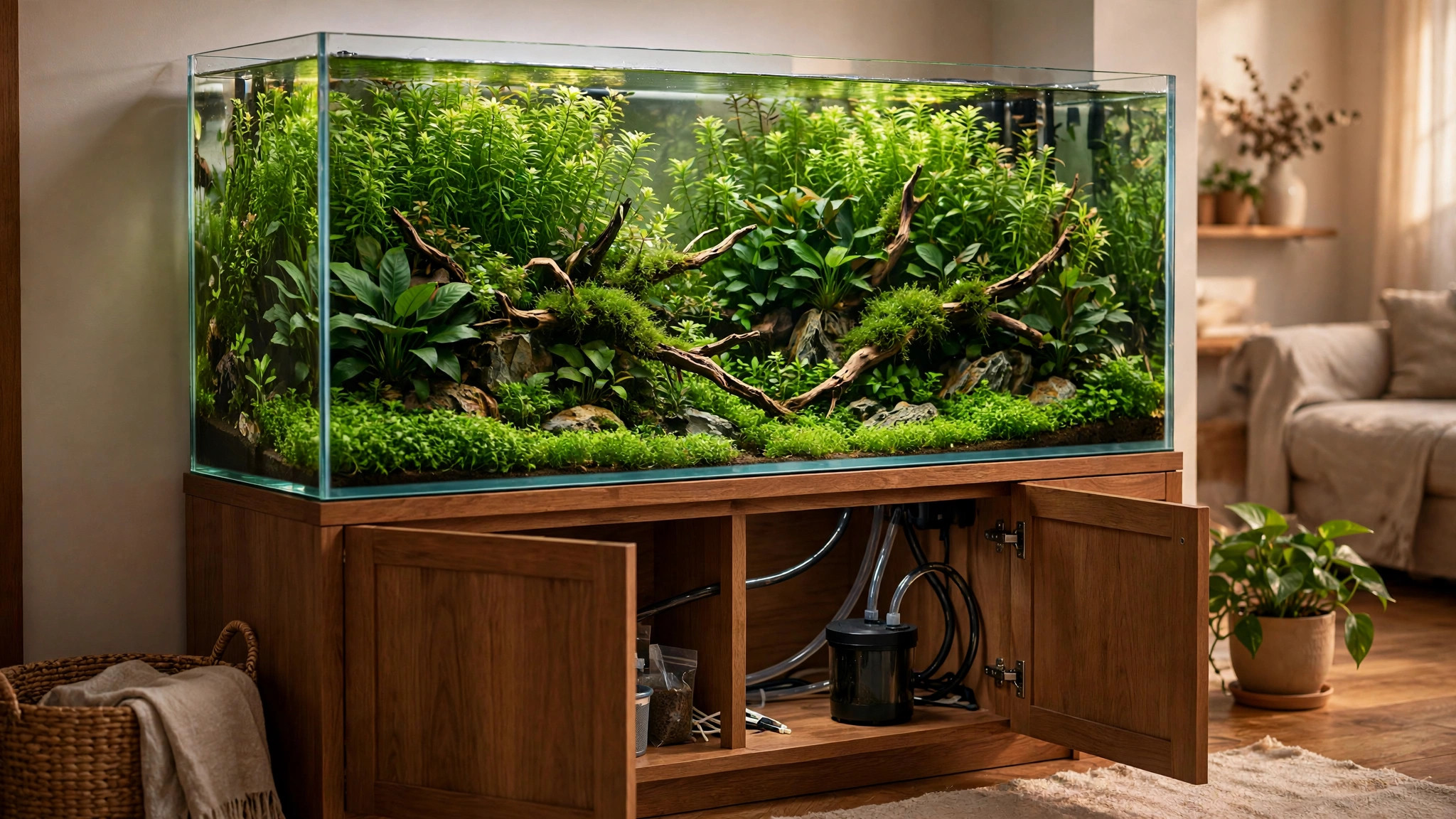
A 40-gallon tank is the size where filtration gets serious. It's too big for a hang-on-back to keep pristine under a full plant load, and big enough that every equipment choice is visible, audible, and permanent-feeling. So you buy a canister filter because "canisters are silent" — and then you spend the next month listening to a faint rattle through the cabinet every time you sit down to watch the tank.
The short answer: the Fluval 307 is the best quiet canister filter for a 40-gallon planted tank for most keepers. Its 303-GPH eTEC pump sits squarely in the ideal 200–350 GPH class for this tank size, reviewers confirm it runs up to 25% quieter than the previous generation, and the EZ-Lift baskets plus AquaStop valves make maintenance genuinely easy. The OASE BioMaster 2 Thermo 350 is the premium silent pick with a built-in heater; the EHEIM Classic 350 is the decades-proven workhorse; the Hydor Professional 350 is the quiet value alternative.
Why a Canister Fits a 40-Gallon Planted Tank
At 40 gallons, your plant mass is doing serious biological work — a dense carpet and stem background consume ammonia around the clock — so the filter's job narrows to circulation, particulate polishing, and hosting a large, stable bacteria colony. A canister gives you all three in a package that hides in the cabinet: liters of media instead of milliliters, a return pipe you can aim precisely through dense growth, and nothing hanging on the back glass to fight your aquascape.
The sealed body is also CO₂-friendly. Unlike a hang-on-back's waterfall return, a canister's submerged return doesn't churn the surface and strip injected CO₂ aggressively — a real advantage if you're running pressurized gas. There's one caveat worth knowing: sealed, vigorous circulation does drive off a little dissolved CO₂, so most high-tech keepers run the return just below the surface and place the diffuser in the return current. Our canister filter setup guide covers the full sizing and media layout this article's picks assume.
What "Quiet" Actually Means
Canister noise comes from exactly four sources, and only one of them is the motor you read about in reviews:
- Trapped air. The number one cause of a new canister sounding like a coffee percolator. A filter that hasn't fully purged air will rattle until the air escapes — usually within 24 hours of running, sometimes longer. Tilt the canister gently while running to burp it.
- Cabinet vibration. A hard canister body on a hard cabinet floor hums. A foam mat underneath breaks the contact and silences it.
- Impeller issues. A hair, a grain of sand, or a worn ceramic shaft in the impeller well produces a buzz audible across the room. Pull it, wipe the shaft and magnet, reseat it — the most common fix there is.
- Motor hum. The thing manufacturers advertise about. Modern eTEC-style motors and German-engineered pumps are genuinely close to silent here — this is the least of your worries with any filter on this list.
To put numbers on it: in independent testing by Aquarium Store Depot, an Eheim Classic 250 scored 50 decibels — average for the field — while the OASE BioMaster 250 came in as the second-most-silent canister they tested. And a reviewer who ran a Fluval 307 side-by-side against the older 306 confirmed it runs up to 25% quieter than the previous generation. In a closed cabinet, any of the four filters below fades into background — the differences between them matter most if your tank sits in a bedroom or a quiet office.
The Four Best Quiet Canister Filters, Compared
| Filter | Rated flow | Tank rating | Noise story | Standout feature | Best for |
|---|---|---|---|---|---|
| Fluval 307 | 303 GPH | 40–70 gal | Up to 25% quieter than previous generation, confirmed in side-by-side testing | EZ-Lift baskets, AquaStop valves | Most keepers — top pick |
| OASE BioMaster 2 Thermo 350 | 300 GPH | Up to 90 gal | BioMaster line ranked second-quietest in independent testing | Built-in 200 W heater, EasyClean pre-filter | Premium, clutter-free setups |
| EHEIM Classic 350 (2215) | Modest pump output | Large-tank class | Extra-silent pump reputation; decades of quiet operation reports | Legendary durability, sips power | Set-and-forget reliability |
| Hydor Professional 350 | ~280 GPH | Mid-to-large class | Owners consistently call it "super silent" | Swivel fittings, spray bar + jet outlet | Quiet performance on a budget |
1. Fluval 307 — Our Top Pick
The 307 is the Goldilocks filter for a 40-gallon planted tank. Its 303 GPH pump and 40–70 gallon rating land exactly where a 40-gallon needs to be: enough headroom to throttle back, not so much flow that you're fighting velocity against delicate stems. Fluval's eTEC motor construction delivers that flow at just 16 watts, and the re-engineered pump genuinely runs up to 25% quieter than the previous 06 generation — confirmed by reviewers who ran old and new side by side.
What keeps the 307 on top isn't just the motor. The EZ-Lift media baskets let you pull the whole media stack out with one finger for cleaning, and the AquaStop valves let you disconnect the hoses without draining anything — maintenance stops being a chore you dread. The unique vertical pre-filter cartridge gives extra mechanical surface area before water ever reaches your biological media, and it ships with authentic Fluval media (Bio-Foam, carbon, Quick-Clear, BioMax rings) so you're filtering from day one.
Affiliate disclosure: the link below is an affiliate link — if you buy through it, AquaVerdia earns a small commission at no extra cost to you. I checked this listing while writing: it was live, in stock, and purchasable. (Prices and availability change; Amazon sets both, so I never quote a price here.)
Check the Fluval 307 Performance Canister Filter on Amazon ★4.5
One note on honesty: while researching this article I also checked current Amazon availability for the other picks below. The OASE BioMaster 2 Thermo 350 and the EHEIM Classic listings showed as currently unavailable, so I've left them unlinked rather than sending you to a dead page — check your local aquarium shop or other retailers if one of them is your choice.
2. OASE BioMaster 2 Thermo 350 — Premium Silence
If the tank lives in your bedroom or your home office, this is the filter to beat. The BioMaster line tested as the second-most-silent canister in independent testing, and the Thermo 350 pairs that quiet operation with a genuinely useful trick: a fully integrated 200-watt heater inside the canister body. One less glass tube in the display, one less piece of equipment to stare at, and no heater for livestock to huddle against or burn on.
The engineering story holds up elsewhere too. The EasyClean pre-filter pulls out as a sealed cartridge — you rinse it weekly without disconnecting hoses or spilling water on the floor, and your biological media stays undisturbed for longer, which matters for colony stability. Four-stage sealed filtration routes water through coarse and fine foams plus Hel-X biomedium, with 5.6 liters of filter volume at a modest 16 watts of filter power. The 300 GPH max flow and up-to-90-gallon rating give a 40-gallon planted tank comfortable headroom, and the priming/venting button makes startup after cleaning quick.
The honest tradeoff: it's the priciest filter here, and if the internal heater element ever fails, the repair is more involved than swapping a standalone heater. Run a small backup heater in the tank if your livestock is temperature-sensitive — a single point of failure for temperature control is a bad bet regardless of brand.
3. EHEIM Classic 350 (2215) — The Reliability Legend
The Eheim Classic is the oldest design on this list, and it shows in the best possible way: there are Classics that have run continuously for 15+ years with nothing but impeller cleanings. Eheim's canister pumps are famous for being extra silent and extra energy-efficient — the brand's entire reputation is built on German-engineered motors that simply don't die.
What you get is above-average media capacity for a compact body, a pump that sips power, and a filter that asks almost nothing of you. What you don't get is modernity: the design hasn't been updated in years, the green tubing is an eyesore in a display tank, chemical media is sold separately, and you can't adjust the flow — the output is what it is, so you size and diffuse it with a spray bar. Priming is manual rather than push-button, which surprises first-time buyers.
Buy the Classic 350 if your priority list reads: quiet, reliable, cheap to run, in that order — and you're willing to forgive a filter that looks like it time-traveled from 2005. It's the "buy it once" option.
4. Hydor Professional 350 — Quiet Runner-Up
Hydor's Professional line is the sleeper of the canister world: Italian-made, rated around 280 GPH for the 350, and repeatedly described by owners as "super silent." It packs thoughtful details that matter in daily use — inlet and outlet connectors that swivel freely so hoses route without kinks, a telescopic intake tube, and both a spray bar and a jet outlet in the box so you can shape the return for planted-tank gentleness without buying extras.
Setup is fast and the instructions are genuinely clear, which counts for something if this is your first canister. Two caveats from long-term owners: fit the media trays precisely, or the motor housing won't seat tightly; and disconnecting the intake/outlet hoses can spill some water, so keep a towel handy during maintenance. Media customization isn't as deep as the Fluval's basket system, but what ships in the box is effective.
This is the pick if you want Hydor-quiet operation — a real, owner-confirmed quiet — at a price that sits well below the premium tier.
How to Size Flow for a 40-Gallon Planted Tank
Ignore the turnover numbers on the box — they're rated at zero head height, and your canister sits two to three feet below the tank in a cabinet. Every bend in the hose and every tray of media costs flow, so budget a 40–50% haircut off the rated GPH when estimating what the tank actually receives. This is why "buying a bigger filter and throttling down" is standard advice: oversized media beds keep parameters rock-steady, and you solve velocity (not filtration) with a spray bar or flow-control valve.
For a 40-gallon planted tank with normal stocking, the target is a canister in the 200–350 GPH rated class — the medium-canister sweet spot in our canister sizing guide. Both the Fluval 307 (303 GPH) and the OASE BioMaster 2 Thermo 350 (300 GPH) sit squarely in it, and both throttle down gracefully for delicate stems. Plants should sway gently in the current, not stream horizontally — watch the stems, not the spec sheet, for your final setting.
Six Noise Killers (Before You Buy Anything New)
If your current canister is the thing keeping you up at night, work through this list before spending money. Nine times out of ten, the noise isn't the motor.
- Purge the air. Run the filter for 24 hours, then tilt it gently side to side while running to burp trapped air from the head and trays.
- Decouple the vibration. Slide a foam mat or folded towel under the canister. Cabinet-transmitted hum disappears instantly.
- Clean the impeller. Unplug, pull the impeller, wipe the shaft and magnet, check for hair or grit, reseat firmly. A worn ceramic shaft on an old unit is a cheap replacement part.
- Check hose connections. Loose connections let air in, which then rattles through the head. Everything should be snug and drip-free.
- Shorten the hoses. Excess hose loops create air traps and cost flow. Cut to the minimum comfortable length with gentle curves, no tight kinks.
- Close the cabinet. Obvious, but a closed cabinet door is worth more acoustic damping than any motor upgrade.
What to Skip
Also skip no-name canister clones with no parts support. A canister is a 10-year appliance: you will eventually need an impeller, an O-ring set, or a replacement valve, and brands with no spare-parts pipeline turn a cheap repair into a full replacement. Every filter on this list has parts you can buy today — that matters more than any spec sheet.
Frequently Asked Questions
What size canister filter do I need for a 40-gallon planted tank?
A canister rated at 200–350 GPH — the medium-canister class. Real-world output is typically 40–60% of the box rating once media is loaded and hoses are plumbed, so this class delivers the gentle-but-thorough circulation planted tanks want without blasting stems.
Are canister filters really silent?
Nearly, once they're primed and air-free. A properly set-up canister in a closed cabinet is inaudible from across a quiet room. If yours rattles, the cause is almost always trapped air, cabinet vibration, or a dirty/worn impeller — all fixable in minutes.
Can I run a canister filter with injected CO₂?
Yes — canisters are actually better for CO₂ than hang-on-back filters, because the sealed body and submerged return don't churn the surface and strip gas. Run the return just below the surface, place your diffuser in the return current so fine mist gets carried through the plant mass, and watch the drop checker after any flow change.
How often should I clean a canister on a planted tank?
Rinse the pre-filter or intake sponge every few weeks in old tank water, and open the main canister every 6–12 weeks: rinse mechanical media, swish biological media gently (never scrub it, never tap water — chlorine kills the bacteria), replace polishing floss. With a pre-filter, you can stretch full cleanings toward the long end.
Fluval 307 vs OASE BioMaster 2 Thermo 350 — which is quieter?
Both are excellent, and the difference is small enough that features should decide. The BioMaster line tested as the second-quietest canister in independent testing, and the Thermo 350 adds the built-in heater; the Fluval 307 was confirmed up to 25% quieter than its predecessor and offers easier basket maintenance at a lower price. Either disappears into a closed cabinet.
Will a canister intake eat my shrimp or fry?
Without protection, yes — newborn shrimp and fry can't fight the intake current. Slide a coarse sponge pre-filter over the intake strainer: it saves livestock, adds biological surface area, and stretches the time between canister cleanings. Rinse it monthly in old tank water.
The right filter for a 40-gallon planted tank is the one you stop thinking about. Size it in the 200–350 GPH class, purge the air, decouple the vibration — and then get back to the part that matters: watching the plants grow.