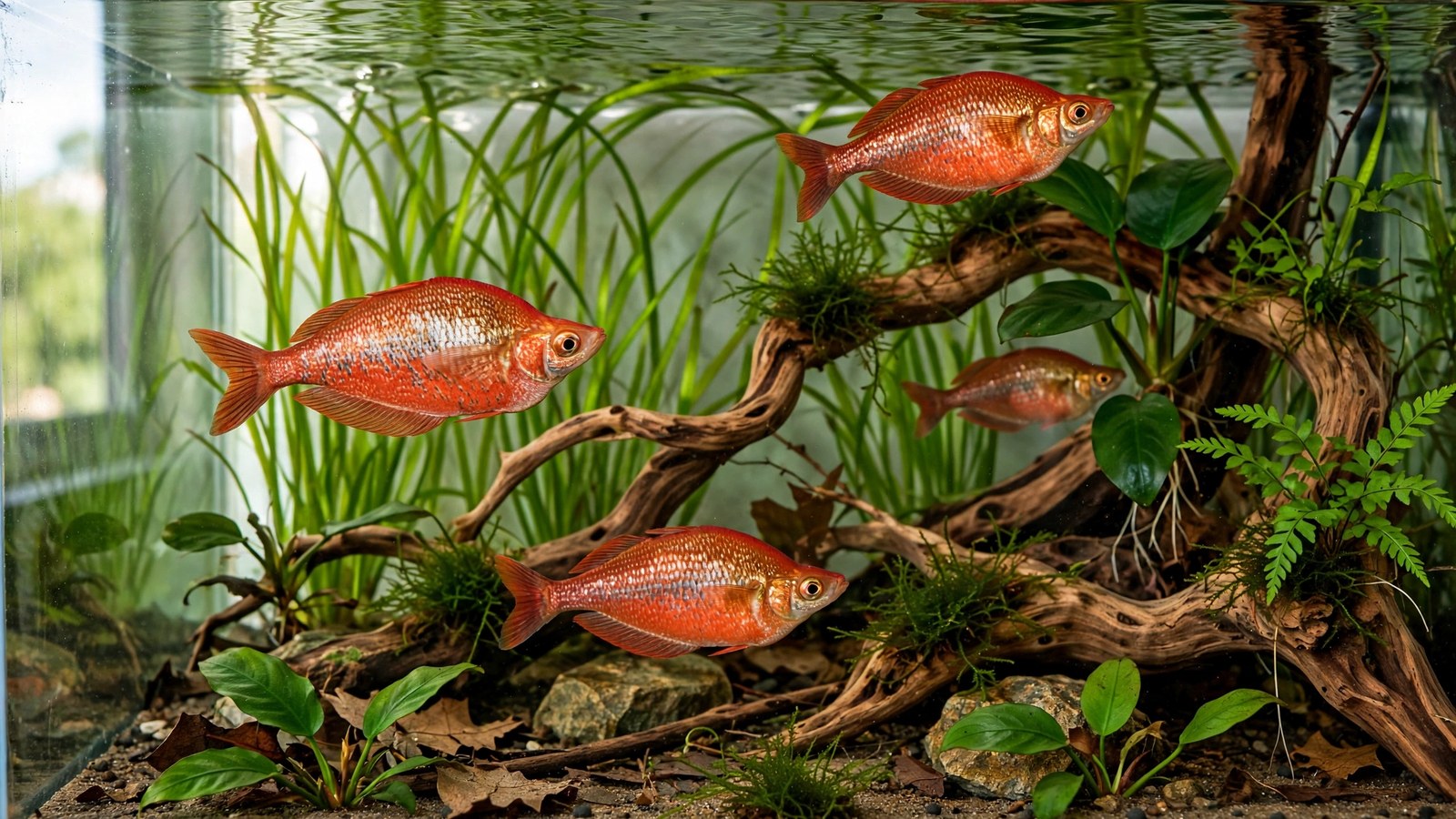
The male red rainbowfish in a well-set planted tank looks like a struck match behind glass — salmon-red, deep-bodied, glowing against dark plants. Glossolepis incisus swims only in Lake Sentani on New Guinea, where it is listed as Endangered, so the fish you buy is almost certainly tank-bred. This guide shows you how to build a red rainbowfish planted tank that recovers that wild color: hard alkaline water, a long footprint, and lighting that flatters red fish.
The direct answer: a red rainbowfish planted tank needs 55–75 gallons, hard alkaline water (pH 7.0–8.0, 71–79°F), a school of 8–10 Glossolepis incisus, tough plants like Anubias, Java Fern, and Vallisneria, plus red-spectrum lighting over dark substrate for the males' salmon-red color. Citable fact: Glossolepis incisus is endemic to a single lake — Lake Sentani, Papua, Indonesia — and the IUCN lists it as Endangered, so captive-bred stock is the only responsible source.
Meet Glossolepis incisus, the New Guinea Red
The red rainbowfish — sold as salmon-red, New Guinea red, or millennium rainbowfish — is Glossolepis incisus, a deep-bodied New Guinea rainbowfish. Adult males reach about 15 cm and flare salmon-red when settled and displaying, while females stay silver-green with a darker mid-body stripe.
G. incisus lives only in Lake Sentani near New Guinea's northern coast, where introduced fish, pollution, and habitat pressure have pushed it into the IUCN's Endangered category. Reputable sellers carry tank-bred lines — ask before you buy. For the broader picture, start with our planted rainbowfish tank roundup.
What makes a red rainbowfish planted tank different
These are active mid-water cruisers that need straight-line swimming space more than decoration. Give them a long 48-inch tank and they patrol in formation all day. Cramp them in a tall, narrow tank and you get stressed, pale fish that hide.
Think of the layout as an arena with walls: dense planting at the back and sides — Vallisneria along the rear glass, Anubias and Java Fern tied to bogwood — with the center third left as open sand. The Australian banded rainbowfish planted tank uses the same open-lane logic, but the red's hard-water needs and bigger body set it apart.
Tank Size, Substrate, and Hardscape
Fifty-five gallons is the floor for 8–10 juveniles; 75 gallons is the sweet spot for adults and the extra males that drive the best color. Deep-bodied males need the footprint, not the height. Our 75-gallon planted build covers filtration and layout for exactly this size.
| Element | What to use | Why |
|---|---|---|
| Substrate | Dark sand or fine dark gravel, 5–7 cm deep | Dark substrate amplifies red coloration; sand is gentle on foragers |
| Bogwood | 2–3 pieces with caves and overhangs | Shelter for females; anchors for Anubias and Java Fern |
| Rockwork | Smooth slate or river rock ledges | Breaks sightlines between rival males |
| Open zone | Center third clear of planting | Cruising lane — where the school shows its color |
The substrate is one of the two great color amplifiers for this species (lighting is the other). Pale sand or bright gravel washes the reds out almost completely. Choose your dark floor with our best substrate for planted tanks guide, which covers depth, grain size, and nutrient options.
Hard, Alkaline Water — Non-Negotiable
Aim for pH 7.0–8.0 with moderate hardness (8–15 dGH) and 71–79°F. In soft, acidic water these fish fade, eat less, and succumb to columnaris and fin rot they'd otherwise shrug off. If your tap is soft, crushed coral or aragonite in the filter lifts hardness and buffers pH far more stably than chemicals.
Cycle the tank thoroughly first. A canister or oversized hang-on-back filter keeps the open water crystal clear so the reds read at full saturation.
Plants That Survive Rainbowfish Traffic
Rainbowfish are rough on delicate stems, so plant tough. Vallisneria is the backbone: tall, hardy, tolerant of hard water, forming the rear curtain the school weaves through. Anubias and Java Fern tie to wood and rock where the school can't uproot them; Amazon swords anchor the corners. Match plants to your light level with the aquarium plants for fish tank guide.
Lighting That Makes Red Pop
Under cool-white 6500K lighting red fish look merely pinkish; under a red-spectrum-enriched light, the same male glows ember. Choose a full-spectrum LED with a strong red channel and run it at 60–80% of maximum — long-standing keeper advice that genuinely transforms the tank. Keep enough blue and green for plant growth; eight hours daily, extending to ten only once plant mass is established.
Feeding for Color and Size
Feed a quality small-pellet staple twice daily, rotating in frozen bloodworm, daphnia, and brine shrimp 3–4 times a week — the carotenoids feed the red pigment directly. A 4 cm juvenile reaches 8–10 cm in its first year with steady feeding. Portion to what the school finishes in two minutes, and change 30% weekly to hold nitrates under 20 ppm.
Schooling, Mates, and the Cross-Breeding Rule
Eight is the minimum school; ten to twelve is better, stacked male-heavy, because males color up hardest with rivals to posture at. Calm tank mates work: other rainbowfish, larger tetras, barbs, and corydoras. Skip tiny shrimp colonies and aggressive cichlids. Rainbowfish rank among the most rewarding schooling fish for planted tanks — a lonely pair stays dull, a school of ten is a spectacle.
Weekly Care Rhythm
| Task | Frequency | Notes |
|---|---|---|
| 30% water change | Weekly | Match temperature and hardness |
| Glass and leaves | Weekly | Wipe glass; rinse algae off Anubias leaves |
| Trim Vallisneria | Every 2–3 weeks | Thin outer runners so the lane stays open |
| Filter maintenance | Monthly | Rinse media in tank water; refresh crushed coral if pH drifts |
| Test pH and hardness | Monthly | Catch softening drift before color fades |
Frequently Asked Questions
Are red rainbowfish really endangered?
Yes — the IUCN lists Glossolepis incisus as Endangered because it lives only in Lake Sentani and nearby streams on New Guinea, where introduced species and habitat pressure have shrunk wild numbers. The trade runs on captive-bred lines, so always confirm your stock is tank-bred.
How big do red rainbowfish get?
Adult males reach about 15 cm (6 inches) with a deep, almost disc-like body; females are smaller at 10–12 cm. That deep-bodied adult size is why 55–75 gallons with a 48-inch footprint is the realistic minimum — anything shorter cramps their cruising behavior and dulls their color.
Can I keep red rainbowfish with other rainbowfish?
Yes, but never let them breed together. Crossing Glossolepis incisus with other rainbowfish species produces hybrids that muddy pure lines — a long-standing hobby warning. If you mix species, keep it male-only, remove any eggs promptly, and buy from breeders who maintain separated lines.
How many red rainbowfish should I keep?
Eight is the minimum school, but ten to twelve with a male-heavy ratio gives the best color. Males intensify their salmon-red when posturing at rivals. Single fish or small pairs stay washed out and stressed — this species is built for a crowd.
Why is my red rainbowfish not red?
Check three things: water hardness (soft, acidic water fades them — raise pH to 7.0–8.0), lighting (a red-spectrum channel over dark substrate), and social setup (more males, no bullies). Juveniles and females are naturally less red; full salmon color appears in mature males after a few settled months.
Where can I read the species profile?
The Seriously Fish profile on Glossolepis incisus documents wild parameters, lake habitat, and behavior, and is worth reading before you stock your tank.
The Payoff
Give the school hard water, a long open lane, red-rich light over dark substrate, and six quiet months to mature — and the pale silver juveniles become a squadron of ember-red New Guinea natives. That is a tank nobody walks past.