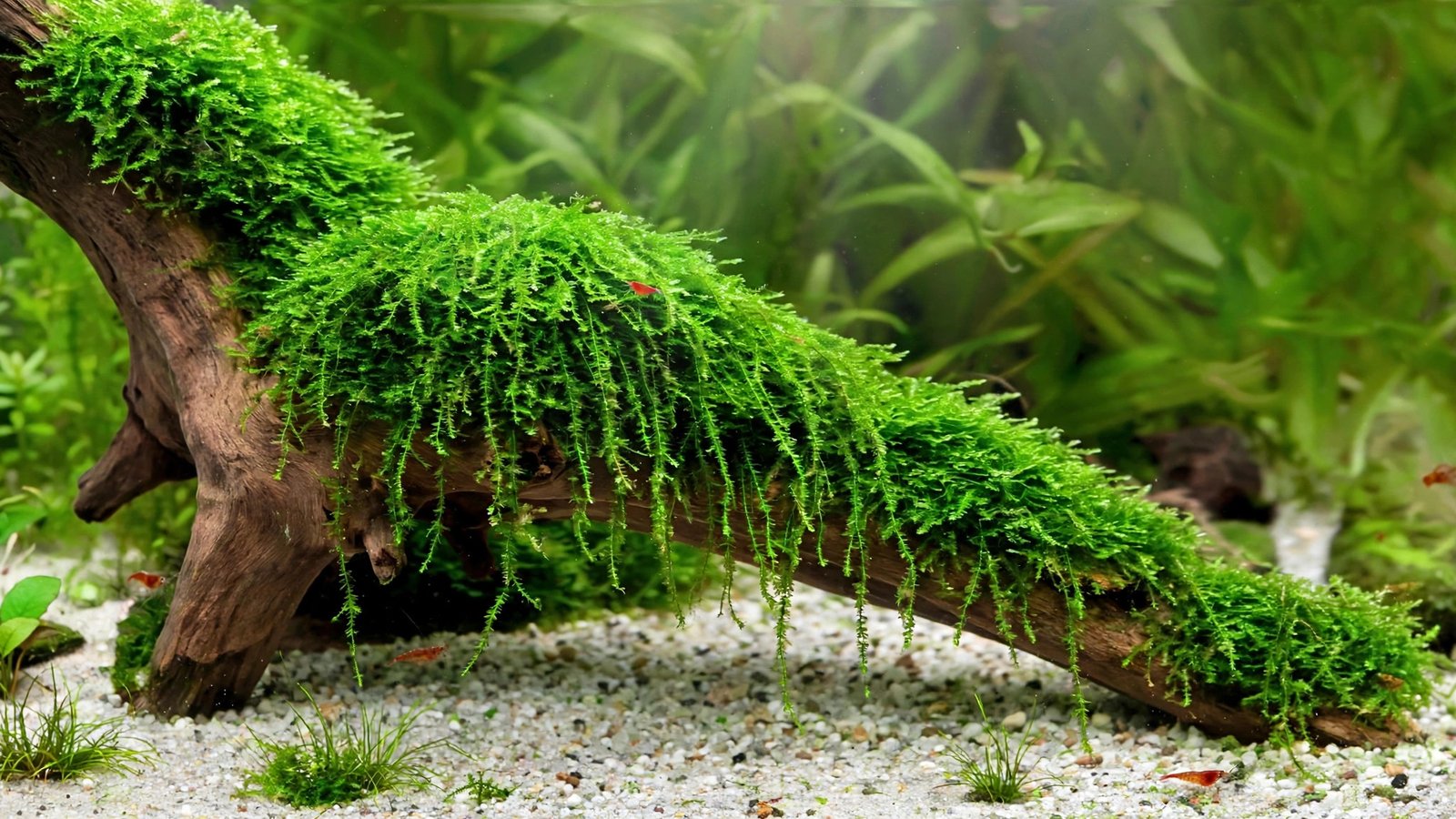
Hang this moss from a branch and it does something no other moss does: it drapes. Where the best aquarium mosses sprawl, creep, or climb, weeping moss grows in teardrop fronds that bend downward like a miniature weeping willow — which is exactly why a weeping moss aquarium looks instantly ancient. This guide covers attaching it, dialing in light and CO2, and trimming so the signature droop survives every cut.
What Makes Weeping Moss Droop
The droop is architecture, not trimming. Submersed Vesicularia ferriei grows in overhanging, frond-like shoots that bend downward as they extend — the trait Prof. B.C. Tan used to identify the species from Chinese imports. Its leaves resemble Christmas moss's, but end in blunt tips, and the shoots arch far further down than any relative's.
That habit dictates placement: weeping moss wants elevation. Glue it to a high branch, a vertical trunk, or an overhanging ledge, and gravity does the aquascaping — fronds cascade like a willow canopy. Stick it flat on low rocks and you waste its defining feature. The opposite of flame moss (which climbs) and Java moss (which sprawls anywhere).
Lighting, CO2, and Water for a Weeping Moss Aquarium
Weeping moss is forgiving about light. Low to medium intensity — roughly 25–50 PAR — grows it well; brighter light does not deepen the droop, it mostly invites algae into the dense fronds. Run 6–8 hours daily, and shade the moss if neighboring plants demand bright light.
CO2 is optional but genuinely useful: 15–30 ppm visibly accelerates its slow baseline, with new fronds in weeks rather than months. Without CO2 it still survives and spreads — it just takes its time. Dose a lean all-in-one fertilizer weekly or biweekly; heavy dosing feeds algae faster than the moss.
| Parameter | Target range | Notes |
|---|---|---|
| Temperature | 59–86°F (15–30°C) | Best 68–77°F; cooler water deepens color |
| pH | 5.0–7.5 | Thrives in soft, slightly acidic water |
| GH / KH | Soft–medium | Adapts widely; stable beats ideal |
| Light | 25–50 PAR, 6–8 hrs/day | Low–medium; more light ≠ more droop |
| CO2 | 0–30 ppm | Optional; 15–30 ppm speeds growth |
| Flow | Gentle–moderate | Keeps debris out of the fronds |
How to Attach Weeping Moss
Weeping moss has no true roots — it anchors with microscopic rhizoids. Never bury it in substrate; it rots. Four reliable methods:
- Cyanoacrylate gel: Dab small portions onto damp hardscape, hold 30 seconds, flood. Permanent within a day; the moss grows over the glue in weeks. Best for precise canopy work.
- Cotton thread or fishing line: Wrap thin layers around branches. Cotton rots away in 4–8 weeks as the moss grips; fishing line lasts — remove it once the moss holds.
- Mesh sandwich: Spread moss between two stainless or plastic mesh sheets for instant moss walls, then drape the wall over a branch.
- Wedge into crevices: Stuff portions into wood cracks and rock gaps — the most natural look, zero supplies.
Spread portions thin: thick clumps rot in the middle where light and flow cannot reach. Small patches spaced a centimeter apart knit into a lush mat in 2–3 months. If you have experience attaching epiphytes like Java fern to driftwood and rocks, the same glue-and-thread instincts apply.
Trimming for the Weeping Shape
Uncut weeping moss eventually betrays its name: old fronds grow leggy and trail horizontally instead of arching down. Trim every 3–4 weeks once established — frequency matters more than severity.
With sharp curved scissors, cut fronds back to about two-thirds of their length, shaping from the outside in so the silhouette stays teardrop: longest at the center of the drape, shorter at the edges. Each cut tip forks into two, which is how sparse strands become a dense curtain over a few months. Siphon clippings out immediately; fragments sprout wherever they settle. The technique mirrors trimming Java moss, but the goal is opposite — you are sculpting a curtain, not a carpet.
Propagation and Tank Mates
Any trimmed fragment becomes a new plant: press healthy clippings onto fresh hardscape with glue or thread and they anchor within weeks — the same approach used when propagating Java moss works verbatim. One healthy portion can colonize an entire aquascape in a few months.
Weeping moss shines in shrimp and nano tanks — shrimplets shelter in the drooping curtain while adults graze biofilm off the fronds; it pairs well with the species in our subwassertang care guide. Keep it away from Siamese algae eaters and large goldfish, which shred the fronds. It coexists fine with Fissidens fontanus and marimo moss balls without competing.
Buying Real Weeping Moss (and Spotting Fakes)
True weeping moss is frequently mislabeled — the Flowgrow database notes many "weeping" mosses never develop the downward-bent shoots. Buy only from sources that name Vesicularia ferriei explicitly, and compare the growth habit against the Flowgrow database entry on Vesicularia ferriei. Prefer tissue-culture cups (Tropica's 1-2-Grow line sells it under item 2340): pest-, algae-, and snail-free. The Barr Report's Vesicularia ferriei species profile lists the identifying traits — downward-bent shoots, blunt-tipped leaves — worth memorizing before you buy.
Frequently Asked Questions
Does weeping moss need CO2?
No — weeping moss grows fine without injected CO2 in low-tech tanks. But 15–30 ppm CO2 visibly accelerates its naturally slow growth, with new fronds appearing in weeks instead of months. Treat CO2 as a speed upgrade, not a requirement: a low-tech weeping moss aquarium simply takes longer to fill in.
Why isn't my weeping moss drooping?
Three usual causes. Too little light flattens the habit and fronds creep horizontally. No trim lets old fronds grow long and trail sideways — cut back every 3–4 weeks. Or a fake: mislabeled mosses never develop the downward arch. Give true Vesicularia ferriei 2–3 months on an elevated branch and the willow drape appears.
How fast does weeping moss grow?
Slow to moderate — slower than Java moss, faster than Fissidens. A glued portion visibly spreads in 4–6 weeks without CO2 and forms a full canopy on a branch in 3–5 months. With CO2 and medium light, cut roughly a third off that timeline. Patience is the price of the droop.
Can weeping moss grow as a carpet?
Not well. Its shoots re-attach to surfaces very slowly, so carpet attempts end with loose, drifting fragments. Weeping moss is an epiphyte — glue, tie, or wedge it onto driftwood, rocks, or mesh walls. For a foreground effect, drape a moss wall over a low ledge; it reads like a carpet while the moss stays anchored.
Is weeping moss good for shrimp tanks?
Excellent. The dense, drooping fronds trap biofilm that cherry and amano shrimp graze constantly, and baby shrimp shelter inside the curtain. It prefers the same soft, slightly acidic water (pH 5–7.5) that dwarf shrimp thrive in and tolerates low-light shrimp setups. One of the best mosses for a breeding tank.
Weeping moss vs Christmas moss — which should I choose?
Choose weeping moss for a cascading, willow-like drape from elevated hardscape — nothing else does it. Choose Christmas moss for flatter surfaces, tiered tree canopies, and easier sourcing (it is cheaper and nearly always genuine). Both are easy Vesicularia species with similar care; the decision is purely about the silhouette you want.
The Willow Look, Earned
Weeping moss rewards one decision above all: give it height. Mounted on a branch with modest light, regular trims, and a few months of patience, Vesicularia ferriei builds the weeping canopy that made it famous. Buy the real species, attach it thin, trim on schedule — and let gravity do the rest.