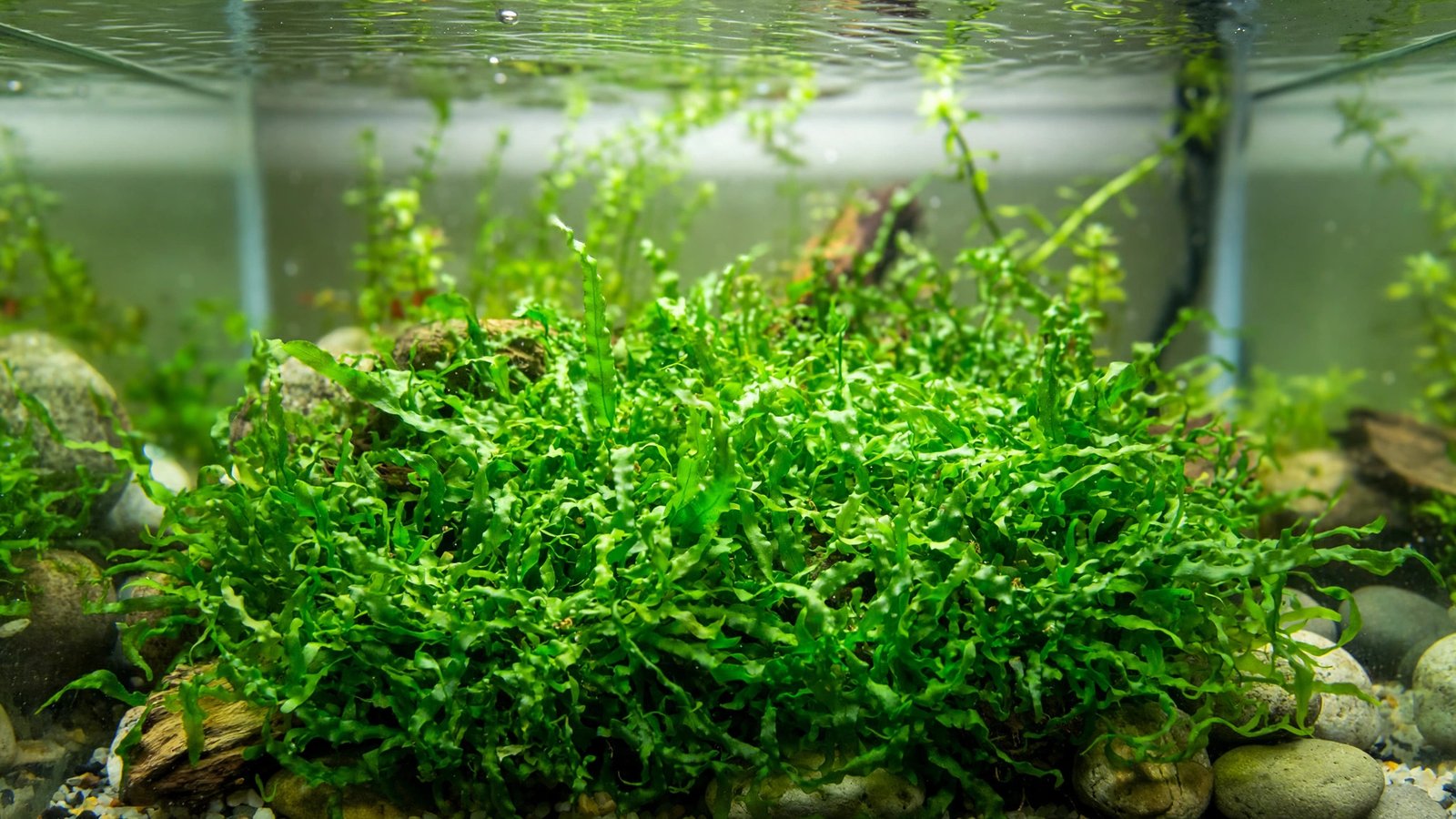
You almost certainly misspell its name — so does half the internet. Subwassertang comes from the German Süßwassertang ("freshwater seaweed"), and somewhere in an early forum thread the ß was misread as a B, and the mistake stuck. But the spelling is the least surprising thing: the clump sold as "round pellia moss" is no moss at all. It is the gametophyte of a true fern, Lomariopsis lineata — and once you know what you are actually growing, keeping it lush is straightforward.
The Identity Story: A Fern in Moss Clothing
The hobby spent years arguing about what subwassertang was. It entered the trade through German aquarist circles, where it was first assumed to be Pellia endiviifolia, a genuine liverwort — hence "round pellia moss." Then a molecular phylogenetic study in 2009 settled the argument: the plant is not a moss, not a liverwort, and not an algae. It is the prothallus — the free-living gametophyte stage — of a true fern, most closely related to Lomariopsis lineata, a fern native to Southeast Asia.
That finding explains everything about the plant's behavior. Ferns alternate between a large leafy sporophyte and a tiny sexual prothallus — and in the aquarium, subwassertang's prothallus never completes the cycle. Attempts to coax a sporophyte out of it have failed, which is one reason researchers suspect the aquarium strain may be an undescribed species rather than L. lineata proper. Instead it simply grows: a thallus one cell thick, profusely branched, reproducing entirely by fragmentation.
That one-cell thickness explains both its beauty and its weaknesses: soft, translucent ruffled ribbons that catch light like wet tissue paper, but tissue that tears easily and smothers under packed detritus. Like Bolbitis heudelotii, a true aquarium fern, it prefers shaded, current-swept positions and sulks in blazing light — it simply does the same job with none of a fern's usual hardware: no roots, no rhizome, no fronds.
Subwassertang vs. Its Doppelgängers
The trade names around this plant are a genuine mess: "subwassertang," "süsswassertang," "pellia moss," "round pellia," and "Loma fern" get applied to at least two different organisms, and some retailers cannot tell them apart. Here is how to read what you are actually buying.
| What the label says | What it actually is | How to tell |
|---|---|---|
| Subwassertang / round pellia | Fern gametophyte, Lomariopsis lineata | Translucent, ruffled ribbons; branches profusely; thallus one cell thick; no midrib |
| Süsswassertang (some sellers) | The true liverwort Monosolenium tenerum | Opaque, thicker thallus with a visible midrib; larger, flatter lobes; feels sturdier |
| Riccia fluitans, the true floating liverwort | True liverwort | Bright lime-green, forked Y-shaped branching, floats unless tied down |
| Java moss, a true moss | True moss | Tiny leaflets arranged on wiry stems; grows rhizoids that grip wood |
| Christmas moss, another true moss | True moss | Branching, triangular fronds like tiny Christmas trees; grips surfaces firmly |
The practical rule: buy from a source that prints Lomariopsis lineata on the label and inspect the portion first. Real subwassertang looks like crinkled green cellophane; an opaque, leathery portion with an obvious central rib is probably Monosolenium tenerum — also a fine aquarium plant, just not the one you ordered, and it grows and trims differently.
Why Aquarists Keep Coming Back to It
Strip away the taxonomy and subwassertang earns its reputation simply. First, it is one of the hobby's most forgiving plants: it tolerates low light that would starve most foreground plants, asks for no CO2, feeds from the water column, and survives beginner neglect — irregular water changes, cheap lighting, fluctuating parameters — that melts demanding species. A golf-ball portion will quietly persist through a new tank's ugly early months while everything else adjusts.
Second, it is a shrimp and fry magnet. The densely branched cushion is a three-dimensional maze that cherry shrimp graze constantly for biofilm, while newborn fry hide in the interior where larger fish cannot follow. A loose ball drifting at the surface becomes a floating refuge that also shades the tank — genuinely useful in breeding setups, and it pairs naturally with marimo moss balls, which tolerate the same dim corners.
Third, it resists algae unusually well for a slow grower. Its translucent, constantly dividing thallus seems less hospitable to algae than moss of similar growth speed, so in long-term scapes a subwassertang cushion can hold its position for a year or more with only periodic thinning.
Tank Setup and Water Parameters
Subwassertang's rootlessness reshapes the usual planting advice: substrate choice is nearly irrelevant. With no roots to feed and no rhizoids to grip, aquasoil, sand, or bare glass all work — what matters is the water column, the light, and something to attach the plant to. For any new portion, follow the same routine for preparing new plants for your tank: rinse away packing medium, inspect for hitchhiking snails, and quarantine if the tank houses prized livestock.
| Parameter | Target range | Notes |
|---|---|---|
| Temperature | 20–28°C (68–82°F) | Best color and health under 26°C (79°F); browning increases above 28°C |
| pH | 6.0–7.5 | Adaptable; thrives in the mildly acidic range of most planted tanks |
| GH / KH | GH 3–15, KH 1–5 | Soft to moderately hard water is fine; avoid extreme hardness |
| TDS | 100–300 ppm | Typical planted-tank range; sensitive to abrupt chemistry swings |
| Light | Low to medium, ~20–40 PAR | Shade-tolerant; direct high light invites algae on the slow tissue |
| CO2 | Not required | Optional supplementation improves density and growth speed |
| Fertilizer | Light water-column dosing | Half to full dose of a complete all-in-one; low overall demand |
One more note on flow: the fronds are light and naturally unanchored, so a strong filter outflow will relocate loose portions across the tank. Aim for gentle, diffuse flow — enough to keep detritus out of the cushion, not so much that the plant migrates.
Light, CO2, and Fertilizer
Subwassertang genuinely prefers shade — it is one of the few foreground-texture plants for under overhangs, beneath driftwood, or in dim corners where nothing else grows. In the wild, Lomariopsis prothallia grow on damp, shaded stream banks, and the aquarium strain keeps that preference. Aim for roughly 20–40 PAR; under strong lighting, tuck portions into shadow rather than dimming the whole tank — shaded cushions under an Anubias canopy grow a deeper green and resist algae better.
CO2 injection is firmly optional. It will grow perfectly well in a low-tech tank for years; added CO2 merely accelerates growth and can produce denser, more vividly green cushions. Do not buy a CO2 system for this plant alone.
Fertilizer demands are modest: half the label dose of a complete liquid all-in-one is plenty in most tanks, stepping up to full dose only in heavily planted, lean-water setups. Keeping fast-growing stems like pearl weed in the mix helps too — they stabilize the water column and outcompete algae, indirectly protecting your slow-growing cushion.
Anchoring and Aquascaping: Making a Rootless Plant Stay Put
The skill that separates a thriving subwassertang scape from a plant drifting behind the filter intake: without roots or gripping rhizoids, it will not fasten itself like true mosses do — give it a mechanical home and two to three months to settle.
The most reliable methods: tuck portions deep into rock crevices or driftwood forks, where branching eventually wedges them in place; tie them down with dark cotton thread or fishing line, loosely enough for new growth to push through; or press thumbnail-sized tufts into small dabs of cyanoacrylate gel on dry hardscape for ten seconds. For carpets or moss walls, sandwich a thin layer between two sheets of stainless steel or plastic mesh and cable-tie the edges — within a few months the thallus grows through and the panel disappears.
Floating is not a failure mode; it is a placement. A loose ball drifting at the surface becomes a dense sphere that shrimp colonize aggressively, giving the same fry refuge as an anchored cushion with zero maintenance. Keep one floating ball alongside your anchored portions — with full access to surface light and CO2 it usually grows fastest and becomes your free propagation stock.
Trimming, Propagation, and Maintenance
Propagation is simple: pull the cushion apart. Every fragment grows on — fragmentation is its only reproductive strategy, so you will never buy it twice. One golden rule: turn off the filter and powerheads before trimming, because any missed cutting will colonize wherever it lands.
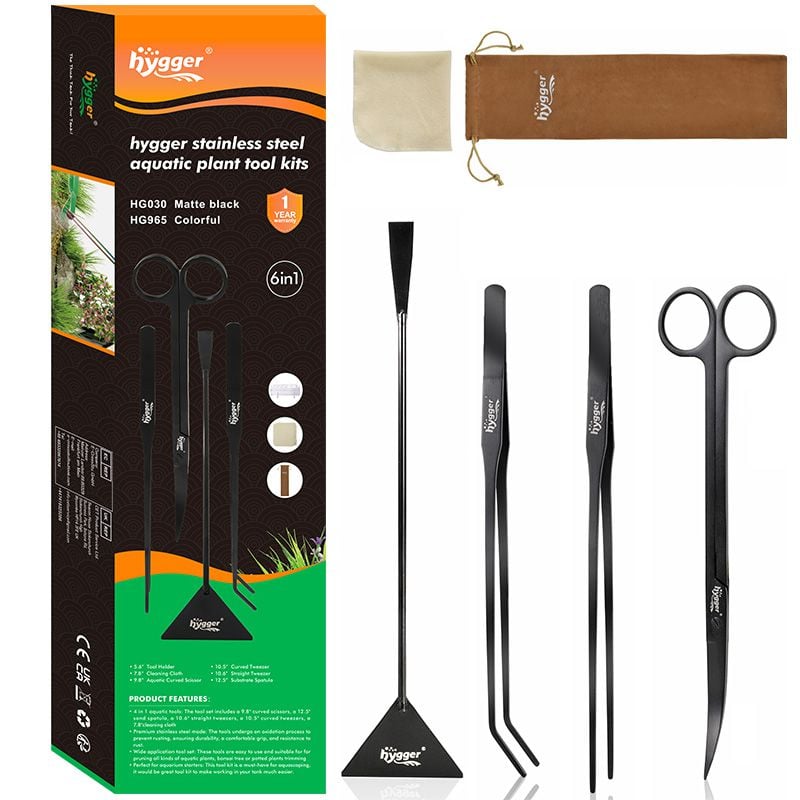
Trim with sharp, curved aquascaping scissors, cutting from the outside inward to open the cushion's interior. The most useful maintenance is thinning, not shaping: every couple of months remove a third of the densest interior growth so light and flow reach the middle, plus any browned fronds. Net or siphon every floating cutting immediately — each is a viable plant for new placements or to share with other hobbyists.
Expect slow to moderate growth: a golf-ball portion becomes fist-sized within three to six months under low-tech conditions. Growth stalls are almost always environmental — check temperature first, then packed detritus smothering the interior, then whether a faster neighbor is shading it out.
 ★4.6
hygger 6-in-1 Long Aquarium Aquascaping Tools Kit
Check Price on Amazon ★4.6Algae, Browning, and Troubleshooting
Healthy subwassertang is a deep, translucent green with visibly ruffled, branching ribbons. The most common problem is browned, yellowing interior growth — usually caused by trapped organic debris. The cushion's dense branching is an excellent detritus trap; mulm settles in, blocks light and flow to the inner fronds, and they decay. The fix is mechanical: during each water change, waft a turkey baster or soft siphon through the cushion to lift debris out without tearing the thallus.
Heat is the second suspect: quality declines past 28°C (82°F), with browning and a limp, stringy texture. If your tank runs hot in summer, move portions to the coolest, shadiest spot and increase surface agitation. Sudden chemistry swings can also trigger a brown-out — stability matters more than perfect numbers.
Algae on subwassertang is uncommon, usually a dusting of green algae on the oldest outer fronds in high-light, high-nutrient tanks. Remove the affected portion, rinse it gently in old tank water, pick off the worst fronds, and re-anchor the clean remainder. A colony of cherry shrimp or Amanos grazing the cushion continuously is the best long-term insurance — one reason this plant is a classic in shrimp scapes alongside flame moss, another shrimp-tank favorite. In shaded epiphyte groupings it pairs beautifully with Bucephalandra tucked into the same crevices.
Frequently Asked Questions
Is subwassertang actually a moss?
No. Despite trade names like "round pellia moss," subwassertang is the gametophyte (prothallus) of a true fern, most closely related to Lomariopsis lineata. A 2009 molecular study confirmed it is neither a moss nor a liverwort. It behaves differently from true mosses: it has no rhizoids that grip surfaces, grows as a one-cell-thick branching thallus, and reproduces only by fragmentation.
Do I need CO2 to grow subwassertang?
No. Subwassertang is a genuine low-tech plant that grows well for years without injected CO2. It draws its modest nutrition from the water column and tolerates low light. CO2 supplementation will speed up growth and can produce denser, more vividly green cushions, but consider it an optional bonus rather than a requirement.
Can I plant subwassertang in the substrate?
You should not bury it. Subwassertang has no roots, so buried portions cannot anchor and will rot from the middle outward. Instead, tie it to rocks or driftwood with cotton thread or fishing line, fix it with cyanoacrylate gel, tuck it into hardscape crevices, sandwich it in mesh for carpets, or simply let it float as a ball.
Is subwassertang safe for shrimp and fry?
Yes — it is one of the best plants for breeding tanks. The densely branched cushion forms a three-dimensional maze that shrimp graze constantly for biofilm, while newborn fry shelter in the interior where larger fish cannot reach them. A floating ball at the surface doubles as shade and refuge.
Why is my subwassertang turning brown?
Browning almost always means trapped detritus or excess heat. Gently siphon mulm out of the cushion's interior during water changes, and keep temperatures under 26°C (79°F) where possible — quality declines noticeably above 28°C. Sudden water-chemistry swings can also cause brown-outs, so keep parameters stable rather than chasing perfect numbers.
What is the difference between subwassertang and süsswassertang?
Usually nothing — "subwassertang" is a misspelling of the German Süßwassertang ("freshwater seaweed") that stuck in the hobby. The confusion is that some sellers apply the name "süsswassertang" to a different plant entirely, the true liverwort Monosolenium tenerum. Buy from sources that name Lomariopsis lineata on the label, and check that the portion is translucent and ruffled rather than opaque and leathery.
A Living Fossil Stage in Your Foreground
There is something quietly remarkable about keeping subwassertang: you are growing a life stage that was never meant to be permanent. In a Southeast Asian stream, the sporophyte of Lomariopsis lineata unfurls proper fern fronds while its prothallia do their brief sexual business and die. In your tank the prothallus never gets the memo — it just keeps branching and fragmenting, a fern's childhood stretched into a low-maintenance adulthood. Give it shade, cool water, something to hold onto, and occasional thinning for one of the hobby's most distinctive textures. Cross-check the Buce Plant subwassertang profile and the Wikipedia taxonomy overview for the 2009 reclassification details.