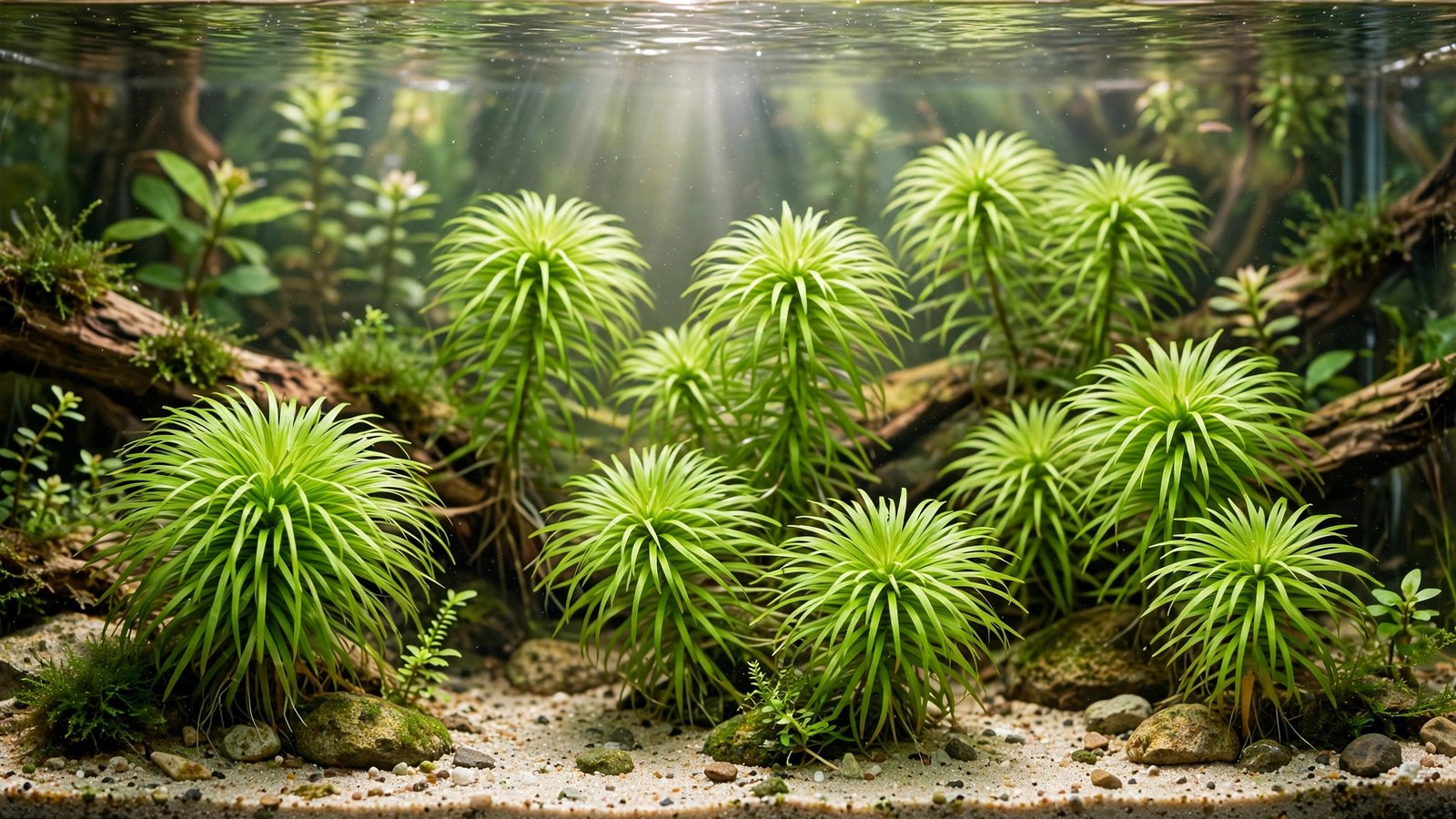
Most "Belem" cups in the shop fridge are not Belem at all — they are Syngonanthus macrocaulon, and proper syngonanthus macrocaulon care is the difference between a cup that melts in ten days and a golden-green bush your friends ask about by name. Its shoot tips fan into star-like crowns, but only in soft, acidic, bright water with steady CO2. Hard tap water? This guide saves you the price of the cup. New to planted tanks? Start with our complete guide to freshwater aquarium plants first.
What syngonanthus macrocaulon care really demands
Syngonanthus macrocaulon comes from very soft blackwater rivers near the Amazon's mouth. This pipewort (Eriocaulaceae) grows as a branched stem plant with densely set, narrow, arching leaves about 2–3 cm long, and shoot tips flare into rosette-like crowns — the whole appeal, and your health gauge. Bright crowns mean you are doing it right; dull, stalled tips mean the water is off.
Despite the crowns, it is a stem plant, not a true rosette. Energy goes into lateral shoots, so it forms a bushy stand rather than a leggy stalk — provided light reaches every crown. Shade it under floaters and lower leaves melt.
The Belem name mess, untangled
It entered the hobby via Japan's Rayon Vert as "Tonina sp. 'Belém'", named for the Brazilian city near its collection site. It is not a Tonina — that genus holds one species, T. fluviatilis, and the genera flower differently. In 2010, Christel Kasselmann matched hobby samples against Berlin-Dahlem herbarium material and identified it as Syngonanthus macrocaulon. Traders merged the labels into "Syngonanthus Belem": botanically wrong, commercially everywhere. Our Syngonanthus care guide covers the genus-level Belem shape; this is the species-specific version.
| Plant | Size and shape | How to tell it apart |
|---|---|---|
| S. macrocaulon | Midground–background bush | 2–3 cm arching leaves, star-like crowns |
| S. 'Manaus' | Significantly taller, larger | Same look at bigger scale |
| S. 'Lago Grande' | Similar size | Spikier crown tips, not the rounded star |
Tank setup: soft, acidic, bright
Get the water right and everything else gets easier. Macrocaulon wants GH and KH ≤ 5, pH 5.5–6.5, and 22–28 °C. Soft water is the single biggest dealbreaker — above 8 dGH from the tap, plan on remineralized RO. This plant does not adapt to hard water; it declines.
A fine, nutrient-rich aquasoil is the best upgrade you can buy: it feeds the roots and buffers KH and pH downward into the plant's comfort zone. That buffering is why macrocaulon's reputation improved in the aquasoil era — from "nearly impossible" to merely demanding.
Light should be strong and unshaded: 80–120 µmol PAR at the substrate, 7–8 hours daily while settling, 8–9 once growth is steady. Run CO2 near 30 mg/L — stable matters more than extreme. Start low and raise it slowly while watching your livestock: one bubble per second is a safe starting point on a typical 40-liter tank, and any gasping at the surface means you have gone too far, so dial it back. Dose balanced macros and micros with enough iron for bright golden-green foliage, and keep gentle circulation so CO2 reaches every crown. It sits well beside other soft-water Eriocaulaceae like Eriocaulon cinereum, and shares the acidic-substrate demands of Tonina fluviatilis, the one true Tonina it was once mistaken for. The Flowgrow aquatic plant database entry for Syngonanthus macrocaulon is a solid independent reference for these figures.
Planting and trimming: the 4-centimeter rule
Rinse tissue-culture gel off, split the portion into clumps of three to five stems, and plant each with tweezers at 45 degrees, 2–3 cm apart, deep enough to anchor. Shallow planting is why new stems float up overnight. Tissue-culture stock is the safest buy: no algae, no snails, no hitchhikers.
Once happy, it propagates itself: side shoots appear at the stem bases — separate them at four or five leaves and replant. Expect rooting in 7–10 days, a dense bush in four to six weeks. Do not move it during this window; every replanting resets the clock.
Trimming has one oft-repeated rule: cut only the uppermost 4 cm and replant the tops. Short cuttings establish fast into clean crowns; longer ones root along their entire lower stem and look ragged.
Troubleshooting: melting, algae, stunting
Some melt after planting is normal, especially from tissue culture — old leaves give up while the plant builds submersed ones. Judge it by new crown tips. Whole-plant melt is a water problem: check GH, KH, and CO2 stability before touching the fertilizer bottle.
Know the classic failure: tips go transparent, then brown, then growth stalls — even with consistent dosing. A detailed thread on Syngonanthus macrocaulon melting documents exactly this. Usual culprits: hardness creeping up as aquasoil exhausts its buffering, CO2 fluctuating through the day, or iron too low for the bright-green coloration. Tiny, stunted new growth points the same way.
| Symptom | Likely cause | Fix |
|---|---|---|
| Transparent tips turning brown, growth stalls | Hardness creep or CO2 instability | Test GH/KH; refresh buffering or switch to RO; stabilize CO2 near 30 mg/L |
| Old leaves melt, new crowns fine | Normal transition | Leave it alone; trim dead leaves after two weeks |
| Pale, washed-out foliage | Iron or micro deficiency | Raise iron/micros; keep pH under 6.5 so iron stays available |
| Algae coating the leaves | Too much light for the CO2 balance | Cut photoperiod to 7 hours; fix CO2 stability first, light second |
Should you grow it? An honest verdict
Grow it if you run aquasoil, have soft tap water or RO, inject CO2, and enjoy tuning a tank — it rewards you with one of the hobby's most distinctive textures. Do not grow it in hard tap water without RO, without CO2, or as a first planted tank. The difficulty lives in the water chemistry: soft water plus aquasoil makes it genuinely manageable; without them it is a slow, expensive melt. Still building skills? Start with the easiest aquarium plants for a beginner community tank — or try a dwarf hairgrass carpet, which asks far less of your water.
Frequently Asked Questions
Is Syngonanthus macrocaulon the same as Belem?
In shops, effectively yes; botanically, no. The plant sold as "Belem" (from the old trade name Tonina sp. 'Belém') was reidentified as Syngonanthus macrocaulon in 2010, and most cups labeled Belem today are macrocaulon. "Syngonanthus Belem" is a trader's merger of old and new labels. Care guidance is identical either way.
Can Syngonanthus macrocaulon grow without CO2?
It needs injected CO2 (near 30 mg/L) plus strong light and soft acidic water — start your CO2 low and raise it only while your livestock stays calm, since 30 mg/L is a target reached gradually, not a starting dose. Without injected CO2 the crowns stay small, growth stalls, and the plant declines over weeks. This is a high-tech species by nature. In a low-tech tank, pick an easier plant instead.
Why is my Syngonanthus macrocaulon melting?
Some melt after planting is normal transition, especially from tissue culture — watch the new crown tips, not old leaves. If the whole plant melts, or tips go transparent then brown, check water first: GH/KH above 5, exhausted aquasoil buffering, or fluctuating CO2 are the usual causes. Stabilize chemistry before changing fertilizers.
How do you propagate Syngonanthus macrocaulon?
It propagates itself once happy: side shoots appear at the stem bases — separate them at four or five leaves and replant. For cuttings, follow the 4-centimeter rule: cut only the top 4 cm, since longer cuttings root along their whole lower stem and look ragged. Expect roots within 7–10 days in stable, soft, CO2-rich water.
Will it grow in hard tap water?
No. Hard water is this plant's biggest dealbreaker — it wants GH and KH at or below 5 and pH 5.5–6.5. In hard tap water it stunts, then melts, regardless of light or fertilizer. Above 8 dGH from the tap, use remineralized RO water or choose a different plant. No additive substitutes for genuinely soft water.
Name it right, plant it once into already-soft water, trim four centimeters at a time — and Syngonanthus macrocaulon pays you back with crowns like tiny green chandeliers. It asks for chemistry, not luck.