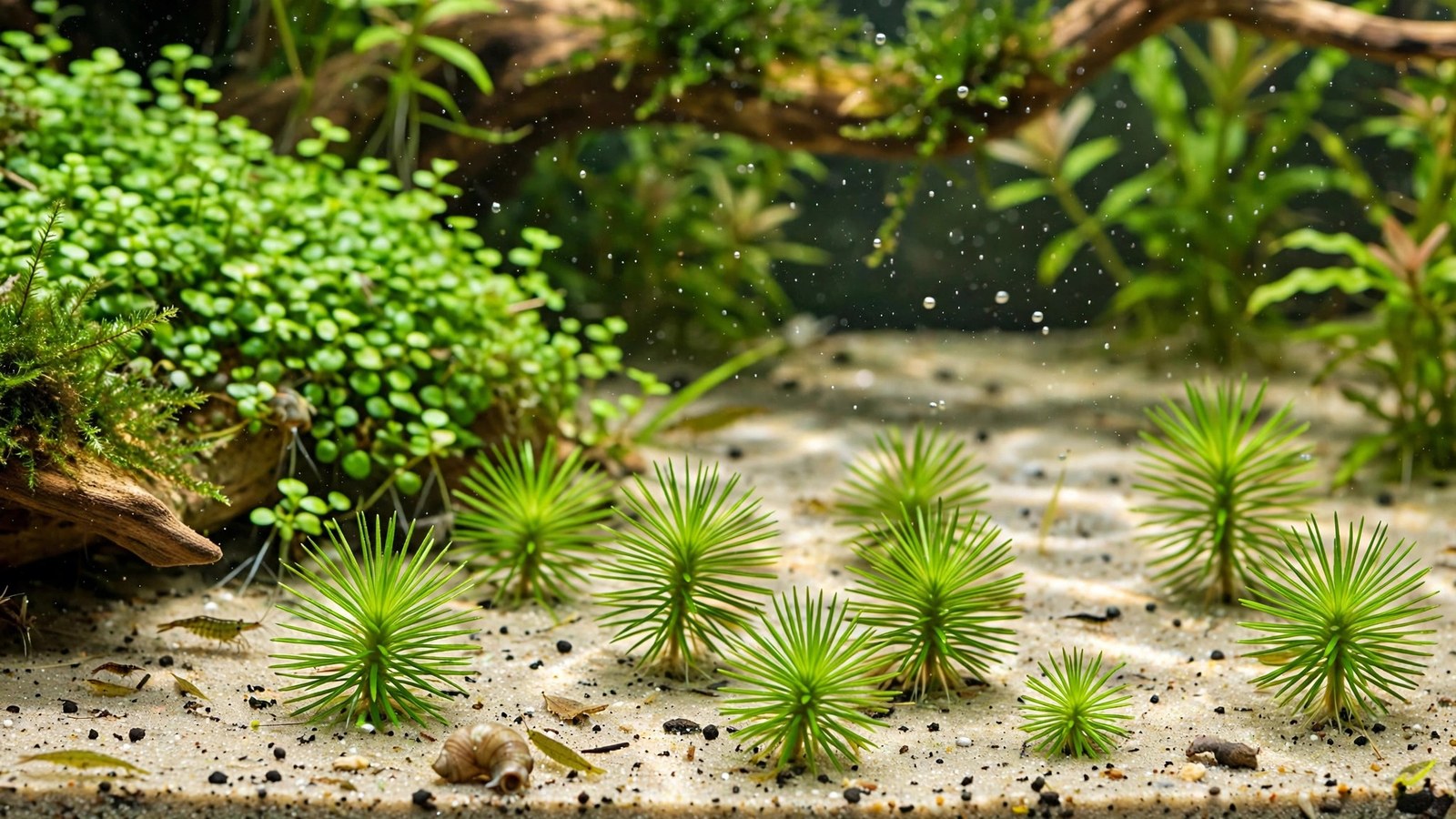
Most hobbyists buy Eriocaulon cinereum because it looks indestructible — a flawless, spiky green rosette on the shop shelf that resembles a miniature sea urchin. They plant it in medium light, skip the CO2, and watch it melt within two weeks. Getting eriocaulon cinereum care right is a firmly high-tech affair: intense light, injected CO2, soft acidic water, and a nutrient-rich substrate are all non-negotiable, and the plant punishes corner-cutting fast.
Eriocaulon Cinereum Care: Light and CO2 Are Non-Negotiable
The single most expensive mistake with this plant is underestimating its light demand. E. cinereum is a shallow-water species that needs 60–100+ PAR at substrate level on an 8–10 hour photoperiod. If you are unsure where your tank sits, read our breakdown of how much light aquarium plants need before you buy the plant — this species is the textbook high-light gate.
Below that threshold it does not adapt — it stalls, stops producing new leaves, and algae colonizes the fine foliage faster than the rosette can outgrow it. Older leaves yellow from the tips inward, and within 10–14 days the crown starts to soften. That is not a plant adjusting; it is a plant dying.
CO2 is equally load-bearing. Target 25–30 ppm with a lime-green drop checker by lights-on — the gas must be saturated before the photoperiod begins, not ramping up mid-morning. Start low and dial up slowly, watching your livestock for gasping — fish and shrimp come before plants. If you have not run pressurized CO2 before, work through our guide to setting up CO2 in a planted tank first. Liquid carbon is not a substitute at this light level.
| Light at substrate | Response |
|---|---|
| High (60–100+ PAR) | Compact rosette, new leaves weekly, golden center |
| Medium (~30–50 PAR) | Stalls, elongated leaves, no visible growth |
| Low (under 30 PAR) | Algae takeover, crown rot, melt within 2–4 weeks |
Water Chemistry and Temperature
E. cinereum prefers soft, slightly acidic water: pH 5.0–7.0 with 5.5–6.8 as the sweet spot, and general hardness between 3 and 8 dGH. It tolerates medium-hard water better than most Eriocaulon species.
What it does not tolerate is instability. Sudden swings in pH, hardness, or temperature trigger crown melt in otherwise healthy tanks — a large water change with mismatched parameters can collapse a rosette overnight. Match replacement water to tank temperature and drip-acclimate new plants for 30–60 minutes.
Temperature is forgiving: 18–28°C, with 22–26°C producing the best growth. Weekly water changes of 30–50 percent keep organics low — detritus settling into the rosette crown is a fast route to rot.
Planting, Substrate, and What to Buy
Buy Tropica's 1-2-Grow! tissue-culture cup (TR-091-TC): in-vitro, pest-free, snail-free, shrimp-safe, and already in submerged form. Tropica's official plant page for Eriocaulon cinereum rates it high for light and CO2 — trust that rating. Genuine buying advice: grab the cup and a pack of root tabs together — the tabs are how a budget substrate feeds this slow grower, and the sterile format suits sensitive shrimp tanks per Garnelenhaus's 1-2-Grow! care notes.
Planting: rinse the gel off, divide the cup into 4–6 portions, and plant each 2–3 cm apart with fine tweezers, roots in and crown just above the substrate — a buried crown rots within days. As a heavy root feeder and slow grower, deficiencies show as chronic stunting rather than fast yellowing.
| Substrate | Verdict | Notes |
|---|---|---|
| Nutrient-rich aquasoil | Best | Feeds roots 6–12 months; buffers pH downward |
| Inert sand + root tabs | Good budget route | One tab per cluster; replace every 6–8 weeks |
| Coarse gravel, no tabs | Poor | Compacts and starves a slow feeder — expect stunting |
For aquascaping, it pairs well with fine-textured midground plants such as Cyperus helferi, whose grass-like leaves echo the rosette's fine texture without competing for the same light zone. If the high-tech demands feel like too much, Helanthium tenellum is a far more forgiving foreground with a similar carpeted look in medium light.
Trimming Flower Stalks and Dividing Offshoots
Under good conditions E. cinereum sends up delicate flower stalks 5–10 cm tall with button-like flowers — a sign of a thriving plant. The catch: flowering drains the rosette's energy, and heavy-flowering plants sometimes die back afterward. Snip stalks at the base with sharp, sterilized scissors as soon as they appear.
Propagation is by division. A healthy rosette produces daughter plants at its base; wait until the offshoot has 6–8 leaves, then separate it with a clean scissor cut and replant 2–3 cm away. Do not tear them apart — the shared base tears easily and wounds invite rot. Divide every 8–12 weeks.
Trim dead or algae-coated outer leaves back to the crown at any time, removing only clearly damaged leaves — never cut the growing tip. The technique transfers: once you can split E. cinereum cleanly, Murdannia keisak and similar rosettes divide the same way.
Troubleshooting: Why Your Rosette Is Melting
Melting almost always traces to one of four causes, in this order: insufficient light, inconsistent CO2, a sudden parameter swing, or a buried crown. Check light first — PAR under 50 at substrate is the number-one killer — then confirm the drop checker is lime-green by lights-on, not an hour after.
If light and CO2 check out, look at the timeline. Melt 24–72 hours after a large water change points to a parameter swing; melt over 3–4 weeks points to chronic deficiency — usually CO2 or substrate nutrition. Tissue-culture plants often look stressed for the first 5–7 days, so give them a week before diagnosing.
Recovery is possible if the crown is still firm: fix the cause, trim the mush, and the center pushes new leaves within 2–3 weeks. A soft, fully discolored crown is done — remove it before it fouls the water. For a similar sculptural accent that forgives minor CO2 lapses, Rotala indica bonsai handles the same high-tech conditions with slightly more tolerance.
Frequently Asked Questions
Can Eriocaulon cinereum grow without CO2?
No. This is one of the clearest CO2-obligate foreground plants in the hobby. Without 25–30 ppm of injected CO2 it stalls within weeks and melts, even under strong light. Liquid carbon cannot deliver the stable dissolved levels a slow rosette needs — pressurized CO2 is the only reliable route.
Why is my Eriocaulon cinereum turning brown and mushy?
Brown, translucent leaves that disintegrate at a touch usually mean the crown is rotting from one of four causes: light below ~50 PAR, inconsistent CO2, a sudden pH or hardness swing, or a buried crown. Fix the cause first, then trim damaged leaves back to firm tissue — a firm crown regrows in 2–3 weeks.
Should I cut the flower stalks?
If health matters more than display, yes — snip them at the base as soon as they appear. Flowering diverts energy from the rosette and heavy-flowering plants sometimes die back afterward. If the plant is thriving and you enjoy the look, leaving one or two up is a fine middle ground.
What substrate is best for Eriocaulon cinereum?
Nutrient-rich aquasoil is best — it feeds the heavy root system for 6–12 months and buffers pH into the plant's preferred range. Inert sand works with a root tab under each cluster, replaced every 6–8 weeks. Avoid coarse gravel without supplementation; it starves this slow feeder.
How fast does Eriocaulon cinereum grow?
Slowly: a few new leaves per week, reaching 3–7 cm over 2–3 months. The payoff is that it rarely needs trimming and holds its shape for months. Divide daughter rosettes every 8–12 weeks if you want the cluster to spread into a carpet.
Is It Worth the Effort?
E. cinereum is not a beginner plant, and it should never be sold as one. But with high light, pressurized CO2, soft water, and rich substrate, it repays the setup: a tight sea-urchin rosette with a golden-green heart.