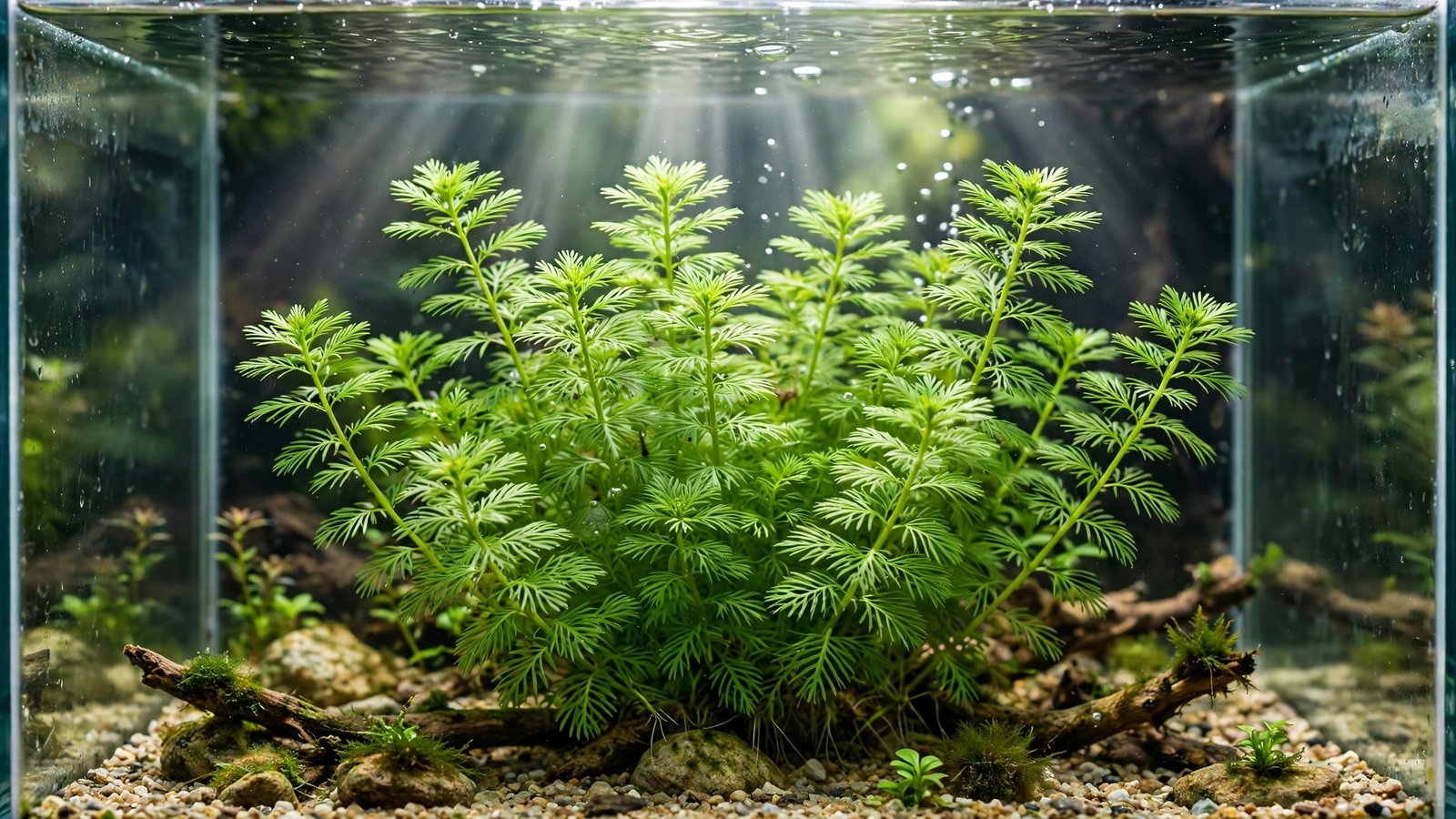
The number one way hobbyists kill Hottonia palustris has nothing to do with light, fertilizer, or algae. They buy a pot of lush emersed stock, plant it deep in the substrate on day one, and watch the whole stem melt within a week. Hottonia palustris care starts with understanding what this plant actually is: a bog plant of European marshes that has to learn to live underwater.
Meet the water violet
Hottonia palustris is native to shallow waters, ditches, and marshes across Europe and northern Asia. In the wild it spends part of its life with leaves above the waterline — which is why nursery pots look so different from the submerged aquarium form. Emersed leaves are thicker and waxy; submerged leaves are soft, deeply divided like the teeth of a double comb, and arranged in whorls along stems that can reach 80 cm.
That double life is the plant's superpower and its trap. The trap is the melt described above. The superpower is adaptability: few stem plants move between pond margins, coldwater tanks, and warm tropical setups as willingly.
Hottonia palustris care: the staged submersion method
When your pot arrives, rinse the nursery medium off gently and separate the stems. Instead of planting them at final depth, set them in 5–10 cm of water with the lower stems in substrate and the tops near the surface — a breeder box or shallow container inside the tank works well.
Over the next 2–3 weeks the plant sheds its emersed leaves and pushes soft, feathery submerged growth from the stem nodes. Move stems to their final position only once you see at least 10 cm of new submerged foliage and fresh white roots.
Expect the transition to look ugly — yellowing, dropping leaves are normal shedding, not dying. Worry only if the stems themselves turn mushy and translucent: that means the planting was too deep or the water is stagnant.
Aquarium conditions that work
Hottonia is happiest in cool water — 15–20°C is its sweet spot — which makes it a standout for unheated tanks and temperate setups where tropical stems sulk. It tolerates typical tropical temperatures into the mid-20s, though growth gets leggier and algae gains an edge as heat rises.
Light should be medium: roughly 6–8 hours daily at moderate intensity. A nutrient-rich substrate matters more than raw light — Hottonia feeds heavily through its roots, so aquasoil or a good base layer under sand pays off. Dose the water column sparingly; read up on whether aquarium plants really need fertilizer first, because in a cool, slow-growing tank you need far less than the label suggests.
CO2 is a genuine bonus, not a requirement. Injected CO2 thickens the whorls and speeds up the transition from emersed stock, but in a low-tech setup the plant still grows — just slowly, which makes it a natural fit for a low-tech planted tank setup rather than a high-energy CO2 system.
Pond planting: shallow first, deep later
Plant it in a basket of heavy loam with the crown about 5 cm below the surface and let it establish through spring. Once rooted and growing strongly, you can lower the basket to 30–60 cm — established plants handle real depth, young ones do not.
In the pond it pulls double duty: submerged foliage oxygenates the water, and dense whorls shelter newts, tadpoles, and fish fry. In May and June, cool ponds often trigger the plant's party trick — slender stalks rising above the surface carrying pale pink to violet flowers, the reason for the "water violet" name.
| Setup | Aquarium | Pond |
|---|---|---|
| Planting depth (new stock) | Shallow container, 5–10 cm | Basket at ~5 cm below surface |
| Final depth | Any, once transitioned | Up to 60 cm once established |
| Temperature | 15–20°C ideal, tolerates 22–26°C | Temperate outdoors, overwinters dormant |
| Light | Medium, 6–8 hrs/day | Full sun to part shade |
| Substrate | Nutrient-rich aquasoil or capped soil | Heavy loam in a planting basket |
| Flowering | Rare indoors | Pale pink/violet, May–June |
Growth, trimming, and tankmates
Hottonia grows slowly — a few centimeters a month in a cool low-tech tank — which is a feature, not a bug. It rarely outgrows its space. To trim, snip the top 10–15 cm of a stem and replant the cutting; the remaining base usually branches into two new tips.
As a companion it pairs naturally with other easy cool-water stems. Try it alongside hornwort for a layered oxygenator effect, or behind the faster, bushier Limnophila sessiliflora so the featherfoil foliage contrasts against bolder leaves. Water wisteria is another forgiving stem that shares its taste for moderate light.
One caution for warm tanks: above about 26°C the plant's metabolism outruns what its fine leaves can sustain, and melting from the base upward is common. If your tropical tank runs hot, choose a true tropical stem like Rotala rotundifolia for the aquarium and save Hottonia for the pond.
What healthy nursery stock looks like
True Hottonia palustris is sold by aquatic and pond nurseries, usually in 9 cm pots or pond baskets. Healthy emersed stock has firm, upright stems with intact whorled leaves — avoid pots where the lower stems are already brown and soft, since those will not recover after submersion.
Buy from a nursery that grows it as an aquatic or marginal plant rather than a generic garden center. Aquatic specialists ship it with the roots protected, and their staff can usually tell you whether the batch was grown emersed or submerged — that one detail tells you how gradual your transition needs to be.
Frequently Asked Questions
Why is my Hottonia palustris melting after planting?
Almost certainly because it was emersed-grown stock planted straight into deep water: the air-grown leaves cannot survive submerged and the stem rots. Remove the mushy portions, replant the firm stems in 5–10 cm of water, and let new submerged leaves form over 2–3 weeks before moving them deeper.
Can Hottonia palustris grow in a tropical aquarium?
Yes, it tolerates typical tropical temperatures into the mid-20s°C, though its ideal range is 15–20°C. In warmer tanks growth becomes leggier and base-melt is more likely, so give it the coolest, best-circulated spot and moderate your expectations — or keep it in a temperate tank where it truly thrives.
Does Hottonia palustris need CO2?
No. CO2 speeds up the emersed-to-submerged transition and produces denser whorls, but the plant grows fine without it in a low-tech setup with medium light and a nutrient-rich substrate. Because it is a slow grower, its CO2 demand is modest compared with fast stems.
How deep can I plant Hottonia in a pond?
Start new plants shallow, with the crown about 5 cm below the surface in a basket of heavy loam. Once established and growing strongly through spring, established plants tolerate depths up to 60 cm. Moving a young plant deep too soon usually rots the crown.
Will Hottonia palustris flower in my aquarium?
Rarely. The pale pink-violet flowers appear May–June on stalks that rise above the water, which needs a cool pond or paludarium with an exposed surface. In a fully submerged aquarium, flowering essentially never happens — grow it for the foliage.
Is Hottonia palustris good for fry and shrimp?
Yes, it is one of the better shelter plants. The dense, finely divided submerged leaves give fry and shrimplets endless hiding spots from larger tankmates, and as a strong oxygenator it helps keep water quality stable in breeding and grow-out tanks.
The bottom line
Hottonia palustris asks for one thing most aquarium plants do not: a patient, staged introduction to life underwater. Respect its bog-plant origins, give it cool water, medium light, and a real substrate, and it repays you with some of the finest foliage in the hobby. For the botanical background, the Hottonia palustris Wikipedia entry covers its native range and family, and the RHS Hottonia palustris plant profile is a solid reference for pond cultivation.