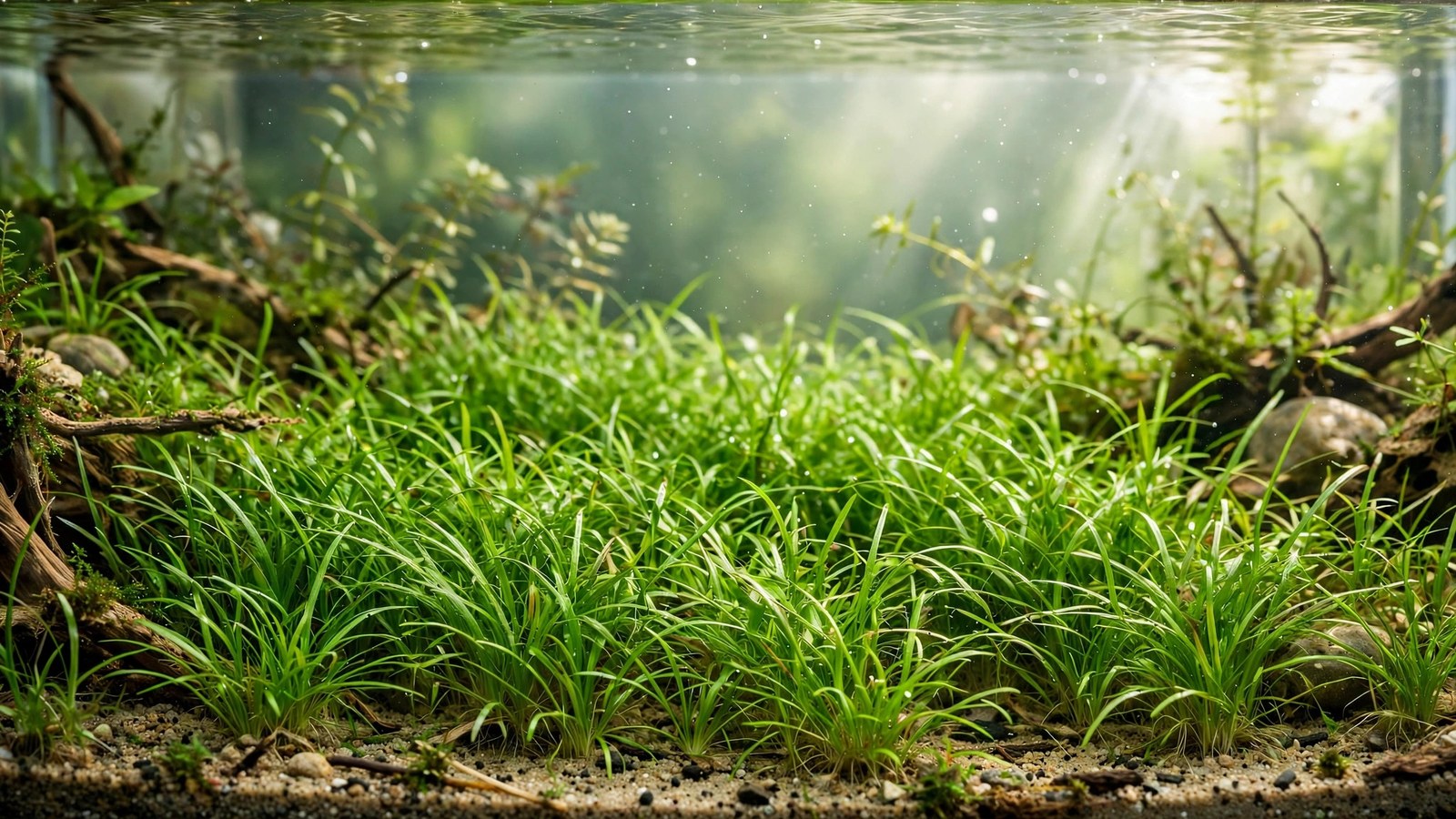
Here is the mistake that kills most pygmy chain sword carpets before they ever start: people plant Helanthium tenellum in low light and watch it grow into a 15-cm-tall grassy tuft — the exact opposite of the tight foreground carpet they saw in the shop. This little rosette plant only behaves itself when it gets the light, substrate, and spacing it needs. Get those three right, and you'll have a lush lawn of fine, runner-spread blades in eight to ten weeks.
What makes pygmy chain sword different
If you've bought this plant before, you may know it as Echinodorus tenellus — that was its old botanical name before taxonomists moved it into the Helanthium genus. Nurseries and older forum posts still use the old name, so check both when you shop: you want the same plant either way — the Tropica plant database lists it under its current name with full cultivation data. Either name, you're dealing with a true rosette plant — every leaf grows from a single basal point — with narrow, grass-like blades about 2–3 mm wide.
It carpets by sending out runners (stolons): thin horizontal stems that creep along the substrate and sprout a new baby plant at each node — a different mechanism from the creeping rhizomes of carpets like marsilea hirsuta. This is exactly how chain swords spread in nature, and it's why the plant is so forgiving of clumsy planting — even a few survivors will re-colonize bare patches on their own. The trade-off is patience: runners only move 2–4 cm per week once the plant is settled, so a carpet planted sparsely needs two to three months to knit closed.
Two commercially available variants share this behavior: 'Green', the classic bright-green form, and 'Red', which develops coppery-red blades under strong light. They are the same species and want the same treatment, but the red form is pickier about keeping its color — under medium light it fades to olive-green, so plan on 50+ PAR and lean, stable nutrients if you choose it.
How to plant it for a real carpet
The single most important step is spacing. A pot of pygmy chain sword arrives as a dense clump, and planting the whole clump in one hole gives you a slow-spreading grass tuft, not a carpet. Split it into individual rosettes or pairs — you'll typically get 15–25 plantlets per pot — and push each one into the substrate so the crown sits just above the surface. Burying the crown rots it; floating it loose means it drifts and never roots.
- Prepare fine substrate. Runners slide easily through fine sand or nutrient-rich aquasoil — the same fine bed that dwarf hairgrass demands works perfectly here. Coarse gravel wider than 5 mm catches runners above the surface and slows the carpet dramatically.
- Feed the roots. Press a root tab every 8–10 cm under the planting zone. This plant pulls most of its nutrition from the substrate, and a bare sand bed runs out of steam in about a month.
- Space 2–3 cm apart. Use tweezers, plant at a slight angle, and don't worry if some leaves fold — the plant will re-orient itself.
- Flood and wait. Keep light at medium intensity for the first two weeks; blasting high light on a newly planted carpet just grows algae on struggling plants.
Planting runners requires tweezers; the section walks through the planting technique: a proper aquascaping tool kit.
Light: the one variable that decides everything
Light doesn't just control growth speed here — it controls shape. Under medium light (roughly 30–50 PAR at the substrate), blades stay 3–5 cm tall and runners spread horizontally: the lawn look. Under low light, the plant stretches upward toward the light source, blades reach 10–15 cm, and runners slow down. You can't fix a tall, thin stand with fertilizer or CO2; only more light makes it carpet again.
| Light level | Height | Runner spread | Verdict |
|---|---|---|---|
| Low (<25 PAR) | 10–15 cm | Slow, sparse | Not a carpet — looks like tall grass |
| Medium (30–50 PAR) | 3–6 cm | 2–4 cm/week | Ideal for 'Green'; carpets in 8–10 weeks |
| High (50+ PAR) | 2–4 cm | Fast | Required for the 'Red' variant's color |
If you're setting up lighting from scratch, match your photoperiod to a consistent 6–8 hour day rather than a long dim one. Short, bright days grow the plant harder than long, dim days do, and they give algae less time to colonize the slow starters. High-light carpets like glossostigma demand more light and attention than this, but pygmy chain sword is happy right in the medium band. If you've added CO2 injection, the same rule holds — CO2 speeds the carpet and deepens the green, but it won't flatten a low-light stand on its own.
Trimming: mow it like a lawn
Once blades reach 3–4 cm tall, give the carpet a haircut with curved aquascaping scissors, trimming everything down to about 2 cm. This "mowing" does two things at once: it evens out the canopy so light reaches the lower runners, and it signals the plant to redirect energy into horizontal runner production instead of vertical leaves. Your carpet will look ragged for a week — that is normal. Within ten days, fresh blades push through denser than before.
Mow every three to four weeks once the carpet is established — the same mowing approach keeps Monte Carlo carpets dense too. Skip trimming and the older blades shade out the runners, which stalls the spread and leaves you with a thin, see-through lawn. Old, algae-speckled leaves don't recover — cut them off at the base rather than waiting for them to improve.
Emersed vs submerged growth
This plant has two distinct looks. Grown emersed (out of water, as nurseries sell it — dwarf hairgrass arrives this way too), leaves are shorter, broader, and waxy, and the plant often carries tiny flower stalks. Submerged leaves are longer, finer, and softer. Almost every pot you buy is emersed-grown, which is why the first two weeks after planting look like a disaster: the waxy emersed leaves melt away. Don't panic and don't rip it out — the roots are fine, and new submerged-form leaves start emerging from the crown within days of the melt.
If you buy tissue-culture cups instead of potted plants, you skip most of this transition: tissue cultures are already adapted to wet conditions and show almost no melt. They cost more per plant, but for a carpet that fills in visibly faster with less algae risk on dying leaves, many aquascapers consider them worth it.
Common problems (and fixes)
Melting right after planting. The most reported "problem" is actually the emersed-to-submerged transition described above. Leave the roots alone; trim away fully dissolved leaves so they don't fuel algae. New growth within two weeks means the plant is fine.
Algae on a slow starter. New carpets grow slowly for the first month, which gives thread and diatom algae a foothold on the short blades. Reduce light intensity 10–15%, keep the photoperiod at 6 hours until runners are moving, and keep up weekly 30% water changes. Spot-dose liquid carbon (follow the bottle's dosing exactly) on algae patches if you don't run pressurized CO2.
Carpet grows up, not out. Tall blades with slow runners is the classic low-light signature. Raise light intensity or shorten the distance to the light — don't reach for fertilizer, which feeds the algae instead.
Pale or yellowing leaves. Usually a root-feeding problem: the substrate is depleted. Push a fresh root tab within 5 cm of the pale zone and watch the new blades come in greener within a week.
Pygmy chain sword vs dwarf sagittaria
These two are the classic foreground-carpet decision, and they solve different problems. Dwarf sagittaria grows taller (up to 15 cm even in decent light) and spreads faster, making it a better midground edging plant, while pygmy chain sword stays reliably under 8 cm and gives a finer, grass-lawn texture. If you want a tight low lawn in front and a taller transition behind it, plant Helanthium tenellum in the foreground and dwarf sagittaria just behind — the height step reads beautifully and both spread by runners without fuss.
For other fine-textured options in the same niche, dwarf hairgrass demands more CO2 and light to carpet well, Monte Carlo gives a leafy round-leaf carpet instead of the grass-blade look, and marsilea hirsuta offers a clover-like texture for a completely different foreground. Pygmy chain sword sits in the middle: easier than both, with a texture no other rosette plant quite matches.
Frequently Asked Questions
Is Echinodorus tenellus the same plant as Helanthium tenellum?
Yes — the same species, renamed. Botanists moved the pygmy chain sword out of the Echinodorus genus into Helanthium based on genetic evidence, and nurseries are slowly catching up. If a shop label says Echinodorus tenellus, you're buying the right plant; the care requirements are identical. When researching older forum threads, search both names or you'll miss half the advice.
How long does it take to form a carpet?
From sparse 2–3 cm spacing in medium light with CO2, expect a closed carpet in about 8–10 weeks. Without CO2, add two to four weeks. The first month looks unimpressive — melting, then thin new blades — and runners only start visibly spreading once the plant has rebuilt its submerged leaves, typically around week three or four. Planting denser from the start is the fastest way to cut the timeline.
Can it grow without CO2?
Yes. Pygmy chain sword is one of the more CO2-optional carpeting plants: it will spread and stay low in medium light without injection, just more slowly. CO2 mainly accelerates the fill-in and deepens the green of the blades. If you're running a low-tech tank, pair it with nutrient-rich substrate and skip the 'Red' variant, which genuinely needs high light and CO2 to hold its color.
Why is my chain sword growing tall instead of carpeting?
Low light, almost always. In dim conditions the plant stretches upward to reach the light, blades can hit 10–15 cm, and runner production stalls. Raise the light intensity to at least 30 PAR at the substrate level and trim the tall blades down to 2 cm. Within two to three weeks the new growth comes in shorter and runners resume spreading horizontally.
Should I get the 'Green' or the 'Red' variant?
Choose 'Green' unless your tank runs high light (50+ PAR) with stable CO2. The green form carpets reliably in medium light and low-tech setups. The 'Red' variant needs that stronger light to stay red — in medium light it fades to olive and looks unhealthy, which leads many aquarists to misdiagnose a lighting problem as a nutrient deficiency. Same planting and trimming rules for both.
Will it survive a pH crash or soft-water tank?
It's fairly tolerant of soft, slightly acidic water, which is why it shows up in shrimp and soft-water community tanks. But a sudden pH crash from exhausted aquasoil or neglected water changes will melt it like any other plant. Keep carbonate hardness above 3 dKH and water changes weekly, and treat crashes as a water-chemistry problem first, not a plant problem.
Bottom line
Pygmy chain sword rewards exactly three things: medium light, root-zone nutrition, and the discipline to split the clump and plant it sparse. Everything else — CO2, fancy trimming tools, the dry start — is acceleration on top of that foundation. Plant it this weekend at 2–3 cm spacing with fresh root tabs, and by the end of the year you'll be mowing a lawn your fish can swim over.