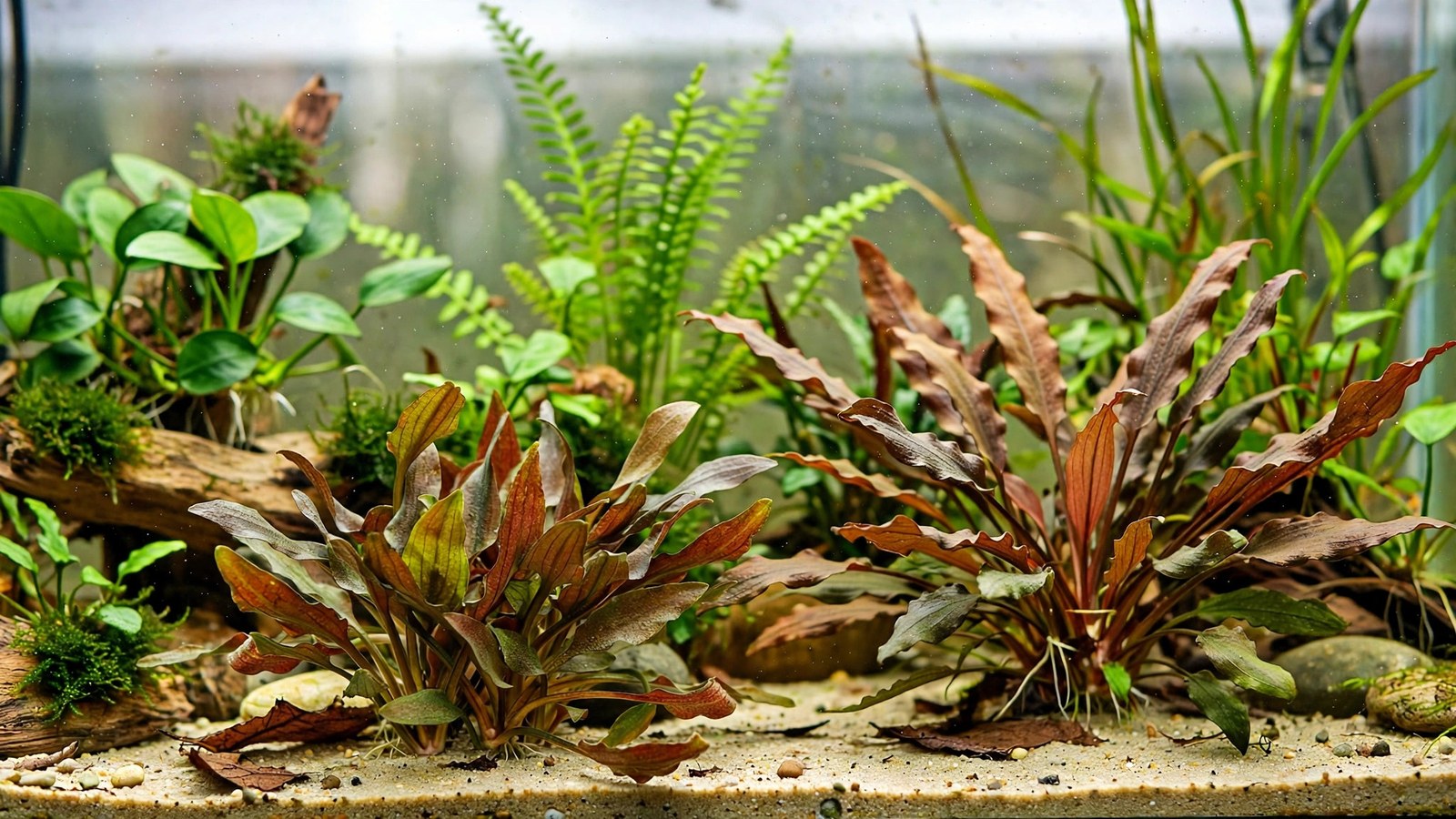
Most beginner crypts punish the tiniest mistake: a cool water change, a curious nudge, and they melt to mush overnight. Walkeri doesn't. This bronze-leaved Sri Lankan native grows quietly in a basic low-tech setup, which is why cryptocoryne walkeri care keeps appearing on every "easiest crypts" list worth reading. This guide covers planting, root feeding, runner propagation, and — most usefully — how to buy the right plant when every shop labels it something different.
Pair it with the other low-drama species in our roundup of the easiest aquarium plants for a beginner community tank and you'll have a scape that mostly takes care of itself.
Why This Bronze Crypt Is a Beginner Staple
Walkeri earns its reputation by being boring in the best sense. Where fussy crypts stall and melt at the first parameter wobble, walkeri keeps growing through a young tank's rough patches. Its lance-shaped leaves shift between green and warm bronze depending on light and iron, so one cluster gives you two colors for zero effort. Under stronger light the bronze deepens; under a stock kit LED it stays a pleasant olive-green.
Its quiet superpower is predictable size. Walkeri grows to 10–15 cm with an 8 cm rosette spread and then largely stops — what you plant in the midground stays a midground plant. Compare sizing options in our complete freshwater aquarium plants guide before you lay out the tank.
Cryptocoryne Walkeri Care in a Low-Tech Tank
Walkeri care is mostly restraint: a stable home, fed roots, and being left alone. Stock-LED lighting is enough. CO2 is not required — it only makes growth faster and denser. Temperature anywhere in the normal tropical range (22–28 °C) works.
Hard water is where walkeri outshines its relatives. Many crypts are soft-water specialists; walkeri evolved in fast-flowing limestone streams, so it tolerates pH 5.5–8.0 in soft or hard water. If hard tap water makes wendtii unhappy, try walkeri — our Cryptocoryne wendtii care guide covers the comparison.
The genuine need is nutrition at the roots: nitrogen, phosphate, iron, and calcium. Aquarium soil plus ordinary column dosing is enough; in inert sand or gravel, push a root tab under each cluster every two to three months. Yellowing older leaves is the classic "feed my roots" signal — a fresh tab usually greens new growth within two to three weeks.
Planting and Runner Propagation
Plant walkeri like you mean it to stay — because you do. Wash potted plants free of rockwool (rinse gel from tissue-culture cups), push roots deep with pinsettes, and keep the crown just above the substrate surface; buried crowns rot. Then commit to the spot: crypts strongly object to relocation, and moving an established walkeri is the fastest way to trigger melt.
Space plants about an inch apart for quick coverage. Walkeri spreads by runners, sending offshoots along the substrate that become daughter plants — one cluster can become a drift of a dozen rosettes in a few months. To propagate, wait until a daughter has five or six leaves, sever the runner, and replant. Large clusters can also be split at the rhizome, roots and leaves to each piece.
Melting Without Panic
Walkeri melts less than most crypts, but "less" isn't "never." Emersed-grown stock often sheds original leaves in the first two to four weeks; sudden parameter swings can do the same to established plants. As long as roots and rhizome are firm, don't throw it away — new submersed leaves emerge from the center within weeks once things stabilize.
Buy the Right Plant: Walkeri, Lutea, 'Hobbit', and Legroi
Cryptocoryne lutea is a taxonomic synonym of Cryptocoryne walkeri — botanically the same species. In the trade, though, four labels behave slightly differently:
| Label | Height | Best use |
|---|---|---|
| Walkeri (standard) | 10–15 cm | Midground rosette cluster |
| 'Lutea' (standard) | 10–15 cm | Same species, same job as standard walkeri |
| 'Legroi' | ~10 cm | Compact midground form |
| 'Lutea Hobbit' | ~5 cm | Foreground or nano tanks; very slow growing |
For midground planting, the first three are interchangeable — buy the healthiest specimen with firm roots. 'Hobbit' is the genuinely different one: a dwarf form selected from a standard plant and lab-propagated, reaching just a few centimeters and coloring a deep purplish-brown under good light. Want the classic beginner midground crypt? Take any of the other three. For a trickier same-genus option, see our Cryptocoryne beckettii care guide, or compare the tiny foreground specialist in our Cryptocoryne parva care guide.
Frequently Asked Questions
Does Cryptocoryne walkeri need CO2?
No. Low to moderate light and a fed substrate are enough for long-term health. CO2 is an accelerator, not a requirement — with it the plant grows faster, denser, and more bronze. Without it, expect steady new leaves every few weeks rather than rapid bushy growth.
How long does walkeri take to establish?
Allow three to six weeks after planting, especially for emersed-grown stock, which may shed original leaves while converting to submersed growth. Once new leaves emerge from the crown, it's established. Runner offshoots typically appear within two to four months in healthy conditions.
Is Cryptocoryne lutea the same as walkeri?
Yes — C. lutea is a taxonomic synonym of C. walkeri, so standard 'Lutea' is the same plant. The variants that differ are 'Legroi' (compact, ~10 cm) and 'Lutea Hobbit' (dwarf, ~5 cm, very slow). For midground planting, any label except 'Hobbit' is interchangeable.
Why are my walkeri leaves turning yellow?
Yellowing older leaves usually means hungry roots — push a root tab under the cluster and keep water-column dosing consistent. New growth should come in green within two to three weeks. If new leaves yellow too, check iron, since the bronze coloration depends on it.
Can walkeri grow in sand or gravel?
Yes, with help. Inert substrates hold no nutrients, so bury a root tab under each plant and replace it every two to three months, placed slightly below and beside the crown so spreading roots find it. Active aquarium soil is easier, but disciplined root tabs in sand work fine.
How do I make walkeri more bronze?
Stronger (moderate) light, available iron, and CO2 intensify the bronze — in that order. But don't blast it with light to force color: too much light without balanced nutrition invites algae on slow-growing leaves. Patience delivers the bronze within a month or two.
The Honest Bottom Line
Walkeri is the crypt you buy when you want a crypt that behaves — the one still standing, bronze and unbothered, where fancier crypts melted months ago. Plant it permanently, feed its roots, and buy the right form for the job. For the trade profile, see Buce Plant's Cryptocoryne walkeri plant profile, and the Cryptocoryne walkeri entry on Wikipedia confirms the lutea synonymy.