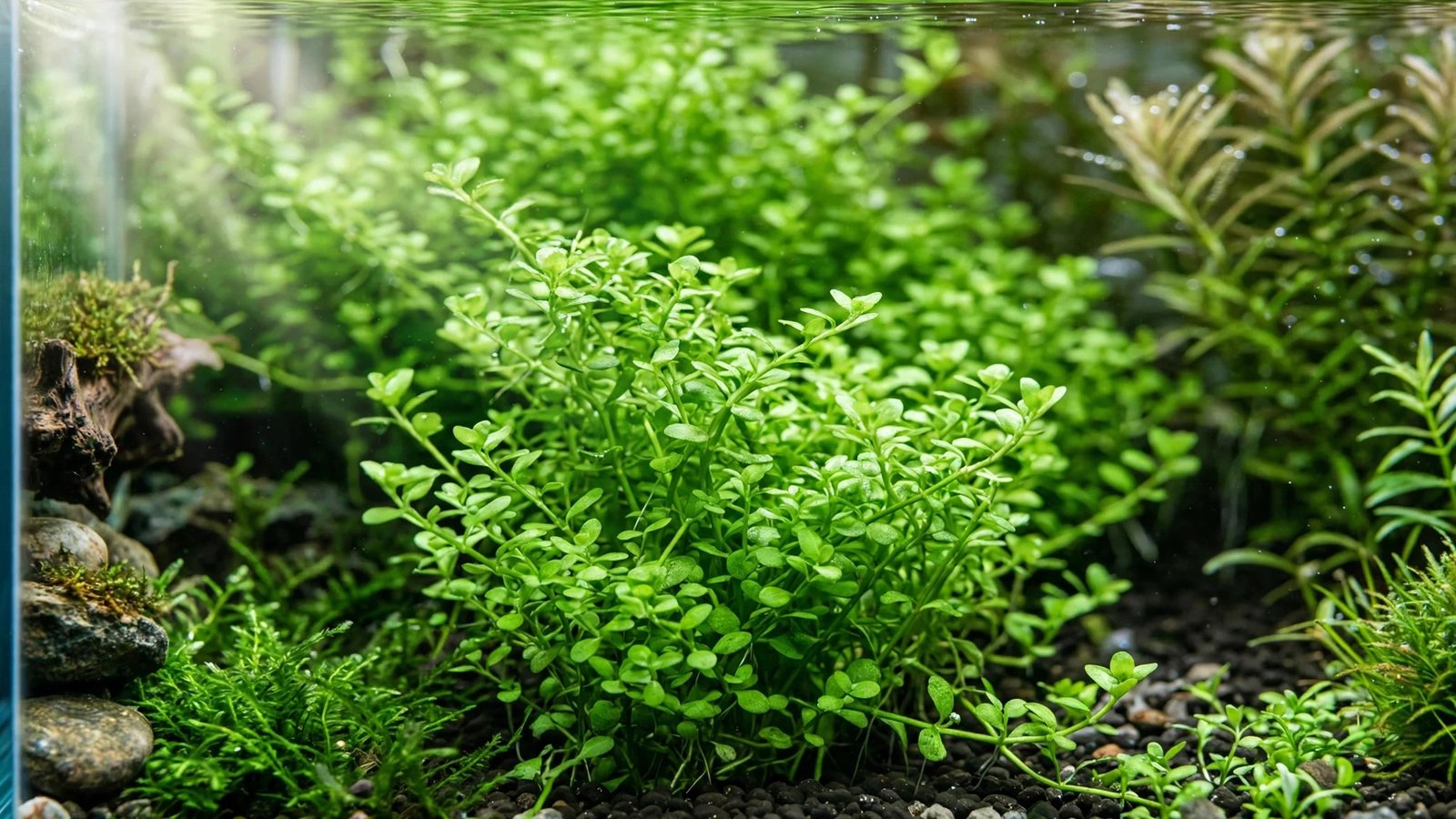
Carpet, bush, or floater — you choose, because this plant does all three. Pearl weed care is about managing versatility: Hemianthus micranthemoides (the plant sold as pearl weed, though its taxonomy is debated) grows as a creeping foreground carpet, a trimmed midground bush, or a floating mass, adapting its form to how you treat it. It's fast, forgiving, and one of the most useful all-rounders in the hobby.
This guide covers pearl weed's three growth styles, planting technique, light and CO2 needs, trimming strategies for each form, propagation, and troubleshooting common issues.
Quick Care Reference
| Parameter | Requirement |
|---|---|
| Light | Medium to high (40+ PAR; carpets need 60+) |
| CO2 | Helpful; carpets establish much faster with it |
| Growth rate | Fast |
| Placement | Foreground (carpet), midground (bush), or floating |
| Difficulty | Easy to moderate |
| Temperature | 68–82°F (20–28°C) |
| pH | 5.5–7.5 |
| Height | 1–8 inches depending on trimming (2–20 cm) |
One Plant, Three Personalities
Pearl weed's claim to fame is morphological flexibility. Left alone, it grows upright into a bushy midground plant 4–8 inches tall with small round leaves on branching stems. Trimmed short and often, it creeps along the substrate as a bright green carpet — less demanding than HC Cuba but with a similar effect. Floated, it forms a trailing mass with roots dangling, beloved by shrimp and fry.
A note on naming: the plant sold as "pearl weed" is usually labeled Hemianthus micranthemoides, though botanists have questioned whether the aquarium plant matches the true species. For hobby purposes the name is stable — every seller and grower means the same plant — so don't let the taxonomy debate affect your purchase.
Planting Pearl Weed
You'll usually buy it as bunches or tissue-culture cups. For a carpet, separate into small portions of 3–5 stems and plant them about an inch apart across the target area — pearl weed spreads by creeping runners, so even spacing fills in evenly. For a bush, plant a cluster of stems together in the midground. For floating, just drop it in.
Plant shallow — half an inch to an inch deep. The stems are fine and uproot easily before roots establish, so plant carefully with tweezers and avoid disturbing the area for the first week. Strong flow can uproot new plantings; baffle filters or plant behind hardscape until rooted. It grows in any substrate, but fine-grained aquasoil gives carpets the best grip and nutrition.
Light and CO2
As a bush or floater, medium light (40+ PAR) suffices — pearl weed grows happily and stays bright green. As a carpet, it needs strong light (60+ PAR) reaching the substrate; under dim light, carpet plantings grow upward instead of creeping, defeating the purpose. Eight hours daily is standard.
CO2 is the great accelerator for pearl weed. Without it, growth is steady but slow-ish; with CO2, it becomes one of the fastest small plants available, carpeting in weeks rather than months. For a pearl weed carpet specifically, CO2 is strongly recommended — it's the difference between a project that succeeds in a month and one that frustrates you for half a year. Compare with Monte Carlo, the other forgiving carpet, which follows the same rule.
Fertilizer and Nutrition
Pearl weed is a moderate feeder that takes nutrients from both water and substrate. In carpets, root nutrition matters — aquasoil or root tabs under the planting zone make a real difference. Dose comprehensive liquid fertilizer for the water column, especially in high-tech setups where fast growth depletes nutrients quickly.
Watch for pale new growth (iron deficiency) and general yellowing (nitrogen). Because it grows fast, deficiencies show quickly and correct quickly — one of the advantages of a speedy plant. In low-tech bush form, fish waste plus occasional fertilizer is usually plenty.
Three growth forms all draw from the water column; liquid covers all: a liquid fertilizer like Seachem Flourish.
Trimming: Shaping Each Form
Maintaining a carpet
Shear the top regularly with aquascaping scissors — every 2–3 weeks once established. Regular mowing keeps it low and encourages horizontal spreading; neglected pearl weed carpets grow upward into a shaggy mound. Trim slightly below your target height to account for regrowth.
Shaping a bush
Pinch or trim the tops to encourage branching, shaping it like a hedge. Pearl weed bushes respond well to frequent light trims, developing dense, cloud-like form. It's an excellent midground "filler bush" in nature-style scapes.
Managing floaters
Thin regularly — floating pearl weed multiplies fast and shades everything below. Harvest the excess for other tanks or fellow hobbyists. The dangling roots are prime shrimp habitat; many breeders keep a floating portion permanently for shrimplet shelter.
Propagation
Every cutting roots. Trimmed tops replant easily; carpet runners can be divided and moved. Side shoots root while still attached, so established plantings can be split into portions like sod. Pearl weed is generous — one purchase typically becomes many within a couple of months.
Troubleshooting Common Problems
Carpet growing upward instead of spreading
Insufficient light at the substrate. Increase intensity, ensure taller plants aren't shading the carpet zone, and trim aggressively — cutting the tops forces energy into lateral runners. This is the number one pearl weed carpet failure, and it's always light.
Melting after planting
Emersed-grown or tissue-culture stock melts some leaves while converting — normal for the first 1–2 weeks. Keep it planted, maintain stable conditions, and new submersed growth follows. If melting continues, check for ammonia or major parameter shock.
New plantings uprooting
Fine stems, shallow roots, strong flow — the classic combination. Plant deeper (an inch), use tweezers, reduce flow temporarily, and consider planting into aquasoil rather than coarse gravel, which grips poorly. A week of calm water lets roots anchor.
Algae in the carpet
Carpets trap detritus and grow algae when flow is poor or nutrients are imbalanced. Keep the carpet clean with gentle siphoning during water changes, maintain good flow across it, and don't over-fertilize. Amano shrimp patrol carpets effectively. Compare notes with dwarf hairgrass carpets, which face identical challenges.
Pale or yellow growth
Nutrient deficiency — usually nitrogen in fast-growing high-tech setups, iron if only new growth pales. Increase dosing and judge new growth within a week or two; pearl weed responds fast.
Where Pearl Weed Excels
Pearl weed is the Swiss Army knife of small plants. Use it as: a low-tech-friendly carpet alternative (easier than HC Cuba, faster than Monte Carlo), a midground bush for soft texture, floating fry/shrimp cover, a cycling-tank nutrient sponge, or a "test plant" in new setups — its fast response to conditions tells you quickly whether light and nutrients are right. It pairs well with everything, contrasting nicely with bold plants like Cryptocoryne wendtii or Anubias nana petite on hardscape.
Pearl Weed in Shrimp Tanks
Pearl weed is a shrimp-keeper favorite, and for good reason. Its fine, dense foliage offers enormous surface area for biofilm — the primary food for shrimplets — and its tangled growth gives babies shelter from fish and even from adult shrimp. A floating portion with dangling roots is essentially a shrimp nursery: shrimplets graze the roots constantly. Because pearl weed grows fast without demanding perfect parameters, it suits the stable, low-tech conditions shrimp prefer. Just keep it trimmed so it doesn't overrun a nano tank — in a 5-gallon shrimp cube, a pearl weed bush can become the entire aquascape within two months if neglected.
Frequently Asked Questions
Is pearl weed a good carpet plant?
Yes — it's one of the more forgiving carpet options. It needs strong light at the substrate and regular trimming to stay low, and CO2 dramatically speeds carpeting. It's easier and faster than HC Cuba, with slightly larger leaves and a less manicured look. For a first carpet attempt, it's an excellent choice.
Does pearl weed need CO2?
Not strictly — it grows fine without CO2 as a bush or floater. But CO2 transforms it: growth speed multiplies and carpets establish in weeks instead of months. If you're specifically growing a pearl weed carpet, CO2 is strongly recommended; for bush or floating form, it's optional.
Why is my pearl weed growing tall instead of carpeting?
Not enough light reaching the substrate. Increase intensity, remove shading from taller plants, and trim the tops aggressively to redirect energy into horizontal runners. Carpeting is a light-driven behavior — dim conditions always produce upward growth. Strong light plus regular mowing is the complete formula for a low, dense carpet.
How fast does pearl weed grow?
Fast — especially with CO2, where it can grow an inch or more per week. Even without CO2 it's respectably quick. This speed is why it's great for new tanks and why carpets need trimming every 2–3 weeks once established.
Can pearl weed grow floating?
Yes, and it thrives floating — forming trailing masses with dangling roots that shrimp and fry love. It's a great way to hold trimmings or provide instant cover. Just thin it regularly so it doesn't shade the tank. It ranks among the most adaptable small plants you can keep.
Pearl weed vs Monte Carlo — which carpet is easier?
Both are forgiving, but pearl weed is faster and more adaptable — it also works as a bush and floater, while Monte Carlo is carpet-or-nothing. Monte Carlo gives a neater, lower carpet with rounder leaves; pearl weed gives a slightly wilder, taller carpet faster. Beginners often succeed sooner with pearl weed.
Bringing It All Together
Pearl weed earns its place in every hobbyist's toolkit: a carpet when you mow it, a bush when you don't, a floater when you need one — fast, bright, and forgiving in all three roles. Plant it with intent, trim it with discipline, and it becomes whatever your scape needs. Few plants offer this much flexibility for this little effort.