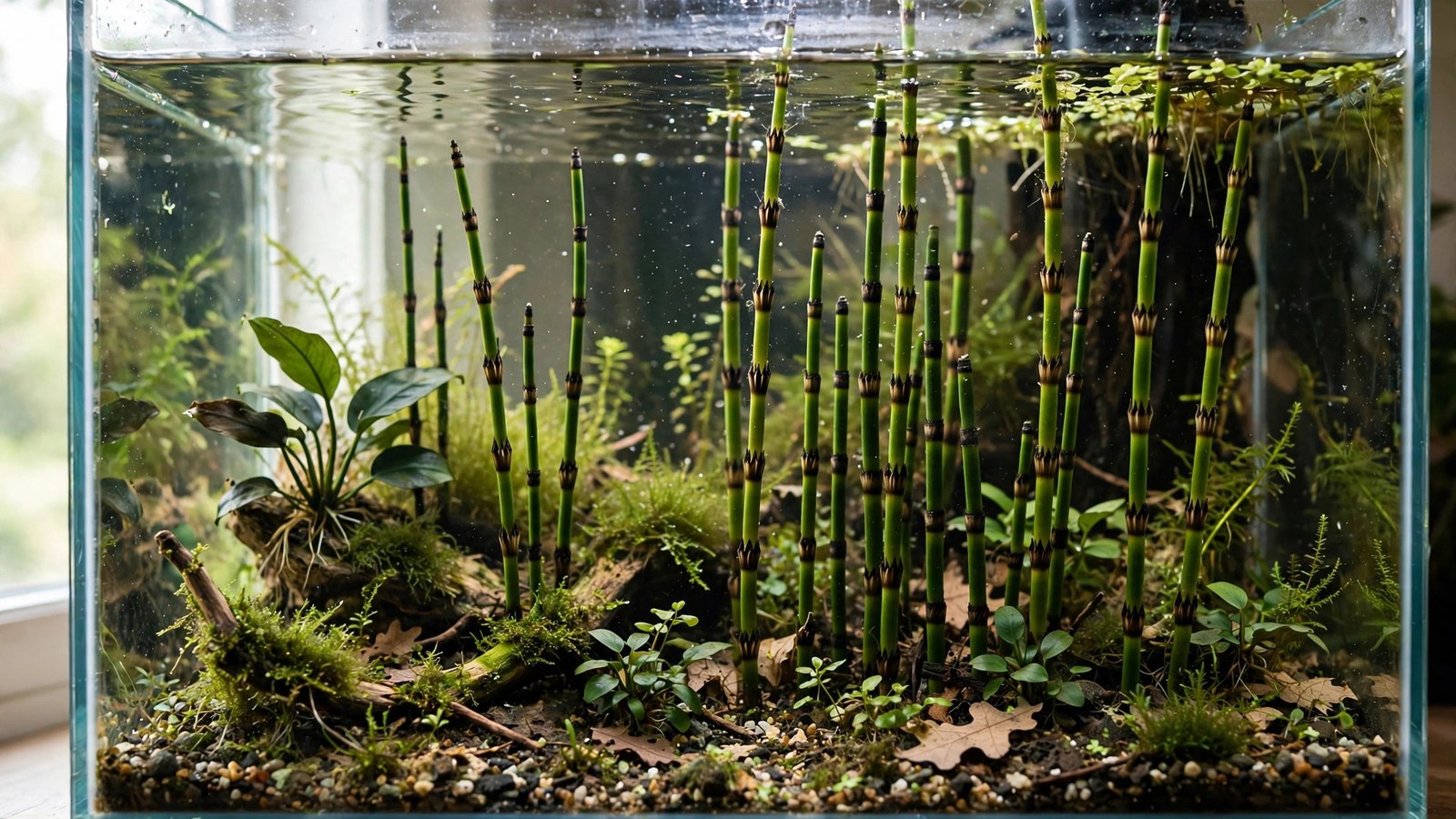
Hundreds of aquarists have watched their "aquatic" horsetail rush melt into a soggy brown stump. If you are asking whether you can grow Equisetum hyemale aquarium style, fully underwater: it excels in paludariums, open-top emergent setups, and ripariums — but fails when kept permanently submerged.
Here is the good news: used the way nature intended, horsetail rush is one of the most striking vertical accents for an open-top aquarium. Read on to see it alongside the best background plants for tall aquariums, then learn how to plant and contain it.
Why Horsetail Rush Fools Aquarium Keepers
Horsetail rush looks designed for a planted tank: segmented stems rise dead straight like green bamboo, each node ringed with a dark brown band — a prehistoric silhouette nothing else in the hobby matches. Buyers assume submerged stems will keep growing underwater. They will not.
Its physiology is built for air: submerged stems lose rigidity, turn translucent from the base up, and dissolve. Nurseries market it for pond margins — crowns in wet soil at the water's edge or pots in an inch of water — because that is where it evolved. Treat it as an emergent plant, like Helfer's umbrella grass, and it rewards you with vigorous evergreen spears. Treat it as a submerged stem plant and you get a slow-motion collapse lasting three to eight weeks.
Equisetum hyemale aquarium setups that actually work
The honest version of the Equisetum hyemale aquarium question is not "can it grow underwater?" but "how do you grow it with an aquarium?" Every successful setup keeps the roots and crown wet while the stems reach for the air:
| Setup | How horsetail is placed | Best for | Difficulty |
|---|---|---|---|
| Paludarium (land + water) | Planted in the land section or a shelf in saturated soil | Showpiece tall-jungle look | Easy |
| Open-top tank, emergent | Pot on a raised ledge; stems pierce the surface | Dramatic vertical accent for existing aquariums | Easy |
| Riparium / hanging planter | Container hung on the rim, roots dipping into the water | Zero substrate disturbance | Easiest |
| Shallow aquarium or tub | Pot stands in 1–2 inches of water on the tank floor | Low, wide tanks and Wabi-kusa projects | Easy |
In paludariums it reads like a prehistoric shoreline — pair it with trailing submerged greenery such as Cardamine lyrata, the Japanese cress, for a striking above-and-below contrast. In open-top tanks, stems rising 3–5 ft (about 90–150 cm) out of a rimless aquarium turn it into a living sculpture — just keep the crown moist at all times; a dried-out crown goes dormant and may not recover.
Planting and Containing Horsetail Rush
Horsetail's second surprise, after the submersion issue, is its ambition. It reproduces by spores and vigorous underground runners — pond keepers call it "the plant that eats ponds." Left loose in substrate, it will send runners into anywhere damp. Containment is not optional; it is step one.
- Use a rigid container. A nursery pot, pond basket lined with landscape fabric, or any pot without drainage slits. 6–8 inches deep gives runners room to circle.
- Fill with loam topsoil — potting mixes float and foul water — and press rhizome sections 1–2 inches under the surface.
- Set water level at the soil surface, plus about 1 inch above it in shallow setups. Deeper planting suffocates the crown.
- Cap and hide. Half an inch of sand or gravel stops soil from clouding the tank; tuck the pot behind background hardscape so only stems show.
- Never plant it bare-root into aquarium substrate, and never mix its pot into a bed you might rescape — hunting escaped runners later is a tank teardown.
Propagate in spring: lift the pot, cut the rhizome mass into chunks (each with a growing point), and repot. That is also your annual maintenance — it prevents burst pots and gives you free plants.
Light, Water, and Seasonal Care
Horsetail rush is refreshingly undemanding once positioned correctly. Outdoors it takes full sun to full shade; indoors, bright indirect light keeps stems deep green and upright. Floppy, leaning stems almost always mean too little light — move the pot closer to light rather than adding fertilizer.
Water quality requirements are the opposite of fussy: ordinary dechlorinated tap water, wide pH tolerance, hardiness across zones 4–11 (outdoors stems may die back in winter while rhizomes survive; indoors they stay evergreen). Feed lightly — one root tab per month in the growing season — because over-fertilizing an aggressive runner is how you end up with stems crowding out everything else. Compared with heavy feeders like Bacopa monnieri, horsetail is a low-nutrient plant; treat it like one.
Maintenance is seasonal. Each spring, remove the oldest, floppest stems at the base and divide rhizomes that have filled the container — the same spring-division rhythm used for tall marginal species like Murdannia keisak. Through summer, snip any runner sneaking over the pot rim the moment you see it. Ten minutes a season is all this plant asks — far less than high-maintenance reds like Persicaria 'Sao Paulo'.
Where to Buy and What to Expect
Because horsetail is a marginal plant, buy it from pond and bog-plant suppliers, not tissue-culture aquarium brands — potted nursery stock arrives as established rhizomes. Pond retailers like Aquatic Plants' rough horsetail listing document its shallow-water, emergent requirements, and shops such as Play It Koi's horsetail rush page flag the running growth habit. Rinse, repot in loam, give bright light.
Horsetail's emergent stems rise where true submerged background species top out — a contrast that also frames compact red stems like those in our Hygrophila Araguaia guide. Just remember the division of labor: they stay underwater, horsetail stays emergent.
Frequently Asked Questions
Can horsetail rush grow fully submerged in an aquarium?
No — not long-term. It is a marginal pond and bog plant (planting depth −5 to 0 cm). Fully submerged stems stall within weeks and rot from the base up over one to two months. Grow it emergent, with stems in the air, instead.
How deep should the water be over a horsetail pot?
Plant the crown at the soil surface with roughly 1 inch of water above the soil in shallow setups, or keep soil simply saturated in paludarium land sections. Deeper planting suffocates the crown and invites rot — never bury it deeper.
Is horsetail rush invasive in a home setup?
Inside a sealed aquarium it cannot escape, but its runners are extremely aggressive inside a container. Pot it in a rigid container without drainage slits, watch for escaping runners each season, and snap off the cone-like fertile shoots before they release spores.
How tall will Equisetum hyemale get in a paludarium?
Expect 3–5 ft (about 90–150 cm) of segmented, hollow green stems with brown bands at each node in bright light. Stems in lower light stay shorter and may lean — bright light keeps them upright and intensely green.
How do I propagate horsetail rush?
By division in spring: lift the pot, cut the rhizome mass into chunks with at least one growing point each, and repot in loam topsoil. This doubles as annual maintenance — a full pot slows growth and can eventually split containers.
The Bottom Line on Horsetail Rush
Horsetail rush is not an aquarium plant — but grown emergent with one, it becomes one of the most rewarding plants you can own. Give it a contained pot, wet feet, bright light, and air, and its prehistoric green spears will outlive almost every submerged plant you own.