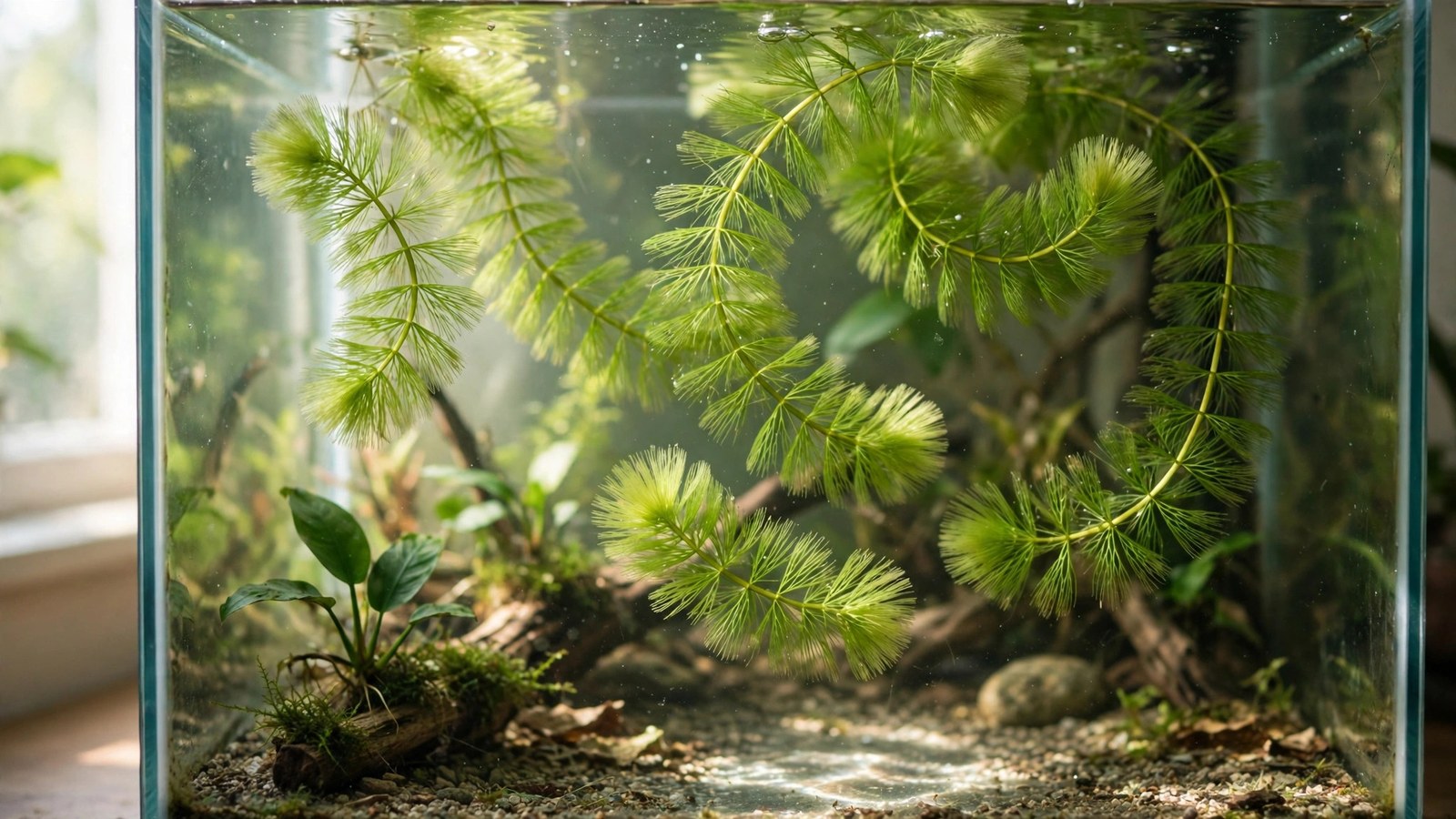
Here's the mistake nearly every beginner makes: you bring a lush hornwort bunch home, carefully push the stems into your gravel, and two weeks later the buried ends have turned to mush while the tops float around your filter intake. The costly truth is that burying hornwort the way you'd plant a sword or crypt almost guarantees it rots — because hornwort grows no roots at all. So, does hornwort need substrate? The short answer is no — and the full answer matters more: how you place it decides whether it explodes into your tank's fastest-growing background or slowly sheds itself to death.
Does Hornwort Need Substrate? The Short Answer
No — hornwort (Ceratophyllum demersum) is a true rootless plant: no root crown, no feeder roots, nothing to drive into gravel or aquasoil. Every feathery whorl of needle-like leaves pulls nitrogen, phosphorus, and trace minerals straight from the water, the same way Salvinia and Amazon frogbit feed while floating. That's the opposite of heavy root feeders like Amazon swords, which stall without root tabs — for hornwort, your liquid fertilizer routine is the entire feeding program. For the full picture beyond placement, see our complete hornwort care guide.
How Hornwort Feeds Without Roots
Because it feeds through leaf surfaces, hornwort is one of the most aggressive nutrient sponges in the hobby — a few bunches can visibly starve out green-water algae in a new setup within a couple of weeks, given moderate light (roughly 30–50 PAR). In nature, stems resting on a lakebed can grow small rhizoid holdfasts that grip sediment. These aren't roots — they don't feed the plant — and they form inconsistently in aquariums.
Floating vs Planted vs Weighted: Compared
| Method | Growth speed | Shedding risk | Best for | Watch out for |
|---|---|---|---|---|
| Floating | Fastest — closest to light and the CO2-rich surface layer | Lowest | Breeding tanks, shrimp tanks, algae control | Blocks light below; corral with an airline-tubing ring |
| Weighted down (not buried) | Fast | Low | The classic "planted" look without rot — best all-rounder | Stems can drift if weights slip |
| Buried in substrate | Moderate | Highest — buried stems melt in 1–3 weeks | Short-term aquascapes, coarse gravel only | Anything buried deeper than ~1 inch rots and fouls the water |
The pattern is simple: the less stem you bury, the better hornwort performs.
The Easiest Method: Just Float It
Drop the bunch in and walk away. At the surface, hornwort gets your strongest light and first access to CO2 diffusing into the top inch of water — floaters often outgrow weighted stems by an inch or more per week. Floating hornwort doubles as a nursery: shrimp graze the fine leaves for biofilm, and fry hide in the tangle. The tradeoff is shade: a full mat can cut light below by 50–70%, so corral it with a 12-inch loop of airline tubing joined with a connector. The same trick works for Water Sprite, another plant that thrives floating or planted.
How to Anchor Hornwort Without Planting It
Want the tidy background-forest look without the rot? Use a plant weight, not your substrate:
- Rinse the bunch and trim crushed or brown stem ends — ragged ends are where rot starts.
- Wrap a soft lead-free plant weight around the bottom inch of stems, snug but not crushing.
- Rest the weighted end on the substrate surface or tuck it under the top ½ inch — never push stems deep.
- Space stems an inch apart so light reaches lower leaves; cramming causes the shaded bases to shed.
- Check after a week: if the bottom inch looks pale or slimy, trim it and re-weight higher.
When Substrate Helps — and When It Hurts
Substrate helps exactly one thing: holding the plant where you put it. A shallow tuck into coarse gravel (3–5 mm grain) works for a neat background row, and coarse gravel beats fine sand because water flow around the stem slows rot. Substrate hurts whenever it smothers: buried sections get almost no light and sit in a low-oxygen microzone, turning translucent, then brown, then disintegrating into ammonia-spiking waste within 1–3 weeks.
Why Hornwort Sheds Needles
Needle shedding — tiny green bristles clogging your filter intake — is the top complaint about this plant, and it's almost never about substrate. The usual triggers, in order of likelihood:
- Too little light. Hornwort sheds lower needles first below roughly 20 PAR. Raise intensity or trim the tops.
- Nutrient crash. Fast growth can exhaust potassium or iron in lightly stocked tanks. A weekly all-in-one dose usually stops shedding within two weeks.
- Temperature shock. Float the sealed shipping bag for 20–30 minutes to equalize before planting.
- New-tank adjustment. Fresh bunches often drop 10–20% of needles in week one, then stabilize.
None of these are fixed by planting deeper — compare notes with Egeria densa and Cabomba, which shed from the bottom up under the same low-light conditions. See the Flowgrow aquatic plant database entry for rigid hornwort for the botanical details of its rootless growth habit.
A Responsibility Note
Ceratophyllum demersum is vigorous enough to be invasive outside its native range — it can choke waterways and is regulated in some areas. Check the Tropica plant database entry for Ceratophyllum demersum and your local rules before buying, and never dump plants, trimmings, or tank water into local ponds, lakes, or drains. Bag trimmings and bin them.
Frequently Asked Questions
Can hornwort survive in plain gravel with no fertilizer?
Yes, in a stocked tank — fish waste supplies the ammonia and phosphates its leaves absorb. In a lightly stocked tank, growth slows and needles may yellow within 3–4 weeks; a weekly half-dose of all-in-one liquid fertilizer fixes that. Gravel itself changes nothing, since hornwort has no roots to use it.
Why does my planted hornwort keep melting at the base?
The buried portion gets almost no light and sits in a low-oxygen zone, so it rots within 1–3 weeks. Pull the bunch up, trim the translucent or brown lower stems, and re-anchor the healthy tops with a plant weight resting on the substrate surface. Space stems an inch apart so light reaches the lower leaves.
Is it better to float hornwort or weigh it down?
Floating grows fastest and sheds least — ideal for breeding tanks, shrimp tanks, and algae control. Weighing stems down gives a tidier planted look with only slightly slower growth, better for display aquascapes. Either beats burying stems, the one method that reliably causes rot.
How do you propagate hornwort?
Snip any stem to length and either float the cutting or re-weight it — both the top and the remaining base keep growing, so one snip becomes two plants. Three healthy bunches can fill a background in 6–8 weeks. No hormones or substrate needed; just keep cuttings out of stagnant dead spots.
Will hornwort grow in a tank with no substrate at all?
Absolutely — bare-bottom tanks are one of hornwort's best uses. Breeders run it floating with no substrate at all, and it grows just as fast because all nutrition comes from the water column. It's a perfect temporary plant while a new tank cycles.
Your 5-Minute Hornwort Placement Plan
Want maximum growth and minimum fuss? Float it — corral it with an airline-tubing ring if it shades too much. Want the classic planted background? Wrap the stem bases in a plant weight and rest them on top of your substrate, never buried. Feed the water column instead of worrying about substrate, and if needles start dropping, check light and fertilizer before moving anything. For contrast with a plant that anchors to wood and rock instead, see our Anubias care guide.