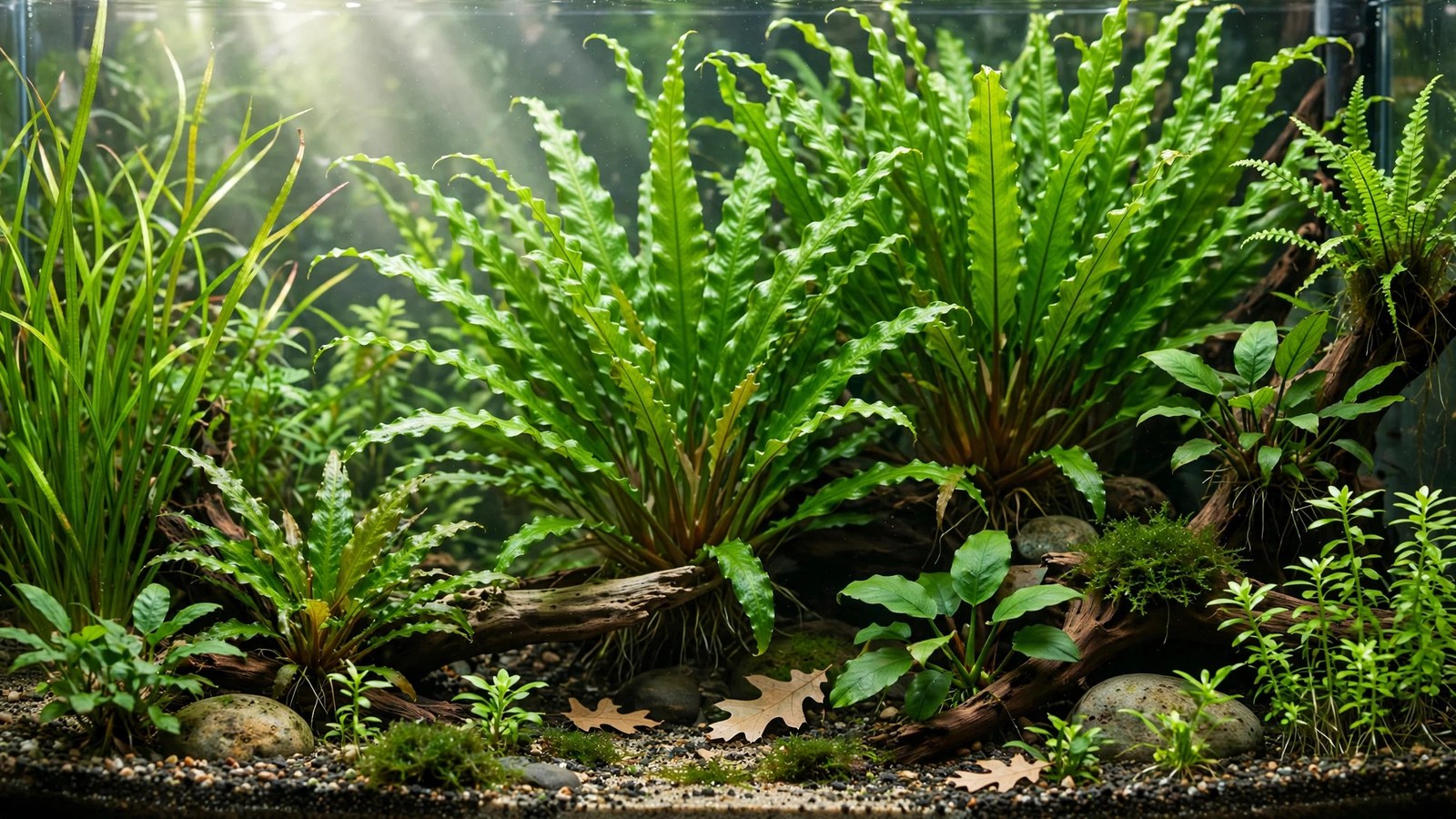
Most crypts melt if you so much as look at them wrong — and the giant bullated crypt at the back of your tank is no exception. Move Cryptocoryne usteriana once, out of impatience, and its magnificent hammered leaves can dissolve into brown mush overnight, costing you months of growth. But treat it with patience, and it rewards you with a dark-green, burgundy-backed anchor plant that tolerates hard tap water most crypts would sulk in.
Why cryptocoryne usteriana breaks the usual crypt rules
Ask five hobbyists for crypt care advice and you'll hear "soft, acidic water or nothing" — and our full guide to crypt melt prevention and recovery backs that up for most of the genus. Usteriana is the exception. Retailers like Buce Plant and Discus.ae explicitly list it as tolerant of medium-hard to hard, even alkaline water — a trait that opens this plant to every aquarist with limestone tap water who assumed crypts were off-limits. It grows beautifully in soft water too; it just doesn't demand it.
The second broken rule is temperament. Tropica's plant database entry rates it "very easy to grow," and compared to fussy species it is — once settled. The catch is the settling: usteriana is sold as a large, pot-bound rosette with an extensive root system, and more root mass in the substrate means more tissue to shock at planting. Handle it right and you'll never know it was risky.
What it actually looks like in a tank
Usteriana's signature is its leaf texture: long, lance-shaped blades with deeply bullated (blistered, hammered) dark-green surfaces. The undersides glow rich burgundy — a color that deepens under good light. Leaves can reach 70 cm in ideal conditions; expect 30–50 cm in home tanks, which still makes it strictly a background plant for tanks 40 cm or taller.
Usteriana vs its two closest cousins
| Feature | C. usteriana | C. wendtii | C. balansae |
|---|---|---|---|
| Typical height | 30–50 cm | 10–15 cm | 40–60 cm |
| Leaf texture | Bullated, hammered | Smooth to lightly rippled | Long, rippled ribbons |
| Underside color | Burgundy | Olive to reddish | Green to bronze |
| Hard-water tolerance | Excellent | Good | Moderate |
| Placement | Background | Foreground/midground | Background |
| Melt risk on planting | High | Moderate | Moderate |
Hard tap water and want a giant background crypt? Usteriana beats balansae on tolerance and wendtii on presence. Want a small crypt for the front glass? Wendtii is the right plant and usteriana is not.
The one rule: plant it once, then leave it alone
Choose its permanent spot on day one, plant it, and don't touch it for at least six months. Crypt melt is triggered by change, and nothing changes a crypt's environment like ripping out its roots.
- Soak the potted plant for 10 minutes, then gently tease the rockwool off the roots, keeping as much fine root mass as possible.
- Dig a generous hole in nutrient-rich substrate — or plain gravel with a root tab pushed 5 cm beneath the spot.
- Fan the roots outward and downward, bury the crown just above the substrate line, and backfill firmly.
- Resist every urge to reposition it. It will look sulky for 2–4 weeks; that is normal.
Even with perfect handling, expect some melt: the outer, emersed-grown nursery leaves will usually yellow and collapse while submerged leaves grow from the crown. Trim dead leaves at their base and give it time.
Water, light, substrate, feeding
Water: pH 6.5–8.0, temperature 20–28°C. Stability beats any target number: a constant pH 7.8 grows a far better plant than a tank that swings with every water change.
Light: low to medium, roughly 20–50 PAR — a genuine low-light survivor and a natural fit for a low-tech planted tank setup. Too little light stalls growth; high light gains little but invites algae onto slow-growing leaves.
Substrate and feeding: a heavy root feeder, so what goes under it matters more than water-column dosing. Nutrient-rich aquasoil is ideal; plain gravel or sand works if you push 1–2 root tabs 5 cm under the crown every 3–4 months. Pale, small new leaves mean the substrate is depleted.
CO2: not required — which is why it ranks among the easiest aquarium plants for a beginner community tank. Added CO2 helps only modestly; for a slow grower, stability beats speed.
Using it as a background anchor
A mature usteriana is a structural element, not decoration. Plant one specimen — or a loose group of three spaced 15–20 cm apart — along the rear glass as the visual anchor of the scape. Its upright habit contrasts beautifully with horizontal hardscape like driftwood, and the burgundy undersides throw warm color upward when fish disturb the leaves. Give it 20 cm of clear space on all sides; a crowded usteriana just etiolates toward the light.
Propagation: runners do the work
Once established (4–6 months), usteriana sends out runners that surface as daughter rosettes nearby. Wait until a daughter has 5–6 leaves, snip the runner, and lift it gently without disturbing the mother. Replant the same day, 15+ cm from the parent.
Frequently Asked Questions
Will cryptocoryne usteriana melt when I plant it?
Probably, at least partially. The nursery-grown outer leaves often yellow and collapse within 2–4 weeks — normal crypt melt, not failure. Leave the roots alone, trim dead leaves at their base, and watch for new leaves from the crown. Panic moves like replanting make it far worse.
Can usteriana grow in my hard tap water?
Yes — its standout trait. Unlike most crypts, usteriana tolerates medium-hard to hard, even alkaline water (pH up to about 8.0). It's one of the few crypts for aquarists with limestone tap water. Stability matters more than perfect numbers, so avoid chasing parameters with chemicals.
How big does cryptocoryne usteriana get?
In home aquariums it typically reaches 30–50 cm tall, with culture listings noting up to 70 cm under ideal conditions. It is strictly a background plant and needs a tank at least 40 cm deep. A mature rosette spreads 20–30 cm wide, so give it generous space at planting time — crowding forces weak, etiolated growth toward the light.
Does it need CO2 or strong light?
No to both. Usteriana is a genuine low-tech plant: low to medium light (20–50 PAR) and no CO2 required. It grows slowly but steadily in a basic setup with root nutrition. CO2 speeds growth slightly, but for a slow grower, stability and patience matter more than high-tech equipment.
Can I move it after it's established?
Technically yes, but you shouldn't unless absolutely necessary. Moving an established rosette disturbs a large root system and almost always triggers a severe melt that can take months to recover from. Choose its permanent spot on day one and leave it alone for at least six months. Good placement beats perfect placement.
How do I propagate usteriana?
It propagates by runners — daughter rosettes that sprout near the mother plant once it's well established, usually after 4–6 months. Wait until the daughter has 5–6 leaves, snip the runner, and lift the young plant without disturbing the mother. Replant it the same day, at least 15 cm from the parent.
Cryptocoryne usteriana asks for exactly one thing — patience — and pays for it with a background plant few others can match: bullated dark-green leaves, burgundy undersides, and the rare ability to thrive in hard tap water. Plant it once, feed its roots, leave it alone.