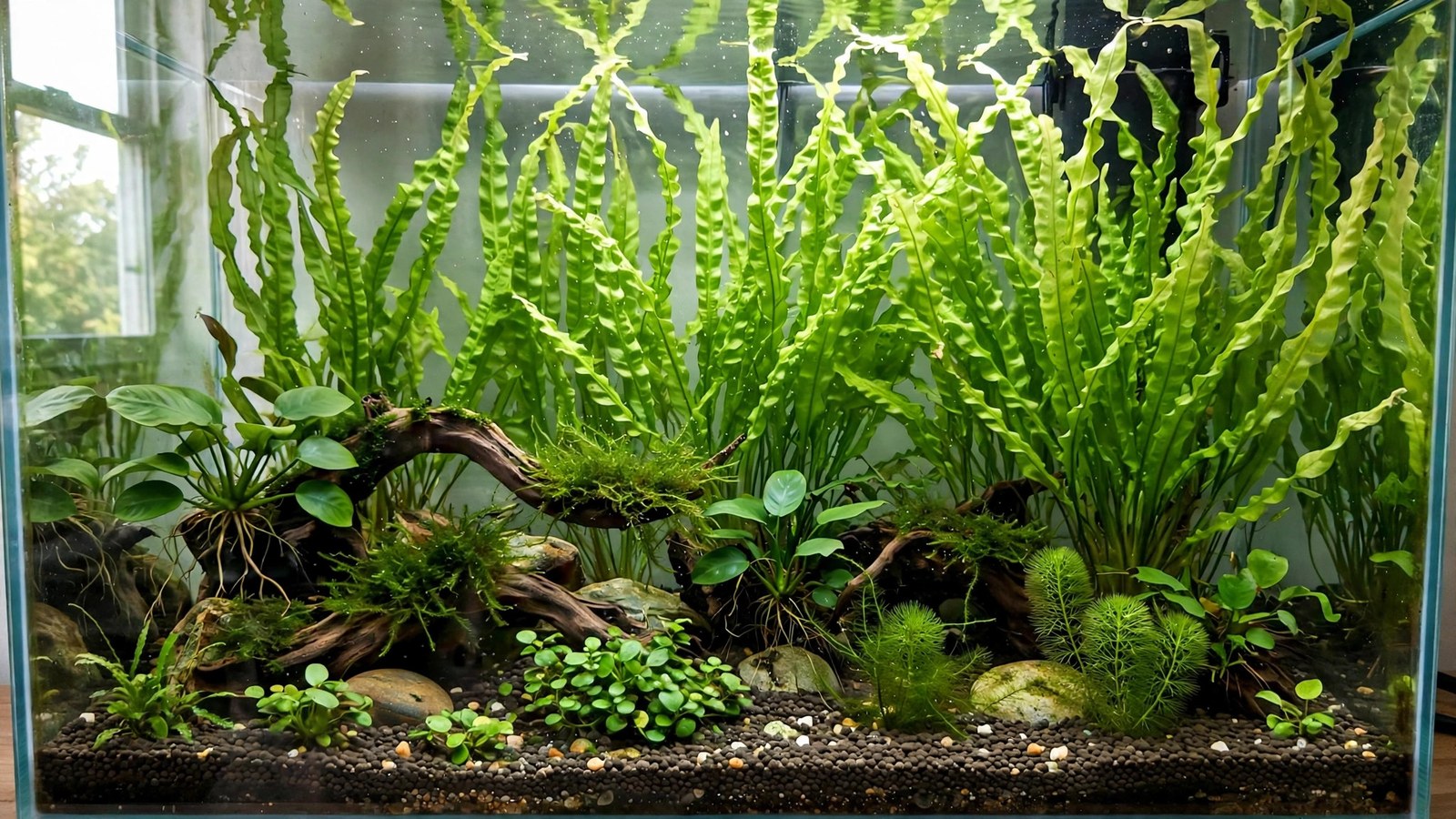
When a planted tank needs height, movement, and a touch of the wild, few plants deliver like this one. Cryptocoryne balansae care rewards the patient aquarist with ribbons of long, hammered, wavy leaves that can stretch half a meter tall and sway gently in the current — a living green curtain for the back of the aquarium. It is not the fastest plant you will ever grow, and it may sulk dramatically after planting, but once it settles in, it becomes one of the most dependable background plants in the hobby.
This guide covers what the species genuinely needs: realistic lighting, whether CO2 is worth it, the substrate it truly wants, water parameters that keep it happy, how to survive the infamous crypt melt, and how to multiply it through runners — all based on how the plant behaves in real home aquariums.
Quick Facts: Cryptocoryne Balansae at a Glance
| Detail | What to know |
|---|---|
| Scientific name | Cryptocoryne balansae (now often classed as C. crispatula var. balansae; still sold as balansae) |
| Origin | Southeast Asia — limestone streams of southern Thailand and surrounding regions |
| Height | 20–60 cm (8–24 in) |
| Width | 15–20 cm (6–8 in) per mature rosette |
| Growth habit | Rosette; spreads by runners |
| Growth rate | Medium — slower than stems, faster than Anubias |
| Light demand | Low to moderate |
| CO2 | Optional; beneficial but not required |
| Best placement | Background of medium to large tanks |
| Difficulty | Easy to moderate (easy once established; the first month is the test) |
What Makes Cryptocoryne Balansae Different
Most crypts are squat midground plants with broad leaves. Balansae breaks the mold: an upright rosette of narrow, strap-like leaves with a crinkled, hammered texture and rippling margins, like a ribbon caught in a breeze. Under good light some forms develop bronze or maroon tones, though most stay deep green.
Size is the defining trait. A mature plant easily reaches 40 cm and can push toward 60 cm in a tall tank with rich substrate — a true background plant, and honestly a poor choice for anything under about 55 liters (15 gallons), where it drapes across the surface. In the right tank, a cluster creates a permanent vertical element that never needs replanting after trimming, unlike any stem plant.
One naming note: botanists now generally treat this plant as Cryptocoryne crispatula var. balansae, but nurseries and retailers still sell it as balansae — searching either name finds the same plant. For a similar wavy-leaf look in a different genus, compare Aponogeton crispus, another wavy-leaved favorite.
Cryptocoryne Balansae Care: Lighting Requirements
Good news: this plant does not demand high light. Low to moderate lighting is the sweet spot — it grows fine under the modest LED that ships with most all-in-one kits, needing roughly 6–8 hours a day of a decent planted-tank light.
Respect the ceiling, though. More light will not meaningfully speed up this slow grower; it will invite algae. Balansae's leaves grow slowly enough that green spot and hair algae can colonize older blades long before the plant outruns them. In a high-light, CO2-injected tank, give it slight shade — position it where hardscape or floating plants like Amazon frogbit break up the most intense light.
Light also influences color: brighter (not blasting) light with good nutrition can bring out warm bronze undertones, while dim light keeps it deep green. Neither is a problem. It shares its unhurried attitude toward light with true low-light specialists like Bolbitis heudelotii.
CO2: Do You Need It?
No — and that is one of the strongest arguments for this plant. Cryptocoryne balansae grows well in a low-tech tank with no injected CO2: slower, with slightly narrower leaves, but healthy and still producing runners.
Adding CO2 makes a real difference, though: faster establishment after planting (meaning less time in the vulnerable melt phase), thicker leaves, and more enthusiastic runner production. If you already inject for other plants, balansae will happily benefit. But there is no reason to buy a CO2 system for this species alone. Spend your budget first on a good substrate and stable conditions — those matter far more to this plant than a cylinder does.
Substrate and Planting
Balansae is a genuine root feeder, drawing most of its nutrition through an extensive root system — so substrate is the single most important decision you will make for it. A nutrient-rich aquasoil is ideal; the roots dive deep and the rosette responds visibly within weeks.
Plain sand or fine gravel works too, provided you feed the roots: push a root tab or two near the base every couple of months. What it cannot tolerate is starvation — pale, stunted new leaves in an inert substrate with no root feeding are the classic sign of an underfed balansae.
Planting technique matters. Dig a hole, spread the roots gently, and set the plant so the crown — where leaves meet roots — sits just above the substrate surface. Buried crowns rot; floating crowns never anchor. Give each rosette about 15 cm of clearance, and do not fear trimming overly long roots before planting — it encourages new feeder-root growth.
Wavy background crypt feeds through roots: Seachem Flourish Tabs at planting.
Rich substrate supports tall balansae stands: a rich aquasoil like Fluval Stratum.
Water Parameters
This is one of the more adaptable crypts, which makes sense given its origins in limestone streams where water runs hard. Aim for the following, but do not chase perfection — stability beats precision:
- Temperature: 22–28°C (72–82°F)
- pH: 6.0–7.5
- Hardness: soft to moderately hard; it handles harder water better than most crypts
- Nitrates: 5–20 ppm is a fine target in a planted tank
What hurts balansae is not a specific number but sudden change. A big parameter swing — a new tank with very different water than the nursery, a hasty rescape, a large unconditioned water change — is the most common trigger for the melt described below. Keep changes gradual and it shrugs off a wide range of conditions.
Growth Rate and Pruning
Expect a medium pace with a slow start. Newly planted balansae typically spends 2–6 weeks doing almost nothing visible while it builds roots — then new leaves begin unfurling from the rosette's center. Once established, a healthy plant produces a new leaf every week or two and starts sending runners after a few months.
Pruning is simple because this is a rosette, not a stem: you never top and replant it. Instead, remove the oldest, outermost leaves at the base with sharp scissors, cutting close to the crown. This removes algae-prone old growth, opens light and flow to the center, and prevents a congested clump. Never remove more than a third of the leaves at once.
Leaves that reach the surface can be trimmed back or left to drape, depending on your taste. Compared with stem backgrounds like Bacopa caroliniana, another tall background option — which needs constant topping and replanting — balansae's prune-from-the-base approach is far less fiddly.
Surviving Crypt Melt (Yes, It Will Probably Happen)
Shortly after planting, your balansae's leaves may turn translucent, dissolve, and collapse into mush. This looks catastrophic, but in the vast majority of cases it is completely normal.
Melt is the plant's stress response to changed conditions: different water than the nursery, the switch from emersed (grown-out-of-water) to submerged growth, a move across the tank, or a parameter swing. The leaves are sacrificed; the root system and growing crown usually survive. This is standard, well-documented hobby knowledge about the genus — not a sign you did something wrong.
The correct response is counterintuitive: do almost nothing. Do not uproot the plant to "check" on it — every disturbance resets the acclimation clock. Leave the rootstock where it is, keep conditions stable, and wait. Within 2–4 weeks, tiny new leaves typically emerge from the crown. You can siphon away the dissolved mush during water changes, but resist digging the plant up. A melted balansae left alone recovers far more reliably than one that is fussed over.
To minimize melt: plant into a cycled, stable tank rather than a brand-new setup; acclimate gradually to your water; and avoid moving the plant for the first two months. Tissue-culture cups tend to melt less dramatically than emersed-grown pots, since the transition shock is milder.
How to Propagate Cryptocoryne Balansae
Propagation is easy because the plant does most of the work. A happy balansae sends horizontal runners through the substrate, and along each runner daughter plantlets form — miniature rosettes with their own leaves and roots.
Let a plantlet grow until it has 4–5 leaves and visible roots, then sever the runner on both sides with scissors and lift it out gently. Plant it elsewhere using the same crown-above-substrate technique. Each daughter is genetically identical to the parent and will grow into a full-sized rosette.
Two practical notes: runners can travel 20 cm or more and pop up in front of neighboring plants, so check around the mother plant every month or two. And a balansae that never produces runners is usually still acclimating or wants richer root feeding — a well-fed, undisturbed plant in a stable tank becomes a runner factory with time.
Placement and Aquascaping Ideas
Balansae belongs in the background. Its height and upright habit make it the backbone of a back wall, and it looks best in odd-numbered clusters (3 or 5 rosettes) in the rear corners or behind a central piece of driftwood. The long leaves arching forward over the midground create depth that flat stem-plant walls cannot match.
- The corner anchor: one large specimen in each rear corner frames the entire scape.
- The flowing wall: a staggered row of 5–7 plants across the back, slightly offset in depth, reads as a natural riverbank.
- The contrast partner: pair the fine, wavy texture with something bold and red like Alternanthera reineckii in the midground.
- The tall-tank specialist: in tanks 60 cm or taller, balansae is one of the few plants that genuinely fills the upper water column without CO2.
For a similarly commanding background plant with broader leaves instead of ribbons, large background plants like the Amazon sword fill the same compositional role with a very different texture.
Tank Mates: Fish, Shrimp, and Snails
Balansae is an excellent community-tank citizen. Shrimp graze its broad leaves for biofilm without harming them. Tetras, rasboras, guppies, and bettas weave through the leaves and use them as shelter — shy species visibly relax once a balansae cluster gives them overhead cover. Snails rasping algae off older leaves are doing you a favor.
The exceptions are the usual plant-wreckers: goldfish, silver dollars, and large herbivorous cichlids will shred the leaves, and digging cichlids will uproot it faster than it can anchor. Most plecos leave it alone, though large commons can be rough on the blades.
One underappreciated benefit: the dense leaf cluster is a superb fry and shrimplet refuge — baby shrimp in particular thrive in the tangle of leaves and roots at the base, where fish cannot easily follow.
Buying Tips: Potted vs. Tissue Culture
Potted plants are usually grown emersed in nurseries, so they arrive with stiff, waxy leaves that look great in the store — then melt dramatically converting to submerged growth. This is normal (see above), but a potted plant can look terrible for a month before it looks good.
Tissue-culture cups hold small lab-grown plantlets guaranteed free of snails, algae, and pesticides. They start smaller and need dividing into portions, but transition with far less drama and are the safer choice for shrimp tanks, where pesticide residues from conventionally grown plants can be a real concern.
Whichever you buy, inspect first: leaves firm, no black mush at the crown, white healthy-looking roots on potted plants. Avoid any pot where the crown smells sour — that is rot, not melt, and it will not recover. For authoritative species data, see Tropica's Cryptocoryne crispatula database entry or Dennerle's plant database profile for Cryptocoryne crispatula.
Frequently Asked Questions
Why is my new Cryptocoryne balansae melting?
Melt is this genus's standard stress response to new conditions — different water, the emersed-to-submerged transition, or being moved. The leaves dissolve, but the roots and crown almost always survive. Leave the plant undisturbed, keep parameters stable, and siphon away the mush during water changes. New submerged leaves typically emerge within two to four weeks.
Does Cryptocoryne balansae need CO2 injection?
No. It grows well in low-tech tanks without CO2, just more slowly with slightly narrower leaves. CO2 speeds establishment, thickens foliage, and encourages runners — a nice bonus if you already inject. But there is no reason to buy a system for this species alone; invest in good substrate first.
How fast does Cryptocoryne balansae grow?
Medium pace with a slow start: two to six quiet weeks building roots, then a new leaf every week or two once established. Runners usually appear after a few months in a stable, well-fed tank. A single rosette can become a 60 cm background specimen within a year under good conditions.
Can I grow it in plain gravel with no fertilizer?
Not well. Balansae is a heavy root feeder, and plain inert gravel starves it — expect pale, stunted new leaves. You do not need expensive aquasoil: plain sand or gravel plus a root tab near the base every couple of months gives it everything it needs. Feed the roots, not the water column.
Is it suitable for a 10-gallon tank?
Honestly, no — not long-term. A mature plant reaches 40–60 cm with leaves that drape across the surface of a small tank and shade everything below. It is best in tanks of about 55 liters (15 gallons) or larger, and truly shines in tall aquariums where its height becomes an asset.
Why are the leaf tips turning brown?
Brown tips on older, outer leaves are usually just age — prune those leaves at the base. If new, central leaves are browning, suspect nutrient deficiency (often potassium or general root starvation), physical damage from strong filter outflow, or deteriorating water quality. Fix the cause and the next leaves will emerge clean.
The Patient Background Plant
Cryptocoryne balansae asks for three things: a rich spot for its roots, stable water, and time. In return it gives one of the most elegant background displays in freshwater aquascaping — tall, rippling leaves that move with the current and anchor the whole composition. The first month may test your nerve when the leaves melt, but gardeners who have been through it once know the secret: leave it alone, and it comes back stronger. Few plants reward patience quite so visibly.