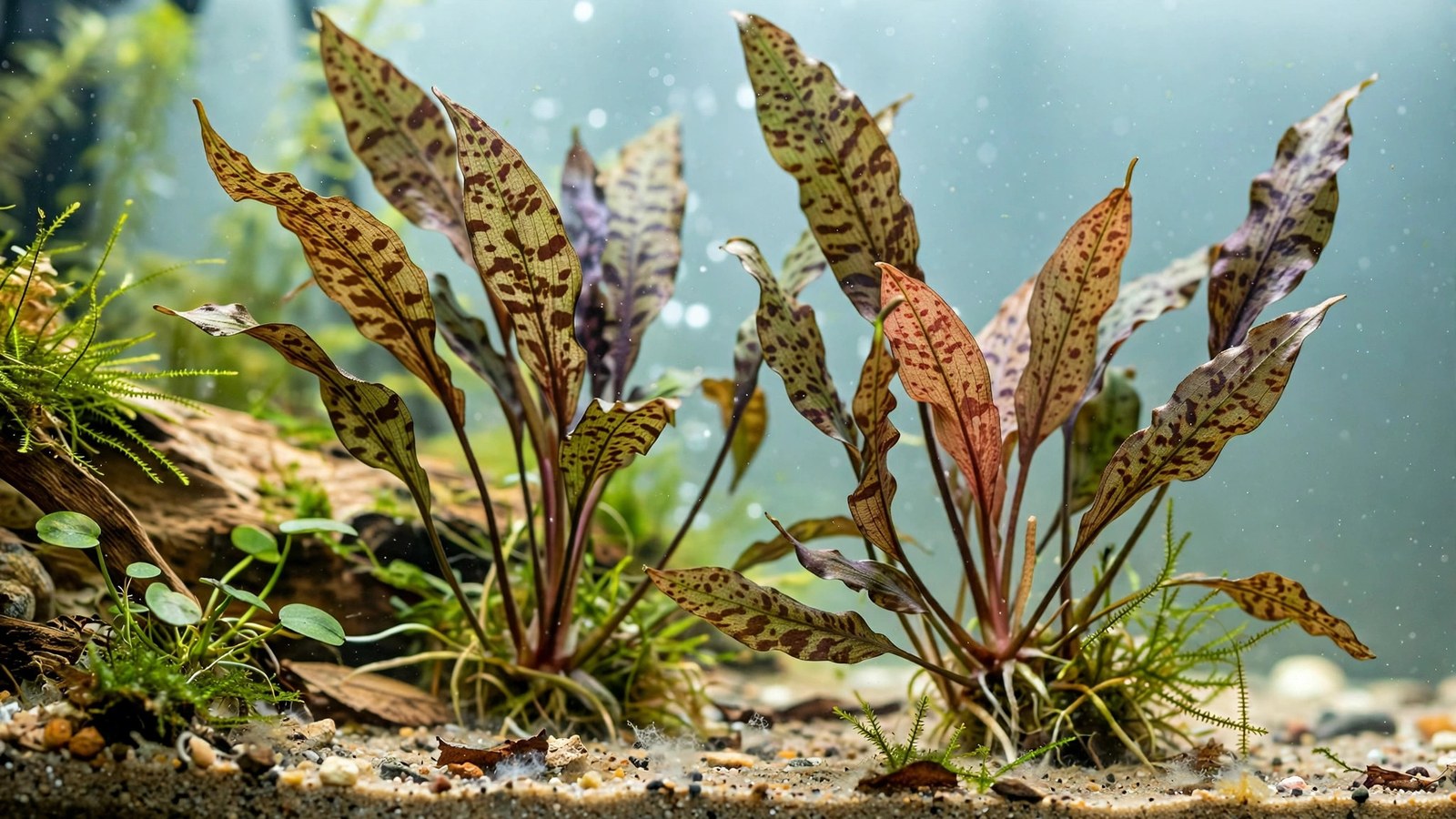
Most crypts are bought for filling gaps. Cryptocoryne nurii is bought for staring at. Its leaves carry olive-to-bronze tiger striping that no other common crypt offers, and once you see a mature clump glow under warm aquarium light, ordinary Cryptocoryne wendtii care starts feeling like a consolation prize. The good news: cryptocoryne nurii care is barely harder than wendtii care — it just rewards soft, acidic water and a rich substrate with dramatically better patterning.
What makes Cryptocoryne nurii different
The pattern is the plant. Each lance-shaped leaf is olive-green to bronze, crossed with darker transverse bars — the source of its collector nickname, the tiger crypt. The trade name "Rose Maiden" belongs to a Malaysian wild variant with a pinkish cast over the same striping. Tropica's plant database notes this form, collected in the wild around 1970, grows as easily as C. wendtii, sends runners that surface surprisingly far from the mother plant, and — critically — that the intensity of the color and pattern depends on light and nutrition. Your water and feeding regime literally draw the stripes.
It is a distinct species, not a wendtii morph. Kew's taxonomic record lists Cryptocoryne nurii as an accepted species native to the Malay Peninsula and Sumatra, growing in wet tropical habitats as a helophyte. That wild life — seasonally flooded, soft, tannin-tinted water — explains its aquarium preferences.
How nurii compares to wendtii and parva
| Trait | C. nurii | C. wendtii | C. parva |
|---|---|---|---|
| Leaf pattern | Olive-bronze tiger striping | Solid green, brown, or red morphs | Plain narrow green leaves |
| Height | 10–20 cm | 10–25 cm | 3–6 cm |
| Growth speed | Slow–medium | Medium | Very slow |
| Hard-water tolerance | Poor — pattern fades | Excellent | Moderate |
| Melt sensitivity | High | Moderate | Moderate |
| Role in the tank | The striped standout | The reliable classic | The nano specialist |
Getting cryptocoryne nurii care right: water, light, and substrate
This is where cryptocoryne care principles converge into this species' specific demands. Nurii survives a wide range but only performs in a narrow one.
Water parameters
Soft, slightly acidic water is the whole game: pH 6.0–7.0, GH 1–6 dGH, and ideally TDS under 150 ppm. Temperature is forgiving at 22–28°C. In hard, alkaline water nurii still grows — slowly, with washed-out greenish leaves that look like a disappointment next to the photos. If your tap water is hard, cutting it with RO water is the honest fix; chasing chemistry with buffers is a treadmill most hobbyists abandon.
Light and CO2
Here nurii rewards restraint. Low to medium light — PAR 25–50 at the substrate — produces the strongest striping contrast, while pushing past PAR 70 tends to flatten the pattern and invite thread algae on the slow-growing leaves. If you are unsure what your light delivers, our aquarium lighting guide shows how to estimate PAR without a meter. CO2 injection is genuinely optional: moderate CO2 (10–20 mg/L) speeds growth and deepens color, but it is a refinement, not a requirement.
Substrate and root feeding
This is non-negotiable. Nurii feeds primarily through its roots, so a nutrient-rich aquasoil — or inert sand loaded with root tabs — is what separates a thriving plant from a sulking one. Push one complete root tab 3–4 cm deep near each plantlet every 2–3 months (monthly in inert sand). The striping is nutrition-dependent: fresh iron and micronutrients at the root zone visibly sharpen the dark bars within a few weeks. Liquid column dosing is a fine supplement, but as our fertilizer deep-dive explains, heavy root feeders answer best to food delivered where their roots are. It makes a natural partner for Amazon sword in the classic heavy-root-feeding corner of a scape.
Planting and aquascaping placement
Nurii shines as a foreground-to-midground drift: a loose cluster of 5–7 plantlets, spaced 4–5 cm apart, reads as one patterned cloud once the runners fill in. Plant the roots firmly but keep the crown — the pale junction where leaves meet roots — slightly above the substrate. Buried crowns rot, and rot in a slow grower costs months. Topping out near 15 cm in most tanks, nurii should sit clear of tall backgrounds like Aponogeton crispus, which will shade it out; low companions such as Pogostemon helferi make a better-scaled foreground pair.
Surviving crypt melt
Crypt melt — the sudden dissolving of leaves after planting or a parameter swing — hits nurii harder than wendtii. The protocol that works:
- Do not move it. Every replanting restarts the clock. Plant once, then hands off.
- Trim melted leaves at the base once they turn translucent, but leave any firm leaf, however ugly.
- Leave the roots and crown untouched. White, firm roots mean the plant is alive.
- Wait 2–4 weeks. New leaves emerge from the crown, smaller at first, then normalize.
The most expensive mistake in the hobby is throwing away a melted crypt on day five. A melted crown with firm roots is a plant in recovery, not a dead plant. For a similarly melt-tested, slow-growing planting partner in blackwater-style setups, see our sibling profile on Schismatoglottis prietoi, which shares nurii's patience requirement.
Propagation
Patience pays you back in plantlets. Mature nurii sends horizontal runners beneath the substrate, and daughters appear 5–15 cm from the mother — sometimes remarkably far. Once a daughter has 4–5 of its own leaves and visible roots, sever the runner with sharp scissors and replant it as its own cluster. Do not divide the central crown the way you might a sword plant; crypts resent crown division and often respond by melting outright. Expect your first separable daughters in 3–6 months in a well-fed tank — slow, but each one is a free specimen of a collector plant.
Frequently Asked Questions
Is Cryptocoryne nurii good for beginners?
Yes, with one caveat. It is as undemanding as wendtii on light and CO2, but it shows its best patterning only in soft, acidic water with a rich substrate. Beginners with hard tap water will grow a healthy but plain-looking plant. If your water is soft or you use RO, it is genuinely beginner-easy.
Why did my nurii melt after planting?
Crypt melt is a stress response to new water chemistry, not a sign of a bad plant. Trim the translucent leaves, keep the crown above the substrate, and do not move it. Firm roots mean it is alive; new leaves typically emerge within 2–4 weeks, adapted to your tank.
How do I get stronger tiger striping?
Three levers, in order of impact: soft acidic water (pH 6.0–7.0), iron-rich root feeding, and low-to-medium light around PAR 30–50. High light washes the pattern out rather than deepening it, and the striping shows strongest on mature leaves — new leaves often emerge plain. Give each change 3–4 weeks before judging results.
Does Cryptocoryne nurii need CO2?
No. It grows well in low-tech tanks without injected CO2, just more slowly. CO2 at 10–20 mg/L speeds growth and deepens color, but it is a refinement, not a requirement. Stable parameters and consistent root feeding matter far more — and if you do add CO2, raise it gradually to avoid pH swings that can trigger crypt melt..
What is the difference between nurii and "Rose Maiden"?
Rose Maiden is a trade name for the Malaysian wild variant of C. nurii with a pinkish cast over the standard tiger striping. Care is identical — same water, feeding, and light preferences — so treat the names as describing color, not different husbandry.
A collector's plant with beginner manners
Cryptocoryne nurii occupies a rare sweet spot: the visual drama of a rare aroid with the temperament of the workhorse crypts beside it. Give it soft water, feed its roots, resist the urge to fuss after planting, and it will reward you with some of the most distinctive foliage in the hobby — a slow, striped cloud anchoring the midground for years.