Some plants arrive in the hobby with a bang — tissue-culture cups in every shop, a thousand forum threads. This crypt arrived with a whisper: a handful of wild-collected pots, a name the trade couldn't agree on, and leaves so heavily crumpled they look like they've been through something. This Cryptocoryne hudori care guide is for the collector who finally got a pot: how to plant it, how to survive the melt, and why this low-light crypt rewards patience like almost nothing else.
In short: Cryptocoryne hudoroi (sold as "hudori") is a slow-growing Sarawak riverbank crypt with hammered, crumpled leaves, unusually tolerant of low light. Plant it in nutrient-rich substrate at 22–28°C under low to medium light, leave it alone for two months, and watch for new leaf tips as your sign of success.
A crypt with a crumpled signature
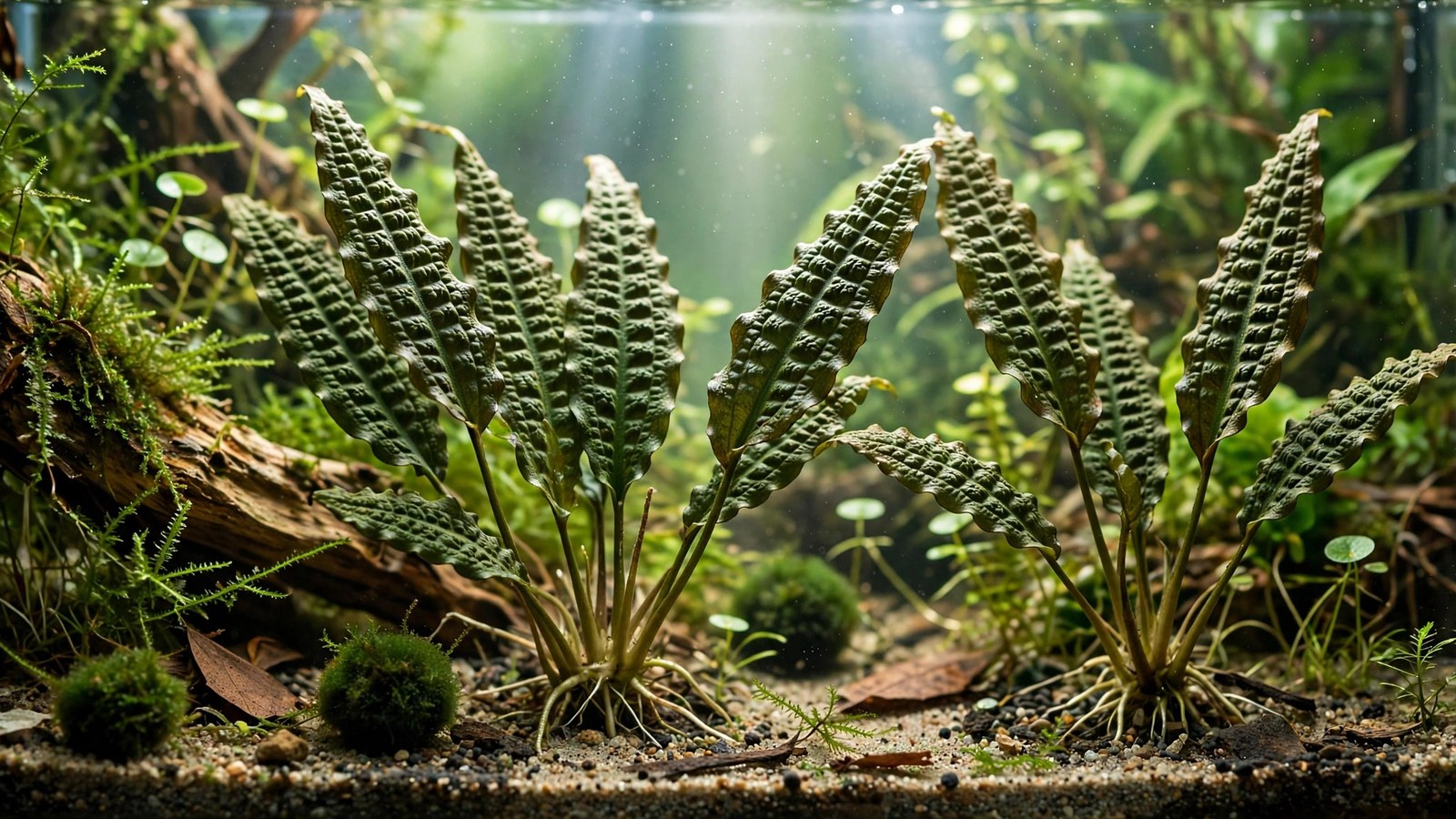
The first thing you notice is the texture. Where most crypts offer smooth, lance-shaped leaves, Cryptocoryne hudoroi grows leaves that look hammered or crumpled, puckered along the entire blade with olive-to-reddish-brown coloration that deepens under good conditions. It's a mid-sized crypt — 15 to 25 cm at maturity — and nothing else in the genus looks like those leaves.
A quick note on the name: the accepted scientific spelling is Cryptocoryne hudoroi, from Sarawak in Malaysian Borneo, where it grows along shaded riverbanks. The "hudori" spelling — used on shop labels, forum threads, and this article — is the trade variant in circulation. Search both spellings; the trade splits roughly half and half.
Like nearly all crypts, it can arrive in emersed (above-water) form and will shed those leaves converting to submerged growth — the famous crypt melt. Our guide to Cryptocoryne care: preventing melt and recovery covers the full melt protocol; hudoroi-specific details are below.
Cryptocoryne hudori care in low-tech tanks
This is where hudoroi earns its reputation. Most collector crypts demand medium light and stable CO2; hudoroi genuinely grows at 20–40 PAR — the dimness under a basic LED on a shaded midground. It won't grow fast, but it grows steadily. In practice, it's a true low-tech planted tank setup candidate: no injected CO2, modest lighting, and a nutrient-holding substrate.
Substrate is the one thing you shouldn't compromise on. Hudoroi is a heavy root feeder — its rosette pulls nearly everything through the roots, and thin gravel with no nutrition leaves it stunted with yellowing outer leaves. Plant in enriched substrate at least 5–6 cm deep, or dose the root zone: one root tab near the crown every 8–10 weeks. Liquid fertilizers are optional and should stay lean — algae on textured leaves is hard to clean off.
| Parameter | Target | Notes |
|---|---|---|
| Temperature | 22–28°C | Best at 24–26°C |
| pH | 6.0–7.5 | Prefers softer water |
| GH | 3–12 dGH | Avoid very hard water |
| Light | 20–40 PAR | Low to medium |
| Substrate depth | 5–6 cm minimum | Enriched substrate or root tabs |
| Water flow | Gentle | Strong current tatters the leaves |
As a midground plant, hudoroi wants to be seen but not blasted: slightly shaded by hardscape or taller stems, with gentle flow around it. Don't tuck it into the darkest corner behind the filter intake — "low light tolerant" is not "no light," and a plant getting almost nothing will just sit there for a year doing nothing at all.
Planting day and the first 60 days
When your pot arrives, the clock starts. Tease the rockwool away gently — don't yank — and split the pot into 2–3 smaller rosettes rather than one big clump; smaller divisions establish faster and look more natural. Set each crown at substrate level: buried crowns rot. Space divisions 8–10 cm apart.
Then the hard part: nothing. For the first 3–5 weeks it may do nothing visible — that is the plant working, roots colonizing the substrate while emersed-grown leaves decline. Remove translucent, slimy leaves with tweezers; keep any leaf that's still firm, even if it looks sad. The truth comes from the crown's center: a small, already-crumpled leaf tip. Old leaves never "recover" — they're replaced.
The 60-day rule is the whole secret of this species: don't move it for at least two months after planting — not a little to the left, not one cm deeper. Crypts answer disturbance with melt, and hudoroi's slow growth means one relocation can cost a season. If your tank grows the hardy Cryptocoryne wendtii steadily, your hudoroi has a fair shot.
Scaping with the crumpled-leaf crypt
Hudori's value in a scape is contrast. A tank full of smooth, straight-leaved plants gets visually quiet fast; one or two crumpled rosettes in the midground break the rhythm the way a rough stone breaks a smooth gravel bed. Plant an odd-numbered group — 3 or 5 divisions in a loose drift — against smoother neighbors, with open substrate in front so the texture reads from the glass.
It pairs naturally with other patterned collector crypts. A drift of hudoroi beside Cryptocoryne nurii pairs two very different leaf architectures in one genus; behind them, tall wavy Cryptocoryne balansae adds height without clashing. If you're still building foundations, the complete guide to freshwater aquarium plants makes species selection much easier.
Shrimp and small peaceful fish are ideal tank mates — shrimp keep the crumpled leaf surfaces cleaner than any tool you own. Avoid goldfish, large cichlids, and enthusiastic diggers; a crypt that takes months to establish does not survive weekly uprooting.
Frequently Asked Questions
Is Cryptocoryne hudoroi hard to find in the hobby?
Yes, it's genuinely uncommon. You won't find it in most local fish shops; it appears through specialist importers, collector-focused sellers, or hobbyist trading groups — often under the "hudori" spelling. Availability is seasonal and unpredictable, so when you see a healthy pot, buy it. Tissue-culture cups appear occasionally but are rarer than potted stock.
Why did my Cryptocoryne hudori melt right after planting?
Because it almost certainly arrived in emersed form, and emersed leaves aren't built for life underwater — they dissolve while the plant grows new submerged leaves. This is the standard crypt transition, not a dying plant. Keep the roots undisturbed, remove slimy leaves with tweezers, hold water parameters steady, and wait. New crumpled leaf tips from the crown within 3–6 weeks mean it's converting successfully.
Can Cryptocoryne hudori grow without CO2?
Yes — it's one of the better collector crypts for CO2-free tanks. It grows slowly under low to medium light with no injected CO2, provided the substrate holds nutrients (root tabs every 8–10 weeks). CO2 speeds growth somewhat and improves color, but it turns a slow plant into a slightly-less-slow plant, not a fast one. Stability matters far more than carbon levels here.
How big does it get, and how long does it take?
Expect 15–25 cm tall at maturity with a rosette spread of 10–15 cm. Timelines are humbling: a newly planted division may take 2–3 months to show strong new growth and 6–12 months to become a substantial clump. This is not the crypt for an instant scape — it's for the tank you plan to keep. An established pot, undisturbed, can live in the same spot for years.
What's the difference between "hudori" and "hudoroi"?
They're the same plant. Cryptocoryne hudoroi is the accepted scientific spelling; "hudori" is a trade variant that spread through shop labels and forums. Both refer to the Sarawak riverbank crypt with crumpled leaves described here. Search suppliers under both spellings to catch every listing, and don't let a seller charge you twice for what is one species with two names.
The verdict: a patient collector's crypt
Cryptocoryne hudoroi will never win a race, and that's the point. In a hobby that rewards the fastest carpet and the loudest color, this is a plant for the aquarist who likes watching something unfurl over months — a crumpled rosette in a shaded midground, slowly becoming the most interesting thing in the tank. For deeper genus background, the Tropica plant database is the most reliable Cryptocoryne reference.