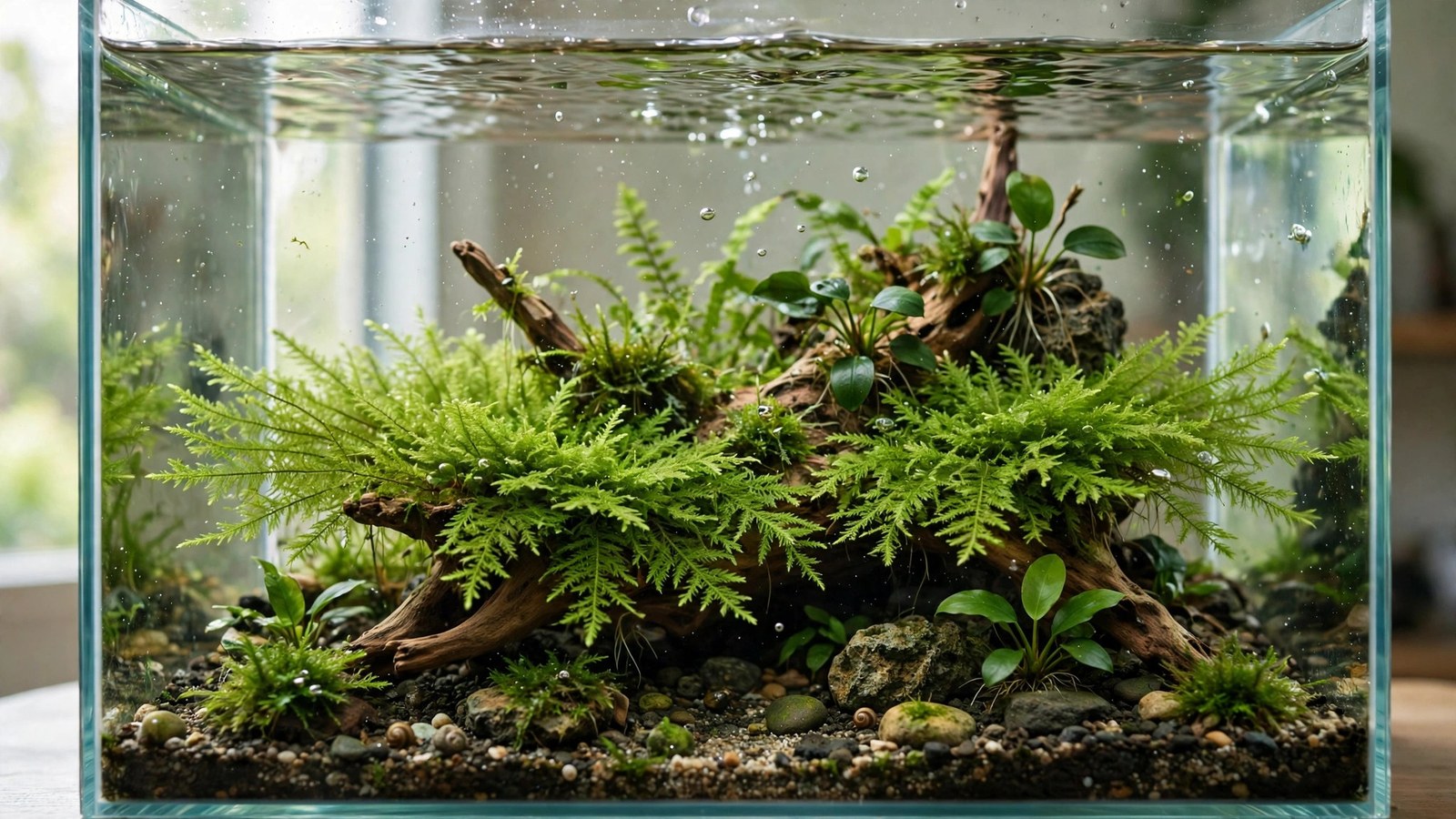
Most mosses grow one predictable way: they creep outward from wherever you tied them down, and you wait. Cameroon moss — sold as both "cameroon moss" and "cameroun moss" — refuses that script. It spreads sideways across rock and wood, building rubbery, fern-like fronds no other aquarium moss produces, and its dense mats are some of the best baby-shrimp shelter in the hobby.
Is cameroon moss hard to grow? Not if you respect its slow start. It thrives without CO2 at 20–25°C, pH 5.5–7.0, and 30–60 PAR. Its signature trait — unique among aquarium mosses — is lateral spreading: rather than growing outward from the attachment point like java or christmas moss, it creeps sideways across hardscape, and trimming the tips feeds the dense mats that shelter baby shrimp.
What Makes Cameroon Moss Different From Every Other Aquarium Moss
If you're still choosing a moss, our comparison of the best aquarium mosses side by side puts it in context — but this plant's differences are structural. It belongs to the liverwort family Plagiochilaceae, which explains the rubbery, fern-like fronds. Touch a portion underwater: it feels firm, almost plastic. That's not a defect — it's the plant's identity.
It is also not pearl moss. Pearl moss (Plagiomnium cf. affine, see our pearl moss care guide) is a separate organism with finer, brighter texture. Some sellers blur the two because both are rare and pricey — confirm the fern-like fronds before you buy.
| Trait | Cameroon moss | Typical trade mosses |
|---|---|---|
| Family | Liverwort (Plagiochilaceae) | True mosses |
| Growth | Spreads laterally across hardscape | Outward from attachment point |
| Texture | Rubbery, fern-like fronds | Fine, feathery strands |
| Start-up | Slow for 4–8 weeks | Fast from day one |
| CO2 | Not required | Not required |
How cameroon moss grows: the lateral-spreading habit
Almost every aquarium moss colonizes by extending outward from its tie point, slowly thickening around the anchor. Cameroon moss does something else: once settled, it sends growth sideways, creeping along rock and driftwood and colonizing new ground from its edges. Given a year, one anchored portion can sheet across an entire hardscape feature.
That habit flips pruning on its head. Snipping the tips signals the moss to invest in lateral runners. Gentle trims with fine aquascaping scissors produce thicker, more carpet-like coverage than leaving it alone. Expect 4–8 weeks of barely-visible growth while rhizoids grip the surface; once attached, growth accelerates and the fronds deepen in color.
Water, Light, and Temperature: The Parameters It Actually Wants
Cameroon moss is a true low-tech moss: no CO2 injection, no demanding fertilizer schedule. Stay inside the ranges below and it largely takes care of itself.
| Parameter | Target | Notes |
|---|---|---|
| Temperature | 20–25°C (68–77°F) | Above 28°C stalls growth |
| pH | 5.5–7.0 | Mildly acidic soft water is best |
| Light | 30–60 PAR | Too little = leggy; too much = algae on slow fronds |
| CO2 | Not required | Injected CO2 speeds growth but is optional |
| Flow | Gentle–moderate | Prevents detritus settling in dense mats |
| Water changes | 25–30% weekly | Clean, stable water beats any additive |
The most common failure is heat, not nutrients. Tanks drifting past 28°C in summer slow it to a crawl, which is why cool shrimp tanks are its natural home. Compared to the near-indestructible mosses in our Java moss care guide, cameroon moss is slightly fussier about stability — sudden temperature or pH swings brown the tips — but it never demands high-tech equipment.
Attaching It to Rock and Driftwood
Never bury it in substrate; it must grip hardscape. Cotton or fishing-line thread works well: wrap golf-ball-sized portions snugly against driftwood or textured rock, crossing the thread in several directions. Cotton rots away in 4–6 weeks, just as rhizoids take over.
Cyanoacrylate gel super glue is the faster option. Dab a small amount on the rock, press a thin tuft into it for 20 seconds, and let it cure before submerging. Gel beats liquid — it stays put instead of wicking into the fronds.
Pruning and Propagation: Working With the Sideways Habit
Prune every 3–4 weeks once established, trimming the leading tips lightly with sharp, fine-tipped scissors. Each cut encourages branching and lateral runners — the exact mechanism that converts a lumpy portion into a smooth sheet over driftwood.
Propagation is simple: every trimmed piece is a new plant. Press trimmings onto fresh hardscape with thread or a dab of gel glue and they'll root within weeks. Keep a small "nursery" stone in the tank so you always have starter portions for new scapes.
Shrimp Tanks: The Real Reason Breeders Chase This Moss
This is where cameroon moss earns its price. The dense, rubbery mats form a three-dimensional maze that baby shrimp use as a nursery — fronds too tight for hungry fish mouths to follow. Shrimp don't eat the moss, so the structure survives grazing; they farm biofilm off its surfaces all day, making the mat a constant food source for newborns.
Anchor it across several low foreground rocks, where shrimplets actually live, rather than one tall feature. It layers well with other fine mosses — willow moss on vertical wood and peacock moss on midground stones give varied shelter textures. On a budget, start with Christmas moss for instant coverage and add cameroon moss as the centerpiece later.
Sourcing It: Honest Expectations About Rarity
Realistic sources are specialist online retailers, hobbyist swap forums, and local club auctions. Expect to pay noticeably more per portion than java or christmas moss, and expect to wait when it's out of stock.
Verify the identity before you buy: ask the seller whether it's the Plagiochilaceae sp. and look for the rubbery fern-like fronds. If it looks like fine bright-green threads, you're likely being offered a different species at collector prices. Also buy healthy stock — brown or algae-coated portions can take months to recover.
Frequently Asked Questions
Is cameroon moss the same as pearl moss?
No — they are different organisms, and confusing them is the hobby's most common cameroon moss mistake. Trade cameroon moss is a Plagiochilaceae sp. with rubbery, fern-like fronds and lateral-spreading growth. Pearl moss is Plagiomnium cf. affine, a finer, brighter true moss. Confirm the fern-like texture before paying collector prices.
Does cameroon moss need CO2?
No, CO2 injection is not required. Cameroon moss thrives in low-tech tanks at 20–25°C, pH 5.5–7.0, and 30–60 PAR without injected CO2. Added CO2 will speed established growth, but it is strictly optional — stable, clean water matters far more than carbon supplementation.
Why is my cameroon moss growing so slowly?
Slow growth for the first 4–8 weeks is normal — the moss is building rhizoids to grip the hardscape. If it stays stagnant beyond two months, check temperature (keep it under 28°C), raise light toward 40–60 PAR, and clear detritus smothering the fronds. Once anchored, growth accelerates noticeably.
How do you make cameroon moss spread?
Trim the leading tips every 3–4 weeks with fine aquascaping scissors. Cameroon moss responds to pruning by investing in lateral runners that creep sideways across rock and wood. Light, frequent shaping beats heavy shearing: you are feeding the sideways creep that builds its signature dense mats.
Is cameroon moss good for shrimp tanks?
It's one of the best mosses for shrimp breeding tanks. The dense, rubbery mats form tight shelter that baby shrimp use as a nursery, safe from fish, while grazing biofilm off the fronds. Shrimp don't eat the moss itself, so the structure lasts. Anchor it across low foreground rocks for maximum benefit.
Cameroon moss rewards the patient aquascaper: a slow, unremarkable start, then a creeping green sheet no other moss can replicate. Give it cool, clean water, sensible light, and a few months — and you'll own one of the most distinctive textures in the hobby.