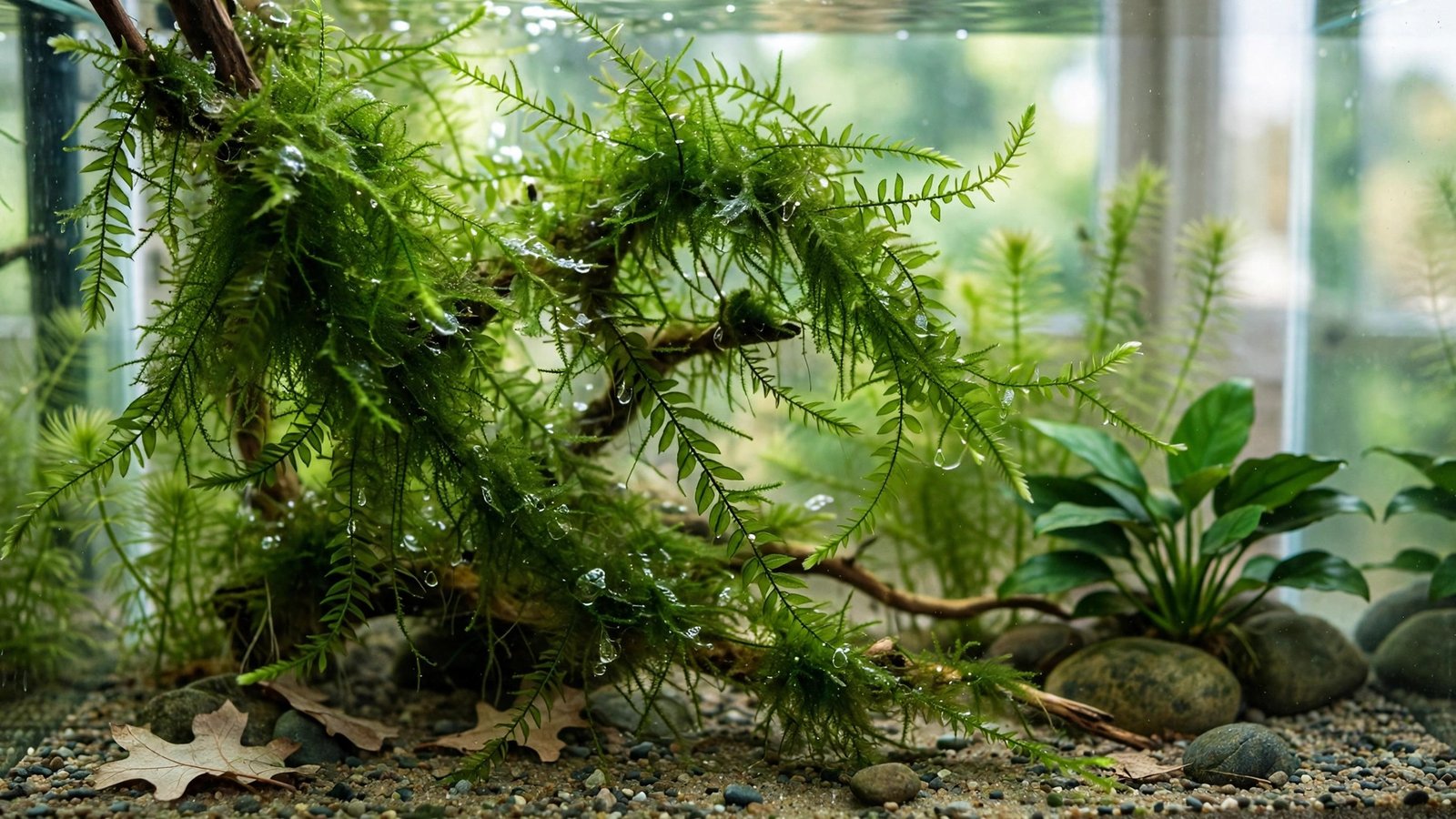
Most aquarium mosses are tropical, and most aquarists treat them that way — warm water, modest flow, slow steady growth. Willow moss breaks that pattern. It is a true cool-water native from European and North American streams that grows better at 18–20°C than at 26°C. This willow moss aquarium care guide covers attachment, flow, parameters, and propagation.
Why willow moss is not like the tropical mosses
Java, christmas, flame, peacock, and taiwan mosses all hail from warm Asian waters. Willow moss comes from a different world: clean, cold, oxygen-rich streams in the northern hemisphere, where it clings to stones and submerged logs in the current. Its leaves are longer and more pointed than java moss, arranged in three rows along stems that reach 60 cm in the wild — the "willow" in its name refers to how those fronds stream downstream.
In cool, unheated tanks it accelerates where java moss slows down. If you keep an unheated room-temperature tank or a coldwater goldfish or hillstream setup, willow moss is one of the few mosses that treats those conditions as ideal. See the best aquarium mosses compared for the full rundown.
willow moss aquarium care
Temperature: the cool-water sweet spot
The ideal range is 10–22°C (50–72°F), with the fastest, healthiest growth around 15–20°C. It survives brief dips to 4°C and tolerates short spells to 26°C, but sustained water above 26°C is the number one killer: fronds brown from the base and algae colonize the dying tissue. If your tank never drops below 25°C in summer, choose a different moss — or run a fan across the surface to pull 2–3°C off.
Light, nutrients, and CO2
Willow moss needs low to medium light (roughly 15–30 PAR at the moss). High light with no CO2 grows algae, not moss. CO2 injection is genuinely unnecessary — this moss evolved in CO2-poor streams. A weekly half-dose of any all-in-one liquid fertilizer covers its needs; it absorbs nutrients entirely through its leaves.
Water chemistry and flow
It accepts pH 5.0–7.5 and carbonate hardness from 0–15 dKH, so it suits soft-water tetras and moderately hard livebearer tanks alike. What it really wants is gentle-to-moderate current: stagnant water lets biofilm coat the fronds and invites hair algae. This makes it a natural fit for a low-tech planted tank setup.
Attaching willow moss to wood and rock
Willow moss has no roots — it anchors with rhizoids and must start life tied to something solid. The reliable method:
- Break off a tuft 3–5 cm across and press it against the wood or stone.
- Wrap cotton thread or thin fishing line around it 4–6 times, snug but not strangling.
- Place it in moderate flow and leave it 2–4 weeks while rhizoids grow into the surface.
- Snip the thread once the moss resists a gentle tug. Cotton dissolves on its own; fishing line needs removing.
Alternatively, dab a thin line of cyanoacrylate gel along a stone, press a tuft onto it for 10 seconds, and put the stone back in the tank. Glue sets in minutes — safe for fish and shrimp once cured.
For a wall effect, lay the moss between two sheets of stainless mesh or plastic canvas, zip-tie the edges, and place it flat against the back glass. Growth fills the mesh in 6–10 weeks. It makes an excellent nursery for shrimp — and for a warm-tank counterpart with a similar texture, see our peacock moss care guide.
Propagation by division
Propagation is easy. Every 6–10 weeks, pull a healthy tuft apart into 2–4 pieces with your fingers and tie each piece to a new spot. Because the moss has no root system to disturb, division sets it back barely at all — new fronds emerge from every cut stem within days at cool temperatures. One initial portion can cover a full piece of driftwood in 4–6 months without ever buying more.
Division doubles as maintenance: older tufts accumulate dead fronds underneath the green tips, so split the clump every few months, discard the brown interior, rinse the healthy outer fronds in old tank water, and re-tie them.
Willow moss vs java moss: which one fits your tank?
They suit very different tanks:
| Trait | Willow moss (Fontinalis antipyretica) | Java moss (Taxiphyllum barbieri) |
|---|---|---|
| Temperature range | 10–22°C ideal, stalls above 26°C | 20–30°C, thrives at 24–26°C |
| Growth speed | Slow to moderate | Slow to moderate |
| Texture | Long, pointed, willow-like fronds in 3 rows | Fine, irregular, branching fronds |
| Flow tolerance | Loves current; suffers in still water | Tolerates still water well |
| Best for | Unheated/cool tanks, stream biotopes, shrimp nurseries | Tropical community tanks, breeding mops, general use |
If your heater runs year-round at 26°C, java moss wins — see java moss care. If your tank has no heater or sits at room temperature, willow moss is the better call.
Troubleshooting: browning, algae, and slow growth
- Browning from the base up: temperature too high (above 26°C sustained) or old growth never refreshed. Divide out the brown interior and move to cooler water.
- Hair algae on the fronds: too much light for the nutrient level. Cut light intensity or duration by 25%, add floating plants as shade, and keep current flowing.
- Stringy, leggy growth: too little light or too-still water. Shift the moss into the filter's path and raise light to medium.
- White biofilm on new tufts: harmless bacterial film, common in new tanks. It clears in 1–2 weeks; shrimp and snails eat it gladly.
- Not attaching: tied too loosely or parked in dead flow. Re-tie snugly and relocate to moving water.
Frequently Asked Questions
Does willow moss need CO2?
No. Willow moss evolved in CO2-poor northern streams and grows fine without injection. A weekly half-dose of all-in-one liquid fertilizer is plenty. CO2 won't hurt it, but it's a wasted expense on this species — cool water and current matter far more.
Can willow moss grow floating?
Yes, but it grows densest when attached to wood or rock in current, where it can anchor and spread. Floating tufts survive and grow slowly, though they tend to drift into filter intakes. Attached placement also keeps debris from collecting on the fronds.
Is willow moss safe for shrimp and fry?
Absolutely. Its dense fronds are one of the best nurseries in the hobby — shrimplets and fry hide in it while grazing biofilm off the leaves. Neocaridina shrimp breed exceptionally well in willow moss in unheated tanks. The fronds also trap food particles for constant grazing.
How fast does willow moss grow?
Slow to moderate. At 15–20°C with good flow, expect a tied tuft to double in volume in about 6–8 weeks. Above 26°C it nearly stops growing. In cool water it out-grows most tropical mosses; in warm tanks it stalls. Regular division keeps it dense and growing steadily.
Is willow moss the same as java moss?
No — different genera entirely. Willow moss is Fontinalis antipyretica, a cool-water northern-hemisphere native; java moss is Taxiphyllum barbieri, a warm-water tropical species. Shops often confuse them because both are sold as loose green tufts. Check the leaves: willow's are longer, pointed, and set in three distinct rows.
The verdict: a cool-water specialist worth knowing
Tie a tuft to driftwood, keep the water cool and moving, dose a little liquid fertilizer weekly, and divide it every couple of months — that's the whole care sheet. Pair it with other mosses for variety (flame moss and christmas moss offer completely different textures), but give willow moss the cool, current-swept spots. Its cold-stream ecology is described in the Fontinalis antipyretica species profile, and the Tropica 'Willow' care data lists its aquarium parameters.