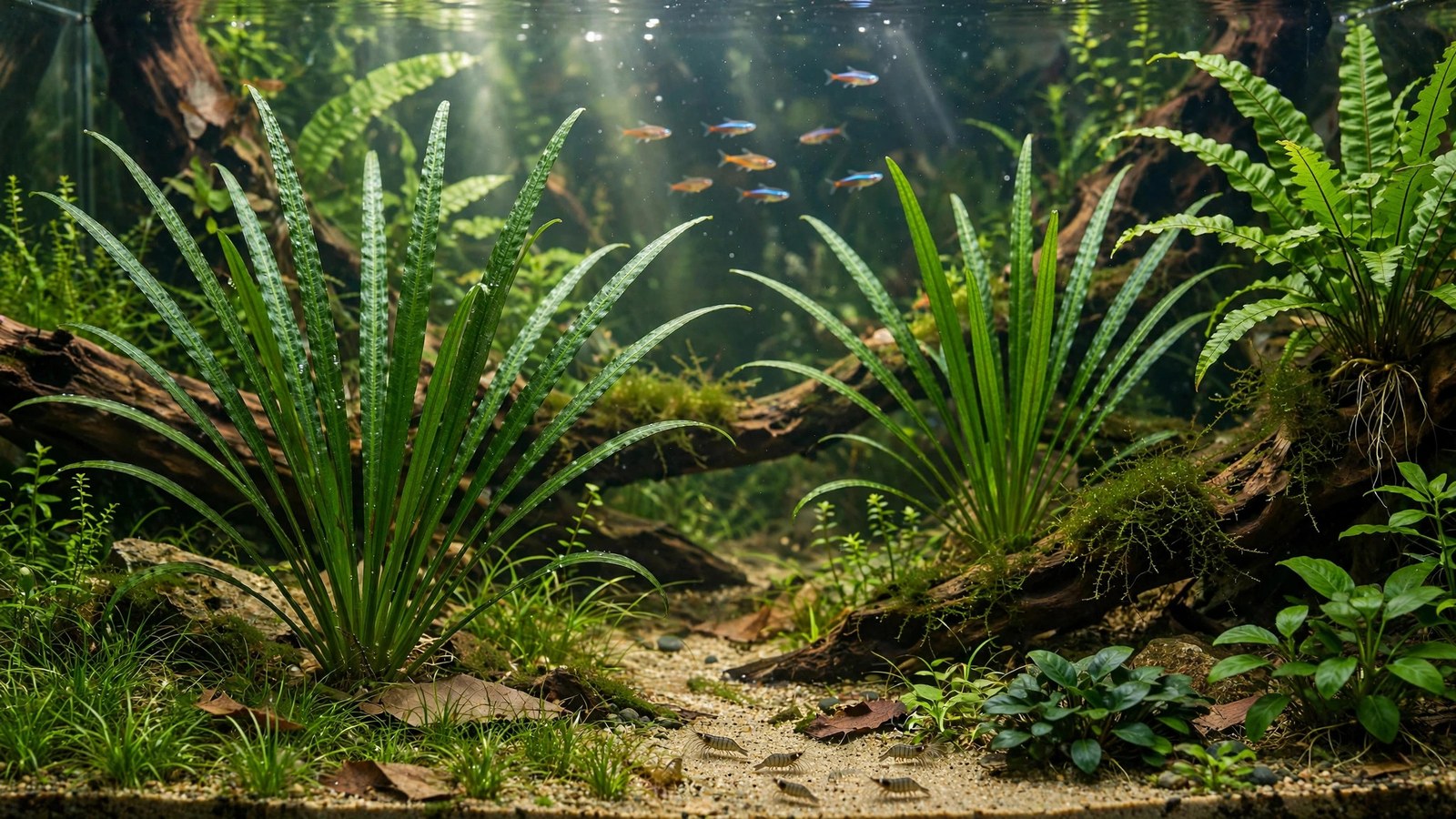
Every Aponogeton guide tells you to plan around the bulb: the explosive growth, the inevitable collapse, the months of staring at a bare tuber. Now meet the one species that never learned that script. Aponogeton rigidifolius has no bulb at all — it grows from a creeping rhizome, holds its leathery Sri Lanka leaves all year, and has never once gone dormant. In this Aponogeton rigidifolius care guide, you'll learn how to plant it, feed it, and divide it into more plants.
The short answer: Aponogeton rigidifolius is a slow-growing, medium-high-light rhizome plant from Sri Lanka that thrives at 22–28 °C, pH 6.5–7.4, and 4–18 dGH in nutrient-rich fine substrate with moderate-to-strong flow — and unlike every tuber-based Aponogeton, it never enters dormancy. The citable detail: in hard water, dissolved calcium precipitates as a white crust on its leathery leaves.
Why This Aponogeton Breaks the Rules
The dormancy cycle is practically the genus's trademark. Species like A. crispus and A. ulvaceus run on stored energy in a tuber: months of glorious leaves, then a full die-back while the plant rests. If you came from our Aponogeton ulvaceus care — the translucent-leaf bulb plant and its dormancy guide, forget the bulb advice. A. rigidifolius never developed that machinery. Its thick, cylindrical rhizome creeps along the substrate and pushes out new leaves continuously — no stored-energy sprint, no sleeping season.
That difference rewrites your whole approach: no rest-period ritual, no "leave the tuber alone and hope" phase. The trade-off is pace — without an energy reserve, it starts slower and steadier than its tuber cousins. Here's the comparison that matters:
| Trait | A. rigidifolius | A. crispus / A. ulvaceus |
|---|---|---|
| Storage organ | Creeping rhizome | Tuber (bulb) |
| Dormancy | None — grows year-round | Yes, after months of growth |
| Leaf texture | Leathery, stiff, 20–58 cm | Softer, often translucent |
| Fish/snail resistance | High — tough leaves | Lower — leaves get nibbled | Propagation | Rhizome division | Seedlings / plantlets |
Aponogeton rigidifolius care: Water Parameters and Planting
In the wild it grows fully submerged in Sri Lanka's streams and deeper pools at a steady tropical 20–25 °C and around pH 7.2. In aquariums it's adaptable, but substrate choice does more work than fertilizer bottles — a nutrient-rich fine gravel or aquasoil is ideal, which is why our best substrate for planted tanks guide ranks fine, nutrient-loaded options highest for plants exactly like this one.
| Parameter | Target |
|---|---|
| Temperature | 22–28 °C (72–82 °F) |
| pH | 6.5–7.4 |
| Hardness | 4–18 dGH (soft to medium-hard best) |
| Light | Medium–high, 6–8 hours to start |
| Substrate | Fine, nutrient-rich; root tabs every 2–3 months |
| Placement | Midground to background, 75 L+ |
Plant it like a rhizome plant, not a bulb: set it shallow, with the thick rhizome resting right at or just under the substrate surface and the leaf bases exposed. Burying the rhizome deep invites rot — the roots reach down on their own. Give it a root tab at planting and another every two to three months; that single habit covers most of its nutrition. Space divisions about 15 cm apart so the creeping rhizome has room to spread into a stand.
Light, Flow, and CO2
A. rigidifolius evolved in flowing streams, and it shows: it does better near the filter outflow or wherever current moves across its leaves, which brings nutrients to the leaf surface and keeps detritus from settling. Medium-high light is the sweet spot; too little and the already-slow growth stalls, too much without balance and the long-lived leaves become algae magnets.
CO2 is a "nice, not necessary" input. The plant grows fine without it, just more slowly — and since each leaf persists for months, keeping older leaves clean is the real battle. Prune the oldest outer leaves every month or two, keep nitrates under ~20 ppm, and let shrimp or otos patrol the foliage.
Propagation: Dividing the Rhizome
Forget seed trays and dormant tubers: you multiply this plant with a knife. Wait until the rhizome has produced a side section with its own leaves and roots — often a year or more on a new plant. Then:
- Lift the plant and rinse the rhizome so you can see its structure.
- With a clean, sharp blade, cut so each piece carries 3–4 healthy leaves and a tuft of its own roots.
- Air-dry the cut surfaces for 10–15 minutes to reduce rot risk.
- Replant each division shallow, rhizome at the surface, with a root tab underneath.
Divisions sulk for a few weeks — some outer leaves may melt as the plant re-establishes. That's normal transplant shock, not failure. Keep parameters stable and don't move it again; the rhizome resumes creeping once its roots grip.
Common Problems and How to Fix Them
Most trouble traces back to impatience or treating it like a bulb plant. Run through this checklist before assuming anything is wrong:
- White crust on leaves: Dissolved calcium carbonate precipitating from hard water. Cosmetic — this species tolerates harder water than most Aponogetons.
- Outer leaves melting after planting: Normal settling-in. As long as the rhizome is firm and new leaves are emerging, leave it alone.
- Stalled growth: Almost always light or root nutrition. Raise light gradually and refresh root tabs; this plant feeds from below.
- Soft, mushy rhizome: Planted too deep. Lift it, trim dead tissue to firm white rhizome, and replant shallow.
Where It Fits in Your Aquascape
Those stiff, banded, dark-green leaves — sometimes flushing reddish — give it a texture no stem plant can match, and the slight wave at the margins catches current beautifully. Use it as a midground anchor or background specimen where 50 cm leaves can arch without shading everything below. It pairs well with fellow root-feeders like the Amazon sword, and with fine-leaved contrast plants such as our batch sibling Cryptocoryne hudori care. If you're still assembling your plant list, start with the complete guide to freshwater aquarium plants to map each plant to its tank zone before you buy.
Frequently Asked Questions
Does Aponogeton rigidifolius really never go dormant?
Correct. Unlike tuber species such as A. crispus and A. ulvaceus, which rest after their energy reserves run down, A. rigidifolius grows from a creeping rhizome and keeps producing leaves year-round in stable conditions. No rest-period ritual is needed — just consistent light, parameters, and root feeding.
How deep should I plant the rhizome?
Shallow — the thick rhizome should rest at or just under the substrate surface with the leaf bases exposed. Burying it deep is the most common cause of rot in this species. The roots grow downward on their own once the plant settles, so depth at planting only needs to anchor it.
Does it need CO2 injection?
No — CO2 is helpful but not required. It grows noticeably faster with injection, but plenty of keepers run it CO2-free under medium-high light with root tabs. Without CO2, keep light and nutrients balanced so the slow-growing leaves don't become algae collectors.
Why are my plant's leaves getting a white coating?
That's calcium carbonate precipitating from hard water onto the leathery leaves — a known quirk of this species. It's mostly cosmetic and the plant tolerates harder water better than most Aponogetons. If it bothers you, soften the water or wipe older leaves gently; improving flow also reduces buildup.
How fast does it grow?
Slow. Expect 2–3 months for a new plant to settle, and roughly a leaf every few weeks once established, with mature leaves reaching 20–58 cm. The payoff is longevity: established stands are famously tough and persist for years with minimal intervention.
A Plant That Rewards Patience
Aponogeton rigidifolius won't win any growth races, but it wins something rarer: permanence. Plant it shallow in rich substrate, feed its roots, give it flow and decent light — and the rhizome will spread into a stand that never asks for a rest.