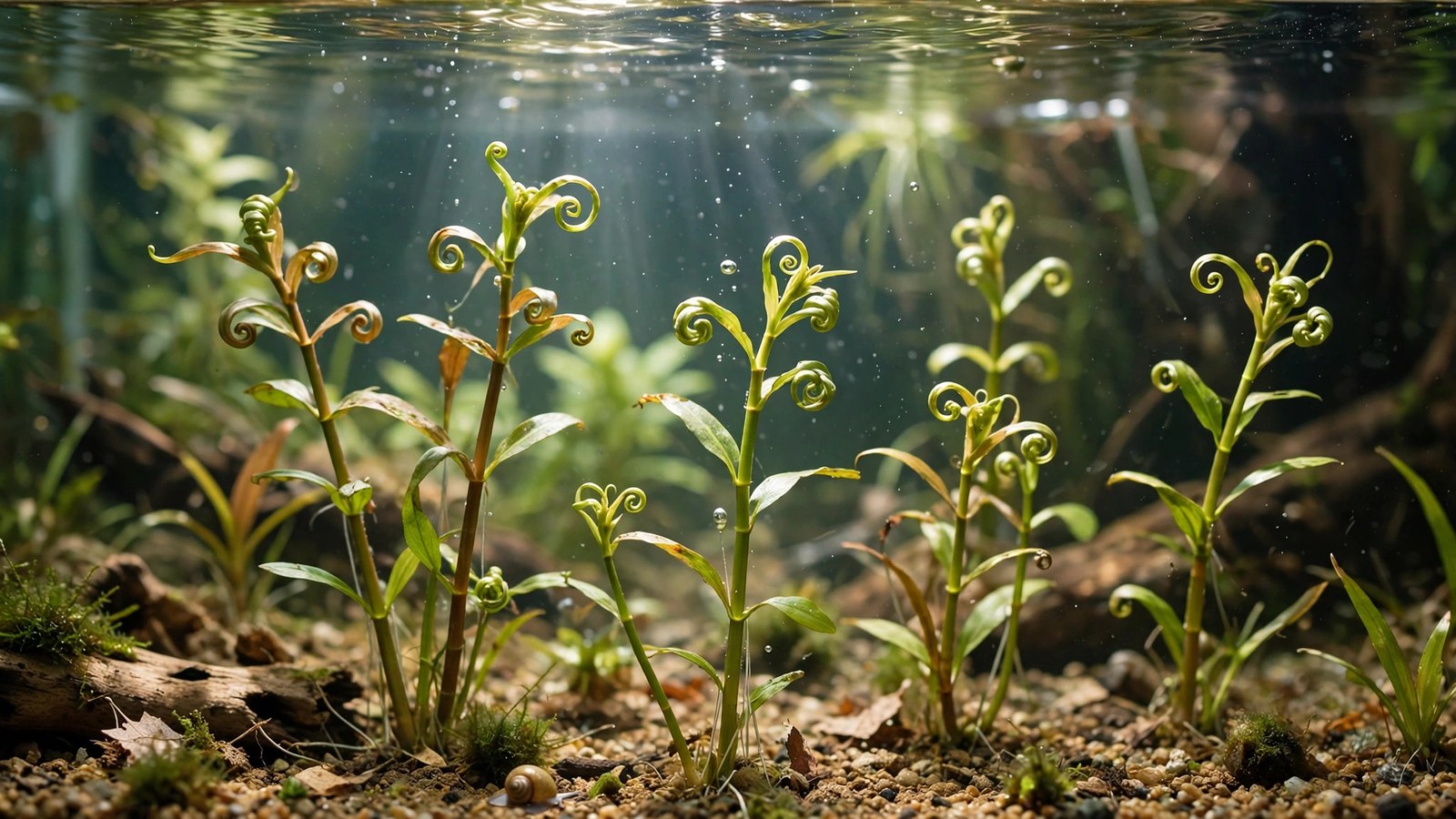
New leaves emerge twisted, curled, and deformed — crinkled like tiny burnt crisps — while old leaves look perfectly normal. Growing tips stall, then die. If your plants' new growth looks tortured while the old foliage is fine, you're seeing calcium deficiency: the immobile-nutrient problem of very soft water, RO systems without remineralization, and occasionally the hidden consequence of "pure water" enthusiasm. It's less common than potassium or nitrogen deficiency, but when it hits, it's unmistakable.
What Calcium Does in Plants
Calcium (Ca) is a secondary macronutrient with structural and signaling roles:
- Cell wall construction — calcium is the mortar of cell walls. New cells literally can't build proper walls without it, which is why deficiency deforms new tissue specifically.
- Cell division — required at growing tips (meristems) where cells divide fastest. Root tips and shoot tips are the hungriest tissues.
- Signal transduction — calcium ions carry stress and environmental signals within the plant.
- Membrane stability — keeps cell membranes intact; deficient membranes leak.
Calcium is immobile in plant tissue — once deposited in old leaves, it stays there. New growth depends entirely on current calcium supply. Cut the supply and the newest tissue fails first: twisted new leaves, dead growing tips, stalled meristems.
Symptoms: The Twisted-New-Growth Signature
The hallmark: deformed NEW growth, normal OLD growth
- New leaves emerge twisted, curled, cupped, or crinkled — distorted shapes, sometimes with hooked tips.
- Growing tips die back — the apical meristem browns and stops; side shoots may try and also deform ("witches' broom" effect in stem plants).
- Leaf edges may brown on new leaves (tip burn), distinct from potassium's old-leaf edge burn.
- Roots stunt — root tips brown and stop extending; new transplants fail to establish.
- Old leaves remain completely normal — this old-vs-new split is the diagnosis.
Advanced deficiency
- Multiple growing tips die; plant becomes a cluster of stunted, deformed shoots.
- New leaves may emerge pale and twisted (combined calcium + iron issues in very pure water).
- Overall growth halts — not slowed, halted, because meristems can't function.
What calcium deficiency is NOT
- Pale new leaves WITHOUT twisting → iron deficiency. See iron deficiency. Calcium twists; iron pales.
- Twisted new growth WITH good water hardness → consider other causes: certain pesticides, extreme CO2 fluctuations, or boron issues (rare). Verify GH is actually low before concluding calcium.
- Old leaves affected → mobile-nutrient issue (N, K, Mg). Calcium never hits old leaves first.
- Melting new growth → see our melting diagnosis guide — melt is tissue dissolution, not deformation.
Causes: The Pure-Water Trap
RO/DI water without remineralization
The classic cause. Reverse-osmosis water is mineral-free — zero calcium, zero magnesium. Keepers who switch to RO for soft-water fish or shrimp but forget to remineralize create a calcium desert. Plants adapted to even moderately hard tap water suddenly can't build cell walls. If you recently switched to RO and new growth twisted within weeks, this is it.
Very soft tap water
Some regions have tap water below 2 dGH — naturally calcium-poor. Tanks in these areas run calcium-deficient indefinitely unless supplemented, especially with fast-growing plants.
Calcium-hungry setups
- Fast-growing stem tanks — high growth rates multiply calcium demand at meristems.
- Snail and shrimp-heavy tanks — invertebrates consume calcium for shells and exoskeletons, competing with plants. A tank full of mystery snails in soft water starves plants of calcium measurably.
- Peat filtration — peat softens water by exchanging minerals, stripping calcium further.
Why it's rarer than you'd think
Most tap water contains adequate calcium — it's the reason GH exists. Calcium deficiency is genuinely uncommon in average tap-water tanks, which is why it's under-discussed. When it appears, there's almost always a soft-water story: RO, rainwater, very soft regional supply, or aggressive softening. If your tap water is moderately hard and new growth twists, look elsewhere first.
The Fix Protocol
Step 1: Test GH and confirm
- Test GH. Below 3 dGH with twisted new growth = calcium deficiency, highly likely.
- Ideally measure calcium specifically (Ca test kits or Ca:Mg ratio) — target roughly 3:1 to 4:1 Ca:Mg.
- Confirm the pattern: deformed new leaves, normal old leaves, dying tips.
Step 2: Add calcium
- GH booster (Ca + Mg balanced) — the correct fix for RO/soft-water tanks. Raises both minerals in proper ratio. Dose per product to reach 4–8 dGH.
- Calcium sulfate (gypsum, CaSO4) — adds calcium without affecting KH/pH. Good when magnesium is already adequate.
- Crushed coral or limestone in the filter — slow-release calcium carbonate; also raises KH and pH. Fine for hard-water setups, wrong for soft-water shrimp tanks.
- Wonder shells / cuttlebone — gradual calcium release; popular in snail/shrimp tanks, benefits plants simultaneously.
Step 3: Remineralize RO water properly (the permanent fix)
- Every RO water change should use remineralized water — a GH booster dosed to your target before the water enters the tank.
- For planted community tanks: target GH 5–8, KH 2–4.
- For Caridina shrimp + plants: GH 4–6 with a shrimp-specific remineralizer (already Ca:Mg balanced).
- Never do large water changes with pure RO — the mineral crash twists new growth within days.
Step 4: Prune and watch
- Trim off deformed growing tips — they won't recover, and removing them encourages healthy side shoots once calcium is restored.
- New growth should emerge normal-shaped within 2 weeks. That's the recovery signal.
- Roots resume extending; transplants start establishing.
Adds calcium plus magnesium and potassium back to soft/RO water: Seachem Equilibrium.
Measure GH before and after dosing so calcium lands in range: API GH & KH Test Kit.
Calcium, Shrimp, and Snails: Shared Need
Like magnesium, calcium is a shared plant-invertebrate need. Shrimp require calcium for molting; snails for shells. The soft-water tank that twists plant tips is usually also producing shrimp with molting problems and snails with thin, pitted shells. One remineralization fix serves the whole ecosystem — plants, shrimp, and snails all recover together. If your snails' shells look eroded and new plant growth twists, calcium deficiency is essentially confirmed before you even test.
Calcium vs. Magnesium: Dosing Them Together
Never fix calcium in isolation when magnesium is also low — and in RO/soft-water tanks, both are always low. Dosing calcium alone into magnesium-poor water creates a worse imbalance (excess Ca antagonizes Mg uptake). Always use a balanced Ca+Mg product or dose both minerals together. The 3:1–4:1 Ca:Mg ratio matters more than either absolute number. Our magnesium deficiency guide covers the other half of this pair.
Calcium and Water Changes: The Dilution Trap
Even in hard-water areas, calcium deficiency can sneak in through excessive RO dilution. Keepers who blend RO with tap "to soften things a bit" sometimes drift toward mostly-RO blends over time — each water change diluting minerals a little further, month after month, until new growth starts twisting and nobody connects it to the slowly shifting blend ratio. If you blend, fix the ratio and stick to it — mark it on the wall if you must — and remineralize the RO portion to a known GH before mixing. Drifting blends are silent deficiency factories.
Frequently Asked Questions
Calcium deficiency often travels with general growth problems — if your plants are stalling beyond just twisted tips, our plants not growing guide walks through the full diagnostic chain.
How is calcium deficiency different from iron deficiency?
Both hit new growth, but differently: calcium twists and deforms new leaves (structural failure — cell walls can't form), while iron pales them (chlorophyll failure — leaves can't green up). Twisted + greenish = calcium. Pale + normal-shaped = iron. Both at once (pale AND twisted) happens in pure RO water with no remineralization — fix with a complete GH booster covering both.
Will calcium deficiency kill the plant?
Eventually, if meristems keep dying — a plant that can't produce functional growing tips can't grow. But it's slow: weeks of deformed growth before real danger. And recovery is complete — once calcium is restored, new tips emerge normal and the plant resumes as if nothing happened. Trim the deformed sections and let it rebuild.
Can hard water cause calcium problems?
Deficiency, no — but imbalance, yes. Extremely calcium-heavy water (limestone aquifers, coral substrate) can antagonize magnesium and potassium uptake, producing their deficiency symptoms in calcium-rich water. If your water is liquid rock and plants still struggle, test the full mineral picture rather than assuming "hard water = fine." Sometimes the fix is softer water, not harder.
Do I need calcium if I only keep anubias and java fern?
Less urgently — slow growers need less calcium per week. But they still need some; months in zero-calcium RO water will eventually deform even anubias's new leaves (slowly — you might not notice for half a year). Any RO-based tank, regardless of planting, should be remineralized. It's not optional husbandry; it's the water itself.
My new leaves twist but my GH is 8. What's going on?
Then it's probably not calcium. At GH 8, calcium is abundant — look at boron (rare, but causes similar tip deformation), pesticide contamination (new plants treated with insecticides), or extreme CO2/pH swings deforming tender new tissue. Also verify the GH test is current — test kits expire, and "GH 8" from a two-year-old kit may be fiction. When the obvious answer doesn't fit, re-test before theorizing.
Respect the Mortar
Calcium deficiency is the soft-water keeper's rite of passage — the lesson that pure water isn't perfect water. Test your GH, remineralize your RO, keep the Ca:Mg ratio sane, and new leaves will emerge flat, smooth, and properly built. The twisted tips straighten out in the only way that matters: the next generation of growth, built with proper mortar.