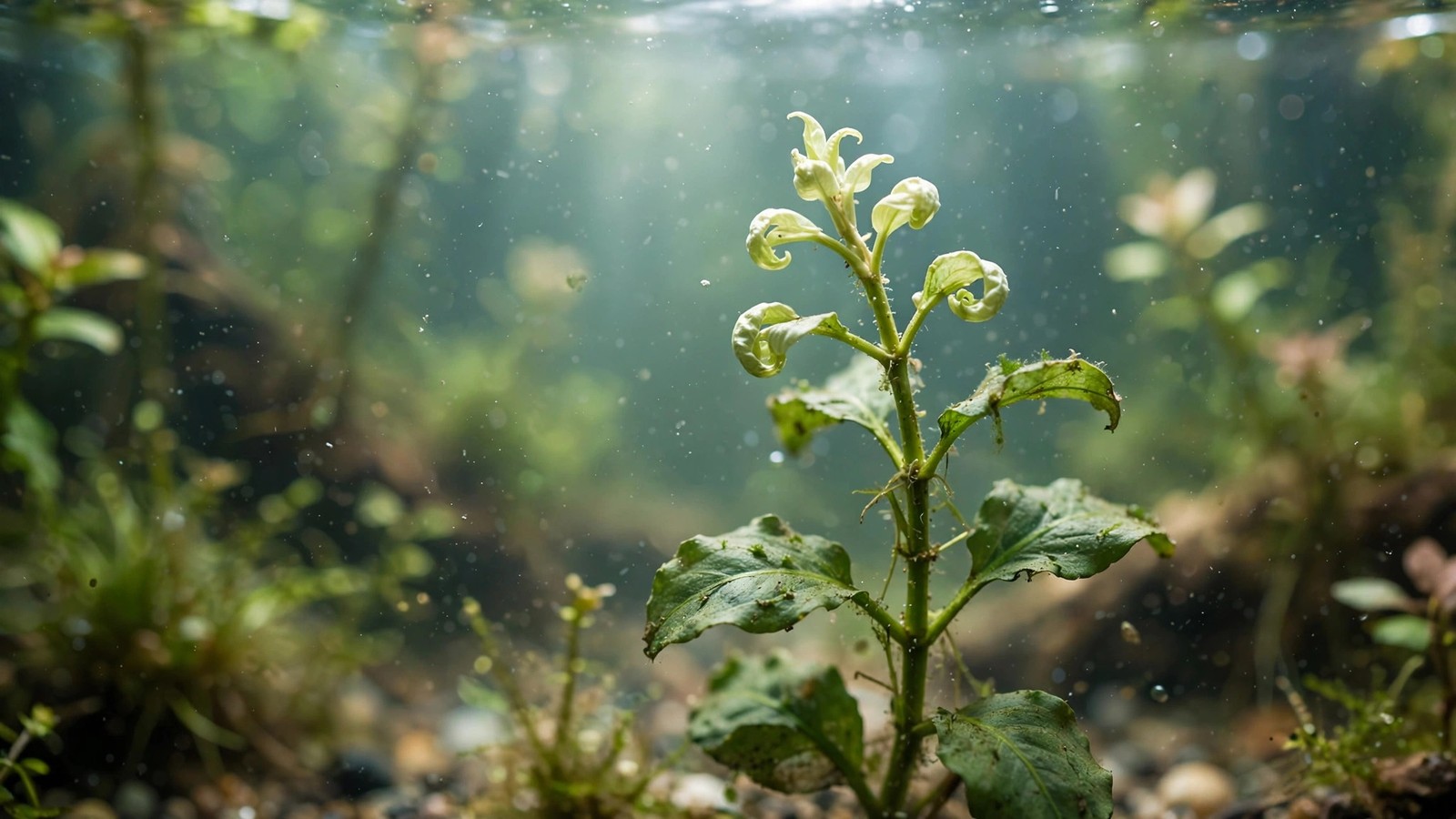
Your plants are alive, but every new leaf emerges small, crinkled, twisted, or misshapen while the older foliage looks fine. That is stunted aquarium plant growth — one of the most misdiagnosed problems in the hobby, because "not growing" and "growing wrong" get treated as the same thing. They aren't. A stalled plant is usually missing a macro growth driver like carbon or light. A stunted plant is growing, but each new leaf comes out deformed — a signature pointing at CO2 distribution failures, immobile nutrients like calcium, or roots that have run out of room. This guide shows how to tell stunting apart from melt and deficiency, how to read new leaves to pin down the cause, and the fixes that restore normal growth.
What "Stunted" Actually Means (And What It Isn't)
Stunted growth has one defining feature: the newest growth is abnormal. Leaves unfurl smaller than they should, edges crinkle or curl, tips hook, stems twist, and internodes compress so the plant looks compacted instead of lush. The older leaves may look perfectly healthy — which is exactly what makes it confusing.
- Melt — tissue softens, turns translucent, and disintegrates, usually all at once after a move or parameter swing. Stunted plants don't melt; their tissue is firm and intact, just malformed.
- Mobile-nutrient deficiency — yellowing, holes, or browning that starts on the oldest leaves (the plant robs old growth to feed new). Stunting shows on the youngest leaves.
- Stalled growth — the plant simply sits unchanged, neither dying nor growing. That's usually CO2 or light below the growth threshold: a different diagnosis.
- Algae damage — algae coats leaves; it doesn't deform them. Clean surface but wrong shape means the problem is inside the plant.
A useful rule: melt kills tissue, deficiency discolors tissue, stunting deforms tissue. Once framed that way, the new leaves become a diagnostic readout — and they are remarkably honest about what's missing.
Diagnosing Stunted Aquarium Plant Growth: Read the Newest Leaves
Nutrients divide into mobile and immobile. Mobile nutrients (nitrogen, phosphorus, potassium, magnesium) can be relocated inside the plant, so shortages appear on old leaves first. Immobile nutrients (calcium, iron, boron) cannot move, so shortages appear on new growth first. Twisted, undersized new leaves are therefore the classic signature of an immobile-nutrient problem — or a transport failure that behaves like one.
Twisted, curled, crinkled, or hooked new leaves
This is the textbook calcium signature. Calcium builds cell walls; without enough at the growing tip, new cells collapse as they expand, producing curled, twisted, or hooked leaves. Expect it in soft-water tanks (very soft tap water can be nearly calcium-free), with lean fertilizers that skimp on calcium — and paradoxically in hard water, where extreme magnesium or potassium antagonizes calcium uptake, or where CO2-driven growth outpaces supply.
New leaves much smaller than old ones, but normally shaped
Miniature but well-formed leaves mean the plant has building blocks but not the energy budget. Prime suspects: CO2 limitation (in injected tanks, almost always distribution/flow rather than bubble count) and light too weak for the plant's demands. Root-bound swords and heavy root feeders show this too — a choked root mass can't supply what new leaves demand.
Pale, yellowish, or glassy new growth
Chlorosis on new leaves (yellow with green veins, or uniformly washed out) points at iron or other immobile micros. Pale plus deformed is an immobile-nutrient double signal; pale but well-shaped is a micro-dosing issue.
Cause-by-Symptom Diagnosis Table
| What the new growth looks like | Most likely causes (in order) | First thing to check |
|---|---|---|
| Twisted, curled, crinkled, hooked tips | Calcium deficiency; Ca antagonism from excess K/Mg; boron shortage (rare) | GH and Ca:Mg ratio; fertilizer's calcium content |
| Leaves much smaller than mature ones, normal shape | CO2 distribution failure; light too weak; root-bound root feeders | Drop checker in the dead spot; flow pattern; root mass |
| Deformed on one side of the tank or one plant group only | Localized CO2/flow dead zone; one exhausted substrate patch | Where the filter outflow actually reaches |
| Pale or yellow new leaves, sometimes green-veined | Iron deficiency; general micronutrient shortfall | Micro dosing schedule; chelate type vs pH |
| Stems fork, split, or grow in zigzags | Tip damage; calcium shortage; grazers on meristems | Look for grazers; check calcium |
| Everything stunted right after a rescape or move | Transplant shock; damaged roots; parameter swing | Give it 2–3 weeks before changing anything |
| Stunting plus an algae explosion on the same plants | CO2 instability (the classic trigger for both) | CO2 timing vs lights; surface agitation |
CO2 Distribution: The Cause Everyone Misses
In injected tanks, genuine CO2 shortage is rare — CO2 distribution failure is epidemic. The drop checker reads green near the diffuser while the far corner bathes in a fraction of that CO2, and plants there grow small, tight, stunted rosettes. The bubble counter tells you how much CO2 leaves the cylinder; nothing about where it goes. If stunting is patchy — one group stunted while the same species thrives elsewhere — distribution is suspect number one. (For the full symptom set, see our guide to CO2 deficiency signs in aquarium plants.) The stunting-specific workflow:
- Map your flow. Watch fine debris travel. You want a gentle tank-wide gyre reaching every plant group. Dead corners behind hardscape are where stunting lives.
- Move the drop checker to the worst-looking area for 48 hours. Blue-green there while the main area reads lime-green means you found the dead zone — the fix is flow, not more bubbles.
- Reposition the diffuser so mist is dragged across the tank by the filter outflow instead of rising straight up beside the glass.
- Check surface agitation. A ripple is good; churning strips CO2 faster than you inject it, creating instability that stunts tips even when average levels look fine.
- Sync CO2 with lights via a solenoid timer starting 1–2 hours before the photoperiod, so target levels are reached before lights ramp up. Plants stunted by the daily CO2 roller coaster often recover within two weeks of proper timing.
Low-tech tanks get a version of this: in a still tank, dissolved CO2 stratifies and dense plantings locally exhaust it. A small powerhead keeping water moving — not blasting the plants — often unlocks growth that fertilizer never did.
The Calcium and Immobile-Nutrient Angle
Calcium deficiency is the most under-diagnosed cause of stunted new growth, because most all-in-one fertilizers assume your tap water provides it and contain little or none. If you keep soft-water species, use RO water, or live in a soft-water region, that assumption fails — and the first symptom is twisted new leaves.
Test before dosing. A GH kit plus your water report (or a Ca/Mg test) tells you where you stand: most planted tanks do well at 4–8 dGH with a calcium-to-magnesium ratio around 3:1 to 4:1. Near-zero GH plus twisting new leaves makes calcium a strong suspect — our calcium deficiency in aquarium plants guide walks through the full symptom set. Fix it by remineralizing with a GH booster containing calcium (calcium sulfate or a commercial GH+ product), raising GH gradually — a degree or two per water change — since stability beats magic numbers.
Two complications matter. First, antagonism: very high potassium or magnesium blocks calcium uptake even when calcium is present, so heavy potassium dosing can produce calcium-deficiency symptoms with a "fine" GH reading — back potassium off before adding calcium. Second, CO2-driven demand: fix a CO2 problem and growth accelerates, jumping calcium demand with it — stunting that appears right after improving CO2 is often supply failing to keep up. For the broader deficiency picture, see our aquarium plant nutrient deficiency guide and the potassium deficiency in aquarium plants guide. For a deeper dive into how calcium and other minerals function in aquatic plants, the classic Wet Web Media article on major and minor aquatic plant nutrients describes calcium shortage as producing "dwarfed, gnarled growth" — the textbook stunting signature.
Root-Bound Plants and the Replanting Fix
Heavy root feeders — Amazon swords, cryptocorynes, vallisneria, large lotus — can stunt themselves from below. In a year-old tank a sword's root mass can exhaust its local nutrient pocket and strangle its own new roots. The signature: a mature plant whose new leaves emerge progressively smaller over months while everything else grows normally. Stem plants show a related pattern when bases rot or compact in deep substrate — the rotting stem base problem starves the crown even though the top looks fine.
The fix: pull the plant, trim the root mass back by a third to a half (healthy white roots regrow fast), refresh the pocket with new root tabs, and replant. Crypts and swords may sulk for a week or two — normal transplant behavior, not a new problem. Within a month, new leaves should emerge at full size. Make root inspection part of your rescape routine: whenever a root feeder's new leaves shrink for no water-chemistry reason, check the roots before touching the dosing.
Other Suspects Worth Ruling Out
Light too weak — or too strong. Weak light yields small, stretched, pale new growth as the plant rations energy (compare our leggy stem plants fix). Excess light without matching CO2 and nutrients causes tight, compact, sometimes reddened new growth that stalls from photoinhibition. If you recently upgraded lights and stunting followed, cut intensity ~20% before changing anything else.
Over-dosing. Excess micros — especially copper, zinc, and boron — stunt growing tips directly, and it looks frustratingly like deficiency. If stunting appeared after you increased dosing, see over-fertilizing symptoms: halve dosing and do two large water changes before adding anything new.
Transplant shock. Tissue-culture or emersed-grown plants often produce a few deformed leaves while adapting to submerged life. Not a deficiency, needs no treatment — only diagnose stunting on growth appearing after 3+ settled weeks.
Exhausted substrate. Aquasoils and dirted substrates deplete over 12–24 months. When root feeders stunt one by one while water-column feeders stay fine, the substrate — not the water — is empty. Root tabs buy time; a substrate refresh is the real fix.
The Recovery Plan: Fix in the Right Order
Change one thing at a time, giving each step 10–14 days:
- Stabilize first. Consistent CO2 timing, steady photoperiod, regular water changes. Instability stunts tips on its own; no nutrient fix works in a swinging tank.
- Fix distribution. Map flow, reposition the diffuser, confirm with a drop checker in the worst spot. This resolves more stunting than any bottle.
- Test GH; address calcium. Remineralize gradually if GH is very low or Ca:Mg is off; moderate heavy potassium dosing.
- Review micros. Dose iron and traces consistently — daily micro-dosing beats weekly dumps for immobile nutrients. Steady and moderate wins.
- Inspect roots. Pull suspect root feeders, trim, refresh root tabs, replant.
- Prune the damage. Deformed leaves won't repair themselves. Trim stunted stem tops to force side shoots and remove the worst leaves so energy redirects into healthy growth.
Recovery Timeline: What to Expect
Within the first week of a correct fix, growing tips resume extension. By weeks two to three, the first new leaves unfurl — your verdict: full-sized and well-formed means the diagnosis was right. Rosette plants are slower; expect 3–4 weeks before new leaves show normal size. Full recovery typically takes 4–8 weeks for stems and 2–3 months for slow rosettes.
If new growth is still deformed after a month of corrected conditions, the diagnosis missed something: re-test GH, re-check the dead-zone drop checker, and consider stacked causes — CO2 distribution plus calcium is a common pair. And don't "fix" a recovering plant by changing more variables: the surest way to snatch defeat from recovery is impatience. Stable, correct conditions grow plants; constant tweaking grows algae.
Frequently Asked Questions
How can I tell stunted growth apart from normal slow growth?
Slow growth produces normal-looking leaves at a slow pace — small tanks, low light, and slow species all do this legitimately. Stunted growth produces abnormal leaves: twisted, crinkled, hooked, or disproportionately small versus the plant's own older foliage. Compare new leaves against the plant's mature leaves, not other species. Malformed versions of what the plant used to make means stunting, not slowness.
My new leaves are twisted but my water is hard. Can it still be calcium deficiency?
Yes. Hard water guarantees calcium is present, not that the plant can use it. Excess potassium or magnesium antagonizes calcium uptake, and fast CO2-driven growth can outpace supply at the tip even in hard water. Check your Ca:Mg ratio (aim ~3:1 to 4:1), moderate heavy potassium dosing, and note whether stunting began when growth accelerated — that pattern means demand outrunning supply, not absolute shortage.
Will the deformed leaves fix themselves once I correct the problem?
No — finished leaves can't be remodeled, so twisted leaves stay twisted. What matters is the next leaves: within 2–3 weeks of a correct fix, new growth should emerge normal-sized and well-shaped. Prune the worst deformed growth on stems to encourage side shoots, and remove badly crinkled rosette leaves so the plant stops maintaining them. Judge recovery only on new tissue.
Is stunted growth contagious — will it spread to my other plants?
Stunting doesn't spread like disease, but its causes are usually tank-wide. Calcium shortage, CO2 instability, or exhausted substrate will eventually mark every susceptible plant — fast stems first, slow anubias last. If only one plant is affected while neighbors thrive, suspect a local cause: a flow dead zone, a root-bound specimen, or transplant shock. Treat the tank, not just the plant.
Can too much fertilizer cause stunting?
Absolutely — a classic trap: twisted new leaves appear, the hobbyist assumes deficiency, doubles fertilizer, and stunting worsens. Excess micros (copper, zinc, manganese, boron) damage growing tips directly, mimicking deficiency. If stunting followed a dosing increase, halve micros, do two large water changes over a week, and observe for two weeks before adding anything. When in doubt: water-change first, dose second.
How long should I wait before deciding my fix didn't work?
Give any single change a full month, judging only brand-new leaves. Stems show verdicts in 2–3 weeks; rosettes need 3–4. If new growth is still deformed after a month of stable, corrected conditions, revisit the diagnosis — stacked causes (poor CO2 distribution plus low calcium is the most common pair) beat a treatment-resistant single cause. Change one variable at a time so you know what worked.
Stunting Is a Message, Not a Mystery
Twisted, undersized new leaves look alarming, but they're one of the most informative symptoms a planted tank offers — the plant tells you, leaf by leaf, which link broke. Read the new growth, fix distribution before reaching for bottles, verify calcium instead of assuming it, check the roots on heavy feeders, and give recovery the weeks it needs. Do that, and stunted aquarium plant growth becomes a brief, solvable detour on the way to leaves that unfurl exactly as they should.
Tissue-culture plants are the exception — they’re grown in sterile gel and adapt with minimal melting, which is part of what you’re paying for. Plants bought submersed from another hobbyist’s tank also transition with little melt, since they’re already in the right form.
Which Plants Melt Most (and Least)
Heavy melters (expect significant leaf loss)
- Cryptocorynes — infamous for “crypt melt,” sometimes dropping every leaf after any disturbance. They almost always recover from the roots within weeks.
- Stem plants grown emersed — rotala, ludwigia, and hygrophila often shed lower emersed leaves while the growing tips transition.
- Amazon swords — emersed-grown swords typically lose their broad oval aerial leaves and replace them with longer submersed ribbon leaves.
Light melters
- Anubias, java fern, bucephalandra — slow-growing rhizome plants transition gradually; occasional old-leaf melt but rarely dramatic.
- Vallisneria — usually transitions well, though it dislikes the move itself and may sulk for a week.
- Floating plants — minimal melt since their leaves were already at the air-water interface.
The Acclimation Protocol
Step 1: Quarantine or dip first
Before acclimating to your tank’s conditions, make sure you’re not acclimating pests along with the plant. Run new arrivals through our quarantine and dip protocol — it adds days upfront but prevents months of regret.
Step 2: Float to temperature-match (30 minutes)
Float the bag or container in your tank for 20–30 minutes to equalize temperature. Plants are less temperature-sensitive than fish, but a 10°F shock on top of transplant stress is an avoidable insult.
Step 3: Trim before planting
Remove any leaves that are already damaged, yellowing, or heavily algae-covered — they won’t recover and they’ll rot in your tank, feeding algae. For stem plants, trim off the bottom inch and any emersed leaves that look unlikely to adapt; the plant wastes energy maintaining leaves it’s going to shed anyway. Keep the healthy growing tips — that’s where recovery starts.
Step 4: Plant correctly the first time
Follow our planting guide — right depth, crown exposed on rosettes, rhizomes unburied on epiphytes. Every uprooting and replanting restarts the acclimation clock, so get placement right on the first attempt. Decide where each plant goes before it goes in the water.
Step 5: Run a gentle first week
For the first 7 days after planting:
- Moderate light — run your normal photoperiod but consider dropping intensity 20–30% if your light is dimmable. Blast-level light on a melting plant grows algae on the dying leaves, not recovery.
- Stable CO2 — if you inject CO2, keep it consistent. Fluctuating CO2 during acclimation is a melt accelerator. If you’re low-tech, this doesn’t apply — see growing without CO2.
- Half-strength fertilizer — new plants with damaged leaves can’t use full dosing, and the excess feeds algae. Ramp to full strength over 2–3 weeks per our fertilizer schedule.
- No disturbance — don’t move, trim, or “check on” new plants for at least two weeks. Every touch resets root establishment. This is especially critical for crypts.
Step 6: Remove melt, keep the base
As emersed leaves melt, remove the mushy material promptly — decaying leaves release ammonia and grow fungus that can spread to healthy tissue. But never discard the plant while the crown, rhizome, or roots are firm and alive. A crypt that’s lost every leaf but has firm roots is a plant that’s about to recover, not a dead plant. Give it 3–4 weeks before judging.
Telling Normal Melt From Real Problems
Normal transition melt:
- Affects oldest/emersed leaves first, newest growth last
- New submersed leaves emerge even as old ones dissolve
- Roots and crown stay firm and white/green
- Timeline: 1–4 weeks, then obvious new growth
Concerning melt (see our full melting diagnosis guide):
- New growth also melts or emerges deformed
- Rhizome or crown turns mushy and brown — this is rot, not transition
- Entire plant dissolves within days with no new growth after 4+ weeks
- Melting spreads to established plants that weren’t recently moved
Buying Tips to Minimize Melt
- Buy submersed-grown when available — hobbyist-grown cuttings transition with almost no melt.
- Choose tissue culture for sensitive species — crypts and delicate stems establish far more reliably from sterile cups.
- Avoid plants already melting in the store tank — some melt is normal, but a plant that’s mostly mush at purchase has less energy for recovery.
- Transport carefully — keep plants damp and out of direct sun/heat. A plant that dries out or cooks in a hot car melts far worse than one transported properly.
The First-Month Timeline: What to Expect Week by Week
Knowing what’s normal when removes most acclimation anxiety. Here’s the typical timeline for a healthy plant adapting to a new tank:
Week 1: The quiet week
Almost nothing visible happens. The plant is growing roots you can’t see and assessing its new environment. Some species (vallisneria, stem plants) may start shedding their lowest leaves. This is normal. Resist the urge to “help” — no moving, no extra fertilizer, no light changes. The most common beginner mistake is intervening during a week when the correct action is nothing.
Week 2: Melt peaks
This is when emersed leaves give up in earnest. Crypts may drop everything; swords shed their broad aerial leaves; stem plants lose lower foliage. It looks catastrophic and it’s usually fine. Keep removing mushy material, keep conditions stable, and watch the crown and growing tips — if those are firm and green, recovery is already underway.
Week 3: The turn
New submersed-adapted leaves emerge — smaller, thinner, often a slightly different shade of green than the emersed foliage. Stem plant tips start growing visibly; crypts push tiny curled leaves from the crown; swords unfurl narrow ribbon leaves. This is the moment most beginners exhale for the first time.
Week 4+: Established
New growth outpaces melt, and the plant is functionally yours. You can resume full-strength fertilizer, normal trimming, and stop treating it as fragile. Some slow growers (anubias, bucephalandra) take 6–8 weeks to show obvious progress — that’s their normal speed, not a problem.
Acclimating Different Plant Formats
Tissue-culture cups
Sterile, pest-free, and already adapted to high-humidity (not emersed) growth — tissue cultures melt the least of any format. Rinse the agar gel off gently (leftover gel rots and feeds fungus), split the portion into small plantlets, and plant per our planting guide. They establish slowly for the first two weeks, then accelerate. No dip needed, minimal acclimation stress — this is the premium experience you’re paying for.
Potted plants
Remove the pot and strip away the rockwool completely — leftover rockwool traps debris and rots. Tease the root mass apart gently; if it’s a dense mat, splitting it into 2–3 smaller portions actually establishes faster than planting one big clump (more growing points, better water flow around roots). Potted plants are usually emersed-grown, so expect the standard 2–4 week melt cycle.
Bare-root / bunched stems
Typically sold as weighted bunches. Remove any bands, foam, or weights, strip the lower leaves, and plant stems individually or in small groups. Bunched stems from the store are often already transitioning — check for new submersed growth at the tips, which tells you the plant is mid-adaptation and will settle quickly.
Hobbyist cuttings
Already submersed-grown and the fastest to establish — often showing new growth within days. The main acclimation factor is water-parameter difference between the two tanks. Float to temperature-match, plant promptly, and they’ll usually take off with minimal melt. This is why experienced hobbyists prefer trading cuttings over buying potted plants.
Frequently Asked Questions
Should I use a “plant starter” or transplant fertilizer?
Products marketed for transplant shock are mostly B-vitamins and mild hormones. They don’t hurt, but there’s no strong evidence they help aquarium plants specifically. Stable conditions and patience outperform any bottle. Save the money for more plants.
My new plant melted completely — bare crown, no leaves. Is it dead?
Probably not, if the crown or rhizome is firm. Crypts and swords routinely lose 100% of their leaves and regrow from the base within a month. The test is firmness: firm and pale/green means alive; mushy and brown/black means rot. Give firm-but-leafless plants a full 4 weeks before declaring them dead.
Can I speed up acclimation with extra light or CO2?
No — and trying usually backfires. A melting plant can’t use extra light; the excess just grows algae on its dying leaves. Keep light moderate and CO2 stable (not boosted) during acclimation. Growth speed comes from the plant’s own adaptation timeline, which you can’t rush, only avoid delaying.
Should new plants go straight into my main display tank?
After quarantine/dipping, yes — there’s no benefit to a separate “growing-in” tank for most plants. They acclimate to your water fastest in the tank they’ll live in. The exception is very delicate species going into a tank with boisterous fish; give those a few weeks in a calm corner or breeder box first.
The Patience Rule
The single most important acclimation skill is restraint: plant it right, set gentle conditions, remove decay, and then leave it alone for a month. The hobbyists with the best plant growth aren’t doing something clever in week one — they’re simply not interfering in weeks two through four while the plants do what they’ve evolved to do. Melt looks like failure and feels like failure, but in most cases it’s the visible part of a plant successfully becoming yours.