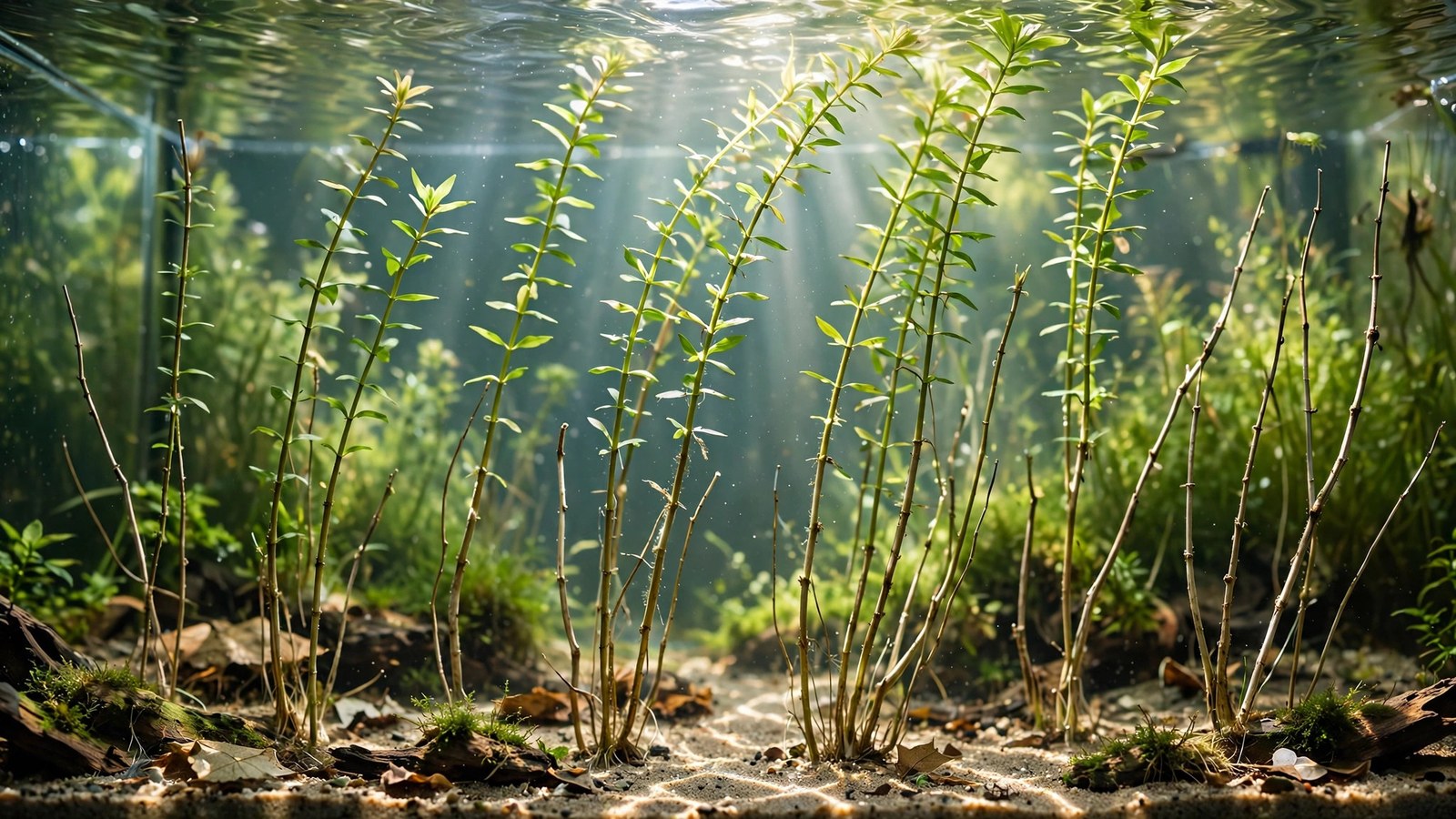
Your stem plants are six inches tall with leaves only on the top two inches — bare, pale stems below and a tuft of growth at the tip, like underwater palm trees. That's legginess: stretched internodes (the stem segments between leaves) caused by the plant reaching desperately for something it isn't getting. Leggy stem plants aren't sick, exactly — they're complaining, loudly, about light, carbon, or both. The fix is part correction, part haircut: diagnose the stretch, then replant the tops for an instantly lush bush.
What Legginess Looks Like
- Long internodes: large gaps between leaf pairs along the stem — the stem stretches instead of bushing.
- Bare lower stems: bottom leaves drop off, leaving naked stem with a tuft at the top.
- Small, pale upper leaves: new growth is undersized and washed-out compared to healthy specimens.
- Leaning toward light: stems bend and curve toward the brightest area — phototropism in action.
- Weak, floppy stems: stretched tissue is structurally weaker; stems flop instead of standing.
Don't confuse legginess with normal lower-leaf shedding in dense plantings (shaded lower leaves drop naturally — that's pruning territory, not a problem) or with potassium deficiency (pinholes in old leaves — see our potassium guide). Legginess is specifically about stretched spacing between healthy-ish leaves.
Causes: What the Plant Is Reaching For
Cause 1: Insufficient light (the big one)
Stems stretch toward light when there isn't enough of it — the single most common cause. Specifically:
- Light too weak for the species — high-demand stems (rotala wallichii, ludwigia super red) under low light stretch hopelessly.
- Light too far — deep tanks with weak fixtures; intensity drops with the square of distance.
- Self-shading — dense planting where lower portions sit in the shadow of the canopy above. The most common scenario: a beautiful bush whose interior is bare because light can't penetrate.
- Floating plants blocking light — a full frogbit cover cuts light dramatically. Thin it or corral it.
- Dirty light fixture — limescale, dust, and condensation on the fixture or lid cut intensity more than you'd think. Clean it.
Cause 2: CO2 limitation
Carbon-starved stems elongate weakly rather than growing compactly. The plant prioritizes reaching (toward potentially better conditions) over dense growth it can't fuel. In injected tanks, fluctuating CO2 produces legginess even when average levels seem fine — the plant never commits to compact growth under unreliable carbon. See our CO2 deficiency signs.
Cause 3: Nutrient imbalance
- Nitrogen excess with low light: plenty of nitrogen fuels elongation, but without adequate light/carbon the growth is stretched and weak — "soft" leggy growth.
- General deficiency: starved plants stretch desperately. But pure nutrient deficiency usually shows leaf symptoms (yellowing, holes) alongside stretch — legginess without leaf symptoms points to light/CO2.
Cause 4: Overcrowding
Stems planted too densely compete for light — each stem shades its neighbors, and all of them stretch upward trying to escape the shade. The classic: a bunch of 20 stems shoved into one spot, all leggy, while a trio planted with spacing in the same tank grows compact. Planting density directly controls legginess.
Cause 5: Wrong species for the tank
Some stems are just leggy by nature in low-energy tanks. Demanding species (rotala macrandra, pogostemon erectus) stretch in anything less than high light + CO2. No amount of pruning fixes a species-tank mismatch — the answer is different plants or upgraded equipment.
The Replant Fix: Turning Leggy into Lush
Here's the beautiful thing about stem plants: legginess is instantly fixable with scissors. The stretched lower stem is worthless, but the healthy top is a perfect new plant.
Step-by-step replant protocol
- Cut the healthy tops: snip each stem 3–4 inches below the healthy top growth, keeping only the compact, good-looking portion. Discard (or compost) the bare lower stems.
- Strip lower leaves from the bottom inch of each cutting — buried leaves rot.
- Replant with spacing: plant cuttings 1–2 cm apart in a staggered grid, not in bunches. Spacing is the anti-legginess — each stem gets light on all sides.
- Plant at an angle (optional pro trick): inserting stems at 45° encourages side shoots from lower nodes, producing bushier regrowth.
- Keep the rooted bases (optional): trimmed stumps left in the substrate usually sprout two side shoots from the top node — free bushiness. Remove them only if they're truly bare and ugly.
After the haircut
- Fix the cause simultaneously — replanting without fixing light/CO2 just grows a new generation of leggy stems. Increase light, stabilize CO2, thin floaters, clean the fixture.
- Trim regularly: don't let stems reach the surface before trimming. Trim when they reach 2/3 of desired height — frequent trims train compact, bushy growth; infrequent trims produce palm trees.
- Replant tops every 2–3 trims: even well-maintained stem beds get woody and bare at the base over months. Periodic full replanting of tops keeps the bed perpetually fresh.
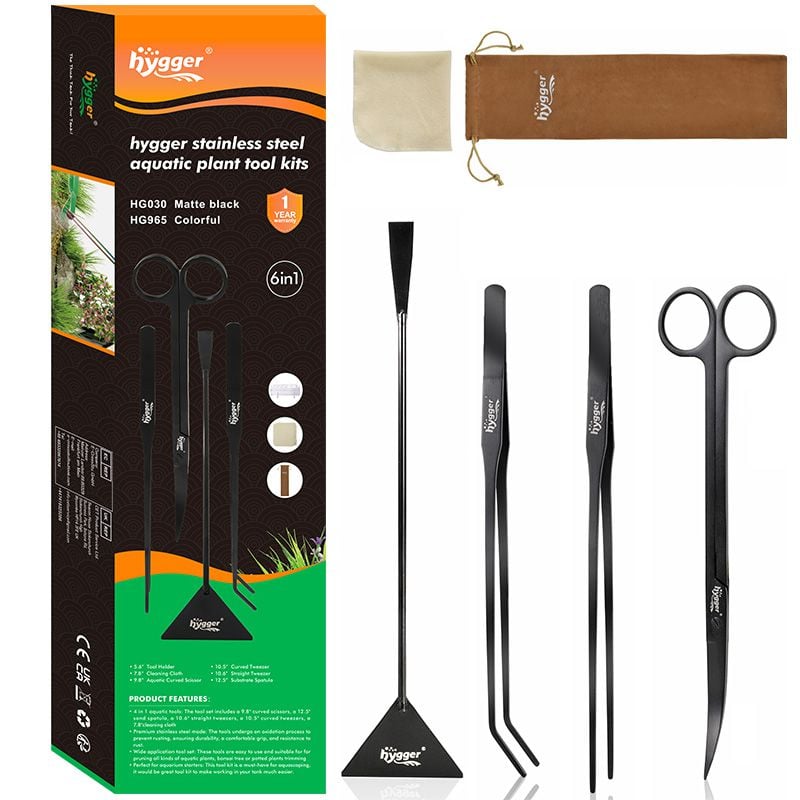
The scissors for the chop-and-replant that turns leggy stems lush: hygger aquascaping tools.
 ★4.6
hygger 6-in-1 Long Aquarium Aquascaping Tools Kit
Check Price on Amazon ★4.6Training Compact Growth: The Long Game
- High light + CO2 + lean-ish nitrogen: the compact-growth formula. Strong light signals "no need to stretch"; stable CO2 fuels dense tissue; moderate (not excessive) nitrogen prevents soft elongation.
- Trim early, trim often: each trim stimulates side shoots — one stem becomes two, two become four. Bushiness is built through repeated trimming, not through letting plants grow tall.
- The "hedge trim": for background stem walls, trim the entire top flat like a hedge. Every cut stem branches, doubling density with each trim cycle. Three hedge trims produce a wall no single planting could.
- Thin ruthlessly: remove every third stem if the bed is overcrowded. Fewer stems with light access outperform many stems in shade.
- Rotate species: if a species stays leggy despite perfect conditions, it's telling you something. Swap it for a naturally compact species (rotala rotundifolia instead of wallichii, ludwigia repens instead of super red) and enjoy the easy win.
Root-zone nutrition that supports compact regrowth: Seachem Flourish Tabs.
Legginess in Specific Situations
New tank legginess
Stems planted in a brand-new tank often stretch during the first month — unsettled CO2, immature biology, cautious light settings. Don't panic-replant immediately; stabilize the tank first (consistent CO2, full photoperiod by week 3), then do the replant fix on whatever's still leggy. Early legginess often self-corrects as the tank matures.
Background stems going leggy while foreground thrives
Classic flow/distribution issue — CO2 and nutrients aren't reaching the back. The foreground gets everything; the background starves and stretches. Improve circulation to the back (reposition the outlet, add a small pump) before blaming light.
One species leggy, others compact
Species mismatch, not a tank problem. That species wants more than your tank provides. Either upgrade conditions or replace it — don't contort the whole tank around one demanding stem. If the whole tank is underperforming beyond just stretch, our plants not growing guide covers the broader diagnostic. And if your stems are also losing their lower leaves to mush rather than just stretching, check stem base rot — a different problem with a different fix.
Frequently Asked Questions
Will leggy stems fill back in on their own if I fix the light?
The new growth will be compact, but the bare lower stem never regrows leaves — those nodes are spent. Fixing light stops future legginess; only the replant fix (cutting tops and replanting) restores the current planting's appearance. Do both: fix the cause, then replant the tops. Within weeks you have a compact bush from what was a palm tree.
How short can I trim stem plants?
Leave at least 2–3 inches of healthy stem with several leaf nodes when cutting tops for replanting — shorter cuttings establish slower and may rot. For hedge-trimming established beds, you can cut quite hard (down to a few inches above substrate) as long as some leaves remain on the stumps — completely defoliated stumps often fail to resprout. The rooted base with leaves = reliable side shoots.
Is legginess a sign my light is too weak overall?
Not necessarily — it's often distribution, not total power. A strong light with dense planting still produces leggy interiors (self-shading). Before buying a stronger fixture: thin the planting, clean the fixture and lid, remove floater overgrowth, and check photoperiod (under 6 hours is too short for most stems). Only if all of those check out and stems still stretch is the fixture itself inadequate.
Why are my stems leggy but my carpet is fine?
Because they experience different light. Carpet plants sit at the substrate directly under the light with nothing shading them; background stems shade each other. The carpet's compactness actually confirms your light is adequate — the stems' legginess is a density/flow issue, not a fixture issue. Thin the stems, improve rear circulation, and replant tops with spacing.
Can I prevent legginess in the first place?
Largely, yes: plant stems with spacing from day one (never bunches), provide adequate light for the species chosen, stabilize CO2 before expecting compact growth, trim early and often starting from the first month, and thin before overcrowding sets in. Prevention is just the maintenance routine done proactively — the keepers with perpetually bushy stems aren't lucky, they're trimming.
Embrace the Scissors
Leggy stems aren't a failure — they're raw material. Every stretched stem is a free top-cutting waiting to become a compact new plant, and every trim doubles your bushiness. Fix the light, stabilize the carbon, plant with spacing, and trim like you mean it. The palm trees become a hedge, the hedge becomes a wall, and legginess becomes a word you only remember when helping beginners. (And when those bushy tops finally color up, our red plants guide shows how to push them from green to crimson.)