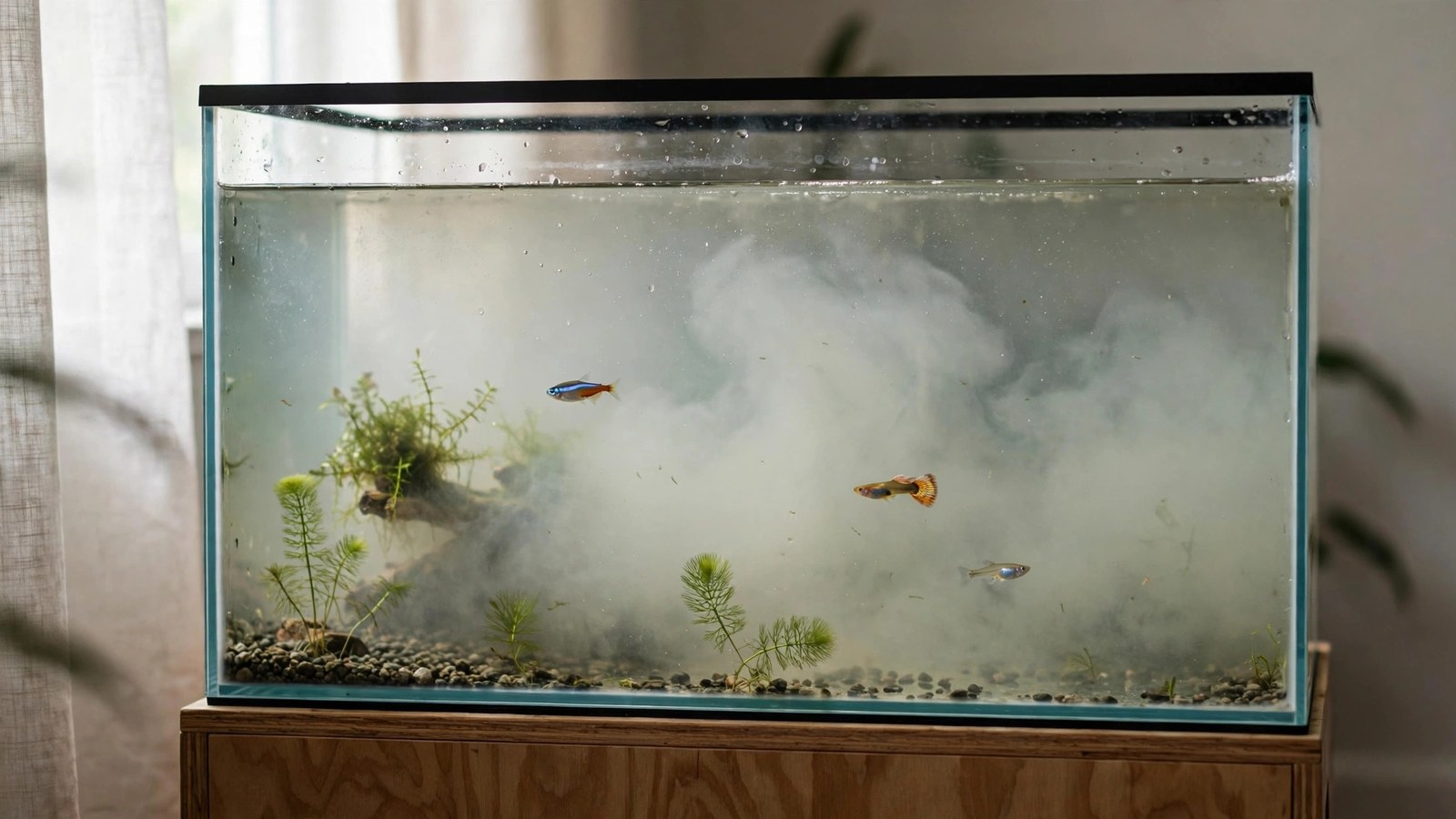
Your fish were swimming happily on Monday. By Friday, two are dead and the rest are gasping at the surface — and the big water change you did on day three probably made it worse, not better. That's new tank syndrome aquarium keepers dread: an ammonia spike striking before your tank's biofilter is ready.
New tank syndrome doesn't mean your tank is defective. It means the bacterial colony that processes fish waste hasn't grown large enough yet, so toxic ammonia builds up. With a test kit, a water-change schedule, and a little math, you can steer almost any new tank through it.
New tank syndrome is the period — typically days 3–21 after setup — when ammonia from fish waste spikes because the beneficial bacteria that neutralize it haven't colonized the filter yet. The key threshold: a liquid test kit reading of 0.5 ppm ammonia or higher means an emergency 50% water change today, not tomorrow.
That rusty brown dust on your glass and leaves during the first weeks isn't a separate disaster — it's the classic companion of an uncycled tank. Read our guide to brown diatom algae in new tanks and how long it lasts.
The New Tank Syndrome Aquarium Timeline: Weeks 1–8
Here's what happens inside a new tank, week by week — so the spikes don't catch you off guard.
| Day range | What's happening | What you do |
|---|---|---|
| Days 1–3 | Ammonia starts rising from fish waste. Readings near zero. | Feed sparingly. Start daily ammonia tests on day 3. |
| Days 4–10 | Ammonia spike. Most dangerous window; 0.5–2+ ppm common. | Test daily. 50% change at 0.5 ppm. Condition every change. |
| Days 10–21 | Ammonia falls; nitrite spike begins. | Test nitrite too. Same change triggers apply. |
| Days 21–42 | Nitrite falls; nitrate rises. The spike cycle is nearly over. | Test every other day. Resume normal feeding gradually. |
| Weeks 6–8 | Ammonia and nitrite read zero consistently. | Weekly testing, then your normal routine. |
Symptoms in Fish: What the Spike Looks Like
Fish die of ammonia and nitrite poisoning, and the signs are specific. Watch for:
- Gasping at the surface or near the filter outflow — ammonia burns the gills and cuts oxygen uptake.
- Red, inflamed gills in light-colored fish — the classic ammonia-burn sign.
- Lethargy, clamped fins, hiding — active yesterday, pinned in a corner today.
- Sudden deaths in the first two weeks with no visible marks — especially tetras, rasboras, and shrimp.
- Erratic darting or rubbing against objects — nitrite interferes with oxygen transport in the blood.
The classic trap: seeing gasping fish and doing a huge water change with untreated tap water, which kills the fragile bacteria that had started growing and resets the clock. Always treat replacement water with conditioner first, and match the temperature.
Symptoms in Plants: Yes, It Hits Them Too
High ammonia doesn't poison plants the way it poisons fish — plants absorb ammonia as fertilizer — but the chaos of the spike period stresses them:
- Melting, translucent leaves in the first two weeks, especially new stems and tissue-culture plants.
- Brown dust on leaves and glass — diatoms feeding on the instability of a new setup.
- Algae on struggling plants — stressed plants leak organics that feed hair algae and black beard algae on plants.
Here's the counterintuitive part: a heavily planted tank with fast growers often sails through the spike with barely a reading, because the plants absorb ammonia themselves. Choosing the easiest aquarium plants for a beginner community tank and planting heavily from day one is one of the best insurance policies you can buy.
Emergency Water-Change Math
During a spike, guessing wastes time. The math most hobbyists use:
- 0.25 ppm: monitor. Test again in 12 hours.
- 0.5 ppm: 50% water change now. This halves 0.5 to 0.25.
- 1.0 ppm: 50% change, wait an hour, another 50% — two halves remove 75% total.
- 2.0 ppm+: back-to-back 50% changes, twice through, re-testing each round.
The rule: each 50% change halves the toxin. A 25% change barely moves the needle — 1.0 ppm becomes 0.75 ppm, still dangerous. During the crisis window, change water on the test reading, not the calendar. Keep replacement water within 1–2°F of tank temperature; thermal shock on top of ammonia poisoning kills fish the spike alone wouldn't.
When Bottled Bacteria and Conditioners Actually Help
Two products get recommended mid-crisis. What each honestly does:
- Bottled bacteria (FritzZyme, Tetra SafeStart, Dr. Tim's): add live nitrifying bacteria directly. Many hobbyists stabilize in 2–3 weeks instead of 6–8. Best added before or at the spike. Keep the bottle refrigerated and check the expiry date; dead bacteria do nothing.
- Ammonia-neutralizing conditioners (Seachem Prime and similar): convert free ammonia into a less toxic form for 24–48 hours, buying time between water changes. But they don't remove ammonia — your kit may still read it. Per Seachem's own Prime product documentation, the effect is temporary, so daily water changes remain the backbone of spike management.
Think of it this way: bottled bacteria shorten the crisis, conditioners soften it, and water changes solve it. The EPA's aquatic life criteria for ammonia shows just how steeply toxicity rises with pH and temperature.
Prevention: Never Do This Twice
- Fishless-cycle every new tank — establish the bacteria colony before livestock arrives. Our cycling guide for planted tanks walks through the full method.
- Or plant heavily and stock slowly — the silent cycling approach: fast-growing plants absorb ammonia while bacteria catch up.
- Never stock a new tank fully on day one. Add a few hardy fish, wait two weeks, test, then add more.
- Keep the test kit. Test weekly for two months, then monthly — and any time fish act strangely.
Frequently Asked Questions
How long does new tank syndrome last?
Typically 6–8 weeks from setup to full stability: ammonia danger in weeks 1–3, nitrite danger in weeks 2–4. Bottled bacteria can shorten this to 2–3 weeks. The tank is done when ammonia and nitrite read zero for a full week under normal feeding.
Can I do water changes during new tank syndrome?
Yes — water changes are the primary emergency tool. Change 50% whenever ammonia or nitrite hits 0.5 ppm, and do back-to-back 50% changes at 1.0 ppm. Always treat replacement water with conditioner and match temperature. The myth that water changes slow cycling is wrong — toxins slow bacterial growth far more.
Will bottled bacteria instantly fix new tank syndrome?
No — nothing works instantly. Bottled bacteria seed the colony and can cut the timeline from 6–8 weeks to 2–3, but you still need daily testing and water changes during the spike. Use a fresh, refrigerated bottle from a reputable brand — never a substitute for water changes.
Is new tank syndrome dangerous for plants?
Less dangerous than for fish, but not harmless. Ammonia itself is plant fertilizer, but new-tank instability melts sensitive species and invites diatoms and algae onto stressed leaves. Heavily planting fast growers like hornwort from day one helps — the plants absorb ammonia and stabilize the tank faster.
How do I know my tank is finally cycled?
When a liquid test kit shows zero ammonia and zero nitrite for seven straight days with normal feeding, while nitrate stays present but manageable (under 40 ppm). That pattern — zero, zero, some nitrate — is the signature of a working biofilter.
The Calm After the Spike
New tank syndrome feels like an emergency, but it's really a waiting game with a test kit in your hand. Test daily, change water on the numbers, leave the filter alone — and in six to eight weeks you'll have a stable, thriving tank.