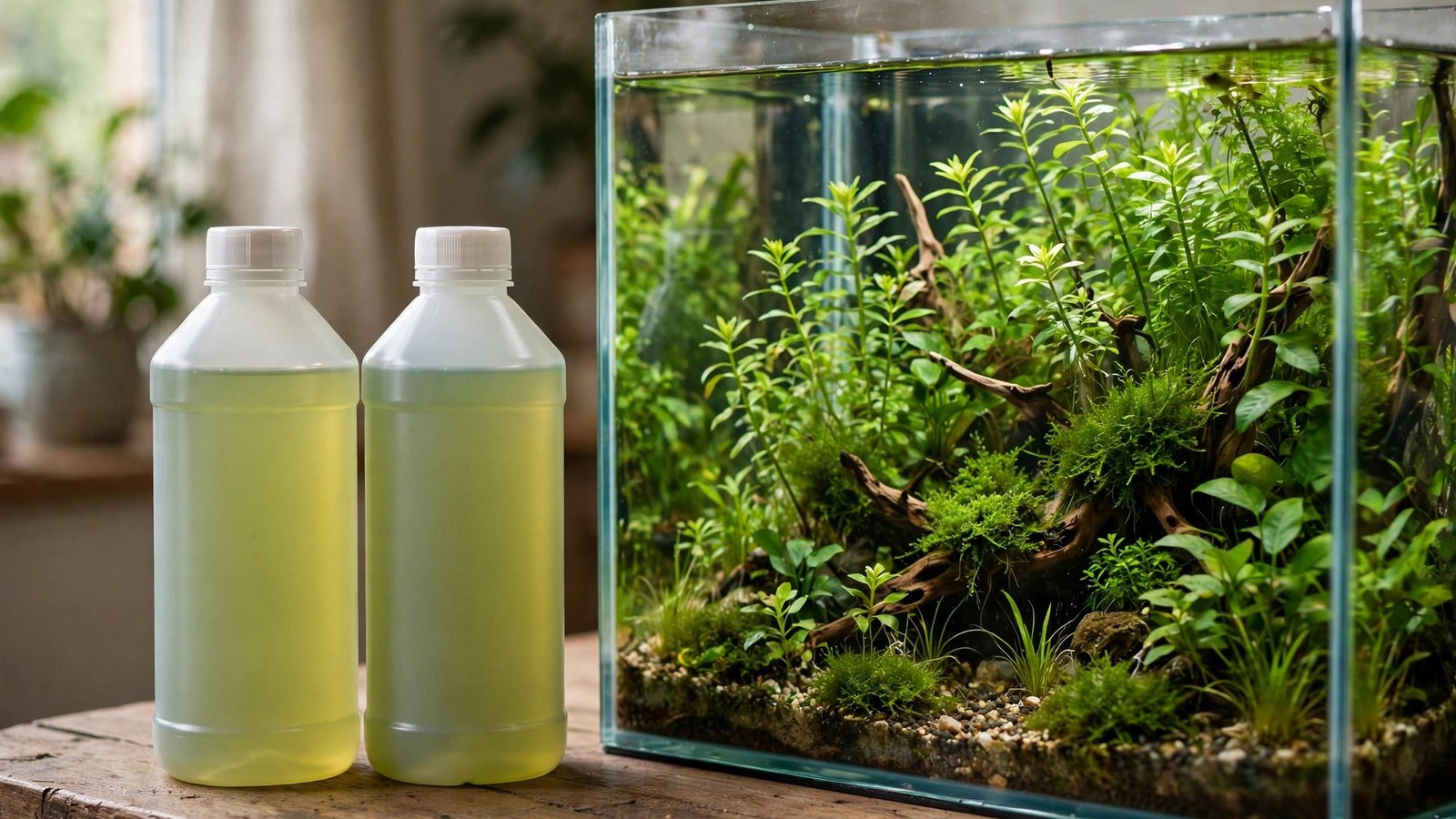
Walk into any aquarium store and you will find two fertilizer bottles with the loudest fan clubs in the hobby: Seachem Flourish and Aquarium Co-Op Easy Green. The seachem flourish vs easy green debate splits plant keepers because these two bottles are not the same kind of product at all — and most people buy one expecting it to be the other.
The Seachem Flourish vs Easy Green question is really about one thing
Does your tank need a vitamin or a full meal? Flourish is the vitamin — trace elements like iron, manganese, and zinc. Easy Green is the full meal — nitrogen, phosphorus, and potassium (the macros) plus those traces, all in one squirt.
That distinction matters because a stocked aquarium already gets plenty of nitrogen and phosphorus from fish food and fish waste. What is missing is usually potassium and trace minerals — exactly the gap Flourish fills. But in a lightly stocked or plant-heavy tank, fish waste cannot keep up, and plants starve for the big three. That is where Easy Green earns its keep. If you are unsure what your water already provides, see whether aquarium plants really need fertilizer and our roundup of the best liquid fertilizers for aquarium plants.
What each bottle actually contains
| Seachem Flourish | Easy Green | |
|---|---|---|
| Type | Comprehensive micro / trace supplement | All-in-one macro + micro fertilizer |
| N-P-K | Essentially 0 (no nitrogen or phosphorus by design) | 2.7-0.5-9 (N 2.66%, P 0.46%, K 9.21%) |
| Macros | None — relies on fish food and waste | Nitrogen, phosphorus, potassium, magnesium |
| Micros | Iron, manganese, zinc, boron, molybdenum, cobalt, copper | Iron, manganese, zinc, boron, molybdenum |
| Standard dose | ~1 ml per 10 gallons, 1–2x weekly | 1 ml per 10 gallons weekly (low light) to 2–3x weekly (medium/high light) |
| Best for | Fish-heavy tanks needing only a trace boost | Beginner low-tech, lightly stocked tanks |
That N-P-K row is the source of nearly every confusion. Flourish contains no usable nitrogen or phosphorus by design — Seachem sells separate nitrogen and potassium bottles for a reason. In a well-stocked tank that is fine: fish supply the macros, Flourish supplies the micros. But in a mostly-plants tank, Flourish alone leaves nitrogen and potassium on the table, and plants show it: pale new growth, pinholes, stalled stems.
Easy Green takes the opposite philosophy. One dose adds about 3 ppm of nitrate plus a potassium-heavy macro load and a full trace package, matching what research says aquatic plants consume most of. For what each trace element does, see our aquarium plant micronutrient dosing guide.
How to dose each one
Easy Green: 1 ml per 10 gallons of tank water. Once a week for low-light tanks (10–20 PAR), twice a week for medium light (20–35 PAR), three times a week for high light (40–50+ PAR). Aquarium Co-Op suggests holding nitrate between 20 and 50 ppm from your dosing — treat the test kit as your dial. The 500 ml bottle treats roughly 5,000 gallons, so check the current price per bottle and do the per-gallon math yourself.
Flourish: roughly 1 ml per 10 gallons, 1–2 times weekly. That is nearly the same per-dose volume as Easy Green. Start weekly in a low-tech tank and step up if you see trace-deficiency signs: pale new leaves, poor red coloration, weak fast growers. Seachem's own dosing thread on its official forum confirms the community consensus of weekly dosing with extra potassium as needed.
Liquids only feed the water column, so pair either with root tabs vs liquid fertilizer, compared for heavy root feeders like swords and crypts — or skip store bottles via our homemade aquarium plant fertilizer guide.
Who wins for which tank?
There is no single winner — only the right bottle for your setup:
- Beginner low-tech tank: Easy Green wins easily: one bottle, one simple dose, nothing to diagnose. For easy low-light species, do low light plants need fertilizer confirms how little most demand.
- Fish-heavy community tank: Flourish wins. Fish waste already supplies nitrogen and phosphorus, so an all-in-one can push nitrate up faster than plants use it. Flourish fills the real gap — potassium and traces — without touching macros.
- High-tech, CO2-injected tank: neither wins alone. Growth under CO2 outpaces either fixed-ratio bottle. You will need dedicated macro dosing — nitrogen and potassium especially — with one of these handling only the micros.
- Brand-new planted tank: hold off on both for the first week or two — When to fertilize a new planted tank explains why early dosing mostly feeds algae.
Can you use them together?
Yes, but think first: Easy Green already contains the same trace elements, so Flourish at full dose doubles up your traces without adding anything new. Combine them only while deficiency symptoms persist — Easy Green at its normal schedule, Flourish at half dose. For most tanks, one bottle is enough.
Both are forgiving — Easy Green is widely used in shrimp tanks, and Flourish's macro-free formula is about as fish-safe as fertilizers get. The real risk is chronic over-dosing: nitrate creeping past 50 ppm, or trace buildup from long-term double dosing. Test nitrate weekly; if it keeps climbing, dose less often.
The bottom line
Remember one thing: Flourish is the vitamin, Easy Green is the full meal. Reach for Easy Green when your tank is light on fish, heavy on plants, or simply new. Reach for Flourish when livestock already covers the macros. And if you run CO2 and high light, stop comparing these two and learn dedicated macro dosing. For reference, Aquarium Co-Op publishes Easy Green's full dosing schedule and guaranteed analysis on its product page — always dose to your test kit readings, not to a schedule you found in an article, including this one.
Frequently Asked Questions
Is Seachem Flourish an all-in-one fertilizer?
No. Flourish is a trace-element (micro) supplement with essentially zero nitrogen, phosphorus, or potassium. Seachem designed it assuming fish food and waste provide the macros, and they sell separate nitrogen and potassium bottles. Treat it as half of a complete regime, not a standalone solution.
Can you use Seachem Flourish and Easy Green together?
Yes, it is safe, but usually unnecessary. Easy Green already includes the trace elements Flourish provides, so both at full dose just doubles your micros. If you combine them, run Easy Green normally and add Flourish at about half dose — only while you still see trace-deficiency symptoms like pale new growth.
Will Easy Green cause algae in my tank?
Only if overdosed relative to what your plants consume. Each dose adds about 3 ppm of nitrate, so in a low-plant, high-light tank, excess nutrients can feed algae. Dose once weekly in low light, keep nitrate in the manufacturer's 20–50 ppm range, and dose to your test kit rather than the calendar.
Does Seachem Flourish raise nitrate or phosphate levels?
Practically not. Flourish is formulated without nitrogen or phosphorus, which is why it is the safer choice for fish-heavy tanks. If your nitrate is rising while dosing Flourish, the cause is your fish load and feeding — not the bottle. Test nitrate weekly to confirm the real source before changing your dosing routine.
Which is better for beginners: Flourish or Easy Green?
Easy Green, by a wide margin. One bottle, one simple dose (1 ml per 10 gallons), macros and micros together — nothing to calculate or diagnose. Flourish is the better tool once you understand your tank's gaps, because it adds only the traces without touching nitrate or phosphate.
If your tank is new and uncomplicated, grab the all-in-one and spend your time enjoying your plants instead of decoding fertilizer labels. Once you know your tank, you will know whether the vitamin or the full meal was what it was missing all along.