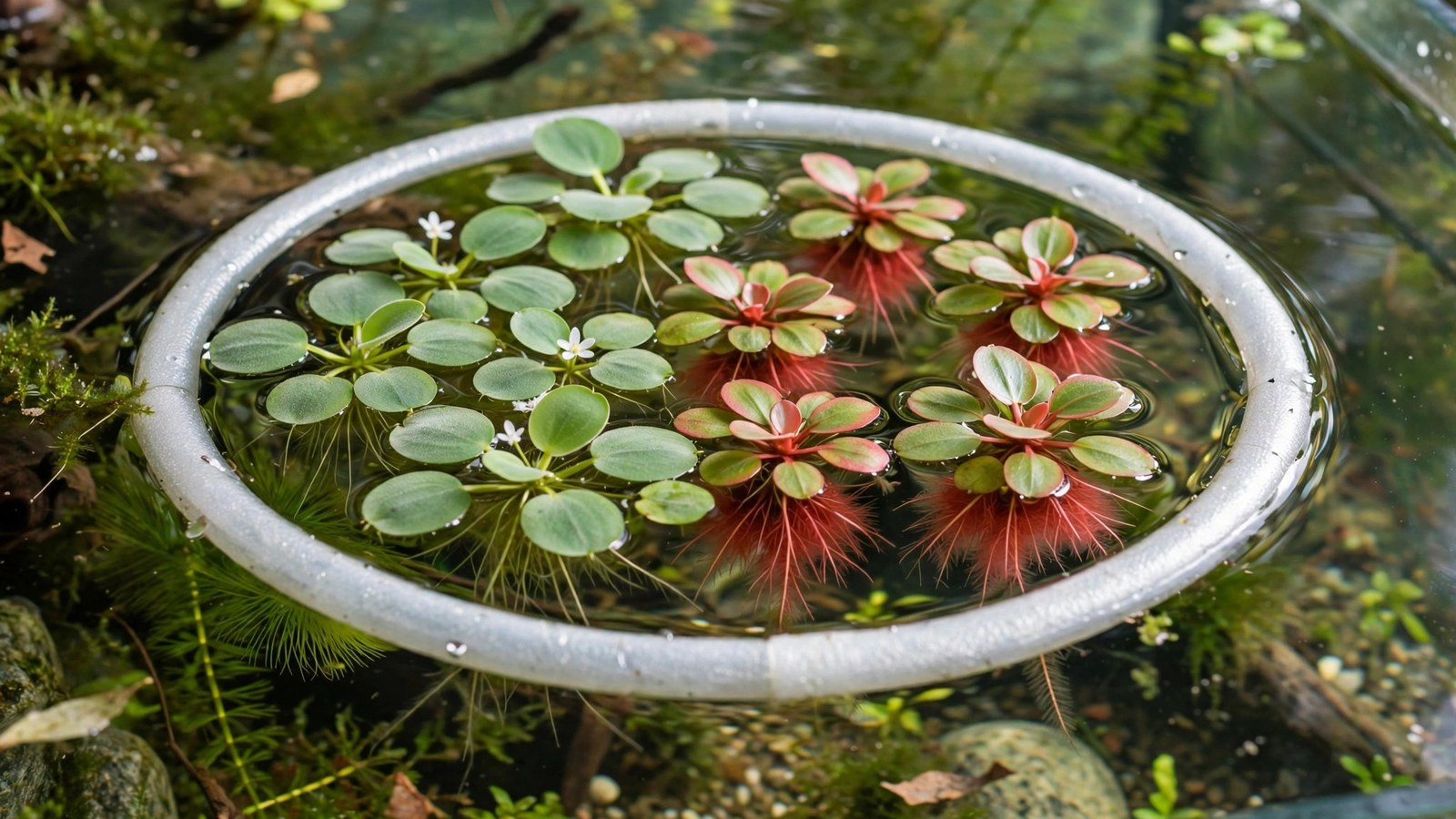
Floating plants are the easiest plants in the hobby to grow and the easiest to regret. Duckweed, frogbit, water lettuce, salvinia, red root floaters — they multiply at astonishing speed, drink nitrates like nothing else, and provide shade and shelter that fish adore. Unmanaged, they become a light-blocking mat that starves everything below. Managing floating plants is the art of keeping their benefits while preventing the takeover: corrals, thinning routines, and light management.
Why Floaters Are Worth the Trouble
Before the management talk, the case for keeping them:
- Nitrate sponges. With leaves in air (unlimited CO2) and roots in water, floaters grow faster than any submerged plant and strip nitrates, phosphates, and ammonia aggressively. They're living filtration.
- Algae suppression. By consuming water-column nutrients and shading the tank, a controlled floater layer is one of the best algae preventatives in the hobby — especially in new tanks.
- Fish comfort. Bettas, gouramis, killifish, and fry all feel safer under cover. Floating roots are prime foraging and spawning habitat; many species won't breed without it.
- Water quality buffering. Fast growth means fast uptake of everything — floaters smooth out the nutrient spikes from feeding and stocking changes.
The price of all this: they never stop growing. A handful of duckweed becomes a carpet in weeks. Management isn't optional — it's the entire relationship.
The Corral: Containing the Spread
A floating corral — a ring that confines floaters to part of the surface — is the single most useful floater management tool. It keeps open water for light penetration, gas exchange, and feeding, while the floaters do their work in their designated zone.
DIY corral options
- Airline tubing ring: Cut a length of airline tubing, join the ends with a straight connector, and float it. Free, adjustable, and nearly invisible. The classic solution.
- Suction-cup anchored ring: Tie the tubing ring to a suction cup on the glass to hold it in one position — otherwise filter flow pushes the whole corral around the tank.
- Feeding rings: Commercial floating feeding rings double as mini-corrals, keeping a small open area for food while floaters surround it.
- Multiple small corrals rather than one big one give better light distribution — several modest patches shade less than one giant mat covering half the surface.
Corral placement
- Keep corrals away from filter outputs — strong surface flow pushes floaters under, sinks them, or blasts them out of the ring constantly. Baffle the flow or position corrals in calm zones.
- Don't corral over your most light-hungry carpet plants. Position floater zones over hardscape, midground, or areas with low-light-tolerant plants (anubias, java fern, crypts handle the shade gracefully).
- Leave the front third of the surface open for viewing, feeding, and gas exchange. A tank fully covered in floaters looks neglected and suffocates surface gas exchange.
The Thinning Routine
Even corralled, floaters outgrow their rings. Thinning is perpetual:
- Duckweed and salvinia: Scoop weekly with a net — remove up to 80% without worry. It'll be back. Duckweed is the "herpes of the hobby" for a reason: assume total eradication is impossible and manage instead. Never let duckweed near a tank you don't want it in — it hitchhikes on nets, hands, and siphons.
- Frogbit and water lettuce: Remove the smallest, oldest rosettes and any yellowing ones, keeping the largest healthy plants. Thin to maintain gaps between rosettes — overlapping leaves rot the ones underneath.
- Red root floaters: Thin to maintain the red coloration — crowded floaters shade each other and go green. The reddest leaves are on plants with space and strong light. Remove green, crowded clusters preferentially.
- General rule: If you can't see any open water, you've waited too long. Thin when coverage hits ~50% of the corral, not 100%.
What to do with thinnings: compost them, offer to local hobbyists, or feed to goldfish/koi (they love duckweed). Never dump live floaters into waterways — duckweed and water lettuce are seriously invasive in warm climates.
Light Management Under Floaters
The shade floaters cast is both their gift and their curse. Manage it deliberately:
- Match plants to shade zones. Under permanent floater cover, plant only low-light-tolerant species: anubias, java fern, bucephalandra, crypts, mosses. Don't fight nature by putting a red rotala under a duckweed mat.
- Adjust light intensity up slightly if floaters cover part of the tank — the open areas still need adequate light, and the fixture doesn't know half its output is being intercepted. Alternatively, thin more aggressively and keep intensity stable.
- Watch for the "floater crash" light shock. If you remove a heavy floater mat all at once, the sudden light increase on shade-adapted plants below can trigger algae and stress. Thin heavily over 2–3 sessions spaced days apart, not all at once.
- Photoperiod stays the same — don't extend light hours to "compensate" for shade. Longer photoperiods grow algae; better to thin the floaters.
Floaters and Water Chemistry
Heavy floater growth changes your tank's chemistry in ways to be aware of:
- Nutrient depletion. Aggressive floaters can strip nitrates and phosphates to zero, starving submerged plants. If your submerged plants show deficiencies while floaters thrive, the floaters are outcompeting them — thin the floaters before increasing fertilizer, or you're just feeding the floaters more.
- pH swings. Fast daytime photosynthesis by a heavy floater mat consumes CO2 and can push pH up significantly during the day, dropping again at night. Large daily pH swings stress livestock — another reason to keep coverage moderate.
- Oxygen at night. Like all plants, floaters consume oxygen in the dark. A full surface mat also blocks gas exchange with the air. The combination can dip oxygen low overnight in heavily stocked tanks — keep surface agitation going and coverage partial.
- Reduced evaporation. A covered surface evaporates less — minor, but your top-off routine may need adjusting.
A reliable pick here is API Leaf Zone.
Choosing the Right Floater
Not all floaters are equally manageable:
| Floater | Growth speed | Manageability | Best for |
|---|---|---|---|
| Duckweed | Extreme | Very hard — nearly impossible to eradicate | Nutrient export, fry cover (commit fully) |
| Salvinia | Fast | Moderate — nets out easily, less clingy | General purpose, easy thinning |
| Frogbit | Moderate-fast | Easy — large rosettes, simple to thin | Display tanks, shrimp tanks |
| Water lettuce | Moderate | Easy — big plants, but needs space | Larger tanks, ponds |
| Red root floaters | Moderate | Easy — beautiful, thins cleanly | Show tanks, color contrast |
Beginner recommendation: frogbit or salvinia — all the benefits, manageable thinning, no duckweed regret. Red root floaters if you want beauty and don't mind slightly slower nutrient uptake. Duckweed only if you understand what you're signing up for (many experienced keepers love it; many more curse the day it arrived).
Floaters in Special Setups
- New tanks: Floaters are the best algae insurance for a new setup — they consume the excess nutrients of the immature phase. Add generously at startup, thin as the submerged garden establishes.
- Low-tech tanks: A natural fit — floaters' access to atmospheric CO2 makes them the fastest growers in a low-tech system. Our low-tech guide pairs well with a managed floater layer.
- High-tech tanks: Useful but secondary — submerged plants under CO2 compete better. Keep a small corral for the aesthetic and fry cover, not as primary filtration.
- Bettal/gourami tanks: Floaters aren't optional decor — bubble-nesters build nests in floating roots, and the cover dramatically reduces stress. Corral to keep a feeding gap.
- Going on vacation? Thin floaters hard before leaving — two weeks of unchecked growth seals the surface. See our vacation guide.
Frequently Asked Questions
How do I get rid of duckweed completely?
Honestly? With great difficulty. The reliable method: remove all fish-safe livestock temporarily, do massive daily netting for 2–3 weeks (every single frond — one left behind restarts the colony), rinse filter media, and quarantine anything moved between tanks. Most keepers who "got rid of it" just manage it down to a small corral and accept the truce. Prevention — never letting it in — is infinitely easier than eradication.
Why are my floating plants melting or turning yellow?
Three usual causes: (1) water on the leaves — splash from filters or condensation rots floater leaves; keep the surface calm and leaves dry; (2) nutrient deficiency — ironically, in ultra-lean tanks floaters can starve too (yellowing frogbit often wants more nitrates/iron); (3) too much surface agitation — constantly dunked floaters drown. Calm surface, dry leaves, adequate nutrients.
Do floating plants need fertilizer?
They eat from the water column like everything else — your normal fertilizer routine feeds them. In fact, floaters are often the first to show deficiencies (they grow fastest, so they hit limits first) — yellowing floaters can be an early warning that the whole tank needs more fertilizer. They rarely need separate fertilizing; they need you to not starve the tank.
Will floating plants block too much light for my carpet?
Only if unmanaged. A thinned, corralled floater layer over part of the tank is fine; a full-surface mat will absolutely starve a carpet below. Keep floaters away from above carpet zones (or accept a low-light carpet like marsilea or crypt parva there), thin weekly, and watch the carpet's growth — if it stalls while floaters explode, the shade is the cause.
Can floating plants go in a tank with a lid?
Yes, with caveats. Condensation dripping from the lid rots floater leaves — leave a small air gap or use a mesh/partial lid. Ensure some gas exchange (don't seal the tank airtight). Many keepers run floaters under glass lids successfully by keeping the waterline an inch below the lid and wiping condensation weekly.
Embrace the Harvest
Here's the mindset shift: thinning floaters isn't a chore, it's a harvest — you're exporting the nitrates and phosphates they absorbed, which is literally nutrient export, the thing every filtration system tries to do. Net, compost, repeat. A well-managed floater layer is the hardest-working, cheapest filtration in the hobby, and it happens to look beautiful doing it.