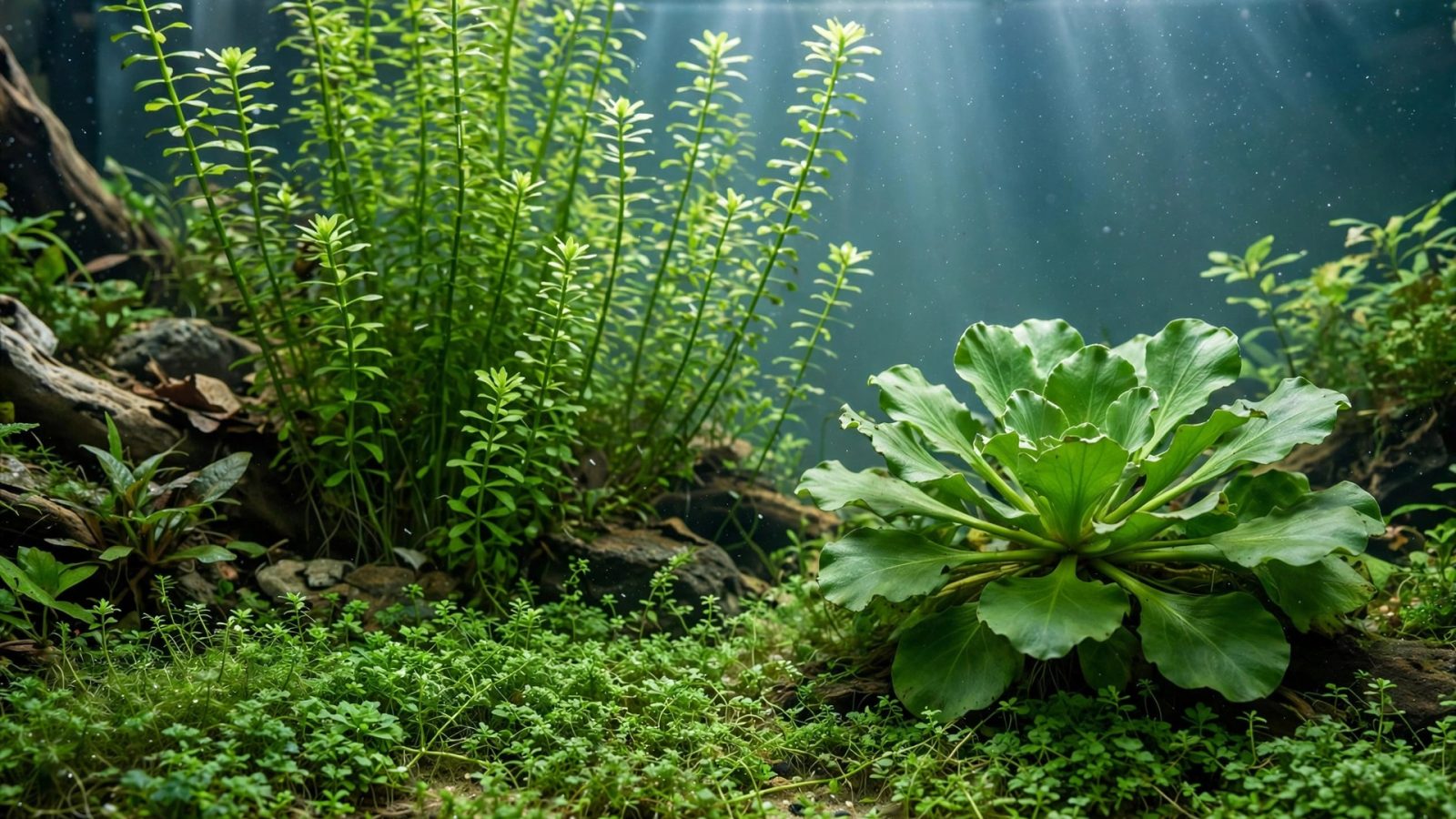
Knowing how to trim aquarium plants is what separates a tank that looks good for a month from one that looks good for years. Untrimmed stem plants grow into a tangled surface mat that blocks light; untrimmed carpets develop dead patches underneath; untrimmed rosettes choke themselves with old leaves. Trimming isn’t cosmetic maintenance — it’s how you control growth direction, encourage bushiness, and keep every plant in the tank getting light.
The technique depends entirely on the plant’s growth form. Stem plants, carpeting plants, and rosette plants each need a different approach, and using the wrong one can set a plant back weeks. Here’s exactly how to trim each type.
Before You Start: Tools and Timing
You need two tools: aquascaping scissors (the curved kind, which let you cut at substrate level without your hand blocking your view) and planting tweezers for replanting cuttings. Regular household scissors work in a pinch but crush stems more than they cut them, which slows healing.
Trim during the first half of the photoperiod, not right before lights-out — plants heal faster while photosynthesizing. And do your trimming before a water change, not after: trimming releases organic compounds and dislodges debris, and the water change cleans it all up. Never remove more than about a third of a plant’s mass in one session; heavy pruning shocks plants and the sudden light increase to lower leaves can trigger algae.
How to Trim Stem Plants
Stem plants (rotala, ludwigia, hygrophila, water wisteria, bacopa) grow as vertical stalks with leaves at intervals. They’re the most-trimmed plants in the hobby because they’re also the fastest growers. You have two methods:
Method 1: Top and replant (recommended for most beginners)
- Identify where the stem is still healthy and compact — usually the top 3–4 inches, where leaves are dense and color is good.
- Cut the stem at a point where the lower portion still has some leaves (never cut below the lowest leaf — a bare stalk usually won’t regrow).
- Remove the lower, leggy portion entirely, or leave it if it has side shoots forming.
- Strip the leaves from the bottom inch of your cutting, then plant it in the substrate with tweezers, pushing it deep enough that it stays put.
- The planted top continues growing as a fresh, compact plant. The rooted base, if left, typically sprouts two side shoots from the cut point — which is how one stem becomes a bush.
This “replant the tops” trick is the single most useful technique in stem-plant care: every trimming session can double your plant mass for free. It’s also the core of propagating aquarium plants from cuttings.
Method 2: Hedge trim (for dense background walls)
When you want a solid wall of stems rather than individual stalks, cut straight across the whole group at the desired height — like trimming a hedge. The cut stems branch from just below the cut, creating denser growth with each trim. The first hedge cut looks ragged for a week, but the regrowth comes in noticeably bushier. This works best on naturally branchy species like rotala and ludwigia.
Stem trimming mistakes
- Cutting too low: leaving a bare stalk with no leaves usually kills it. Always cut above at least one leaf node.
- Letting cuttings float: unplanted cuttings left floating will grow roots and survive, but they grow toward the light horizontally and look messy. Plant them promptly.
- Trimming everything at once: in a Dutch-style tank, trim in sections a week apart so the tank never looks scalped.
How to Trim Carpeting Plants
Carpeting plants (dwarf hairgrass, monte carlo, dwarf sagittaria, marsilea) spread horizontally via runners. Their enemy is their own success: as the carpet thickens, the lower layers get no light and rot, creating dead brown patches under a green surface.
The mowing technique
- Using curved scissors, cut the carpet down to about 1 inch tall across the whole area — yes, this looks drastic.
- Remove all the cuttings with a net or siphon; decaying trimmings left in the carpet cause ammonia spikes and algae.
- Within 1–2 weeks, fresh growth emerges from the runners, denser and lower than before.
This feels wrong the first time — you’re cutting away healthy-looking growth. But a carpet that’s never mowed eventually suffocates itself. Established carpets benefit from mowing every 4–8 weeks depending on growth rate. High-tech carpets with CO2 need it more often; low-tech carpets less.
Thinning runners
If your carpet is spreading where you don’t want it (dwarf sagittaria is notorious for invading neighboring areas), pull unwanted runners with tweezers, tracing each runner back to its origin. Do this during water changes when the substrate is slightly disturbed anyway.
For species-specific carpet technique, see our dwarf hairgrass care guide and monte carlo care guide.
How to Trim Rosette Plants
Rosette plants (Amazon swords, cryptocorynes, anubias, java fern) grow leaves from a central crown or rhizome rather than from vertical stems. You don’t “cut them back” — you remove individual leaves.
The outer-leaf rule
- Identify the oldest, outermost leaves — they’re typically the largest, may show algae, yellowing, or damage.
- Trace the leaf stem (petiole) down to where it meets the crown or rhizome.
- Cut or pinch the stem as close to the base as possible. Pulling can uproot the whole plant; cutting is safer.
- Remove no more than 20–30% of leaves in one session.
New leaves emerge from the center of the rosette, so removing outer leaves never harms the plant’s growth point — you’re just clearing old growth that’s costing the plant more energy than it produces. For swords, this also prevents the plant from becoming a nutrient hog that starves its neighbors.
Cryptocoryne caution
Crypts hate disturbance. Trim dead or melted leaves gently and avoid uprooting or moving the plant — crypts frequently respond to root disturbance with crypt melt, dropping all their leaves at once. They recover, but it’s weeks of ugly you could have avoided.
Rhizome plants (anubias, java fern, bucephalandra)
For these, trimming means removing entire old leaves at the rhizome, plus occasionally dividing the rhizome itself when the plant gets large. Cut the rhizome with a clean blade, making sure each division has at least 4–5 leaves and some roots. Each piece becomes an independent plant. Never bury the rhizome — see how to attach plants to driftwood for proper placement.
How to Trim Floating Plants
Floating plants (frogbit, salvinia, red root floaters, duckweed) need the opposite of encouragement — they need thinning. A complete surface cover blocks all light to the plants below and suffocates gas exchange.
Once a week, scoop out enough floaters to leave 30–50% of the surface open. Use a feeding ring or airline tubing loop to corral floaters to one section if you want to keep them but protect light for the plants below. Compost or discard the excess — never release aquarium plants into local waterways.
What to Do With Trimmings
Healthy trimmings are valuable:
- Replant stem tops to thicken your own tank (free plants)
- Start a second tank — trimmings are how most hobbyists stock new setups for free
- Trade or sell locally — aquarium clubs and local forums always want healthy cuttings
- Compost anything unhealthy — never flush live plants or put them in waterways
Trimming Tools: What Actually Matters
- Wave scissors (curved) — the workhorse. The curved profile lets you cut carpeting plants at a uniform height and reach stems without your hand blocking the view. One good pair handles 90% of trimming.
- Straight precision scissors — for stem plants, where you want a clean perpendicular cut at an exact node. Cheap ones crush stems instead of cutting; if your cut ends look pinched and brown, your scissors are the problem.
- Long tweezers — for extracting trimmed debris from dense plantings without disturbing everything around it.
- A fine net or diatom filter — post-trim cleanup. Floating cuttings left in the tank rot, spike organics, and (for stem plants) root wherever they land, creating weeds in your foreground.
Keep scissors clean and dry between uses — plant sap is mildly corrosive, and rusty scissors tear instead of cut. A quick wipe with rubbing alcohol monthly keeps them surgical. This sounds fussy until you’ve watched a tank of stem plants recover in days from clean cuts versus weeks from crushed ones.
Species-Specific Trimming Notes
Rotala and ludwigia
Respond to topping by splitting into two shoots at the cut node — every trim doubles the stem count, which is how you build those dense Dutch-style bushes. Trim when stems reach the surface, cut at half height, replant the tops. After 3–4 cycles you have a thicket from a single original stem.
Hygrophila
Aggressive growers that tolerate (and need) hard trims. You can cut hygrophila down to a few inches and it rebounds in days. The risk isn’t over-trimming — it’s under-trimming until the lower leaves rot from shading, which then fouls the water.
Vallisneria
Never cut vallisneria leaves mid-blade — the cut end browns and rots progressively. Instead, remove entire leaves at the base, selecting the oldest outermost leaves. It feels wasteful; it’s the only correct method.
Amazon swords
Remove outer leaves at the crown base as they age. Swords also send up emergent flower spikes — trim these unless you’re deliberately propagating, since flowering diverts enormous energy from leaf growth.
Java fern and anubias
Trim individual old leaves at the rhizome. For propagation-sized division, cut the rhizome with a clean blade ensuring each section has several leaves and roots. Never trim the rhizome’s growing tip unless dividing — that’s the plant’s growth engine.
Mosses
Shear like a hedge with wave scissors, removing the top third. Moss accumulates dead brown undergrowth that eventually detaches in ugly clumps — regular shearing prevents this. The trimmings? Every fragment is a new moss plant; rinse and attach elsewhere or share them.
Trimming and Algae: The Connection
Trimming is an underrated algae-control tool, and the mechanism is straightforward: overgrown plants shade their own lower leaves, those leaves decay, decay feeds algae, and the dense canopy traps detritus while blocking flow. A well-trimmed tank has light penetration, water flow, and no rotting biomass — three things algae hate.
The post-trim window deserves respect, though. A heavy trim is a shock: the tank suddenly has far less plant mass absorbing nutrients, while the trimming itself released organics into the water. For 3–5 days after a major trim, your tank is temporarily more algae-prone, not less. Mitigate it: trim before a water change (not after), siphon thoroughly, and consider a slightly shorter photoperiod for the rest of the week. The tank rebounds quickly — and then the improved light and flow pay dividends for weeks.
Frequently Asked Questions
Should I trim new plants when I first plant them?
Lightly, yes. Trim off damaged leaves and overly long roots before planting — they won’t recover and they rot. But don’t do a full shaping trim on day one; let the plant establish for 2–3 weeks first, then shape the new growth. See acclimating new plants.
My stem plants are leggy with bare lower stems. Can trimming fix this?
Yes — this is exactly what replanting tops fixes. Cut the healthy tops, discard the bare lower stems (or leave a few to see if they sprout side shoots), and replant the tops. The legginess was caused by insufficient light reaching the lower leaves; after replanting, keep the bush trimmed shorter so light penetrates, or increase overall light.
How do I trim without uprooting everything?
Hold the plant’s base steady with tweezers in your non-dominant hand while cutting with the other. For carpeting plants, use the wave scissors’ curve to cut without pulling. And accept some disturbance — a few replanted tufts after each trim session is normal, not failure.
Trimming Schedule Cheat Sheet
- Fast stem plants: every 2–3 weeks
- Slow stem plants: every 4–6 weeks
- Carpets: mow every 4–8 weeks
- Rosette plants: remove old outer leaves as needed, roughly monthly
- Floating plants: thin weekly
- Rhizome plants: remove old leaves every few months; divide yearly if desired
Trimming is the highest-leverage maintenance habit in a planted tank — more impactful than any fertilizer tweak. A tank that’s trimmed on schedule looks intentional and stays healthy; a tank that isn’t slowly chokes itself no matter how perfect the fertilizer schedule is. Put it on the calendar alongside your water changes, and your plants will do the rest.