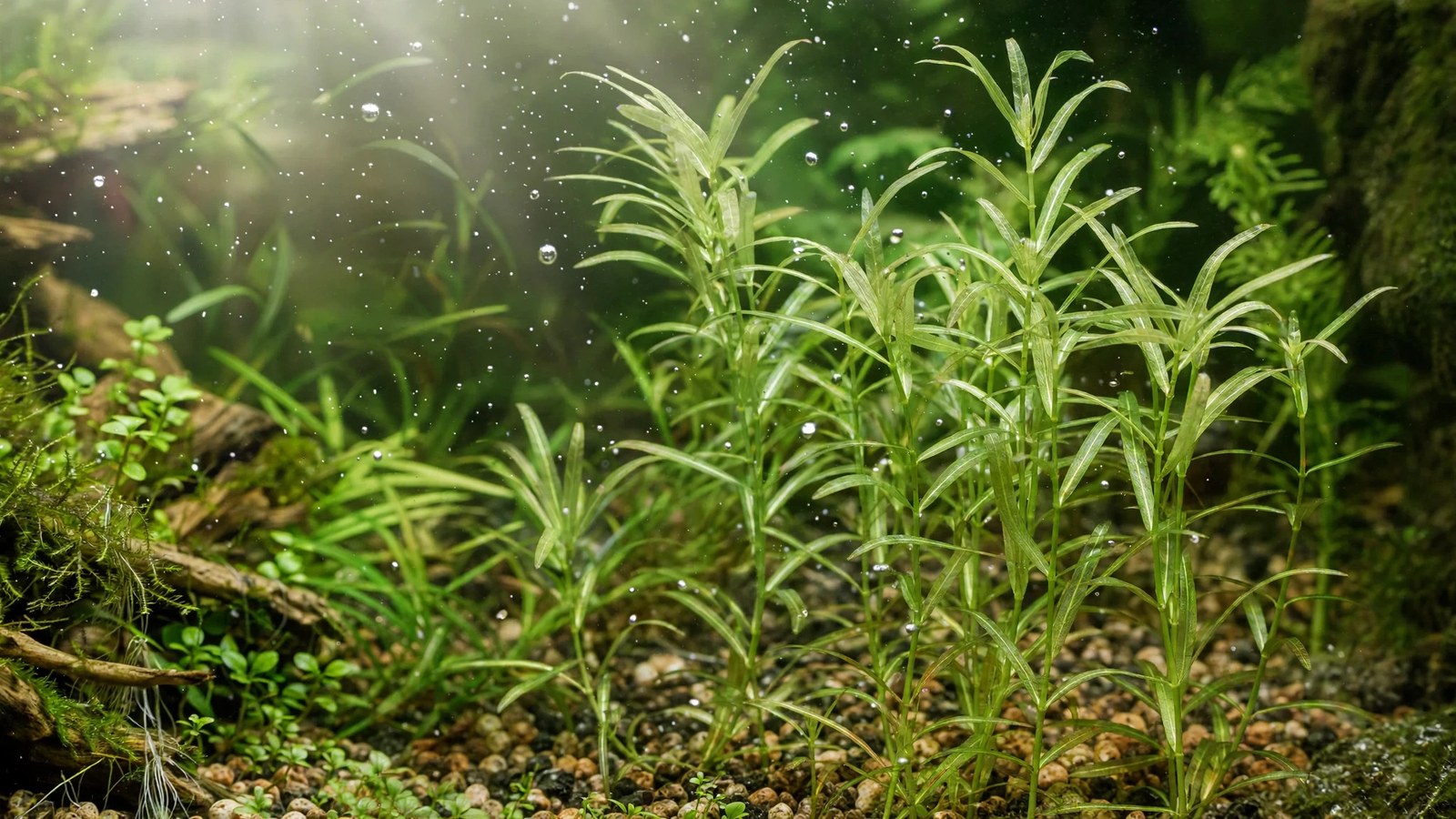
Most planted tanks fail in the first three weeks — not because the plants are wrong, but because the keeper gives up too soon. Few plants prove that point like this one: potamogeton gayi care is a test of patience first and pruning second. This South American stem looks like it's dying for a month, then becomes a runner-spreading weed that can outgrow a 20-gallon tank. This guide walks you through the week-by-week reality so you neither toss a healthy plant nor let it swallow your scape.
The short answer: Plant Potamogeton gayi in groups of 5–8 stems, give it medium to high light, and leave it alone for 2–6 weeks while it melts and rebuilds its roots — do not replant it, even if every leaf yellows. Once established it tolerates 10–28°C and a wide pH range, needs no CO2 (though injection speeds everything up), and spreads by runners you'll prune back roughly monthly. Its olive-green leaves flush reddish-brown under strong light.
Potamogeton Gayi Care: Your First Six Weeks
Here is the single most important fact about this plant: it sulks. Stems shipped to you grew emersed or in someone else's tank, and submerged life requires entirely different leaf structures. Your job is to plant it correctly once, then practice deliberate neglect. If you're new to stems generally, start with our best stem plants for beginners guide to see where P. gayi fits in the difficulty lineup.
Plant stems 5–8 cm apart, burying the bottom 2–3 cm in substrate — sand or fine gravel both work. Then the melt begins: lower leaves yellow, some stems go translucent, and the group can look dead by week two. This is normal. Runners and fresh leaf buds usually emerge from the base between weeks two and six. If you want the full context on why new plants do this, read how to acclimate new aquarium plants before panic-buying replacements.
Light and the Olive-to-Rust Color Shift
Under moderate light, P. gayi is an unassuming olive-green stem. Raise the intensity and the leaves take on a reddish-brown, rusty cast — one of the few easy plants that actually reward you for upgrading your light.
| Light level | Appearance | Growth behavior |
|---|---|---|
| Low (15–30 PAR) | Pale olive, leggy | Survives but stretches; lower leaves drop |
| Medium (30–50 PAR) | Olive green, healthy | Steady growth, runners begin |
| High (50+ PAR) | Olive with reddish-brown flush | Bushy and dense; runner spread aggressive |
The trade-off hiding in that last row: the light that unlocks the best color also turns the plant into the weed of your tank. Keepers in high-light setups thin runners every three to four weeks. Prefer a calm, slow plant? Medium light gives steady growth you can ignore for months.
CO2, Fertilizer, and Root Tabs
P. gayi grows without CO2 injection — a genuine advantage in low-tech setups — but adding CO2 cuts the sulk phase in half and pushes denser growth afterward. If you go low-tech, our guide to growing aquarium plants without CO2 covers the adjustments that matter.
For feeding, this plant is a root feeder: root tabs beat liquid dosing here. Bury one capsule near the base every 2–3 months, pushed 4–5 cm down so it dissolves into the root zone rather than clouding the water. Seachem Flourish Tabs or API Root Tabs are the honest workhorses for this — slow-release nutrients where the plant actually eats, no magic growth claims.
Conservative guidance applies to anything you add: start with the lowest dose or the leanest CO2 rate, watch your livestock for a week, then adjust upward. Overfeeding the water column while the plant feeds from the substrate is the fastest route to an algae bloom.
Pruning a Weed Without Losing It
Once established, P. gayi spreads by runners — horizontal stems sending up new shoots a few centimeters away, "a weed in the truest sense." Every runner is a free new plant, which is also the problem: a neglected group colonizes the foreground within months.
Prune in two layers. First, trim vertical stems to hold the group's height — cut just above a leaf node and the stump forks into two shoots. Second, lift and cut the runners: trace each back to the parent, snip it, and replant or remove the daughters. Don't let cut fragments float loose; they root wherever they settle.
Placement and Tankmates
Place P. gayi in the midground to background of tanks 15 gallons and up. In nano tanks the runner habit becomes a chore; give it room to be a weed and it fills background gaps with almost no help from you.
One warning from experienced keepers: adult bristlenose plecos (ancistrus) can uproot the shallow-rooted stems while grazing, especially during the fragile first month. If you keep diggers, plant the group behind hardscape or wait until roots are established.
Troubleshooting: What Each Symptom Means
| Symptom | Likely cause | Fix |
|---|---|---|
| All leaves yellowing, weeks 1–3 | Normal melt/adjustment | Do nothing; don't replant |
| Leggy, pale upward stretch | Light too low | Raise intensity |
| Never colors up | Medium light ceiling | Push PAR toward 50+ |
| Algae coating on leaves | Excess water-column nutrients | Cut liquid dosing; 30% weekly water changes |
| Stems keep floating up | Shallow planting or diggers | Plant 3 cm deep; shield with hardscape |
| Runners everywhere | Healthy plant in good light | Thin monthly — a feature, not a bug |
For perspective on where this plant sits in the hobby, our freshwater aquarium plants complete guide maps the full landscape of easy to demanding species, and the easiest aquarium plants for a beginner community tank list puts P. gayi among the forgiving options worth trying early. Retailer references like Glass Aqua's Potamogeton gayi listing document its wide parameter tolerance if you want a second data point before buying.
Frequently Asked Questions
How long does Potamogeton gayi take to establish?
Expect 2–6 weeks of visible melting before new underwater growth appears, and up to three months before it looks genuinely lush. Never replant during this window — each disturbance restarts the adjustment, which is how the sulk stretches into months.
Does Potamogeton gayi need CO2?
No, CO2 is optional — P. gayi grows well in low-tech tanks, one of its main selling points. Injected CO2 speeds up establishment and produces denser, faster growth with better color. Start with the lowest injection rate and observe your livestock for a week before increasing.
Why are my leaves turning brown instead of green?
That reddish-brown flush is the plant's light response, not a deficiency — under 50+ PAR the olive-green leaves develop a rusty cast many keepers consider its best look. Translucent or mushy leaves, especially right after planting, mean normal melting rather than a deficiency or disease.
How do I stop it from taking over my tank?
Thin the runners monthly in high light: trace each horizontal runner back to the parent, snip it, and remove or replant the daughter shoots. Remove floating stem fragments promptly — they root wherever they settle. For calmer growth, drop the light to medium, which keeps growth steady but far less aggressive.
What substrate does Potamogeton gayi prefer?
It is unfussy: sand, fine gravel, or aquasoil all work, since it feeds through its roots rather than demanding a specific substrate chemistry. Nutrient-rich substrates give a faster start. In inert sand or gravel, bury a root tab 4–5 cm down near the base every 2–3 months.
P. gayi rewards the patient and punishes the fidgety. One careful planting, a month of deliberate neglect, then a pruning schedule that respects its runner habit — and you get a textured, color-shifting background most "easy" plants never manage.