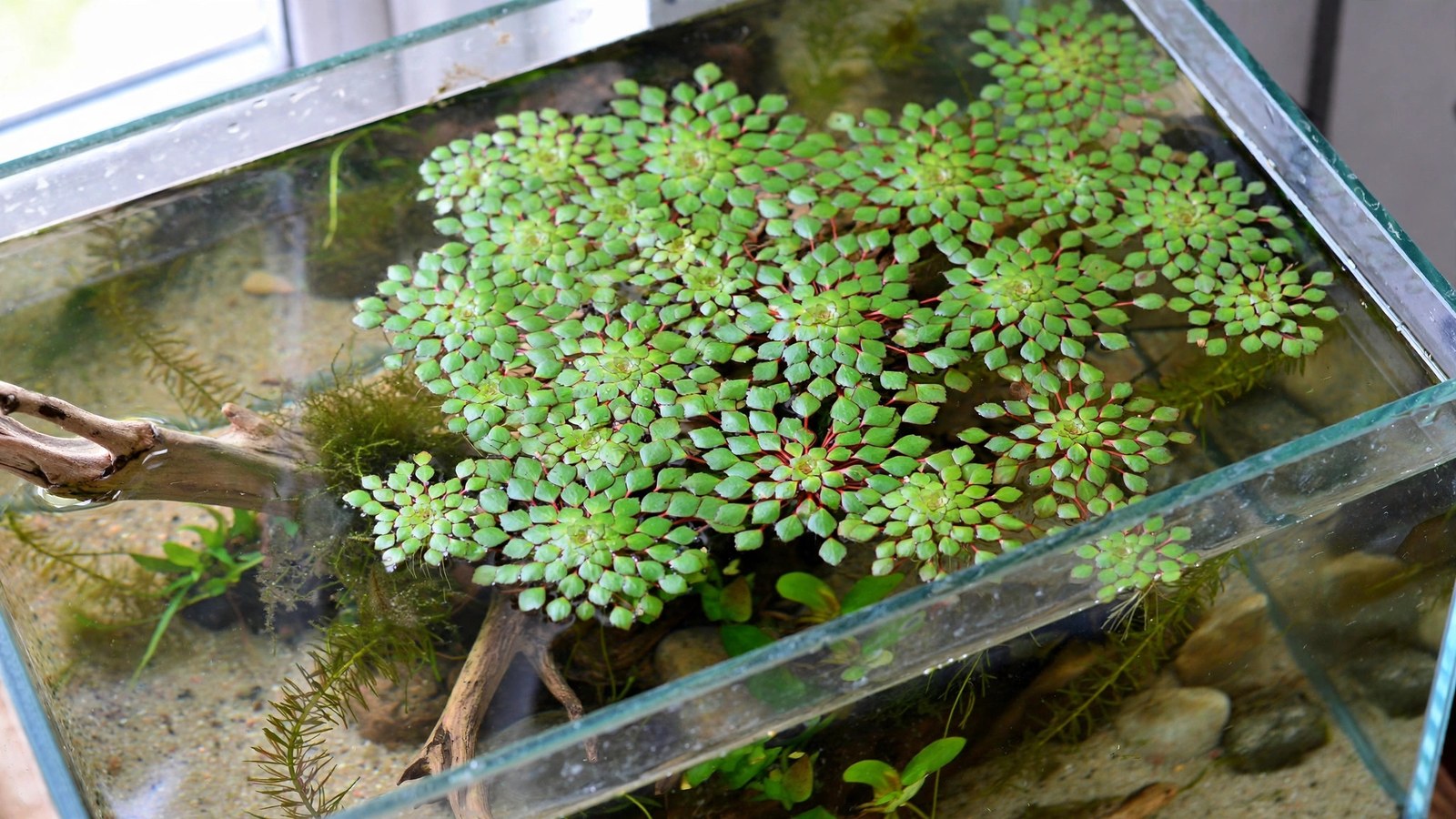
Those red-and-green diamond rosettes floating on the water are why aquarists fall for the mosaic plant. If you are researching ludwigia sedoides care for your tank, here is the truth product pages skip: this is one of the hardest floating plants you can attempt indoors. This guide gives the honest version — when a tank attempt is worth it, and when a sunny pond tub wins.
Can you grow Ludwigia sedoides (mosaic plant) in an aquarium? Technically yes, but Flowgrow flags aquarium cultivation as "a bit more complicated" and says outdoor growing is sometimes the only solution. Its extreme light hunger — cited as 0.75 watts per litre and over, or direct sunlight — makes indoor success rare outside very bright, shallow, nutrient-rich setups.
What Ludwigia Sedoides Actually Is
This is not a stem plant like Ludwigia repens. Ludwigia sedoides roots in the substrate and sends up stems topped with rosettes of diamond-shaped, serrated leaves that sit flat on the water, spanning 8–15 cm and flashing green and coppery-red with light. It comes from stagnant water and slow river zones in Central and South America — open tropical sky, unlimited light, warm still water. That ecology is the whole story of ludwigia sedoides care. New to surface plants? Our 8 best floating aquarium plants for beginners shows how much easier frogbit and salvinia are.
Ludwigia Sedoides Care in the Aquarium: Light, Heat, and Nutrients
An indoor attempt is an expert project. Light is everything: Flowgrow cites 0.75 watts per litre and over, or direct sunlight. Rosettes must sit centimetres under a powerful full-spectrum fixture — shallow tanks help, since intensity fades fast with depth. Under mediocre light they etiolate: leaves shrink, red fades to muddy green, the mosaic becomes a scraggle.
Keep the water warm and calm: 24–28 °C (75–82 °F) — see our inline heater guide for planted tanks if your filter leaves cold spots. Keep surface agitation gentle; strong current pins the rosettes to the glass and bruises leaves.
Feed heavily but carefully: it wants a rich substrate plus a dosed water column, so a complete macro-plus-micro fertiliser is non-negotiable — our NilocG Thrive dosing guide covers the balance. Start at half the label dose, watch fish and shrimp for a week, then raise it only if plants are hungry and livestock are fine. Soft, slightly acidic water suits it; for hard tap water, peat moss can lower pH naturally. Skip injected CO2 — light and nutrients decide success here. For the full picture, see Freshwater Aquarium Plants: The Complete Guide.
The Honest Verdict: When an Aquarium Is the Wrong Home
Most indoor attempts fail the same way: the rosette stretches, lower leaves melt, algae films the floating leaves — which you cannot scrub without tearing them — and the plant declines over months.
| Your setup | Realistic outcome |
|---|---|
| Standard community tank, lid-mounted LED | Failure — not enough light |
| High-tech shallow tank, powerful light, rich substrate | Possible for experienced keepers |
| Sunny pond tub or container pond | Excellent — its natural habitat |
| Bright conservatory paludarium | Good — strong light, warm humid air |
If your tank does not match the second row, skip the indoor experiment. The plant is cheap; the frustration is what costs you.
Growing It in a Pond Tub: the Realistic Path
A 30–80 litre tub, half-barrel, or glazed pot on a sunny balcony is where the mosaic plant shines. Fill it with 15–40 cm of water over 5–10 cm of pond soil capped with gravel, root a rosette in the substrate, and it spreads into a living mandala within weeks.
Full sun is the whole trick: 6+ hours of direct sun does what no aquarium fixture quite manages. Feed the soil with slow-release aquatic tabs at planting, then top up evaporation and clear debris. In warm climates it is perennial; elsewhere, overwinter rosettes in a bright indoor tub.
Sourcing Healthy Rosettes and Propagating
Buy in the warm season from specialist pond-plant nurseries. A healthy rosette is flat, symmetrical, firm, and green with red edges — not bleached, slimy, or curling. Pond-grown stock adapts to a tub instantly; dim-grown stock needs a slow light ramp.
Propagation is the easiest part of ludwigia sedoides care. Cut a floating rosette off the parent stem, keeping a short piece of stem attached, and float it in the target water — it anchors within days. The main stem left behind pushes out a brand-new rosette, so one plant becomes two, then four.
What Goes Wrong: Melting, Stretching, and Algae
Melting after arrival means light or temperature shock between the seller's setup and yours. Trim the mush, keep the rosette floating, and give it two weeks — the meristem often rebounds.
Etiolation — longer stems, smaller leaves, fading red — is the plant reaching for light it cannot find. Move it to a sunnier spot instead of adding more fertiliser.
Algae on the rosettes: floating leaves sit in the highest-light zone, so they collect algae first. A small crew of ramshorn snails grazes film algae off the leaves without damaging them — but snails cannot outpace an unbalanced tank.
For specialist sources, the Flowgrow database entry for Ludwigia sedoides documents the light threshold and aquarium warning, while the Missouri Botanical Garden Plant Finder entry covers zone hardiness and overwintering.
Frequently Asked Questions
Is Ludwigia sedoides a good beginner aquarium plant?
No — it is a poor first aquarium plant. Its extreme light hunger, heavy feeding, and tendency to melt in average conditions frustrate beginners. Master salvinia or frogbit first, and attempt the mosaic plant only once you can keep a high-light tank algae-free.
How much light does the mosaic plant really need?
Flowgrow cites 0.75 watts per litre and over, or direct sunlight. In practice the rosette must sit almost directly under a powerful full-spectrum fixture, or outdoors in at least six hours of direct sun. Ordinary lid-mounted aquarium LEDs are nowhere near this level.
Can I grow it in a pond tub on a balcony?
Yes — this is the realistic path for most growers. A 30–80 litre tub of fertilised pond soil under 15–40 cm of water, placed in full sun, reproduces its natural habitat. Root a rosette in the substrate with slow-release tabs at planting, and it spreads all warm season.
How do you propagate Ludwigia sedoides?
Snip a floating rosette off the parent stem, leaving a short piece of stem attached, and float it in the target water — it anchors within days. The parent stem left behind grows a fresh rosette at the cut point, so one plant multiplies steadily with no special equipment.
Why is my mosaic plant melting?
Sudden melting after arrival is usually light or temperature shock — trim the mush, keep the rosette floating, and wait two weeks. Slow decline over months means chronic under-lighting. Check temperature (24–28 °C), reduce surface current, and only then review fertiliser dosing.
The mosaic plant is genuinely spectacular — and genuinely demanding. Grow it where it wants to grow: under open sky, in a sunny tub, with warm still water and rich sediment. Attempt it indoors only if your light can rival the sun. That is the honest version of ludwigia sedoides care, learned before the plant — not after it melts.