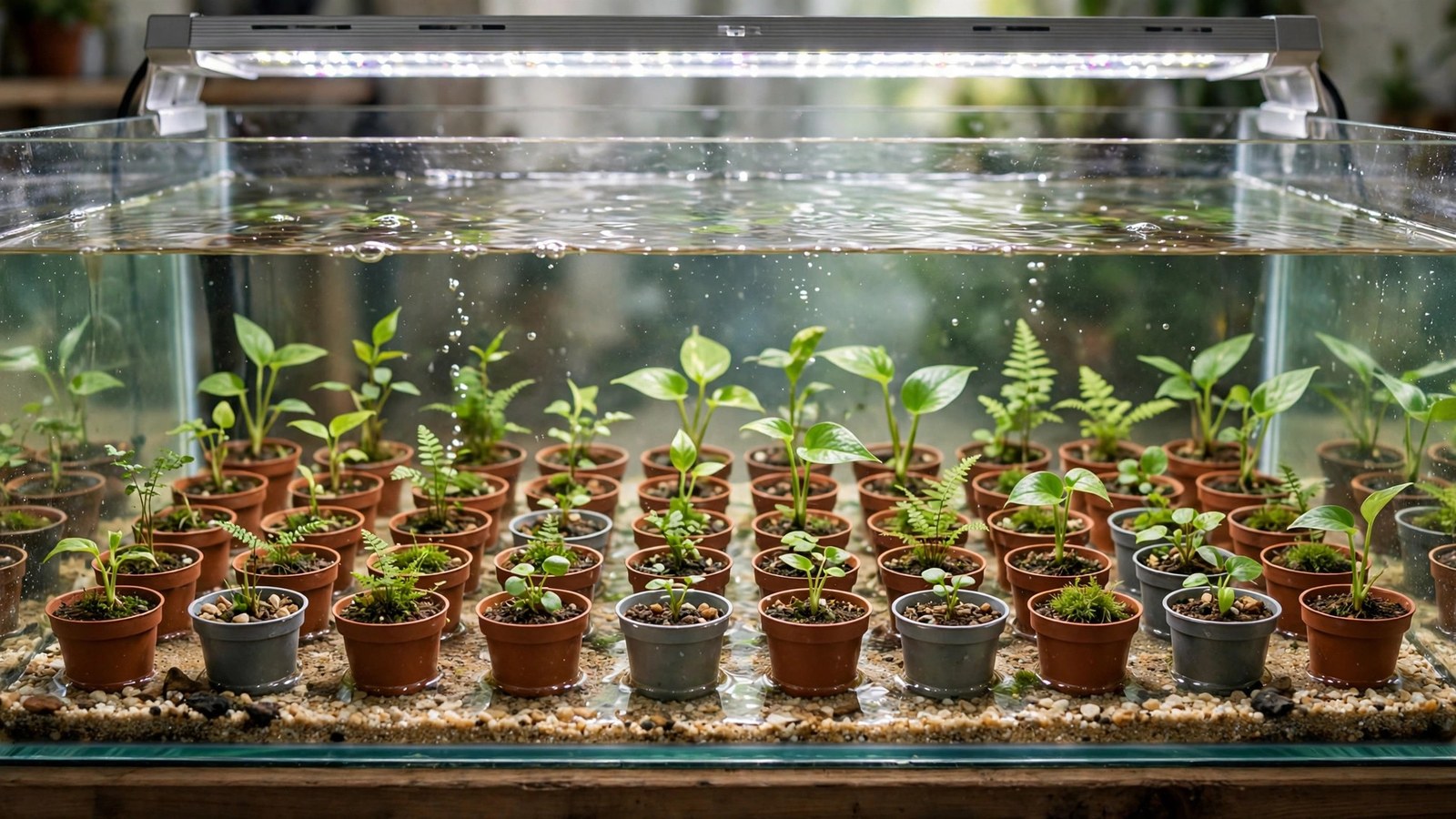
A $40 storage tub, a $60 shop light, and ten weeks of patience can turn one $12 pot of bacopa into thirty sellable portions. An aquarium plant grow out tank is a dedicated production vessel — no fish, no aquascape, just maximum biomass. Here is the whole system: vessel, lighting, fertilizer math, harvest rhythm, and honest profit numbers.
What an aquarium plant grow out tank really is
A display tank asks a plant to look beautiful in one spot. A grow-out system asks it to produce as many sellable nodes as possible, as fast as possible. So ugly is fine: bare-bottom tubs, dense monoculture clumps, stems three inches apart so they grow straight and tall. You do not aquascape a grow-out tank; you farm it.
The jump from hobbyist to producer is a technique jump first — once you have mastered the five propagation methods, every harvest below uses those cuts, scaled up with space, light, and fertilizer.
Choosing your grow-out vessel
You need volume and footprint, not glass clarity:
| Vessel | Capacity | Cost (vessel + light) | Notes |
|---|---|---|---|
| 40-gal storage tub | ~150 L | ~$100–$130 | Cheapest per gallon; 200–300 stems |
| 20-gal long tank | ~75 L | ~$150–$220 | Easy viewing and grading |
| 50-gal stock tank | ~190 L | ~$160–$220 | Emersed setups; indestructible |
Tubs win: a 5-shelf rack holds four to six 40-gallon tubs in a 4 × 2-foot footprint, one LED bar per shelf. Run bare-bottom or with an inch of sand — aquasoil costs $40–$60 per tub, and you dose the water column anyway. Site them near a water source and drain.
Production lighting and photoperiod
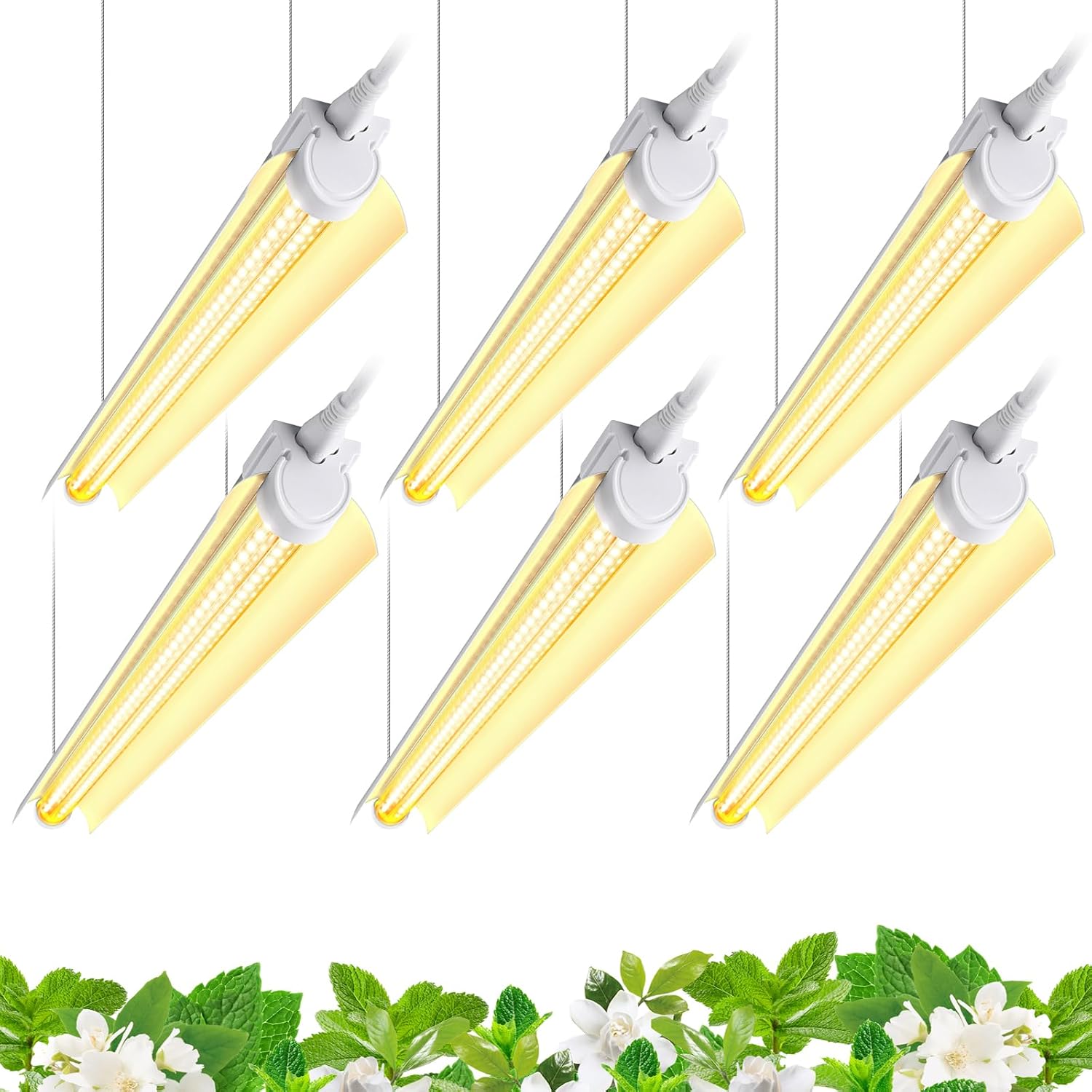
Production lighting means high-output and cheap: two 4-foot 5,000–6,500K shop lights per shelf (~40–60W each) deliver 100–150 µmol/m²/s PAR at 12 inches — near maximum growth for most stems. The science: how much light aquarium plants need.
Run a 10–12 hour photoperiod on a timer. Below 8 hours you leave growth on the table; above 12 you mostly feed algae. Shop grow lights by PAR-per-dollar, not brand: a $35 daylight shop light at 120 µmol beats a $180 "plant light" at 90 — and you will buy four to six as you expand.
 ★4.6
Barrina T8 LED Grow Light
Check Price on Amazon ★4.6Fertilizer dosing at scale
At production scale you dose dry salts. The Estimative Index (EI) approach — dose in slight excess, then reset with a weekly 50% water change — means plants never run out and buildup never accumulates. See do aquarium plants really need fertilizer for why plants want this much food.
Per 40 gallons (150 L), dosed 3× weekly:
| Nutrient | Weekly target | Source salt | Cost/year |
|---|---|---|---|
| Nitrogen | NO₃ 10–30 ppm | KNO₃ | ~$3 |
| Phosphorus | PO₄ 1–3 ppm | KH₂PO₄ | ~$2 |
| Potassium | K 10–30 ppm | K₂SO₄ (with KNO₃) | ~$1 |
| Micros | Fe 0.1–0.5 ppm | CSM+B or DTPA iron | ~$2 |
About $8 a year per tub versus $80–$150 for the equivalent liquid all-in-one (safe liquid ranges: all-in-one fertilizer dosing). CO₂ injection speeds submerged growth 2–4×, but multiple diffusers rarely pay back at hobby scale — emersed setups skip the question entirely.
The harvest cycle
Production runs on a calendar. Fast stems (bacopa, rotala, ludwigia, hygrophila) harvest 4–6 weeks after planting, then every 14–21 days. Slow growers (anubias, crypts, java fern) need 3–6 months first — keep them in a separate tub.
- Days 1–14: no trimming; let cuttings root. Remove melting leaves daily.
- Weeks 3–6: trim stems to 4–6 inches; replant the tops — each trim doubles stock.
- Every 14–21 days: harvest the top 50–60% of stem mass; replant tops, portion the rest.
- Monthly: divide aquarium plants that filled their footprint.
A sellable "portion" is 5–6 stems of 6+ inches, one rhizome section with 5+ leaves, or a golf-ball carpet clump. Bag the day before listing. Time cuts with our aquarium plant pruning schedule so you never harvest a tub into a stall.
Algae control in high-nutrient systems
High light plus EI dosing grows algae the moment plant mass stalls — after a big harvest or a skipped water change. Fix it the boring way: weekly 30–50% water changes, daily toothbrush spot-removal, and replanting harvest gaps within 48 hours.
Twenty to thirty cherry shrimp per tub eat soft algae without touching healthy plants. Skip fish — their waste is uncontrolled fertilizer.
Emersed vs submerged grow-out
Emersed growing — roots in wet substrate, leaves in humid air under a lid — is the commercial nursery method: atmospheric CO₂ runs ~400× more concentrated than dissolved CO₂, so growth is 2–3× faster with near-zero algae and no water changes. Tradeoff: plants arrive looking different and melt on conversion, so label them "emersed-grown."
| Submerged | Emersed | |
|---|---|---|
| Growth rate | Good (faster with CO₂) | 2–3× faster for most stems |
| Algae risk | Moderate–high | Near zero |
| Conversion | None — ships ready to plant | 7–14 days of melt and transition |
Best of both: emersed tubs for bulk production, one submerged tub to convert and photograph inventory.
Packaging and shipping plants
Dead-on-arrival packages kill a selling reputation faster than bad prices. Ship Monday–Wednesday, use 2–3 day service, and add a heat pack below 50°F (10°C) at either end — a cold pack above 85°F (30°C).
Standard wrap: rinse plants, lay them damp on a soaked paper towel, fold it over, seal in a fish bag with air squeezed out. Breather shipping bags are worth the upgrade: gas-permeable film keeps stems oxygenated 3–4 days in transit versus two in a sealed bag — about $0.30 each in bulk.
Price to cover the $5–$8 label plus packaging: $3–$6 per portion with a 3–5 portion minimum. Portioning sizes are in our plant trimmings guide.
Where to sell and the honest profit math
- Local fish club auctions: 80–100% of the sale price to you, no shipping. Membership is usually $15–$30 a year.
- Marketplaces (eBay, Etsy, r/AquaSwap): big reach; expect 10–15% in fees.
- Local fish stores: 30–50% of retail in cash or credit — lowest margin, but moves whole harvests at once.
The math nobody posts: an eight-tub, two-rack farm costs $600–$1,000 to build and $10–$20 a month to run. Output of 40–120 sellable portions monthly at ~$4 each means $160–$480 gross — roughly $100–$400 after fees and supplies. Start with bulletproof species (anacharis, bacopa, water sprite, guppy grass, java moss); check difficulty ratings on Tropica's plant database before committing tub space.
Frequently Asked Questions
Can I use a spare aquarium as a grow-out tank?
Yes — a spare 20-gallon long with a cheap shop light is the classic first grow-out tank, and it lets you grade plants easily. But for scaling past one tank, storage tubs beat glass on cost per gallon and stack on racks. Keep one nice tank for listing photos and bare tubs for production.
Do grow-out tanks need CO2 injection?
Not at hobby scale. Without CO2 you still harvest fast stems every two to three weeks under strong light and EI dosing. Add CO2 only with consistent buyers and one pressurized system feeding multiple tubs through a manifold. Emersed setups bypass the question entirely.
How much does a plant grow-out setup cost?
A single 40-gallon tub with one shop light, a timer, sand, and dry ferts runs about $150. A serious two-rack, eight-tub farm costs $600–$1,000 to build and $10–$20 a month to run. Start with one tub of plants you already grow well.
Which plants are best for growing to sell?
Fast, forgiving stems: bacopa, rotala, ludwigia, hygrophila, anacharis, and water sprite harvest every two to three weeks and ship well. Anubias, java fern, and crypts fetch $8–$15 per portion but grow slowly — keep them as a long-term side line.
Is selling aquarium plants actually profitable?
Modestly — as a hobby that pays for itself and funds your display tanks. A two-rack farm grosses roughly $100–$400 a month after expenses, not thousands. Club auctions give the best margins; marketplaces add fees and shipping. Full-time income from a spare bedroom is a course pitch, not a business.
Build one tub, harvest one crop, sell one batch. If you enjoy the harvest cycle's rhythm — and you will know by the second trim — add the second rack. A grow-out system rewards consistency over ambition: the same water change, the same photoperiod, the same honest portions, week after week.