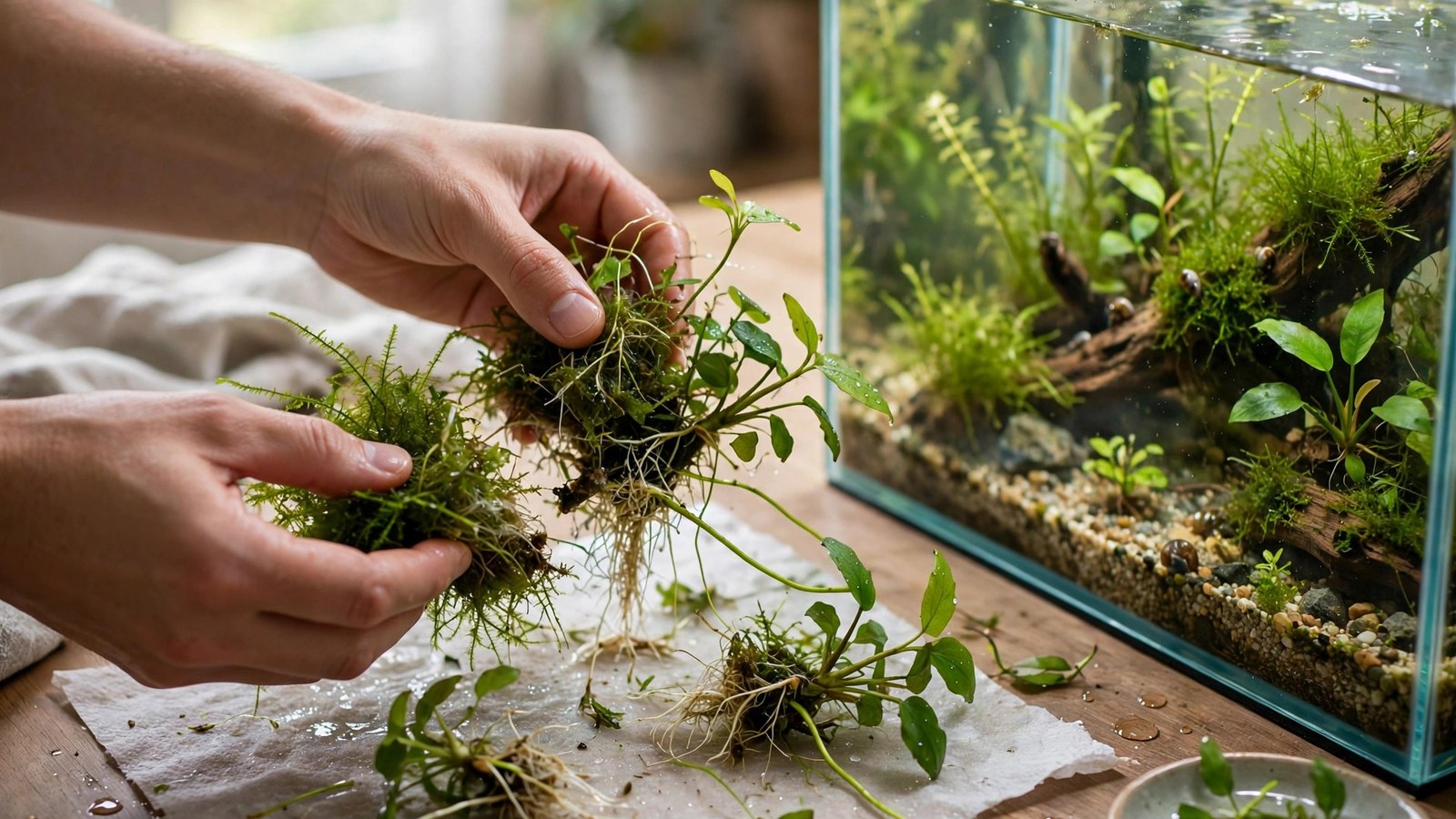
Learning how to divide aquarium plants is the single best money-saving skill in the planted-tank hobby. One healthy Amazon sword or Anubias can be split into three or four independent plants, each one ready to be replanted, shared with friends, or traded at your local fish club — at zero cost. Unlike trimming stem plants, which only gives you cuttings that must regrow from scratch, division produces fully rooted, self-sufficient plants on the spot. It takes ten minutes, needs almost no equipment, and works on most of the hardy rosette, rhizome, and bulb species beginners already own. Below: the exact technique for each growth type, and when to leave the plant alone.
Why Division Beats Buying New Plants
A potted plant from the shop is not really one plant — it is often a cluster of three to five individual crowns crammed together for display. Nursery growers bunch plantlets to look full, and once settled, the plant multiplies further via runners and side shoots. Within six to twelve months, a single pot of Vallisneria or a lone Amazon sword can become a colony occupying half your tank.
Division simply works with that natural growth instead of against it. You separate those individual crowns or rhizome sections, replant them elsewhere, and each division continues growing as a complete plant with its own root system. Compared to other ways of multiplying plants, division has clear advantages:
- Instant plants, not cuttings. Every division already has roots and leaves, so there is no weeks-long wait for a stem cutting to root.
- Near-zero failure rate. You are separating established tissue, not asking a fragment to regenerate, so losses are rare when done right.
- Free aquascaping material. Fill empty foreground zones, start a second tank, or swap plants with other hobbyists.
- Healthier mother plants. Overcrowded crowns compete for light and nutrients; splitting them rejuvenates growth.
There is one important boundary to understand: division only applies to plants that grow as clumps, rhizomes, or bulbs. Stem plants are propagated by cuttings, not division — trying to "divide" a Rotala would just tear it. For that technique, see our guide on trimming stem plants and how to trim aquarium plants generally.
Know Your Plant's Growth Type First
Before you pick up scissors, identify how your plant grows — the technique depends on it. Most popular plants fall into three dividable groups:
| Growth type | Example plants | Dividability |
|---|---|---|
| Rosette / crown plants | Amazon swords, Cryptocoryne, Vallisneria, Sagittaria | Excellent — separate daughter crowns or runner plantlets |
| Rhizome plants | Anubias, Java fern, Bucephalandra | Excellent — cut the rhizome into sections |
| Bulb / corm plants | Tiger lotus, Aponogeton, Crinum | Good — split offset bulbs and plantlet-bearing leaves |
| Stem plants | Rotala, Ludwigia, Hygrophila, Bacopa | Not dividable — propagate by cuttings instead |
If you are unsure which group your plant belongs to, lift it gently (without uprooting it entirely) and look at its base. A cluster of leaves all emerging from one central point with thick roots spreading below is a rosette crown. A thick green horizontal stem creeping along wood or rock is a rhizome. A rounded fleshy body at the base is a bulb. That one observation tells you which section of this guide to follow. If you want to double-check a species' growth habit, the Tropica plant database lists growth characteristics for nearly every commercially available aquarium plant.
What You'll Need
Division is refreshingly low-tech. Gather these before you start:
- Sharp scissors or a clean razor blade — clean cuts heal far better than torn tissue. Sterilize with boiling water or a quick wipe of hydrogen peroxide and rinse well.
- Aquascaping tweezers — long tweezers let you work around roots without disturbing the whole substrate bed.
- A shallow bowl of tank water — park your divisions here while you work so they never dry out.
- Patience. Rushing is how crowns get crushed and rhizomes get mangled. Plan on ten unhurried minutes per plant.
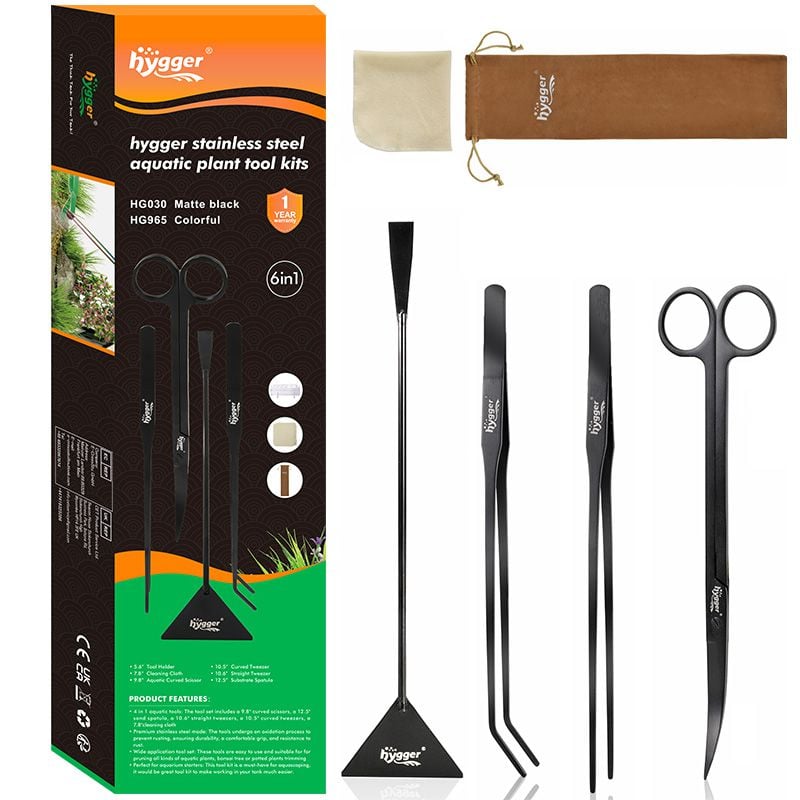
Sharp scissors and tweezers cover every division in this guide: aquascaping scissors and tweezers.
 ★4.6
hygger 6-in-1 Long Aquarium Aquascaping Tools Kit
Check Price on Amazon ★4.6How to Divide Aquarium Plants: Rosette Crowns (Swords, Crypts, Vallisneria)
Rosette plants are the most rewarding to divide because one pot often hides multiple complete plants. The technique is the same whether you are working with a big Echinodorus sword, a Cryptocoryne cluster, or a runner-spreading Vallisneria.
1. Remove the plant carefully
With tweezers or your fingers, gently rock the plant loose from the substrate. Expect a large root mass — swords in particular send dense root networks several inches in every direction. Work slowly; you will lose some fine roots no matter what, and that is fine.
2. Rinse and inspect the crown
Swish the root ball in your bowl of tank water to wash off substrate. At the base you should see individual crowns — distinct growing points, each with its own leaves and roots. A mature Amazon sword typically shows two to five; a large Crypt can show a dozen.
3. Separate the crowns
For most rosette plants, the crowns pull apart by hand with gentle wiggling. Tease them apart at the natural seams, keeping as many roots attached to each crown as possible. If two crowns are fused tightly, make one clean cut with your scissors between them rather than tearing. Aim for each division to have at least four to six healthy leaves and a respectable handful of roots — a division with only one or two leaves will survive, but it recovers much more slowly.
4. Trim and replant
Trim away any mushy or dead roots with your scissors — dark, slimy roots are already rotting and will only foul the substrate. You can also shorten healthy roots by about a third; this sounds counterintuitive, but trimmed roots branch more aggressively in the substrate and the plant anchors faster. For detailed guidance on this step, read our guide on root pruning before replanting. Then replant each division so the crown sits exactly at the substrate surface — never buried, which causes crown rot. New divisions often float loose for a day or two, so review how to anchor aquarium plants if they refuse to stay put.
Special case: runner plantlets (Vallisneria, Sagittaria, chain swords)
Many rosette plants reproduce by sending out horizontal runners that form daughter plantlets a few inches from the mother plant. These are the easiest divisions of all: once a plantlet has four or five leaves and visible white roots of its own, simply snip the runner connecting it to the mother plant and replant the plantlet wherever you like. There is no need to uproot anything.
Dividing Rhizome Plants (Anubias, Java Fern, Bucephalandra)
Rhizome plants grow from a thick horizontal stem — the rhizome — from which leaves grow upward and roots grow downward. Anubias, Java fern, and Bucephalandra all work this way, and their division method is a classic of the hobby.
1. Free the rhizome
Most rhizome plants are tied or glued to wood and rock rather than planted, so gently detach the plant from its anchor. If it is glued, use a thin blade to slice between the glue and the rhizome rather than prying — the rhizome bruises easily.
2. Find natural break points
Look for natural division points — where leaf growth changes direction or the rhizome narrows. Each section you cut must carry at least three to four healthy leaves plus some roots; fewer leaves means a slower recovery.
3. Make one clean cut per division
Cut straight through the rhizome with your sterilized blade in a single confident stroke — sawing mashes the tissue and invites infection.
4. Reattach — never bury the rhizome
Tie each section to wood or rock with cotton thread or fishing line, or glue it with cyanoacrylate gel (safe once cured). Never plant a rhizome in the substrate — it rots; keep it exposed. Growth may pause for a few weeks after division; that is normal.
Fresh divisions behave like new shop-bought plants for the first few weeks — watch for transplant shock and review how to acclimate new aquarium plants for the environmental conditions that smooth the transition.
Dividing Bulbs and Lilies
Bulb plants like tiger lotus, Aponogeton, and Crinum reproduce in two ways: by producing small offset bulbs beside the parent bulb, and (in tiger lotus) by sending up leaves that sprout tiny plantlets along their stems.
Offset bulbs are simple to divide: gently dig around the parent bulb, find the offset — a smaller bulb attached to or resting near the parent — and separate it by hand or with a clean cut of any connecting tissue. Replant the offset with roughly half the bulb buried and the growing tip exposed, the same as you would the parent.
Tiger lotus plantlets take more patience: leaves that reach the surface sometimes develop tiny bulbs at their bases. Let them grow a few small leaves and root nubs, then snip the leaf stem and plant the baby bulb gently in a calm spot.
When Not to Divide Aquarium Plants
Division is stressful even when done perfectly, and some plants should be left alone. Do not divide when:
- The plant is newly purchased or just imported. Shop plants are still recovering from shipping, potting, and the transition to your water. Let them establish for at least four to six weeks of active growth before you split them.
- It is a tissue-culture plantlet. Tissue-culture cups contain tiny juvenile plants that need time to build real root systems and toughen up — dividing them immediately is asking a baby plant to survive surgery.
- The plant is already stressed. Melting leaves, algae-covered foliage, or a plant recovering from a nutrient deficiency needs to heal first. Division redirects energy away from recovery.
- Growth has stalled. If the plant is not producing new leaves, it is telling you something is off — light, CO2, or nutrients. Fix the underlying problem first, then divide once growth resumes.
- You cannot see clear division points. If a rhizome has only two or three leaves total, or a crown cluster is really one fused plant, wait until it matures. Forcing a division on an immature plant gives you two weak fragments instead of one strong plant.
When in doubt, wait a month. A plant that doubles in size over that month will divide beautifully; a plant that struggled for that month was telling you it was not ready.
Aftercare: Helping Divisions Recover
Divided plants have fewer working roots until new ones grow, so the first two weeks are the recovery window:
- Keep water conditions stable. No major water changes, no parameter swings, no new livestock for a few days — stability is what roots need.
- This is a good time to fold division into your aquarium plant pruning schedule as a planned maintenance event rather than a random chore.
- Expect some melting. Crypts in particular may melt some leaves after being disturbed — this is the infamous Crypt melt and it is not your fault. Leave the roots alone; new leaves will emerge from the crown within two to three weeks.
- Watch for floaters. Newly divided crowns with trimmed roots are buoyant and easy for fish to dislodge. Check daily for the first few days and re-seat any escapees.
- Do not over-fertilize. Damaged roots cannot absorb a sudden nutrient dump; dose normally and let root growth catch up.
Frequently Asked Questions
How often can I divide my aquarium plants?
There is no fixed calendar — divide when the plant shows you it needs it. For fast rosette growers like Vallisneria, that might be every three to four months; for slow Anubias, once every year or two. The signs are unmistakable: the center of a sword clump starts looking crowded and pale, runners are escaping in every direction, or the rhizome has outgrown its piece of wood. Healthy plants that are still growing vigorously and uncrowded do not need dividing on a schedule.
How many leaves should each division have?
Four to six healthy leaves per division is the sweet spot for rosette plants, and three to four leaves plus roots for rhizome sections. Fewer leaves means less photosynthesis, which means slower recovery and a higher risk the division stalls. If a crown is too small to meet that minimum, leave it attached to the mother plant and let it grow on — you can always divide it next time around.
Can I divide plants while they are still in the substrate?
Sometimes, yes. Runner plantlets of Vallisneria and chain swords can be snipped in place without disturbing anything. But for crown clusters and rhizomes, removing the plant is almost always better — you get a clear view of the natural division points, you can rinse and inspect the roots, and you avoid tearing tissue blindly underground. The brief disturbance of one removal is gentler than a blind hack in the substrate.
Do I need special fertilizer after dividing?
No special products are needed. A divided plant's limitation is root surface area, not nutrient availability, so extra fertilizer mostly feeds algae. Keep your normal dosing routine and make sure root-feeding plants like swords have root tabs in place — the new roots will find them. If you have not used root tabs before, our root pruning and replanting guide covers preparing the root zone as part of the process.
Why did my crypt melt after I divided it?
Crypt melt is a stress response, not a disease, and disturbance is one of its classic triggers. Crypts often shed their leaves when uprooted, replanted, or even when water parameters change. The good news: the rhizome and roots almost always survive. Leave the plant completely alone — do not dig it up again "to check" — and new leaves will emerge from the base within two to three weeks. This is normal and expected, not a sign you did anything wrong.
Start Dividing: Your First Project
If you have never divided a plant before, start with the easiest candidate in your tank: a runner plantlet on Vallisneria or a chain sword. Snip the runner, replant the baby, and watch it grow — that single success builds the confidence for everything else. From there, work up to pulling apart a crowded Amazon sword, and eventually to slicing a prized Anubias rhizome without flinching.
Within a year of regular dividing, you will look at your tank differently. Empty patches stop being problems and start being invitations. A spare ten-gallon stops looking empty and starts looking like a nursery. And the next time you browse the plant section at the shop, you will do the math — one pot becomes five, for free — and walk right past it.