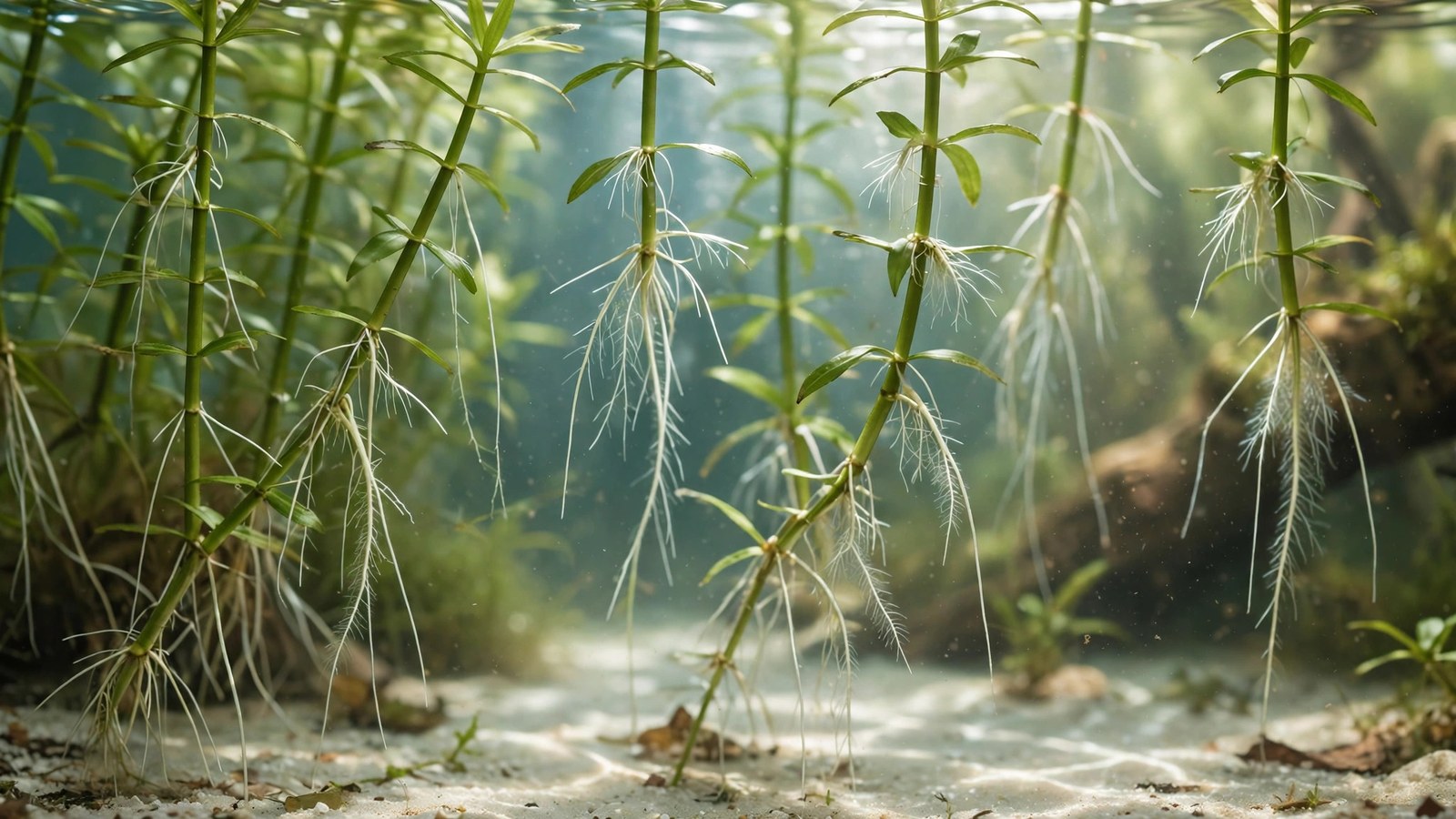
If you've ever looked at your tank and asked yourself why are my aquarium plants growing roots on stem, take a breath: what you're seeing is one of the most normal things a stem plant can do. Those white or brownish filaments are aerial roots — also called adventitious roots — and in most cases they're a sign of an adaptable, healthy plant rather than a sick one. Understanding what triggers them, and which species do it by default, turns a moment of worry into a useful window on what's happening in your tank.
What Aerial Roots Actually Are
Aerial roots are simply roots that grow from somewhere other than the base of the plant — in aquariums, from nodes (the slight swellings or joints) along the stem, sometimes even between nodes. The plant activates dormant root primordia at these points and sends out thin, hair-like roots into the water column or along the substrate.
This is not a mutation, a disease, or a sign that the plant is dying. Botanists call this adventitious rooting, and it's a widespread trait in aquatic and semi-aquatic plants — documented in everything from waterweeds to rice paddies. In the wild, a stem floating free or lying across the substrate uses aerial roots to anchor itself and start absorbing nutrients immediately, wherever it lands. Your plant is running exactly the same program.
Visually, they start as tiny pale bumps at a node, then extend into thin threads — usually white to cream-colored in the water, often turning brown or greyish where they touch the substrate. Don't confuse them with algae strands (which attach irregularly and feel slimy rather than firm) or with decomposing tissue (which looks brown, soft, and dissolves when touched).
Why Are My Aquarium Plants Growing Roots on Stem?
Aerial roots have a few distinct triggers, and knowing which one applies to your tank changes how — or whether — you respond.
1. Nutrient scavenging from the water column
This is the most common reason, and the one that sends hobbyists searching for answers. When the substrate is lean in nutrients — or when the plant's roots in the substrate can't reach enough — stem plants switch strategies and send roots out directly into the water column, where they can absorb dissolved nutrients. Think of it as the plant opening a second storefront because the first one isn't getting foot traffic.
This is especially common in tanks with inert substrates (plain gravel or sand with no nutrient base), in newer setups where root tabs haven't been added, or when the water column itself is lean because no liquid fertilizer is dosed. The roots are literally reaching for food. If your plant is also showing classic hunger signals — stunted or slowed growth, pale new leaves, or nutrient deficiency symptoms like yellowing — the aerial roots are part of the same story.
2. A natural species trait
Some species grow aerial roots no matter how perfect the tank is. Fast-growing stem plants like Ludwigia, Hygrophila, Rotala, and Bacopa are famous for it — they'll sprout roots at nearly every node once established. Many floating and surface-adapted species do the same. For these plants, heavy aerial rooting is not a problem to solve; it's like a dog's tail wagging. You can verify this by comparing with photos of the same species in thriving aquascapes: if you see the same hairy stems in award-winning tanks, your plant is just being itself.
3. A response to trimming and replanting
Cut a stem plant's top and replant it, and watch what happens at the lowest nodes: they burst into roots. A freshly trimmed stem has no root system, so the plant throws out aerial roots as an emergency anchor-and-feed mechanism while it establishes. This is exactly what you want — those roots will grab the substrate and convert into a real root system within a week or two. Newly planted stems sprouting roots is a sign of establishment, not distress.
4. Low light or low CO₂ stress (context matters)
Plants in dim conditions sometimes push roots from higher nodes, essentially hedging: if the stem weakens lower down, the upper portion has an alternative way to hold on and feed. This is less "nutrient scavenging" and more a general stress response. Look for supporting clues — if the plant is also getting leggy or stretching toward the light, the aerial roots are one symptom among several, and the fix is environmental rather than aimed at the roots themselves.
5. Preparing to propagate
Some species use aerial roots as part of their reproductive strategy. When a stem with roots at its nodes breaks or is separated, each rooted section can become a new plant. If your plant is healthy, growing fast, and throwing roots everywhere, it may simply be telling you it's ready to spread.
Are Aerial Roots a Sign of a Problem? (Usually Not)
This deserves to be stated plainly: aerial roots are usually harmless and adaptive. They don't steal energy from the plant — if anything, they add capacity to absorb nutrients. They don't spread like disease. They don't mean your tank is failing. Most hobbyists who post worried photos of "weird stringy things on my stems" get the same answer from experienced keepers: that's normal.
That said, aerial roots can be a symptom worth noticing when they arrive suddenly and heavily alongside other warning signs. Use this quick decision table rather than guessing:
| What you see | Likely meaning | What to do |
|---|---|---|
| Roots at most nodes, plant growing fast, leaves look good | Species trait or normal adaptation | Nothing — or trim for looks |
| Sudden heavy rooting + pale/stunted new growth | Plant is nutrient-scavenging | Add root tabs and/or a balanced liquid fertilizer (start low, observe livestock) |
| Roots appear right after trimming/replanting | Establishment response | Leave them; they'll anchor the plant |
| Roots + mushy stem bases, leaves dropping | Stem may be rotting at the base | Check the base — cut away rot and replant healthy tops |
| Roots + brown mushy roots in substrate too | Possible root rot or substrate issue | Inspect substrate (anaerobic pockets?), improve circulation, consider root tabs |
Notice the pattern: the roots themselves are almost never the problem. They're the plant's coping mechanism. Address the underlying condition — or don't, if there isn't one.
Myths About Aerial Roots, Debunked
Myth: "They mean the plant is starving to death." A plant producing aerial roots is actively solving a problem, which means it has energy to spare. A truly starving plant melts or sheds leaves — it doesn't invest in new root structures.
Myth: "They'll drain the stem and kill it." Roots absorb; they don't parasitically drain their own plant. There's no mechanism by which aerial roots harm the stem they grow from.
Myth: "It means your water is toxic." Aerial roots form in pristine water too, and they're not an indicator of ammonia or nitrite problems. Test your water because you should test your water, not because of the roots.
Myth: "You have to cut them off or they'll take over." They reach a modest length and stop — cutting is purely cosmetic.
How to Manage Aerial Roots
If the roots don't bother you, the honest answer is: do nothing. They'll branch slightly, darken a little, and eventually the plant sheds or reabsorbs old ones. Many hobbyists simply let Ludwigia and Hygrophila wear their fuzzy stems like a badge of vigor.
If you want them gone (cosmetic trimming)
You can snip aerial roots with aquascaping scissors without harming the plant. A few rules:
- Cut, don't pull. Yanking a root can tear stem tissue and open a wound for infection.
- Trim flush at the node with sharp, clean scissors. They'll usually regrow from the same node — this is maintenance, not a cure.
- Do it during a water change, when you can siphon the cut bits out immediately.
- Never trim roots off a newly planted stem that has no established root system — those roots are its lifeline. Wait until the plant is anchored.
If they're a hunger signal (feeding the plant)
When aerial roots arrive with other deficiency signs, the fix is nutritional, not surgical:
- Root tabs under heavy feeders are the direct fix — place one near the plant's base every few months according to the product's instructions.
- Liquid fertilizer feeds the water column — exactly what aerial roots are reaching for. Start with a conservative dose (most hobbyists start at half the label dose for the first week or two) and watch your livestock for any stress before increasing.
- Check whether the roots thin out or stop forming after feeding improves. Plants that are well-fed in the substrate often reduce aerial root production, though some species keep doing it regardless.
- Resist the urge to dump fertilizer: overdosing creates algae blooms, which are a much bigger aesthetic problem than hairy stems ever were. Our guide to over-fertilizing symptoms covers what happens when "more" backfires.
If you want MORE of them (propagation)
Aerial roots are a propagator's best friend. Snip the stem below a rooted node, plant the rooted cutting in the substrate, and it establishes far faster than an unrooted one. The roots hit the substrate already functional, so new growth starts almost immediately. This is how many hobbyists multiply stem plants for free — one mother stem can yield several rooted cuttings once the aerial roots develop.
Species That Do It the Most
If you keep any of these, expect aerial roots as part of the package:
- Ludwigia species (repends, palustris, ovalis) — famously hairy stems, roots at nearly every node.
- Hygrophila species (polysperma, difformis, corymbosa) — vigorous rooters, especially in new growth after trimming.
- Rotala species (rotundifolia, wallichii) — fine, dense roots along stems, often reddish-tinted.
- Bacopa caroliniana / monnieri — thick, obvious white roots from lower nodes.
- Alternanthera reineckii — roots aggressively from nodes, particularly in leaner tanks.
- Floating plants (water lettuce, frogbit) — their entire root strategy is aerial; long trailing roots are the point.
Meanwhile, rosette plants (Cryptocoryne, swords) and rhizome plants (Anubias, Java fern) rarely produce aerial stem roots — they feed through their root systems or rhizomes instead, and their problems look different.
When Aerial Roots Actually Deserve a Second Look
Two edge cases merit investigation beyond "it's fine": (1) One plant roots heavily while everything else thrives. It may just be that species' habit — or a heavy feeder telling you its spot needs a root tab. (2) Roots coincide with sudden, tank-wide changes (rescape, filter change, CO₂ adjustment). The plant may be re-establishing; give it a week or two. In both cases, the roots remain a symptom to read, not a disease to treat. The plant is communicating; your job is to translate.
Frequently Asked Questions
Are aerial roots on aquarium plants harmful?
No — in the vast majority of cases, aerial roots are completely harmless and often beneficial, giving the plant extra nutrient-absorbing capacity. They're an adaptive trait, not a disease. You only need to look deeper if they appear suddenly alongside other distress signals like melting leaves, rotting stems, or stopped growth.
Should I cut off aerial roots on my stem plants?
Only for cosmetic reasons. Trimming them with clean aquascaping scissors is safe, but don't pull them off, and never remove them from newly planted stems that haven't established a root system yet — those roots are anchoring and feeding the plant. Expect regrowth from the same nodes, since the plant is programmed to produce them.
Why do my plants suddenly grow roots on the stems after trimming?
Cutting a stem removes its connection to any established root system, so the plant sends roots out from nodes near the cut as an emergency anchor-and-feed mechanism. This is the ideal response — those roots will grab the substrate and develop into a normal root system within a week or two. Leave them alone.
Do aerial roots mean my substrate lacks nutrients?
Often, yes — heavy aerial rooting combined with pale or stunted new growth suggests the plant is scavenging from the water column because the substrate is lean. Adding root tabs and a conservative dose of liquid fertilizer usually reduces the behavior. But some species root this way regardless of nutrition, so check your plant's species first.
Can I propagate plants using aerial roots?
Absolutely — it's one of the easiest propagation methods in the hobby. Cut the stem just below a node that has developed roots, then plant the cutting so the rooted node sits in the substrate. Because the roots are already functional, the cutting establishes much faster than an unrooted stem piece.
Why are the roots on my stem plants turning brown?
White or cream aerial roots often darken to brown or grey as they age, contact the substrate, or accumulate a light biofilm or algae coating. This is usually cosmetic. The exception: roots that turn brown, mushy, and disintegrate when touched may indicate decay — check the stem base for rot and replant healthy tops if needed.
A Simple Habit for Root-Watchers
The next time you spot threads along your stems, ask: Is the plant growing well otherwise? Did I trim recently? Is this species known for it? If any answer is yes — relax. If the plant is also struggling, reach for root tabs and a careful fertilizer routine before you reach for the scissors. Either way, those little roots are your plant showing initiative. As botanists at institutions like Tropica's plant care resources and university extension programs note, adventitious rooting is one of aquatic plants' most fundamental survival strategies. Your tank is just giving it a stage.