Ask how deep to plant aquarium plants and you'll get five different answers from five different aquarists — and every one of them might be right for the plant they were thinking of. That's because planting depth isn't one number. It depends entirely on the plant's structure: stems want to be buried deep, rhizomes must never be buried at all, and rosette plants need their crown sitting right at the surface. Get it wrong in the "too deep" direction and you're looking at the most common preventable cause of base rot in planted tanks.
This guide covers exactly how far into the substrate each type of aquarium plant should go, why depth matters biologically, the planting technique that keeps everything anchored, and how to spot and fix a plant that was pushed in too far. Note the distinction: this is about how deep you place each plant — not how deep your substrate bed itself should be, which is a separate setup question.
Why Planting Depth Decides Whether Plants Live or Melt
A submerged plant is really two machines in one body. The roots absorb nutrients from the substrate, while the crown, rhizome, or growing tip handles water-column uptake and gas exchange. Burying a plant at the wrong depth breaks this division of labor.
Plant too shallow and the plant floats up with the first water change or filter surge — annoying, but harmless. Plant too deep and the consequences are serious: buried crowns and rhizomes are cut off from water-column oxygen, anaerobic bacteria attack the soft tissue, and the plant begins melting from the base upward. The cruel part is that the leaves can look perfect for weeks while the base silently rots underneath, so by the time you notice, the damage is done.
This is also why "too deep" is the more dangerous direction. A shallow plant complains loudly by floating free. A deep-buried plant dies quietly. When in doubt, plant slightly high — you can always press a floating plant back in, but you can't resurrect a rotted crown.
The Crown Rule: Rosette Plants and Where They Meet the Substrate
Rosette plants — Amazon swords, cryptocorynes, vallisneria, dwarf sagittaria, and most "grass tuft" species — grow from a crown, the thickened base where all leaves emerge. The crown rule is simple: the crown sits at or just above the substrate surface, with only the roots buried below.
Think of it like planting a houseplant: you wouldn't bury the leaf bases of a fern underground. The same applies underwater. Spread the roots outward in a small hole, then settle the crown so it's flush with the substrate surface — a millimeter or two above is safer than a millimeter below.
This matters most for cryptocorynes, which are notoriously prone to "crypt melt" when stressed. A buried crypt crown practically guarantees melt: the soft crown tissue softens in the anaerobic substrate, turns to mush, and the whole plantlet collapses. If your crypts keep melting even though your water parameters are fine, check your planting depth before anything else. The same mechanism kills buried sword crowns, though swords are generally more forgiving.
One exception: when planting vallisneria runners or sagittaria, the spreading runner itself can be laid just under the surface with the daughter crowns at surface level. The runner acts as an anchor line; the new plantlets establish at the correct depth on their own.
Rhizome Plants: Never Bury Them
Anubias, Java fern, and bucephalandra are rhizome plants, and their rule is the strictest of all: the rhizome must never be buried in substrate. These plants are epiphytes by nature — they evolved to grow attached to rocks and wood in flowing water, not planted in soil.
Bury a rhizome and it suffocates. Rhizome rot looks like this: the thick green-brown stem turns black, goes soft, and the leaves detach one by one from a base that smells unpleasant. Once rot spreads through the rhizome, the entire plant is usually lost, though you can sometimes salvage a section if you cut well back into firm, healthy green tissue with sterilized scissors.
Instead of planting, attach rhizome plants to hardscape:
- Cyanoacrylate super glue (gel type, aquarium-safe) — a tiny dab on dry rhizome, pressed to dry rock or wood for 30 seconds. Fast and reliable.
- Cotton thread or fishing line — wrap loosely; the thread rots away naturally as roots take hold.
- Wedge into crevices — tuck the rhizome into a crack in driftwood or between stacked stones, leaving the entire rhizome visible and above the substrate line.
These are true epiphytes — Tropica's plant database classifies species like anubias and Java fern by their attachment-to-hardscape growing habit rather than as substrate-planted species, which is worth confirming before you bury any unfamiliar plant.
Let the roots dangle freely or trail along the rock — roots can touch or even grow into substrate, and that's fine. The rule applies to the rhizome only. For more techniques to keep these plants in place, see our guide on how to anchor aquarium plants without burying them.
Bulb and Tuber Plants: Half-Buried
Bulb plants like tiger lotus, aponogeton, and crinum grow from an energy-storing bulb or tuber, and they want the Goldilocks depth: roughly half the bulb buried, half exposed.
Push a bulb fully under the substrate and it faces the same fate as a buried rhizome — soft rot starting from trapped moisture and poor circulation. Leave it sitting entirely on top and the roots struggle to anchor it, so it tips over or gets nudged loose. The sweet spot is pressing the bulb down until it's half-sunk, with the sprout tip and top half of the bulb visible.
Many bulbs arrive dormant and dry in the pot. Soak them in tank water for a few hours first, then plant half-buried. If a bulb hasn't sprouted within a few weeks, gently unearth it and check — dormant bulbs that feel firm are still viable; soft or foul-smelling ones are spent and should be removed before they foul the water.
How Deep to Plant Aquarium Plants: Stems Go 1–2 Inches Deep
Stem plants — rotala, ludwigia, bacopa, hygrophila, hornwort (well, hornwort floats, but you get the idea) — are the one category that genuinely wants to be buried. Push each cutting 1 to 2 inches into the substrate, which usually means about a third of the cutting's length underground.
Go shallower and cuttings float at the slightest disturbance; each re-planting shocks the plant and resets its rooting progress. Go deeper than about 2 inches and the buried lower leaves melt from light deprivation, which can invite decay along the stem's base.
A few stem-specific refinements:
- Strip the lower leaves from the section that will be buried — leaves under the substrate rot and waste the plant's energy.
- Space stems about an inch apart rather than planting a tight bunch. Crowded stems block water flow and light to the base, which is how the dreaded "bare bottom half" develops. For the full trimming and replanting cycle, see the stem plant trimming guide.
- Plant at a slight angle if your substrate is coarse gravel — the diagonal path through the substrate gives more contact and a stronger hold than a straight-down push.
Carpeting Plants and Runners
Carpeting species (dwarf hairgrass, Monte Carlo, HC Cuba, glossostigma) come in two forms, and each plants differently. Plug-style pots should be split into small portions — roughly a thumbnail of plant per plug — and each plug pressed so its roots are buried and its leaf tips sit just above the substrate surface. Planting an entire pot as one clump guarantees the center rots.
Tissue-culture cups give you dozens of tiny plantlets to work with. Separate them into small clusters, and plant each cluster deep enough that the tiny roots are covered — for cups this often means nearly the whole plantlet is at the surface line, with only the root tips tucked in. Planted too shallow, these feather-light plantlets drift away; planted too deep, they smother. Tweezers and patience are mandatory here, and our full walkthrough on planting tissue culture cups covers the separation technique in detail.
Space carpet plugs 1–2 inches apart. It looks sparse on day one, but each plug spreads outward, and the gaps fill in weeks rather than months. Dense planting slows spread because neighboring plugs compete instead of colonizing.
The Planting Technique That Actually Works
Depth only holds if the plant stays put at that depth. Professional aquascapers use the same method regardless of plant type:
- Drain the tank partially (or plant before the first fill). Planting in 2–3 inches of water, or even damp substrate, is far easier than fighting buoyancy in a full tank.
- Use long aquascaping tweezers. Hold the plant by its roots (rosettes, carpets) or lower stem (stems), never by the leaves — pinching leaves bruises them.
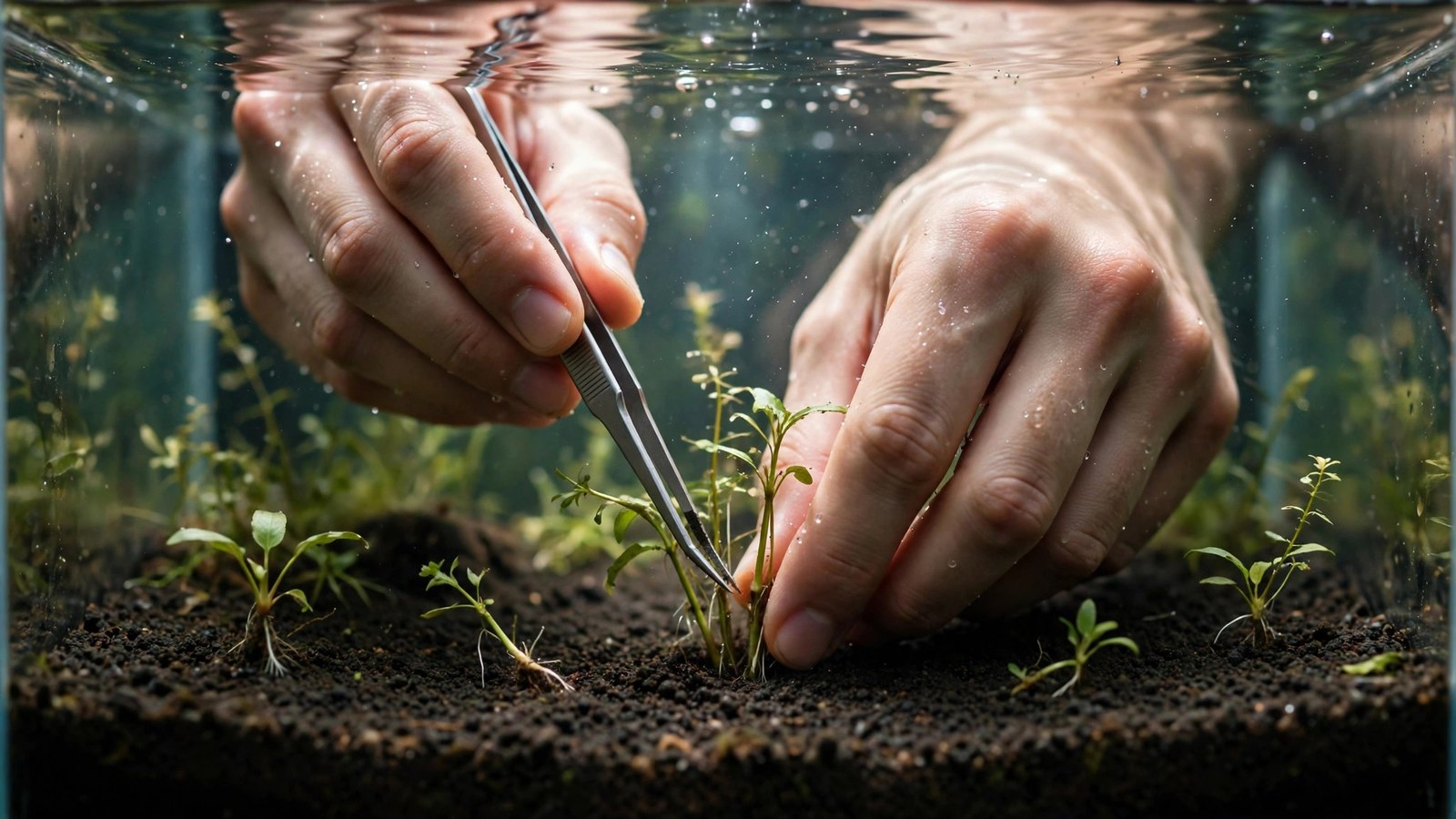
- Make a pilot hole first. Press the tweezers into the substrate at the target depth, open them slightly to create a pocket, insert the plant's root end, then withdraw the tweezers and gently pinch the substrate closed around the plant with your fingers.
- Pull the plant up slightly after planting. This counterintuitive step settles the roots outward instead of folding them into a ball, and confirms the depth is right — the crown should sit at the surface, stems should hold 1–2 inches deep.
- Turn off the filter for an hour after a big planting session so the flow doesn't uproot loose plants before they settle.
 ★4.6
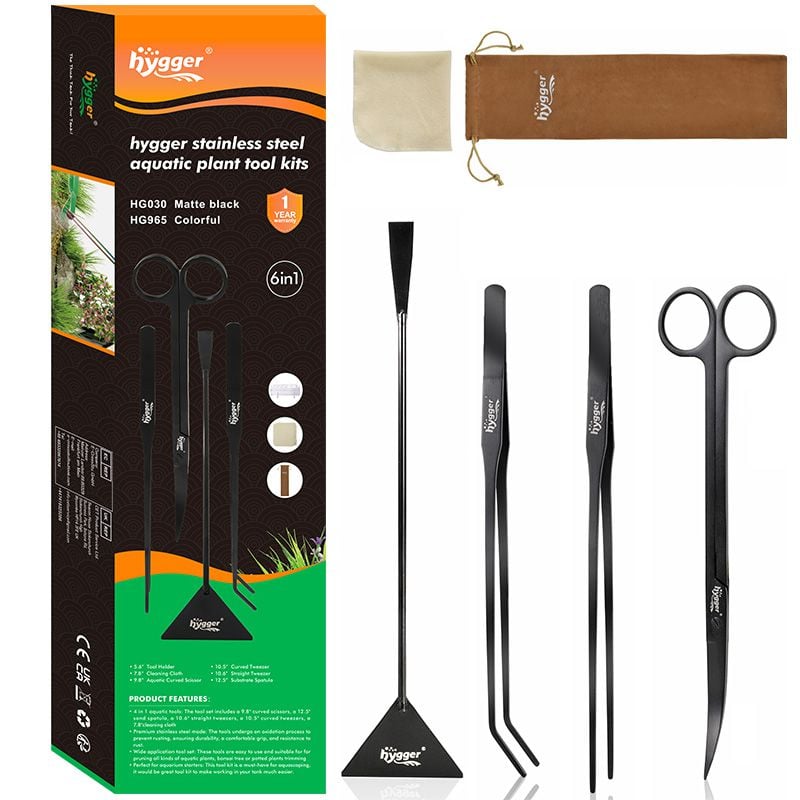
hygger 6-in-1 Long Aquarium Aquascaping Tools Kit
Check Price on Amazon ★4.6Planting depth and acclimation interact: stressed new plants are far more likely to melt when planted wrong. If your plants are fresh from the shop, read how to acclimate new aquarium plants before you start pushing them into the substrate, and how to anchor aquarium plants if floaters keep popping out overnight.
Signs You Planted Too Deep (and How to Fix It)
Diagnosing a depth problem is mostly about reading the pattern of decay:
- Melting from the base upward while the tips look healthy — the classic signature of a buried crown or too-deep stem base.
- Black, mushy rhizome with leaves falling off — rhizome rot from burial.
- Soft, foul-smelling bulb — full burial rot.
- A ring of dead tissue right at the substrate line — the "tide mark" where buried tissue meets water.
The fix is straightforward: gently uproot the plant, trim away all mushy or blackened tissue with clean scissors (don't be timid — rot spreads), and replant at the correct depth. For rosettes, this often means a crown that sat a quarter inch under the surface now sits flush on top. Severely rotted plants may need to be propagated instead — a healthy sword crown can be divided into new plants once it's recovered, turning one rescue into several.
Prevention beats surgery every time: when you plant, lean shallow. A plant that floats can be re-planted in ten seconds; a plant that rotted from over-burial took you weeks to diagnose.
Frequently Asked Questions
Can you plant aquarium plants too deep?
Yes — and it's one of the most common beginner mistakes. Burying a plant's crown or rhizome below the substrate surface cuts off oxygen and water flow, inviting bacterial rot that melts the plant from the base up. Stem cuttings can tolerate 1–2 inches of burial, but rosette crowns should sit at the surface and rhizomes (anubias, Java fern) must never be buried at all. If in doubt, plant slightly shallower than you think you should.
How deep should the roots of aquarium plants be?
Roots themselves should be fully buried — the rule is that the roots go under and the crown, rhizome, or bulb top stays at or above the surface. Spread roots outward when planting rather than bunching them into a ball, which rots. For rosette plants, dig a small pocket, fan the roots out, and settle the crown flush with the substrate. Full root burial with correct crown placement gives the best of both worlds: anchoring plus healthy tissue.
Do anubias and Java fern need to be planted in substrate?
No — they should never be planted in substrate. Anubias, Java fern, and bucephalandra are epiphytes that grow attached to rock and driftwood. Burying their rhizome causes rhizome rot: the stem turns black and mushy and the plant dies. Tie them to hardscape with thread or fishing line, dab them on with aquarium-safe super glue gel, or wedge the rhizome into a crevice. Their roots can dangle freely or grow into the substrate, but the rhizome itself must stay exposed.
Why do my new plants keep floating up after I plant them?
Floating is almost always a technique problem, not a depth problem: stems planted too shallowly (under an inch), roots balled up instead of spread, or the filter current hitting fresh plantings before they settle. Push stem cuttings 1–2 inches deep, pinch substrate around the base, plant at a slight angle in coarse gravel, and switch the filter off for an hour after planting. Species with fine roots, like tissue-culture carpets, need tweezers and a pilot-hole technique to stay down.
How deep do you plant bulbs like tiger lotus?
About half-buried. Press the bulb into the substrate until roughly half of it is under the surface, with the top half and the sprout tip exposed. Fully burying a bulb risks rot in the same way as burying a rhizome, while leaving it sitting loose on top means it tips over or gets knocked free. Soak dormant bulbs in tank water for a few hours before planting, and check un-sprouted bulbs after a few weeks — firm means still viable, soft and smelly means it's spent.
Is planting depth the same as substrate depth?
No, and confusing the two is common. Substrate depth is how thick the substrate bed is across the tank (typically 2–3 inches for planted tanks). Planting depth is how far you push each individual plant into that bed — a per-plant placement decision that varies by species. You need the right bed depth to give roots room, and the right planting depth so each crown or rhizome sits exactly where it should.
Plant Shallow, Not Sorry
Every plant type in your tank has exactly one correct depth: crowns flush at the surface, rhizomes never buried, bulbs half-buried, stems 1–2 inches deep, carpet plugs spaced at the surface line. Memorize those five positions and you'll sidestep the most common cause of base-rot melt in the hobby. Planting is a five-minute skill that pays off for the life of the tank — take the extra minute per plant to check where its crown sits, and your plants will spend their energy growing instead of fighting the substrate.