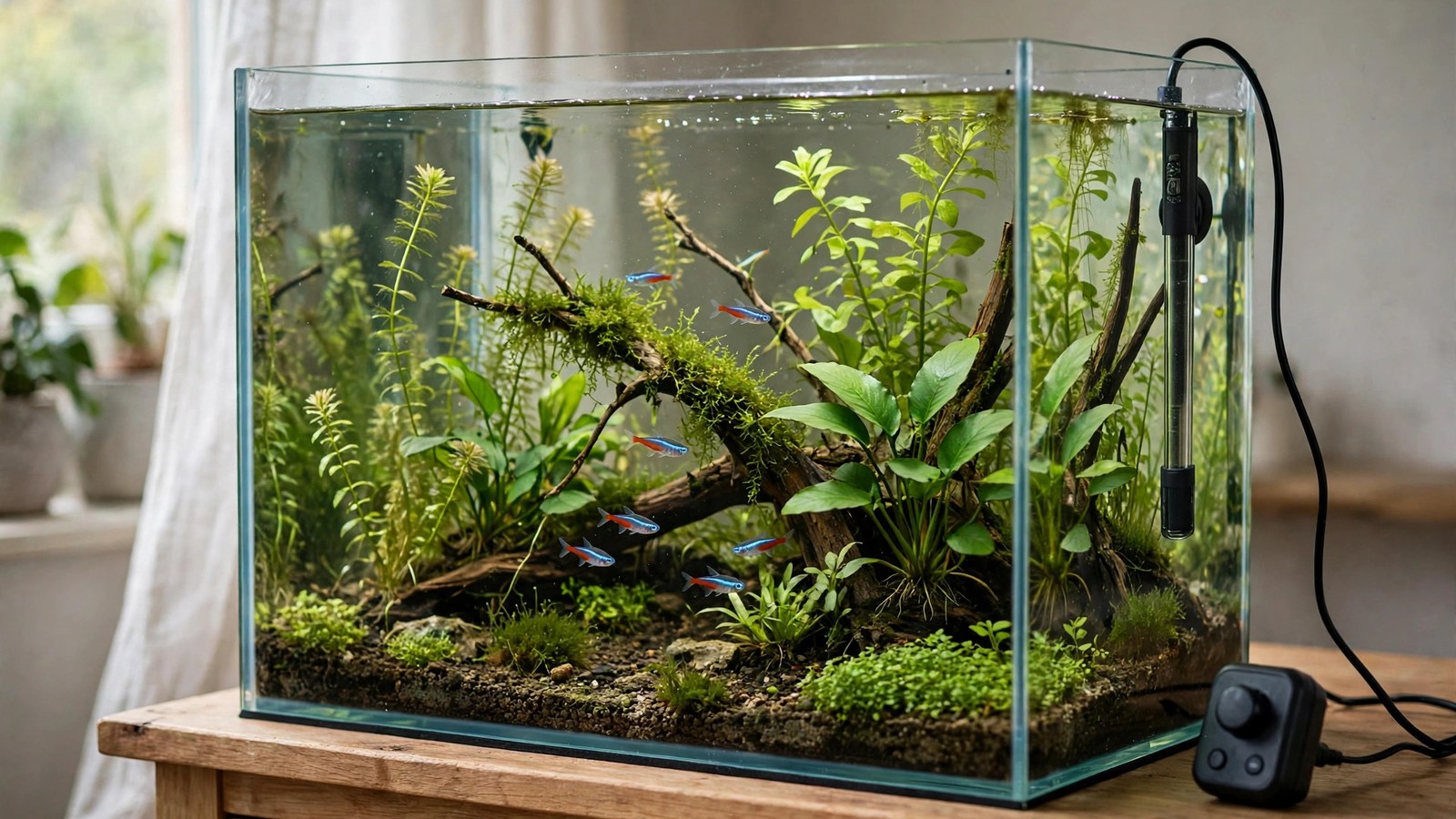
Aquarium heaters fail in the "on" position far more often than anyone expects — a single stuck heater can push a 20-gallon tank past 95°F (35°C) overnight, wiping out fish, shrimp, and heat-sensitive plants while you sleep. A heater controller is the device aquarium keepers trust to prevent exactly that: a $35–$60 device between your heater and the wall outlet that cuts power the moment water temperature climbs out of range. If you're still planning the tank, read our low-tech planted tank setup guide first.
Why Your Heater's Built-In Thermostat Isn't Enough
Nearly every submersible heater has a thermostat built into its head — a small switch that should open the circuit at your set temperature. The most common failure is contacts that arc and weld shut, leaving the element permanently on. The quieter one is calibration drift: the dial says 78°F but the element fires until 84°F, and you never notice because it creeps in over months.
For a planted tank it matters twice over. Fish and shrimp face the acute danger, but plants suffer too: swings wider than ~5°F can melt Cryptocoryne, and warmer water holds less oxygen and less CO2, upsetting the balance your plants depend on. After a heat excursion, fresh activated carbon helps pull the dissolved-organics spike before it feeds an algae bloom.
The thermostat inside a $25 heater is the cheapest component in the most dangerous device in your tank. A controller doesn't replace the heater — it puts a second, independent thermostat in charge, and this one has alarms.
How a Heater Controller Aquarium Setup Protects Your Tank
A controller has three parts: a probe in the water, a relay switching your heater's power, and a display for your target. Heater into the controller, controller into the wall — and the probe, not the heater's internal switch, decides when the element gets electricity.
The key is the two-thermostat stack: set the heater's dial 2–3°F above the controller's setpoint. The controller holds your target; the heater's own switch never trips in normal use and stands by as backup. If the controller's relay ever failed closed, the heater's switch would still open a few degrees later — two failure points instead of one.
Models like the Inkbird ITC-306T add dual heating outlets and day/night setpoints — a mild nighttime dip suits many plants and fish — plus over-temperature and sensor-fault alarms: if the probe fails electrically, the unit kills the outputs and buzzes instead of heating blindly. Skim the ITC-306T user manual before touching the buttons.
Single-Stage vs Dual-Stage: Which Do You Need?
In a normally heated room, a heating-only controller is all you'll ever need. A dual-stage unit earns its keep only if your room runs hot in summer and you cool the tank with a fan or chiller.
| Type | Outputs | Standout feature | Best for |
|---|---|---|---|
| Heating-only (ITC-306T style) | 2 × heating, up to 1100W at 110V | Separate day/night setpoints | Most planted tanks |
| Heating-only with WiFi | 2 × heating | Phone alerts and temperature logs — see the ITC-306T WiFi's official specifications | Travelers, high-value livestock |
| Dual-stage (ITC-308 style) | 1 × heating + 1 × cooling | Switches a fan or chiller when the tank overshoots | Warm rooms without AC |
Buy heating-only unless you already own a cooling fan, and the WiFi version only if remote alerts are worth the premium. The core protection — an independent thermostat cutting power — is identical across all three.
Setting It Up: Setpoints, Differentials, and Alarms
Follow this order and you'll be running safely in fifteen minutes.
- Wire it correctly. Heater into the controller's output, controller into the wall (a GFCI outlet, ideally). Every watt of heating must pass through the controller's relay.
- Stack the thermostats. Set the heater's own dial 2–3°F above your target. For a 76°F target, the heater goes to 78–79°F.
- Set the controller setpoint to your target — 76°F (24.4°C) suits most tropical planted communities. If your unit supports day/night cycles, drop the night value 1–2°F.
- Set the differential (hysteresis) to 1°F: the heater cuts at 76°F and re-engages at 75°F. Under 1°F the relay short-cycles; over 2°F the tank swings more than plants like. While you're at it, measuring TDS in a planted tank takes a minute and baselines your water chemistry.
- Set the alarms: high at +3°F above target, low at −3°F. The high alarm should never sound normally — if it does, the controller's own relay may have failed.
- Calibrate the probe: compare the controller's reading with a trusted glass thermometer and apply the calibration offset.
Where to Put the Temperature Probe
The probe must read the tank's average temperature, not the water at the heater. Place it 4–6 inches away, in the path of your filter outflow or a wavemaker or powerhead flow, at mid-depth, suction-cupped well below the waterline.
Avoid two placements: against the heater glass (it reads element heat, so the controller short-cycles while the rest runs cold) and in a dead corner behind dense stems (stale water, late reactions).
Frequently Asked Questions
Do I really need a controller if my heater has a built-in thermostat?
Yes — the built-in thermostat is the part that fails. Heater thermostats weld shut or drift out of calibration, and then nothing stops the element. A controller adds a second, independent thermostat with alarms. It's the cheapest redundancy in the hobby.
Can I plug two heaters into one controller?
Yes, as long as combined wattage stays under the controller's rating — typically 1100W at 110V, far more than aquarium heaters draw. Two smaller heaters beat one large one on big tanks: a failed unit can only add half the heat.
What temperature should a planted tank run at?
74–78°F (23–26°C) suits most tropical plants, community fish, and shrimp; choose the cooler end for hillstream or temperate setups. A livestock-free plant grow-out tank can also run cool, which slows algae growth while new plants establish and root in before livestock arrives.
Why does my controller click on and off constantly?
That's short-cycling: the differential is too tight or the probe sits too close to the heater. Widen the differential to 2°F and move the probe 4–6 inches away in moving water. If it persists, the heater's dial may be set below the controller's setpoint, making the two thermostats fight.
Will a controller protect against a cracked, leaking heater?
No — a controller only manages temperature; it can't detect cracked glass or stray current. Plug everything into a GFCI (RCD) outlet, which cuts power on current leakage. Use both: the GFCI guards against electrical faults, the controller against thermal runaway.
The Bottom Line
A heater controller is the least glamorous and most valuable $50 in the hobby: fifteen minutes of setup buys a tank its own heater can't cook. Set it once, secure the probe, glance at the display when you feed — and keep everything else just as consistent, including your fertilizer routine (see our APT Complete vs Easy Green comparison). Your plants will never thank you. That is rather the point.