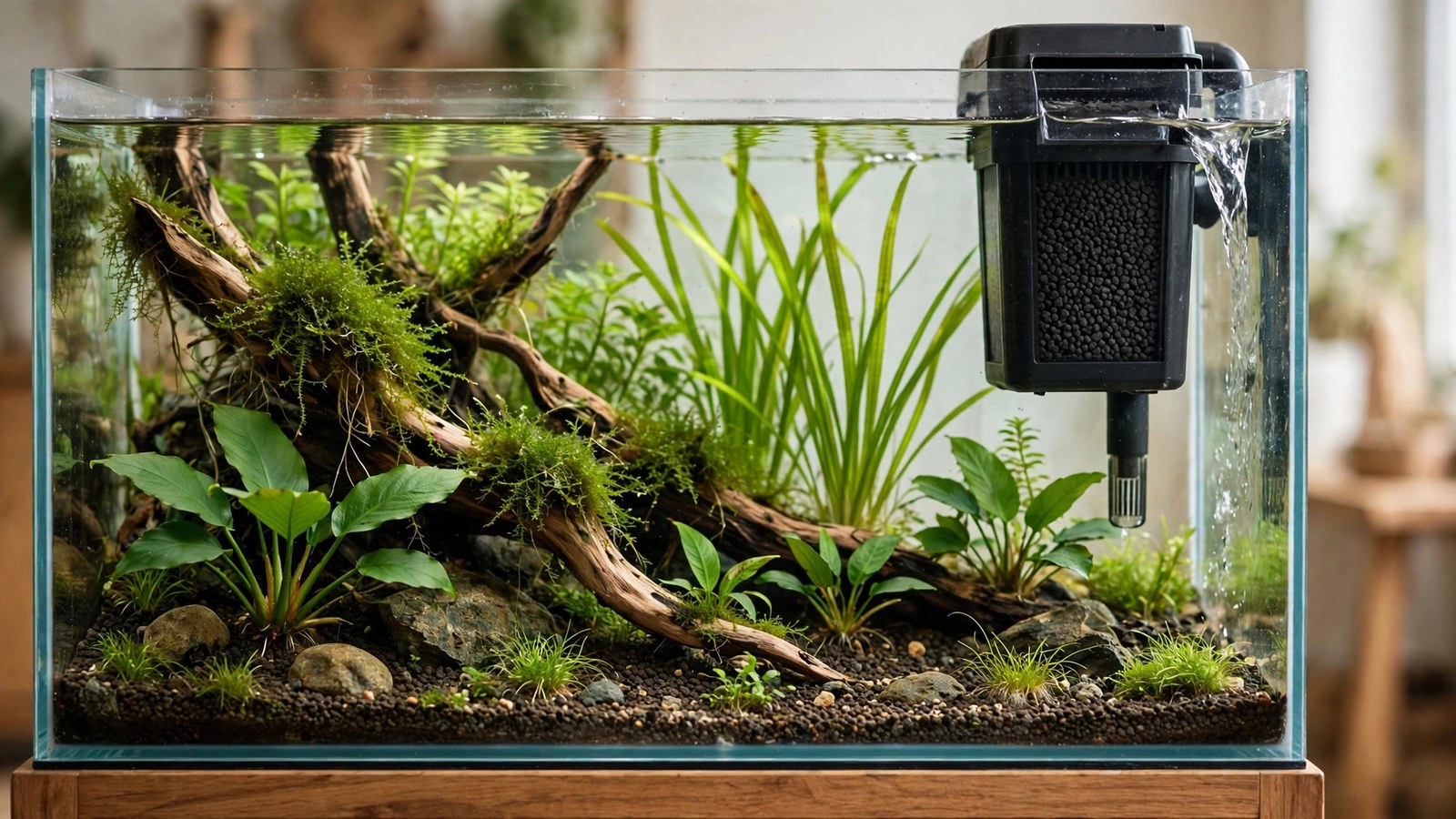
Every month, thousands of aquarists throw away a mesh bag of black granules — and quietly throw away part of their fertilizer budget with it. If you run an activated carbon planted tank setup while paying good money for liquid ferts, the two are working against each other behind your filter lid. The truth is subtler than the forum wars suggest: fresh carbon won't nuke your fertilizer bottle, but it steadily steals the nutrients your plants can least afford to lose.
What Activated Carbon Actually Removes in a Planted Tank
Its pores trap large organic compounds by adsorption — which is why it polishes yellowed water so dramatically — while small inorganic ions slip straight through.
| Substance | What carbon does |
|---|---|
| Dissolved organics and tannins | Strong removal — crystal-clear water |
| Medication residues (dyes, antibiotics) | Strong — excellent for post-treatment cleanup |
| Odors and yellowing pigments | Strong |
| Chlorine and chloramine | Moderate — filter contact time is often too short |
| Chelated iron and trace metals | Partial — chelate complexes get trapped |
| Nitrate, phosphate, potassium | Negligible — inorganic ions adsorb poorly |
| Ammonia and nitrite | Negligible — carbon does not remove these |
Notice what's missing: ammonia and nitrite. Research comparing carbon with zeolite found carbon completely ineffective as an ammonia absorbent. When someone says carbon keeps a tank "safe," they mean visually clean, not biologically clean.
Your Activated Carbon Planted Tank: Does the Carbon Strip Fertilizer?
Here's the honest answer: carbon strips some fertilizer, and which part matters more than how much. Liquid fertilizers deliver two groups of nutrients: macros (nitrogen, phosphorus, potassium) that carbon largely ignores, and micros (iron, manganese, zinc, boron) that arrive as chelated complexes — and those are fair game.
Chelators like EDTA and DTPA are big organic molecules — precisely what carbon's pores trap. When carbon grabs the chelate, the iron comes along with it, locked where your plants can't reach it. That's why iron vanishes first on fresh carbon — and why a fresh carbon bag is a prime suspect when new leaves come in pale despite regular liquid-fertilizer dosing.
There's also a timeline: carbon does most of its adsorption in the first days after installation, then steadily exhausts — a two-month-old bag isn't stealing anything. Before overhauling your routine over this, ask whether your plants genuinely need supplemental fertilizer at all, because the carbon question only bites when you're actively dosing.
When Carbon Earns Its Place in a Planted Tank
Carbon isn't a villain — it's a specialist that shines in four situations:
- After medication treatment. Antibiotics and dyes like methylene blue linger after the illness is gone; a week of fresh carbon scrubs the residues.
- Tannin removal from new wood. Fresh driftwood and Indian almond leaves tint water brown for weeks; carbon clears it in days.
- Odor control. A pond-smelling tank has excess dissolved organics; carbon plus a solid water-change technique fixes the symptom while you find the cause.
- After a decay event. A dead fish found two days late, or a melt after fertilizing a new aquasoil tank went sideways, floods the water with organics; carbon is the fastest cleanup crew.
In every case, carbon is a temporary guest worker: it arrives with a job, finishes it, and leaves.
When to Remove Carbon from Your Planted Tank
Apart from that rule, remove carbon when its job is done: tannins gone, residues scrubbed — pull the bag. Spent carbon isn't harmful; it just isn't helping.
How Long Activated Carbon Really Lasts
The "change monthly!" on filter boxes was written for cartridges manufacturers wanted you to keep buying:
- Days 1–4: roughly 90% of a fresh bag's adsorption happens in the first 48 hours. This is carbon at its most aggressive — and when it steals the most chelated iron.
- Weeks 2–4: capacity drops sharply; treat a bag as spent by week 3–4 in a stocked, fertilized tank.
- Months 2–3: the figure manufacturers quote — e.g. Seachem's official MatrixCarbon dosing guidance (250 mL treats up to 400 liters for several months) — applies to lightly stocked fish-only tanks; planted tanks exhaust it faster.
Burying one myth: exhausted carbon does not dump anything back — no physical mechanism exists for adsorbed substances to release their hold. The only reason to pull old carbon is that its surface is full. And always rinse fresh carbon first: cheap granular carbon ships coated in phosphate-rich dust that feeds algae.
 ★4.8
Pawfly Filter Media Bags
Check Price on Amazon ★4.8Carbon vs Purigen for Planted Tanks
Should you just use Purigen instead? Purigen isn't magically fertilizer-safe — it also pulls organics, and chelates are organics. The real advantage is economic: because you regenerate Purigen with bleach instead of replacing it, running it continuously costs almost nothing.
| Factor | Activated carbon | Purigen |
|---|---|---|
| Organic removal | Excellent | Excellent — often visibly better |
| Effect on fertilizers | Traps chelated iron and trace metals | Also removes organics, but regeneration makes "extra" use nearly free |
| Regenerable | No — throw it away | Yes — soak in bleach, then dechlorinate |
| Best use | Quick one-off cleanup jobs | Continuous water polishing |
For permanently polished water without a monthly carbon tax, Purigen is the smarter long-term play — see our Purigen for planted tanks guide.
Dosing Adjustments If You Keep Running Carbon
Spotting pale new growth despite steady micro-nutrient dosing? Check the carbon bag's age first, then try three adjustments:
- Time iron around carbon changes. Fresh carbon is hungriest in its first days, so dose your main iron shot in the second week of a bag's life, not on installation day. Pale new growth on steady micros? Check the carbon's age first.
- Bump iron by roughly a quarter. Continuous carbon users can raise chelated iron ~25–30% to compensate — watch new leaf color for two weeks, and learn how iron dosing really works for redder plants first.
- Put iron in the substrate. Root tabs bypass water-column carbon entirely — pairing lean water-column micros with a solid root-tab regimen is the clearest insurance policy.
And the honest option: skip continuous carbon altogether. Most thriving planted tanks don't run it. Clean water comes from a consistent weekly routine, not black granules.
Frequently Asked Questions
Does activated carbon remove nitrates or phosphates from the water?
Practically no. Nitrate, phosphate, and potassium exist as small inorganic ions, and carbon's pores are built to trap large organic molecules instead. If you're battling high nitrates, carbon won't help — water changes, plant uptake, and lighter feeding are the real levers.
Will activated carbon starve my aquarium plants completely?
No — but it can nibble the edges. Macros pass through untouched, and iron loss only matters on fresh carbon within its first few weeks. Plants still grow well on a normal dosing routine; only demanding plants show symptoms, and only while the carbon is fresh.
How often should I replace activated carbon in a planted tank?
Every 3–4 weeks if you run it continuously, since most adsorption happens in the first days and capacity falls fast in a stocked, fertilized tank. The smarter move is on-demand use: install it for a week after medication treatment or during tannin leaching, then remove it.
Should I remove activated carbon before dosing medication?
Always. Carbon adsorbs medication compounds out of the water, under-dosing your fish and letting a treatable illness run out of control. Pull the bag before the first dose; after the full treatment course, add a fresh bag for a week to scrub the residues.
Is spent activated carbon dangerous to leave in the filter?
No. Exhausted carbon doesn't release trapped substances back into the water — that myth has no physical mechanism behind it. Old carbon simply stops being chemical filtration and becomes extra biological media as bacteria colonize its pores, which is completely harmless.
The Bottom Line
Activated carbon is neither the fertilizer assassin the forums claim nor the harmless magic rock the filter companies sell. It has a sharp first week and a dull third: brilliant on tannins, odors, and medication residues; gently thieving chelated iron while fresh; spent once exhausted. Treat it like a guest with a job — not a permanent resident.