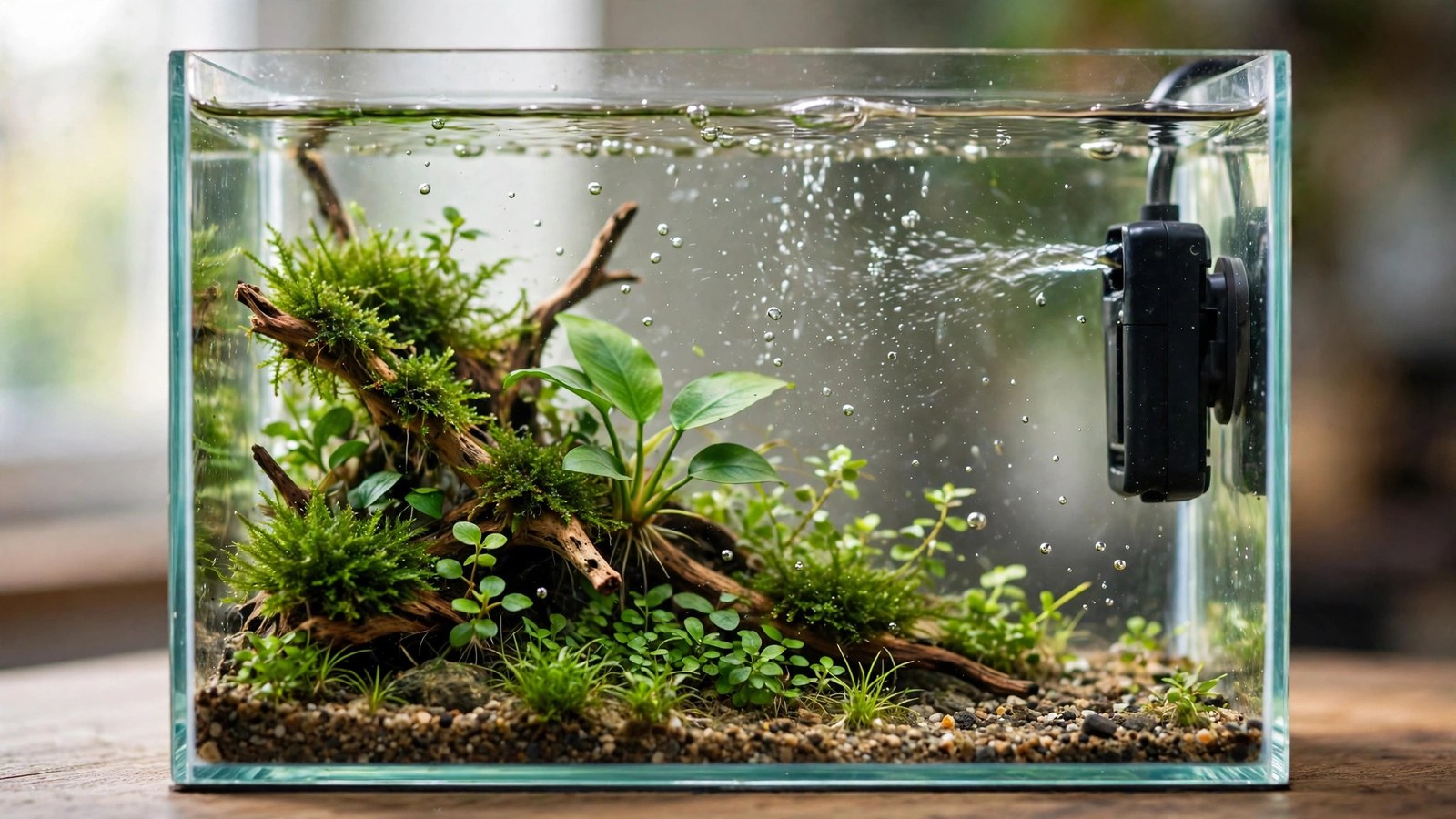
The fastest way to wreck a nano planted tank is a filter that flattens stems, eats baby shrimp, and churns the surface until every bubble of injected CO2 escapes. Internal filters dodge all three: they sit and discharge fully submerged, and nano-tuned models come with foam intakes shrimplets cannot enter. These five real models earn the best internal filter for planted tank title for different setups. If you are still choosing between filter styles, skim our head-to-head of every filter type for planted tanks first.
Short answer: the best internal filter for a planted tank matches gentle, adjustable flow to your tank volume — roughly 3–5× turnover per hour — with a sponge-shrouded intake and the venturi OFF in CO2-injected tanks. Submerged discharge wastes far less injected CO2 than a hang-on-back filter's waterfall. Dennerle Nano Corner Filter leads for shrimp cubes; Fluval U2 is the safest all-round default.
Why an internal filter fits a planted tank so well
A planted tank needs gentle circulation, shrimp protection, and minimal surface agitation when injecting CO2. Internal filters check all three by construction.
First, CO2 retention. A hang-on-back filter's waterfall return and a lily pipe aimed at the surface both drive dissolved CO2 out of the water. An internal filter's output stays submerged, and many models ship with a spray bar you can aim at the back glass, spreading nutrients with barely a ripple. Before you tweak gas and flow, read up on acclimating plants to new CO2 levels — sudden changes stress plants more than slow ones.
Second, shrimp safety. Planted tanks and shrimp colonies are natural partners, but open powerhead intakes trap shrimplets. Nano-focused internal filters have fine-pore foam intakes or narrow slots instead. Pair the right filter with shrimp-safe dosing habits and the colony practically manages itself.
Third, simplicity. No pipes over the rim, no priming, nothing to drill. The unit hides in a corner or behind tall stems, mounts on suction cups in seconds, and lifts out whole for cleaning. For low-tech setups, an internal filter is often all you ever need.
What the best internal filter for planted tank setups does differently
What separates the good ones from the shelf units:
- Adjustable, diffused flow. A spray bar or diffuser spreads current; a single hard jet flattens plants and trenches the substrate.
- A genuinely fine intake. Narrow slots or a foam sleeve beat coarse grilles. Coarse intake? Budget for a prefilter sponge.
- Real media volume. A foam block plus ceramic biomedia holds the bacterial colony that keeps ammonia at zero; cartridge-only units clog fast on decaying leaves.
- Quiet motor, low wattage. 2–8 W is the sweet spot for nano to mid-size models that run 24/7 in your living space.
- Easy cleaning in place. Flip-top lids, magnetic cartridges, and slide-out foam make maintenance a two-minute job.
Our 5 picks, compared at a glance
| Filter | Tank size | Rated flow | Shrimp-safe | Price tier |
|---|---|---|---|---|
| Dennerle Nano Corner Filter | 10–40 L | 150 L/h | Yes | Budget |
| Fluval U2 Underwater Filter | 45–110 L | 400 L/h | Needs prefilter sponge | Mid |
| Aqueon QuietFlow E Internal 10/20 | Up to 10 / 20 gal | 60 / 130 GPH | Needs prefilter sponge | Budget |
| Oase BioPlus 100 | Up to 100 L | 500 L/h | Needs prefilter sponge | Premium |
| Sicce Shark ADV 600 | 26–47 gal | 158 GPH | Yes — adjustable intake | Mid |
1. Dennerle Nano Corner Filter — best for shrimp nano cubes
The classic European shrimp-cube filter. Its wedge hides in a corner, the fine-pore pre-filter sponge is baby-shrimp safe, and the rotatable spray tube washes nutrients over carpets without blasting them. At 150 L/h and 2 W it is near-silent. Trade-offs: rated to only 40 L, no chemical media stage, and the spray tube wants its mini-brush monthly.
2. Fluval U2 Underwater Filter — best all-rounder for small planted tanks
The U2's three-way output — top jet, spray bar, or bottom output — gives the soft, even circulation a 10–30 gallon planted tank wants, and two foams plus BIOMAX hold plenty of bacteria. It mounts horizontally for shallow tanks. Trade-offs: bulky for true nanos, the intake needs a sponge sleeve for shrimplets, and cartridges are proprietary.
3. Aqueon QuietFlow E Internal — best budget US pick
The cheapest way into decent internal filtration: the E10 (60 GPH) covers up to 10 gallons and the E20 (130 GPH) up to 20, with a bioholster grid and auto-restart after power cuts. Trade-offs: the carbon cartridge strips liquid fertilizers — swap it for a sponge — and the intake grille needs a prefilter sponge before any shrimp go in.
4. Oase BioPlus 100 — best for larger low-tech corners
German-built and chunky, the BioPlus 100 moves 500 L/h through a 0.5 L media volume and sits neatly in a corner. Its outflow nozzles clear surface film, and the filter-only version can retrofit the integrated heater later. Trade-offs: the 12 × 11 cm footprint is the largest here, and it costs roughly double the budget picks.
5. Sicce Shark ADV 600 — muscle for big planted tanks
For planted tanks above 25 gallons, the Shark ADV 600 pushes 158 GPH through an extendable modular cartridge system, and the adjustable intake keeps small fish out. The transparent body shows clogging before it becomes a problem. Trade-offs: overkill for true nanos, and the venturi must stay OFF in CO2-injected tanks.
Maintenance rhythm that keeps plants happy
Planted tanks shed — decaying leaves, algae film, plant litter — so squeeze the sponge in a bucket of old tank water every two to four weeks, never under the tap: chlorine kills the bacterial colony you are trying to clean. Rinse one media stage at a time, and never replace all media at once. An overdue filter shows up as rising nitrates and stringy algae, not a noisier motor. When you plant new stems, wait until they root before the first clean — see how to acclimate new aquarium plants. The UK Aquatic Plant Society has a useful thread on nano filter options with real keeper experiences.
Frequently Asked Questions
Is an internal filter better than a hang-on-back filter for a planted tank?
For CO2-injected planted tanks, usually yes. Internal filters discharge below the waterline, so they drive off less injected CO2 than a hang-on-back's waterfall return. For non-CO2 tanks either works — the difference only matters when you pay for every CO2 bubble.
Are internal filters safe for baby shrimp?
Only models with foam-shrouded intakes or narrow slots. The Dennerle Nano Corner Filter is safe out of the box; the Fluval U2 and Aqueon QuietFlow E need a prefilter sponge over the intake first.
What flow rate does my planted tank need?
Target roughly 3–5× your tank volume per hour — a 40-liter tank wants about 120–200 L/h. CO2-injected tanks can push toward 5–10× if flow is diffused through a spray bar. Adjustable output matters more than raw rating.
Can I use an internal filter in a low-tech tank without CO2?
Absolutely — they are arguably ideal for low-tech tanks. With no injected CO2 to lose, the gentle circulation simply distributes nutrients to every plant. Pair one with the approach in our low-tech planted tank setup guide for the lowest-maintenance tank style there is.
Why are my plants melting after I installed the filter?
Usually transplant shock, not the filter. But check two things: carbon cartridges stripping your liquid fertilizers, and venturi aeration off-gassing CO2 if you inject. Fix both, aim the output at the glass instead of at the plants, and give new plants two weeks.
The bottom line
Choose by tank size and inhabitants, not brand loyalty: Dennerle for shrimp cubes, Fluval U2 for most small planted tanks, Aqueon for tight budgets, Oase BioPlus 100 for bigger low-tech corners, Sicce Shark ADV 600 when you need muscle. All five suit the setups in our lightly planted aquarium guide. Set gentle flow, keep the venturi off, ditch the carbon, and let the plants do the rest.