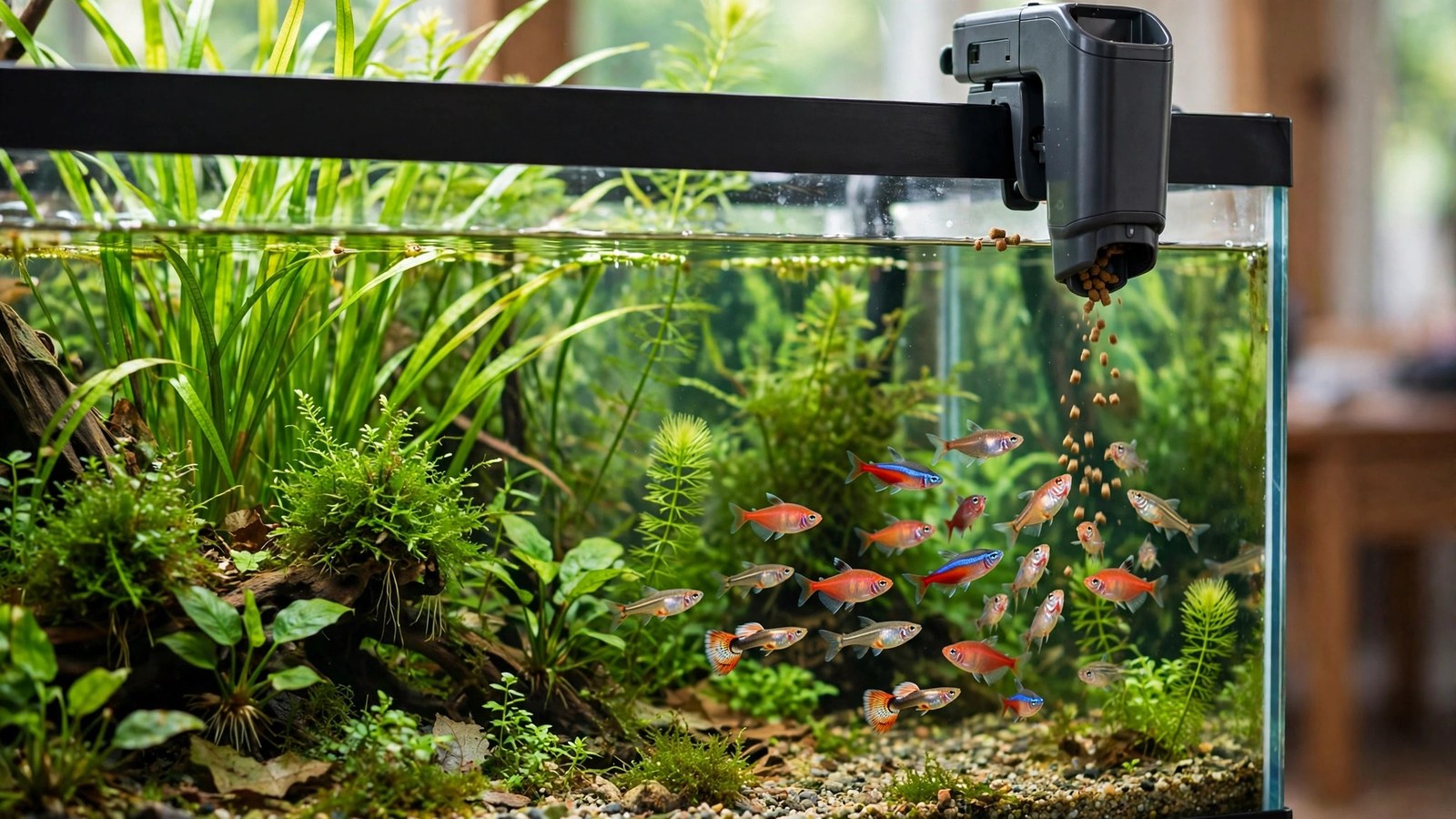
Coming home from a week away to hungry fish and a tank going green is a lesson nobody wants twice. An automatic feeder can make your planted tank genuinely vacation-proof — but only if you pick the right type and set it up properly. The best automatic fish feeder is a timed drum feeder with an aerated hopper, loaded with pellets, and tested for five days before you leave.
The best automatic fish feeder is a timed drum-style feeder with an actively ventilated hopper — moisture clumping, not dead batteries, is the leading cause of feeder failures. For 5–10 day trips it runs on a schedule with pellets or granules; portion-cup feeders dispense up to 14 pre-measured meals; smart feeders add phone control. Reference point: the classic Eheim autofeeder holds about 100 ml and ventilates its chamber at each feed.
The best automatic fish feeder for planted tanks, by trip length
Healthy adult community fish handle a 2–4 day fast with ease, and skipping meals beats an overfeeding neighbor every time. Feeders earn their place on trips of 5+ days, or in tanks with fry that can't fast — see our vacation plant care guide. Trips of 5–10 days suit a portion-cup feeder with pre-measured meals; 10+ days suit a drum feeder's large hopper or a smart feeder you adjust remotely. Stocked fish-first? Our fish-first plant selection guide helps balance stocking with planting.
Timed drum feeders: the set-and-forget workhorse
A drum feeder holds food in a hopper over the tank; a timer rotates a drum and drops a measured amount through an adjustable opening. The classic example is the Eheim autofeeder: roughly 100 ml capacity, up to four daily feedings, active chamber ventilation at each feed, splash-proof buttons, and a low-battery warning — see the Eheim's official autofeeder product page. Drum feeders run entirely on batteries: no WiFi, no app, nothing to fail while you're airborne. Portions are approximate, so measure what each cycle actually drops during your test week. They pair naturally with a set-and-forget low-tech tank automation setup, where lights and feeding run on simple timers.
The long-running benchmark timed-drum feeder; matches the section’s set-and-forget thesis: EHEIM Everyday Fish Feeder ★4.0.
Portion-cup feeders: precision for short trips
A portion-cup feeder swaps the hopper for a carousel of cups — fourteen on the well-known Fish Mate F14. You pre-measure each meal, the quartz timer rotates one cup into place up to four times daily, and every dose is exact. Portions stay sealed until serving, so humidity can't reach tomorrow's meals. The F14 takes flakes, pellets, and sticks, runs over a year on one AA battery, and mounts on the hood, condensation tray, or glass edge — see the Fish Mate F14 instruction manual. It's also the best choice for exact sinking-pellet rations for bottom dwellers; pair it with our algae wafers guide.
Smart and WiFi feeders: control from your phone
Smart feeders add app programming, remote feeding, and jam or low-food alerts — the Eheim autofeeder+ adds WiFi control, roughly 125 ml capacity, and email notifications. For trips beyond two weeks, spotting a missed feed remotely is real peace of mind. The trade-off: mains-powered units stop in a power cut, so choose one with battery backup and a working onboard schedule.
Feeder types compared
| Type | Best for | Max trip | Portions | Risk |
|---|---|---|---|---|
| Timed drum | Multi-week trips | 2–4 weeks | Approximate | Flakes clumping in humidity |
| Portion-cup | 5–10 day trips, exact rations | 14 meals | Exact per meal | Limited capacity |
| Smart / WiFi | Long absences, remote tweaks | Indefinite (with power) | App-precise | WiFi outages, mains power |
Moisture clumping: the number-one failure mode
The hopper sits above warm, evaporating tank water. Flakes absorb humidity first: they swell, stick, and form a plug the drum can't clear. You return to a full hopper and hungry fish.
Use a ventilated or sealed chamber, pellets over flakes, and a splash-free spot. In humid rooms, a portion-cup design or an F14-style airline attachment keeps food dry until serving.
Flakes versus pellets: matching food to your feeder
Pellets and granules are the feeder food of choice: uniform size meters evenly, low surface area resists humidity, and slow-sinking pellets reach mid-water fish before the current carries them off. Flakes work in dry rooms and sealed portion-cup feeders, but over a warm tank they're the first food to jam. Match sinking foods to the eaters; our shrimp food guide helps size bottom-dweller rations so nothing decays uneaten. One hard limit: feeders dispense dry food only.
A vacation countdown that actually works
Two weeks out, buy and mount the feeder, then run a 5–7 day test: check what each cycle drops, confirm pellets land where fish reach them, and watch for jamming on humid days. One week out, set portions 20% below your normal ration. The day before, load fresh dry food, install fresh batteries, and confirm the timer. While away, leave the schedule alone; on return, ramp feeding up over two days.
Planted-tank specifics: flow, algae, and uneaten food
Mount the feeder where pellets drop into open water, away from the filter output — food swept into a dense carpet rots unseen. Uneaten food is the main vacation algae trigger: plants absorb some excess, but a decaying pile overwhelms them and fuels green water within days.
Keep the rest hands-off: stable light timers and steady fertilization prevent the nutrient swings that invite algae. An automatic fertilizer doser can run dosing while the feeder handles meals.
Frequently Asked Questions
Can fish survive two weeks without any food?
Healthy adult community fish can fast 7–14 days without lasting harm, since their metabolism slows when unfed. Fry and juveniles under 6 weeks old cannot fast and need daily food. For a long weekend, no feeder at all is the safest option.
Will an automatic feeder cause an algae bloom while I'm away?
Only if it overfeeds. Uneaten food decays into ammonia, and a sudden ammonia load outpaces what plants absorb — fueling green water and thread algae. Set portions 20% below normal, prefer pellets over flakes, and confirm every cycle is eaten within minutes.
Do automatic feeders work with flake food?
They dispense flakes, but flakes are the worst feeder food: their large surface area absorbs humidity, swells, and jams drums. In dry rooms or sealed portion-cup feeders they're fine. Over a warm tank, switch to pellets or granules — they meter evenly and resist clumping.
What happens to the feeder during a power cut?
Battery-powered drum and portion-cup feeders keep running on their AA batteries through any outage — a big advantage. Mains-powered WiFi feeders stop without battery backup, so choose backup power or rely on the onboard schedule instead. Short outages of a day or two need no feeding at all.
Can I feed bottom feeders and shrimp with an automatic feeder?
Yes. Portion-cup feeders are ideal — place an exact count of sinking pellets or mini wafers in each cup, matched to your bottom dwellers. Drum feeders work if food drops into open water rather than into the plants. Frozen foods are the exception: feeders dispense dry food only.
How many times per day should the feeder dispense?
Mirror your normal routine: once or twice daily suits most community fish, and two smaller feeds are gentler on water quality than one large one. Fry do better with 3–4 small feeds, which most timers support. Don't feed more while away — consistency beats quantity.
Set it up, test it, then stop worrying
The right automatic fish feeder makes a planted tank genuinely vacation-proof — but the feeder is only half of it. The other half is your test week: consistent portions, dry food, pellets landing in open water. Get that right and you can leave with confidence.