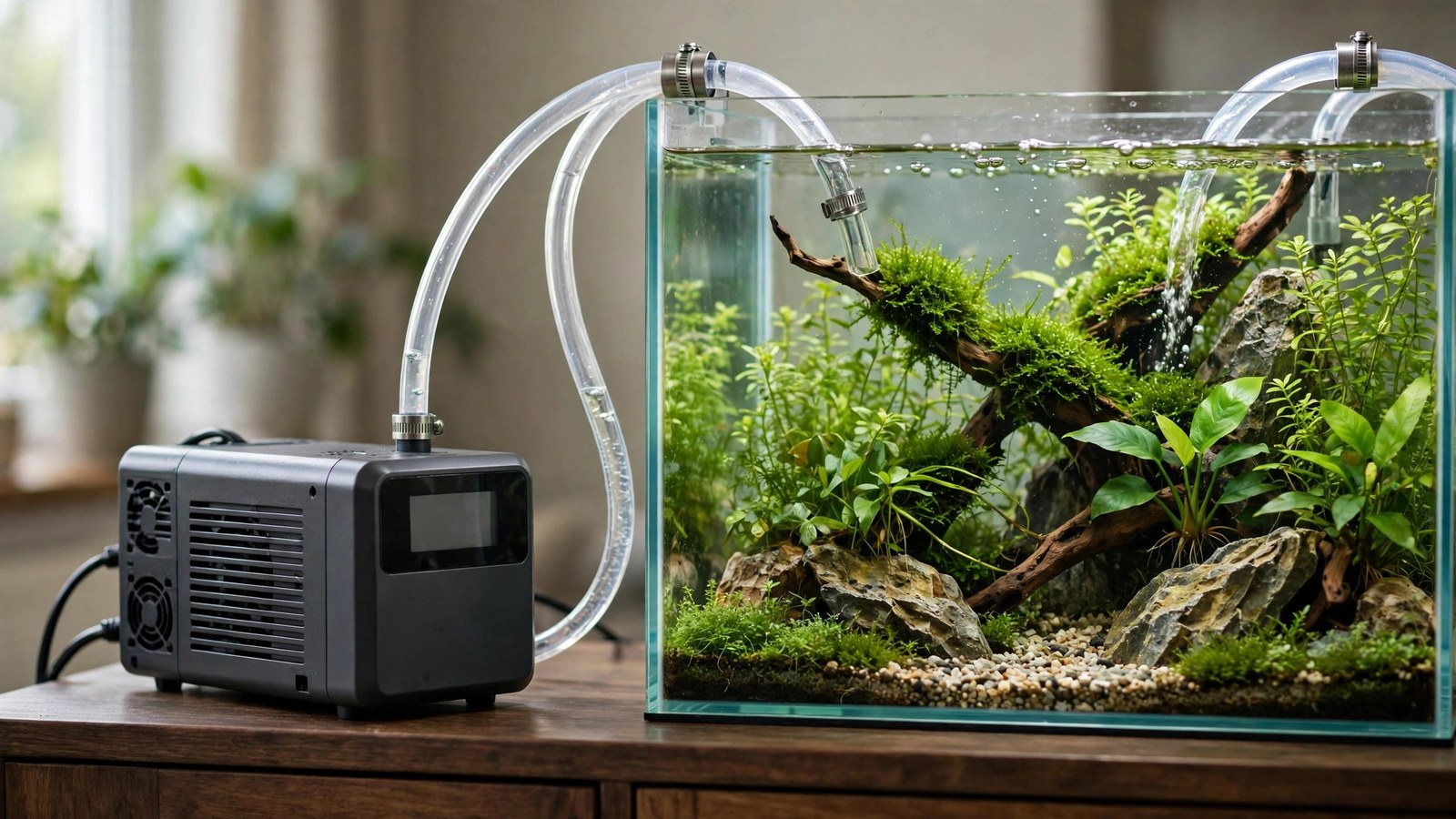
Last July I watched a reader's prized carpet of Hemianthus callitrichoides melt in five days — not from algae or bad water, but because his apartment sat at 31°C and his tank followed it right up there. That's the lesson most equipment guides skip: the best aquarium chiller for planted tank owners isn't a luxury gadget, it's insurance against the single most common summer tank crash.
By the end you'll know whether you even need one (plenty of tanks don't), how to size horsepower to tank volume, and which of five proven chillers fits your situation — nano, bedroom-quiet, or big aquascape. No hype, no fake reviews.
Do You Need an Aquarium Chiller at All?
Honest answer first: probably not. If your room never pushes tank water past 28°C (82°F), a chiller is money and electricity spent on nothing. Clip-on cooling fans drop water 2–4°C through evaporation and cost a fraction — most tropical planted tanks get through summer on fans alone. If you're on the fence, read our chiller vs cooling fan comparison before spending a cent.
Fans have real limits, though. They cool by evaporating water, so in humid climates they barely move the needle — and you'll top off the tank daily as water vanishes into the air. DIY tricks like frozen bottles or a fan across a wet towel hit the same ceiling: a few degrees, inconsistently, with daily effort.
The tanks that genuinely need chillers share a pattern: hot apartments without air conditioning, south-facing rooms, or intense lighting. Warm water holds less dissolved oxygen and less CO2, so heat crashes show up first as stalled growth and gasping livestock — worth remembering when setting up a CO2 aquarium. The first casualties are the demanding plants: carpets like Hemianthus and Glossostigma, most mosses, and delicate stems like Tonina and Syngonanthus. Keep Caridina shrimp and the case is stronger — they want water under 26°C, and a hot week can wipe a colony.
Finding the best aquarium chiller for planted tank setups: 5 picks by scenario
There's no single "best" chiller — only the best one for your tank size, noise tolerance, and climate. These five are the models hobbyists keep recommending with consistent long-term results; the tradeoffs below are the honest ones.
| Model | Best for | Power | Tank range | Noise profile |
|---|---|---|---|---|
| Active Aqua AACH10HP | Nano & small tanks | 1/10 HP | ~20–40 gal | Moderate |
| JBJ Arctica DBA-075 | Quiet living spaces | 1/10 HP | ~20–40 gal | Quiet |
| Teco TK-150 | Premium aquascapes | 1/8 HP | ~20–40 gal | Very quiet |
| AquaEuroUSA Max-Chill | Mid-size value | 1/4 HP | ~40–80 gal | Moderate–loud |
| Active Aqua AACH25HP | Large tanks | 1/4 HP | ~60–90 gal | Moderate–loud |
Active Aqua AACH10HP — best for nano and small tanks
The workhorse of small planted tanks. Simple digital controller, widely available, and the most affordable entry into real compressor cooling. Pros: cheapest reliable chilling; set-and-forget thermostat. Cons: louder than premium brands; cooling-only, so it won't double as a heater in winter.
JBJ Arctica DBA-075 — best quiet pick
The 1/10 HP Arctica has a titanium coil (corrosion-proof, fine for any water chemistry) and a reputation as one of the quieter units in its class — the one people buy when the tank sits in a bedroom. Pros: quiet; compact. Cons: costs more than the Active Aqua for the same horsepower; dated controller.
Teco TK-150 — best premium pick for aquascapers
Italian-built, 1/8 HP, rated for tanks up to about 40 gallons with a titanium exchanger and a digital controller accurate to about 1°F. The chiller serious aquascapers buy when the display tank is the room's centerpiece. Pros: exceptionally quiet; precise control; excellent build. Cons: premium price; thinner distribution in some regions.
AquaEuroUSA Max-Chill 1/4 HP — best value for mid-size tanks
When 1/10 HP isn't enough for a 55–75 gallon tank, the Max-Chill 1/4 HP delivers more cooling per dollar than anything else here. Pros: strong pull-down for the money; digital thermostat. Cons: the loudest unit on this list; bulky footprint; thinner brand support.
Active Aqua AACH25HP — best for large tanks
The bigger sibling of the AACH10HP, stepping up to 1/4 HP for 60–90 gallon aquascapes. Pros: proven, affordable 1/4 HP option; same simple controller. Cons: noise and size scale up with it; heavy power draw in summer.
Sizing a Chiller: HP vs Tank Volume (and Matching Pump Flow)
Horsepower ratings assume a normal room. The practical rule: 1/10 HP for 20–40 gallons, 1/4 HP for 40–80 gallons, 1/2 HP for 80–120+ gallons. If your room regularly exceeds 32°C, or the tank sits under high-output lighting, size up one step — the heat your aquarium lights add can raise tank water several degrees above room temperature. An undersized chiller runs constantly and never reaches the set point.
Then match the pump. Every chiller specifies a flow window (the Teco TK-150 wants roughly 80–130 gallons per hour). Run a dedicated pump or loop it through your canister filter: flow below the minimum makes the compressor short-cycle, while far too much flow pushes water through too fast to cool. If how to make aquarium plants grow faster is on your mind, stable temperature matters as much as light and CO2 — swings stress plants more than a steady warm baseline.
The article's mid-size pick is the Active Aqua 1/4 HP (40-92 gal, titanium evaporator); slot in the sizing/pick discussion: the Active Aqua 1/4 HP chiller ★4.1.
Frequently Asked Questions
How much can a cooling fan cool compared to a chiller?
A clip-on fan lowers water temperature by 2–4°C through evaporative cooling, but the effect collapses in humid air and evaporation forces daily top-offs. A chiller gives a precise, repeatable pull-down of 5–10°C regardless of humidity, and holds it with a thermostat.
What size chiller do I need for a 40-gallon planted tank?
A 1/10 HP chiller is the standard choice for a 40-gallon tank in a normal room. If your room regularly exceeds 32°C, or the tank sits under intense lighting, step up to 1/4 HP — an undersized unit runs constantly and still misses the set point on hot days.
Can an aquarium chiller also heat the water?
Most models on this list are cooling-only, so you'll still need a heater for winter. Some JBJ and Teco lines offer heat/cool versions with a built-in heater circuit — check the exact model number before buying, because the cooling-only and heat/cool versions often look identical.
How loud is an aquarium chiller?
Budget 1/10–1/4 HP units run roughly 45–55 dB — a loud refrigerator hum — while premium models like the Teco TK-150 and JBJ Arctica sit around 35–40 dB. If the tank is in a bedroom, noise should outweigh price in your decision: a loud chiller cycling at 3 a.m. is a purchase you'll regret.
Do I need a separate pump for the chiller?
You need water flowing through the chiller within its rated flow window, but not necessarily a dedicated pump. Many keepers loop the chiller inline with their canister filter's return line. A separate small pump gives more predictable flow and keeps filter maintenance independent of the cooling loop.
The Bottom Line
Start with the honest question — is your tank actually too hot? — and only then shop. For most keepers, a 1/10 HP unit from Active Aqua or JBJ covers a nano to medium tank, with the Teco TK-150 as the quiet premium step up and 1/4 HP models for large aquascapes. Once installed, it's genuinely set-and-forget: a thermostat-controlled chiller holds temperature through heatwaves and holidays, which is what our vacation plant care guide assumes. And warm water is a documented stressor — see how temperature stress affects aquarium fish — so believe your livestock if they say it's hot.