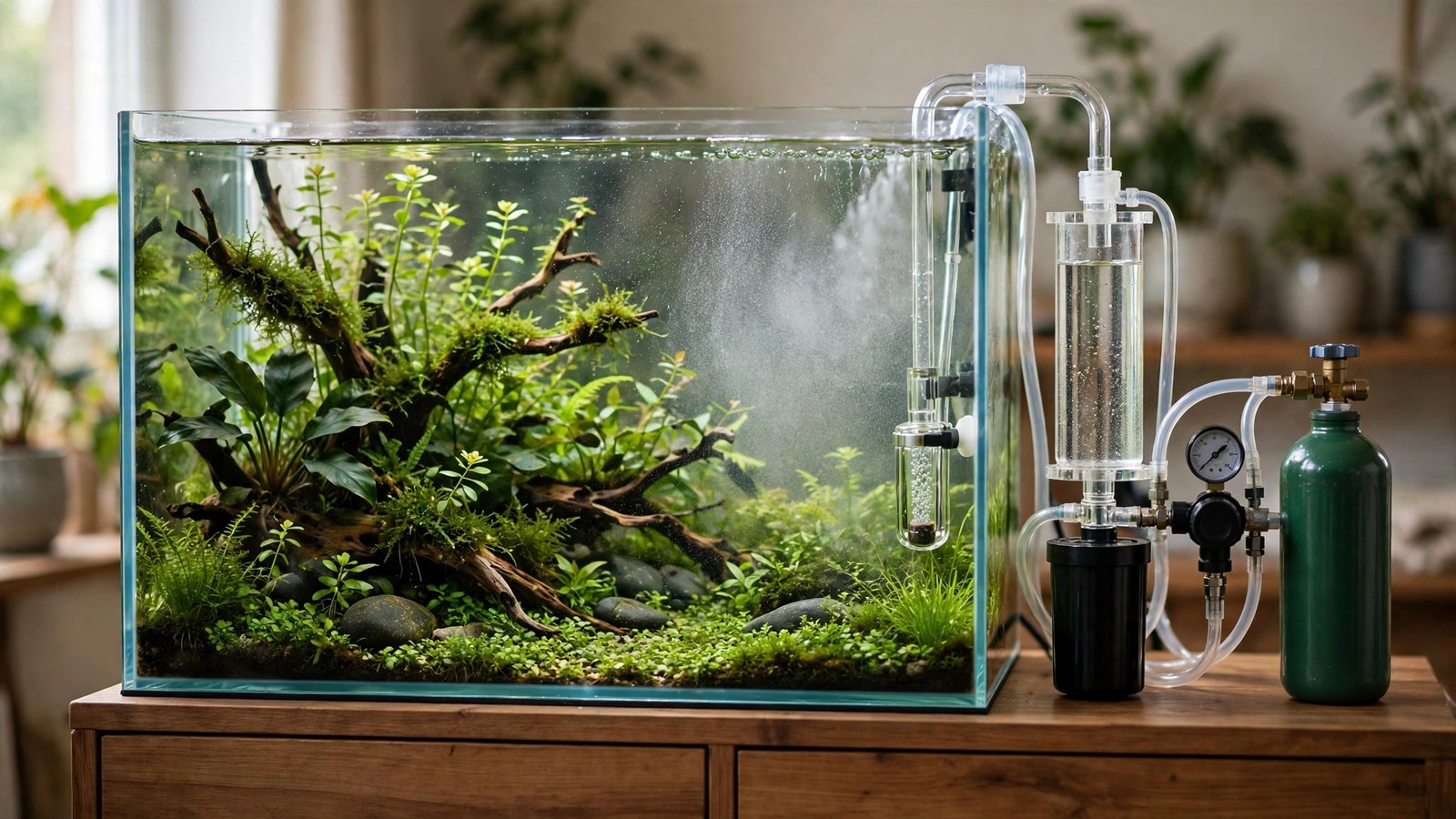
Getting CO2 into your tank is only half the battle — getting it dissolved is the other half. You can inject the perfect bubble rate and still watch most of it rise to the surface and pop uselessly into the room if your diffusion method is wrong for your setup. The three serious options — in-tank diffusers, inline reactors, and inline atomizers — trade off efficiency, aesthetics, cost, and maintenance in ways that matter a lot in practice.
What "Diffusion" Actually Means
CO2 dissolves into water slowly through the gas-water interface. Diffusion devices maximize that interface in two ways: making bubbles smaller (more surface area per unit of gas) and keeping bubbles in contact with water longer (more contact time). Every method below is just a different combination of these two levers. Efficiency is measured as the fraction of injected gas that actually dissolves before reaching the surface — and the difference between methods is dramatic, from roughly 60% to near 100%. For a full walkthrough of CO2 hardware from cylinder to tank, the 2Hr Aquarist CO2 system guide covers regulators, diffusion, and tuning in one place.
Option 1: In-Tank Ceramic Diffusers
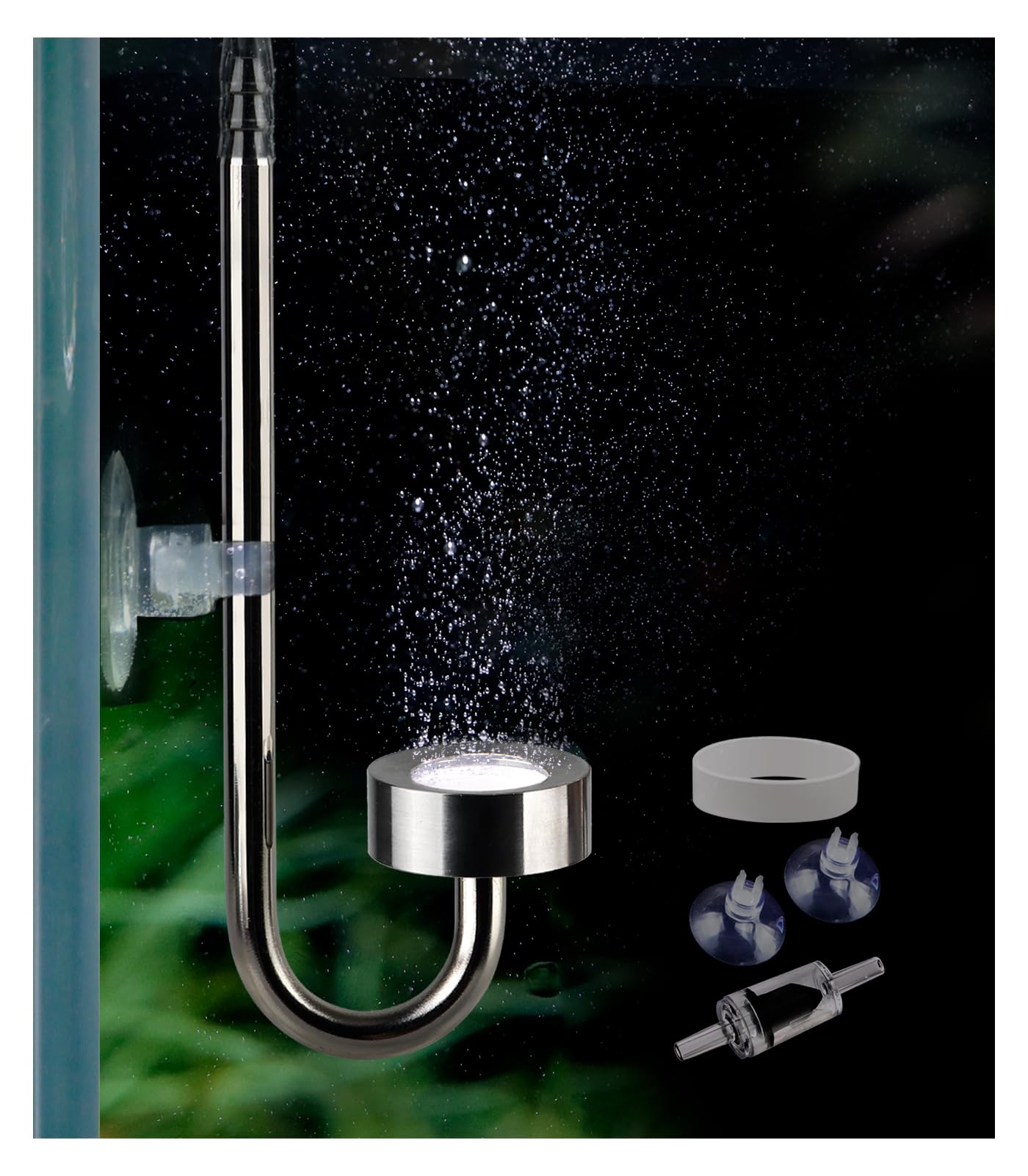
The classic glass or acrylic diffuser sits inside the tank, usually low and near the filter outflow. Gas passes through a porous ceramic disc that shatters it into a fine mist of micro-bubbles, which then rise slowly through the water column, dissolving as they go.
Strengths
- Cheap and simple — a quality glass diffuser costs a few dollars, needs no plumbing changes, and works on any tank.
- Visible confirmation — you can see the mist, count bubble rate at the bubble counter, and spot problems (clogged disc, kinked line) instantly.
- No filter flow restriction — nothing sits in the filtration path, so flow stays at full strength.
- Easy to reposition — move it under the outflow to blast mist around the tank for better distribution.
Weaknesses
- Lowest efficiency — typically 60–80% dissolution. A visible mist escaping at the surface is wasted gas; you compensate by injecting more, which burns through your cylinder faster.
- Clogs over time — algae, biofilm, and mineral deposits block the ceramic pores. Soak in diluted bleach periodically, and replace discs every 6–12 months.
- Visible equipment — a glass diffuser, suction cups, and CO2 tubing inside a scaped tank is an aesthetic compromise many aquarists eventually tire of.
- Placement-sensitive — a diffuser in a dead spot dissolves poorly no matter how fine the mist. It must sit in active flow.
Best for: nano and small tanks, beginners, renters who can't replumb anything, and anyone who wants the simplest possible working setup.
A reliable pick here is Clscea stainless steel CO2 diffuser.
 ★4.3
Clscea Stainless Steel CO2 Diffuser Atomizer DC300-20
Check Price on Amazon ★4.3Option 2: Inline Reactors
An inline reactor is a chamber plumbed into the canister filter's return line, outside the tank. CO2 enters the chamber and is churned with the filter's water flow — by the time water exits back to the tank, the gas is fully dissolved. No mist, no bubbles, nothing visible inside the tank at all.
Strengths
- Near-100% efficiency — essentially all injected gas dissolves. You run lower bubble rates for the same dissolved CO2, and cylinders last noticeably longer.
- Invisible in the tank — no diffuser, no tubing in the display. Just a spray bar or lily pipe doing its normal job.
- Superior distribution — dissolved CO2 exits with the filter flow and reaches everywhere the current reaches, which is the whole point of good circulation.
- Stable dosing — no mist clouds or burping; drop checker readings are smooth and predictable.
Weaknesses
- Requires a canister filter — the reactor lives in the return line. Hang-on-back or internal filters can't host one (with rare exceptions).
- Reduces flow slightly — the chamber adds resistance. Oversize your filter or accept a modest flow penalty; on big tanks this is rarely an issue.
- Can "burp" — if gas accumulates faster than it dissolves (bubble rate too high for flow), the reactor periodically releases a gulp of gas with an audible blurp and a mist burst. The fix is matching bubble rate to flow, not a design flaw.
- More upfront cost and plumbing — reactor bodies, extra tubing, and hose barbs add up, plus the time to plumb and leak-check everything.
Best for: medium to large tanks with canister filters, aquascapers who want zero visible equipment, and anyone tired of refilling cylinders — the efficiency gain pays for the reactor in gas savings.
Option 3: Inline Atomizers/Diffusers
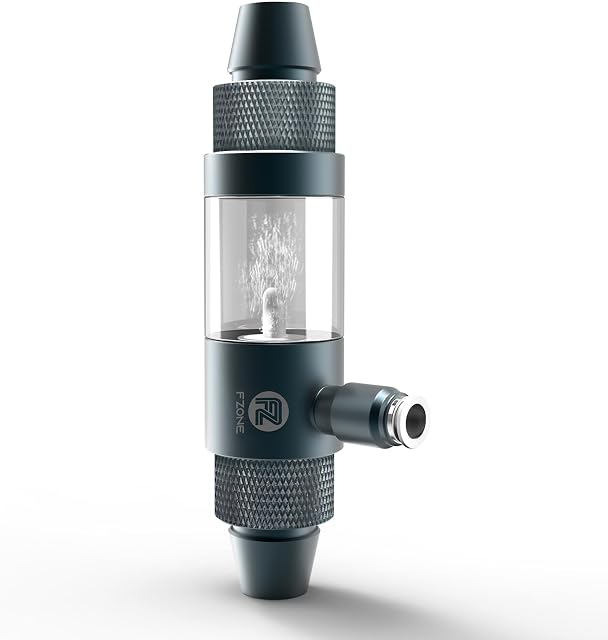
Inline atomizers (sometimes sold as "inline diffusers") are the hybrid: a small unit plumbed into the filter return line containing a ceramic membrane. It produces an ultra-fine mist directly in the return flow, so the mist is blasted around the tank at high velocity instead of rising gently from a corner.
Strengths
- Better efficiency than in-tank diffusers — the mist enters with strong flow and gets distributed before surfacing, typically 80–90% dissolution.
- Nothing visible in the tank — same aesthetic win as reactors.
- Compact and simple — smaller than a reactor, fewer parts, easier to install.
- The mist debate — some aquarists swear the fine mist landing directly on leaves boosts growth beyond what dissolved CO2 alone explains. The evidence is anecdotal, but the "mist theory" has a loyal following.
Weaknesses
- Still not 100% — some mist escapes at the surface, especially in tanks with strong upward flow.
- Ceramic membranes clog — same maintenance as in-tank discs, but harder to access since it's plumbed inline. Buy a unit that disassembles easily.
- Needs strong flow — weak filters don't distribute the mist well, defeating the purpose.
- Higher working pressure — membranes need more pressure to push gas through than an open reactor chamber, so your regulator needs adequate output pressure.
Best for: canister-filtered tanks where you want the clean look but don't want to size and plumb a full reactor — the pragmatic middle ground.
A reliable pick here is Fzone inline CO2 diffuser (1/2 in).
 ★4.1
Fzone Inline CO2 Diffuser
Check Price on Amazon ★4.1Head-to-Head Comparison
| Factor | In-tank diffuser | Inline atomizer | Inline reactor |
|---|---|---|---|
| Dissolution efficiency | 60–80% | 80–90% | ~100% |
| Equipment visible in tank | Yes | No | No |
| Filter requirement | Any | Canister (strong flow) | Canister |
| Typical cost | $ | $$ | $$–$$$ |
| Maintenance | Soak/replace disc | Disassemble, clean membrane | Rinse chamber occasionally |
| Flow impact | None | Slight | Moderate |
| Best tank size | Nano–small | Medium–large | Medium–large |
Methods You Can Skip (Mostly)
A few diffusion approaches show up in old forum threads and budget guides. For completeness: ladder/flip-flop diffusers (bubbles climb a zigzag ramp) are nostalgic but inefficient and huge; airstone-style coarse diffusers waste most of the gas as big bubbles; and powerhead-driven venturi diffusion works but adds noise and equipment. The budget CO2 setups that rely on these are fine as stepping stones, but don't build a long-term high-tech tank around them.
Matching the Method to Your Tank
Nano tanks (under 10 gallons)
An in-tank ceramic diffuser is the sweet spot. Gas volumes are tiny, so the efficiency penalty costs you almost nothing — a paintball CO2 setup will run for months. Reactors are overkill at this scale and hard to plumb on nano canisters.
Medium tanks (20–55 gallons) with canisters
This is the contested zone. An inline atomizer gives you the clean look with simple installation; a reactor gives maximum efficiency and the smoothest dosing. If your filter is generously sized, go reactor. If flow is marginal, go atomizer — it restricts flow less.
Large tanks (75+ gallons)
Reactor, no contest — possibly two, or a reactor plus a diffuser. At this scale, the gas savings from 100% dissolution are substantial, and distributing dissolved CO2 through strong filter flow beats any mist arrangement. Some large-tank aquarists run a reactor on each of two canisters for even distribution.
Tanks without canister filters
In-tank diffuser is your answer. Hang-on-back filters and sponge filters can't host inline equipment. Place the diffuser directly under the HOB outflow or in the path of a circulation pump.
Placement and Flow: The Multiplier
Whichever method you choose, flow is the multiplier. Dissolved CO2 (or mist) must reach every plant; a diffuser in a dead corner leaves half the tank under-dosed while the corner hits 40 ppm. Rules of thumb:
- Place in-tank diffusers low and in the filter outflow path, ideally on the opposite side from the filter intake so water circulates the full tank.
- Aim for gentle but complete circulation — every plant should sway slightly. Dead spots behind hardscape are CO2 dead spots too.
- Don't confuse surface agitation with circulation. You need both: flow through the tank for distribution, and controlled ripple at the surface for oxygen exchange (see balancing agitation and CO2).
- After any rescape, re-check diffuser placement. That beautiful new rock formation may have created a flow shadow over your carpet.
Maintenance Schedules That Keep Efficiency High
- Ceramic discs/membranes: inspect monthly; soak in a 1:10 bleach solution for 2–4 hours when mist output looks coarse or reduced, rinse thoroughly, air-dry. Replace discs yearly.
- Reactors: check for the "burp" monthly — if it's burping, either lower the bubble rate or increase filter flow. Rinse the chamber during filter maintenance; biofilm buildup inside reduces dissolution.
- Check valves: verify quarterly. A failed check valve lets tank water siphon back into the regulator when pressure drops — the single most expensive diffusion-adjacent failure. Replace yearly as cheap insurance.
- Leak checks: after any plumbing change, run the soapy water leak test on every joint. A slow leak at the reactor inlet can waste a cylinder in weeks.
Frequently Asked Questions
Is a reactor really worth it over a cheap diffuser?
On tanks 40 gallons and up with a canister filter, yes — the near-100% dissolution means lower bubble rates, longer cylinder life, steadier CO2 levels, and zero visible equipment. On nano tanks, the gas savings are trivial and the plumbing is fiddly, so a simple in-tank diffuser is the smarter choice.
Why does my reactor "burp" periodically?
Burping means gas is entering the chamber faster than it can dissolve — undissolved gas accumulates at the top until the pressure releases it in a gulp. Reduce your bubble rate, increase filter flow, or both. A properly matched reactor runs silently with no visible gas at the outlet.
Can I use an inline diffuser with a hang-on-back filter?
No — inline equipment needs the sealed, pressurized return line of a canister filter. HOB filters return water via an open waterfall, so there's nowhere to plumb an inline unit. Use an in-tank ceramic diffuser placed under the HOB outflow instead.
Does CO2 mist on leaves actually help, or is dissolved CO2 all that matters?
Dissolved CO2 is what peer-reviewed plant physiology cares about, and reactors deliver it best. The "mist theory" — that micro-bubbles landing on leaves provide a bonus — is popular but unproven. Practically, tanks with good mist distribution do grow well, but so do reactor tanks, so treat mist as a nice-to-have rather than a deciding factor.
How often should I replace a ceramic diffuser disc?
Plan on yearly replacement, with bleach soaks every 1–3 months in between as performance drops. If a disc stays clogged after a proper bleach soak and rinse, it's done. Running a degraded disc forces you to raise the bubble rate to compensate, which wastes gas and destabilizes dosing.
Can I run two diffusion methods on one tank?
Yes, and it's common on large or awkwardly shaped tanks — e.g., a reactor on the main canister plus a small diffuser in a flow shadow behind hardscape. Split the gas with a manifold and tune each branch with its own needle valve. Just remember total dissolved CO2 is what matters; two sources don't double your target.
Pick for Your Filter, Then Optimize Flow
The decision tree is short: canister filter and 40+ gallons → inline reactor; canister with modest flow → inline atomizer; anything else → quality in-tank diffuser placed in active flow. Then spend your real effort on circulation, because even the best diffusion method fails in a stagnant tank. Get the gas dissolved and distributed, and your plants will do the rest.