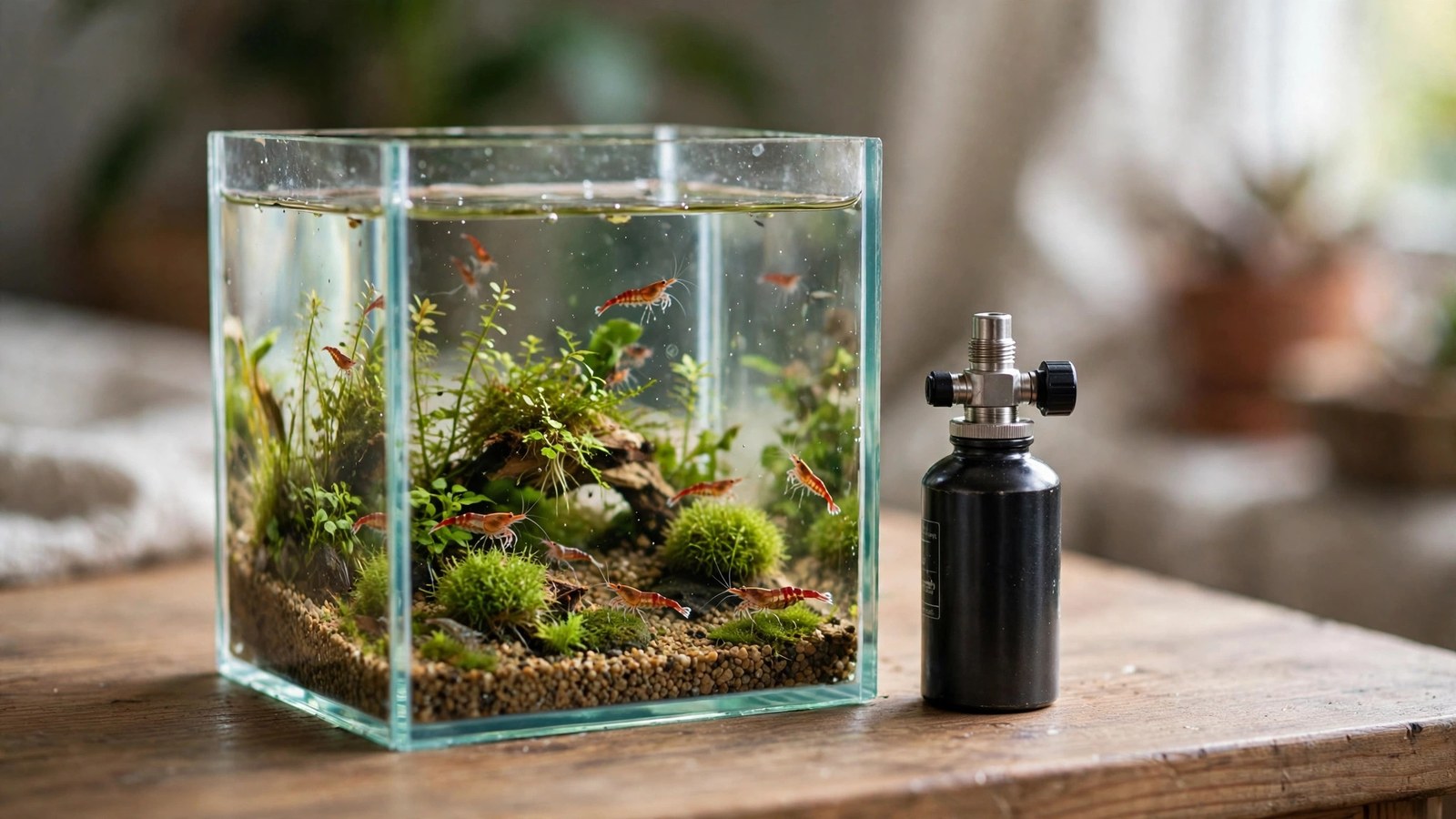
A full-size 5 lb CO2 cylinder next to a 5-gallon desktop nano looks ridiculous — and it's overkill when the tank sips gas. Paintball CO2 setups solve the proportion problem: compact 20 oz (or smaller) paintball tanks, a dedicated compact regulator, and months of gas for nano planted tanks. This guide covers the complete paintball CO2 system for nano tanks: parts, setup, costs, and how long the gas actually lasts.
Why Paintball CO2 Fits Nano Tanks
- Right-sized gas supply. A nano tank at a bubble every 2–3 seconds uses so little CO2 that a 20 oz paintball tank lasts 5–7 weeks — a practical refill interval, not a decade of gas gathering dust.
- Compact footprint. A 20 oz tank is about 10 inches tall — it hides inside or behind a nano stand, on a desk shelf, anywhere a 5 lb cylinder can't go.
- Easy refills. Paintball fields, paintball shops, and many sporting-goods stores refill 20 oz tanks cheaply (often $4–8) while you wait. No welding-supply shop needed.
- Lower upfront cost. A complete paintball CO2 setup typically runs well under half the cost of a full-size pressurized system.
The tradeoff: more frequent refills than a big cylinder (unavoidable physics — less gas stored), and the paintball thread standard means dedicated or adapted hardware. For tanks under ~15 gallons, the tradeoffs favor paintball decisively.
The Parts List
1. The paintball tank (20 oz standard)
The 20 oz tank is the sweet spot — widely refillable, good capacity-to-size ratio. Smaller options exist (9 oz, 12 oz) for pico tanks but need refilling every couple of weeks, which gets old. Larger 24 oz tanks are fine if your refill source handles them. Buy new or check the hydrotest date on used tanks — paintball tanks need testing every 5 years, and fields won't fill out-of-date tanks.
Note: paintball tanks use a different thread (paintball/ASA standard) than CGA-320 cylinders. Your regulator must match. The philosophy — a small disposable cartridge with precise regulation, sized for nano tanks rather than scaled down from big-cylinder hardware — mirrors Tropica's own nano CO2 system, which takes the same right-sized approach for small aquariums.
2. The regulator: paintball-specific or adapted
Two routes:
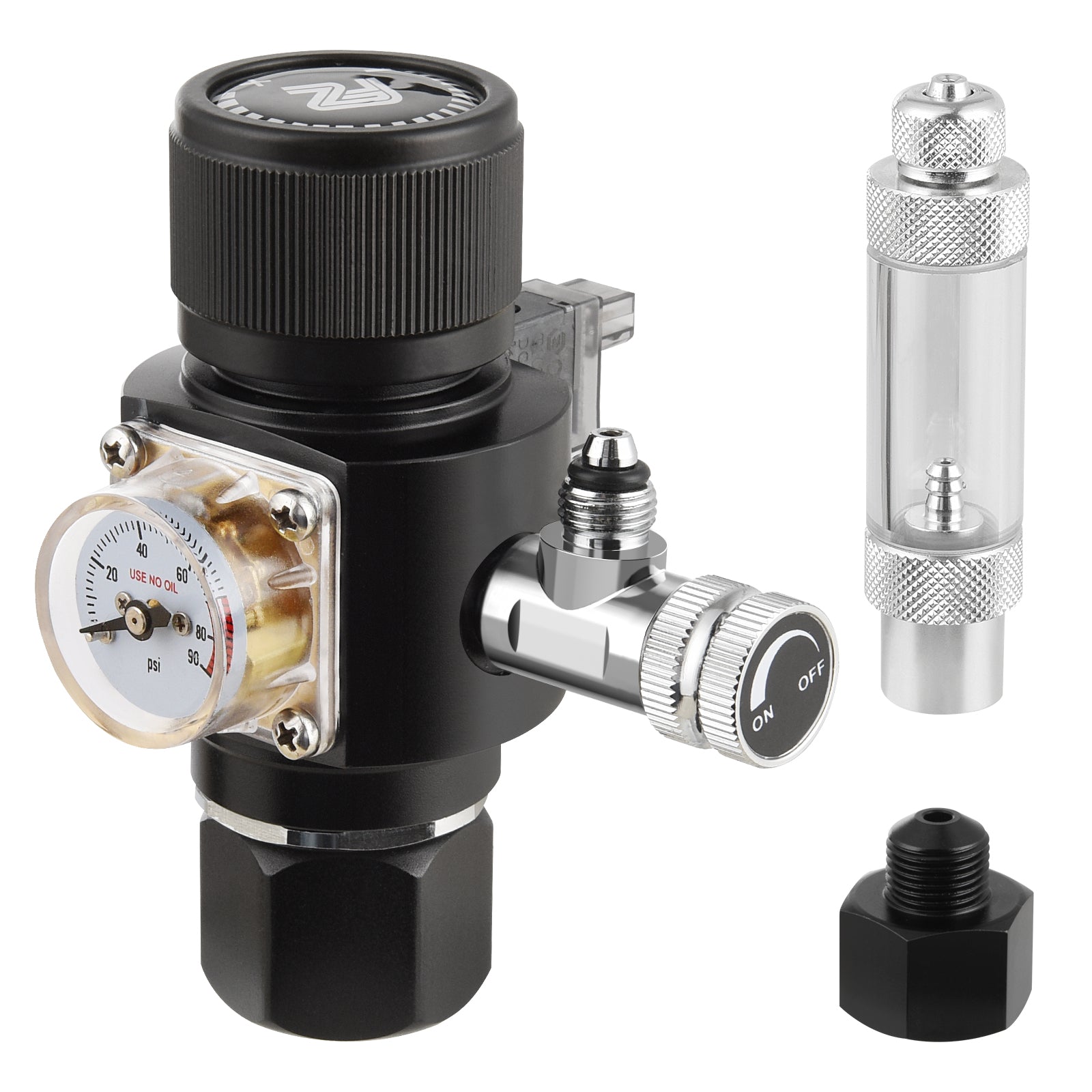
- Paintball-specific CO2 regulator (e.g., compact units from aquarium/paintball crossover brands, or the UNS-style mini regulators with paintball adapters) — threads directly onto the paintball tank. Cleanest option.
- Standard CGA-320 regulator + paintball adapter — a brass adapter converts the paintball thread to CGA-320, letting you use any normal aquarium regulator. More flexible (the regulator transfers to a big cylinder later), but adds a joint and some bulk.
Either way, you want the same features as a full-size setup: needle valve precise enough for very low rates (nano tanks run ~1 bubble per 2–3 seconds — a twitchy valve makes this maddening), and ideally a solenoid for timer control. See our regulator guide for what "good" looks like — the criteria don't change with size, but low-rate precision matters more.
3. The rest of the chain (same as any CO2 system)
- Bubble counter — essential at nano rates, where "a little more" is a big relative change. See bubble counter setup.
- Check valve — non-negotiable; nano tanks back-siphon just as effectively as big ones.
- CO2-resistant tubing — short runs on nanos, so buy quality; there's no reason to economize on three feet of tubing.
- Diffuser — a small glass/ceramic in-tank diffuser is ideal at nano scale (see diffusion methods). Reactors are overkill; a tiny diffuser in the filter outflow path works beautifully.
- Drop checker (nano size) — the same drop checker principles apply; small checkers suit the scale aesthetically.
- Timer + solenoid — nighttime shutoff matters even more on nanos, where small water volumes swing chemistry fast.
A reliable pick here is Tippmann 20 oz CO2 tank.
A reliable pick here is Fzone paintball CO2 regulator.
 ★4.4
Fzone Paintball CO2 Regulator
Check Price on Amazon ★4.4Setup Walkthrough
- Secure the tank. Even a small paintball tank should stand upright and secured — a simple stand, strap, or bracket. Upright matters: tipped tanks can feed liquid CO2 into the regulator, which it's not designed for.
- Attach the regulator to the paintball tank (or via adapter). Snug with a wrench — paintball threads seal on an O-ring, so don't overtighten and crush it; inspect the O-ring at every tank swap.
- Build the chain: regulator → solenoid → needle valve → bubble counter → check valve → diffuser. Keep tubing runs short and kink-free.
- Leak-test everything with the soapy water test — small systems lose a larger fraction of their gas to a given leak, so this step is proportionally more important on nanos.
- Start very low. Begin at ~1 bubble per 3 seconds. Nano water volumes reach target CO2 quickly and overshoot fast — creep up over several days, verifying with the drop checker. Patience here prevents the classic nano disaster: gassing the tank on day one.
- Program the timer: CO2 on 45–60 minutes before lights (nanos saturate faster than big tanks), off 30 minutes before lights-off.
How Long Does a 20 oz Tank Last?
On a typical nano (5–10 gallons) at ~1 bubble per 2–3 seconds, 8–9 hours of injection daily: roughly 5–8 weeks. Variables that shift this: higher light demanding higher rates, inefficient diffusion, leaks (the usual suspect when life is mysteriously short), and longer photoperiods. Keep a spare filled tank if your refill source isn't next door — running out mid-week with no backup means days of CO2 fluctuation, which is an algae invitation.
Refill economics: at $4–8 per fill every ~6 weeks, annual gas cost is roughly $35–70 — trivial. The paintball route stays cheap indefinitely, unlike liquid carbon where daily dosing costs accumulate.
Nano-Specific CO2 Cautions
- Small volumes swing fast. Everything about CO2 — buildup, overshoot, pH movement — happens quicker in 5 gallons than in 50. Adjust in smaller increments and wait longer between changes.
- Surface agitation still applies. Don't seal the surface to "save" nano-scale gas amounts — the savings are pennies and the oxygen risk is real. See balancing agitation and CO2.
- Shrimp + CO2 + nano = triple caution. Nano tanks are the most popular shrimp tanks and the twitchiest CO2 systems. Target 20–25 ppm max, prioritize agitation, and read our fish safety guide — shrimp show stress first.
- Temperature matters more. Nanos swing temperature with the room; gas flow through the needle valve shifts with temperature. If your nano sits near a window or in a room with big day/night swings, expect to nudge the rate seasonally.
- Diffuser placement is critical. In a nano, there's nowhere for dead spots to hide — but also nowhere for a badly placed diffuser's mist to go except straight up. Put the diffuser low, directly in the filter outflow path.
Paintball vs Alternatives for Nanos
| Option | Pros | Cons |
|---|---|---|
| Paintball CO2 | Compact, cheap refills, right-sized | Refill every 5–8 weeks; dedicated hardware |
| 2.5 lb cylinder | 2–3 month fills; standard CGA-320 hardware | Bulky for desktop nanos; fewer refill spots than paintball |
| DIY yeast | Cheapest startup | Unstable output, weekly maintenance, can't shut off at night |
| Liquid carbon | No hardware at all | Daily dosing forever; modest effect; ongoing cost |
| No CO2 (low-tech) | Zero cost/complexity | Slower growth, fewer plant choices |
Frequently Asked Questions
Can I use a regular aquarium regulator on a paintball tank?
Yes, with a paintball-to-CGA-320 adapter — a small brass fitting that converts the threads. This is a popular route because the regulator can later move to a full-size cylinder if you upgrade tanks. Just add the adapter joint to your leak-test routine, and confirm the adapter's pressure rating suits CO2 service.
Where do I refill paintball CO2 tanks?
Paintball fields and pro shops are the primary source — most fill while you wait for a few dollars. Some sporting-goods stores with paintball sections also fill. Welding supply shops generally don't handle paintball threads, so don't count on them. Call ahead to confirm any new source fills 20 oz tanks (some only do smaller).
Is a solenoid necessary on a nano paintball setup?
Strongly recommended. Nanos are the worst tanks for 24/7 CO2 because tiny volumes accumulate gas fast overnight — and DIY-style continuous flow is exactly what you're upgrading away from. A compact inline solenoid plus a timer plug completes the system properly. Manual on/off twice daily is a recipe for a forgotten evening.
How do I know the paintball tank is empty?
Same as big cylinders: the high-pressure gauge holds ~800 PSI while liquid CO2 remains, then drops sharply when only gas is left — you have days at that point, not weeks. With no gauge (some mini regulators omit it), the signal is the drop checker fading from green despite unchanged settings. Keep a spare filled tank so swaps are instant.
Can paintball CO2 run two nano tanks?
Yes, with a manifold and a needle valve per line — but do the math first: two nanos roughly halve the 5–8 week refill interval. For two or more tanks, a 2.5 lb or 5 lb cylinder often becomes more practical. Paintball shines for single nano setups.
Are used paintball tanks safe to buy?
Yes, if the hydrotest date is current (stamped on the tank, valid 5 years) and the tank isn't visibly damaged (dents, deep scratches, corroded threads). An out-of-date tank is a paperweight until retested — factor the test cost into the price. When in doubt, new 20 oz tanks are inexpensive enough that used savings are often marginal.
Small Tank, Proper System
Paintball CO2 isn't a compromise — it's the right-sized tool for nano planted tanks: real pressurized gas with timer control, precise low-rate dosing, and refill costs measured in pocket change. Build it with the same care as a big system (leak-test, drop checker, nighttime shutoff), respect the nano's faster chemistry, and your desktop tank gets the full high-tech growth experience in miniature.