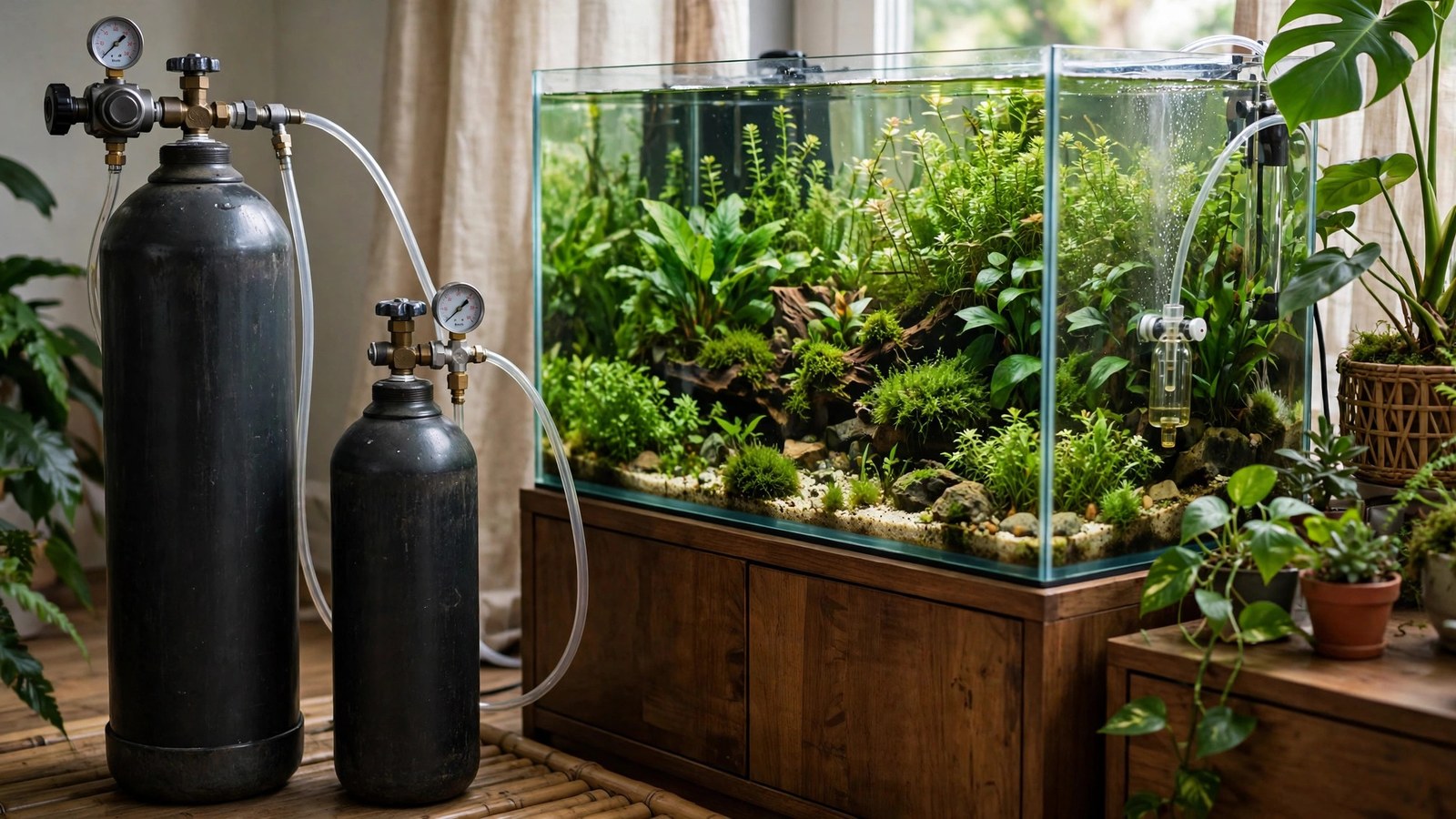
One of the first questions when going pressurized: what size CO2 cylinder should I buy, and how long will it last? The answer depends on tank size, bubble rate, how many hours a day you inject, and how efficiently your diffusion method dissolves the gas. This guide gives you realistic lifespan numbers for each common cylinder size so you can buy once and plan refills without surprises.
The Common Cylinder Sizes
CO2 cylinders for aquariums are sold by weight of CO2 they hold (not by physical volume, though the two correlate). The usual lineup:
| Cylinder size | CO2 capacity | Typical height | Fits under a standard stand? |
|---|---|---|---|
| Paintball 20 oz | ~0.57 kg (1.25 lb) | ~10 in | Yes — anywhere |
| 2.5 lb | ~1.1 kg | ~14 in | Yes |
| 5 lb | ~2.3 kg | ~18 in | Yes |
| 10 lb | ~4.5 kg | ~20 in | Usually |
| 20 lb | ~9 kg | ~27 in | Often not — measure |
Notes: the 20 oz paintball size is a different thread standard (it needs a paintball-to-CGA-320 adapter or a dedicated paintball regulator) — see paintball CO2 for nano tanks. Sizes above 20 lb exist but are impractical for home aquariums. In Europe and elsewhere, sizes are metric (2 kg, 5 kg); the math below works the same — just use your cylinder's rated fill weight.
A reliable pick here is Tippmann 20 oz CO2 tank.
How Long Each Size Lasts: Realistic Estimates
Gas consumption scales with bubble rate and daily run time. A "bubble" isn't a standardized unit, but at typical working pressures, 1 bubble per second ≈ 1–1.5 grams of CO2 per hour through a standard bubble counter. These estimates assume ~9 hours of injection per day (including pre-injection) and reasonably efficient diffusion:
| Cylinder | Nano tank (~1 bps) | Medium tank (~2 bps) | Large tank (~4 bps) |
|---|---|---|---|
| 20 oz paintball | 5–7 weeks | 2–3 weeks | — (too small) |
| 2.5 lb | 2–3 months | 5–7 weeks | 2–3 weeks |
| 5 lb | 4–6 months | 2–3 months | 5–7 weeks |
| 10 lb | 9–12 months | 4–6 months | 2–3 months |
| 20 lb | 18+ months | 9–12 months | 4–6 months |
These are ranges, not promises. Poor diffusion (coarse mist escaping at the surface), leaks (see finding CO2 leaks — the #1 cause of mysteriously short cylinder life), higher bubble rates, and longer photoperiods all shorten life. If your cylinder consistently lasts half the estimate, suspect a leak before suspecting the math. As a sanity check on your bubble rate, Tropica's fertiliser and CO2 guide lists target CO2 concentrations by plant difficulty (roughly 10–15 mg/L for medium plants, 15–30 mg/L for advanced) — useful for confirming your injection level is in a sensible range for your plants.
The Math (So You Can Compute Your Own)
For a quick personal estimate:
- Grams per day = bubbles/sec × 1.25 g/hr × hours injected per day. (Use 1.0 for small bubble counters, 1.5 for large ones — it's approximate.)
- Days per cylinder = cylinder grams ÷ grams per day.
Example: 2 bubbles/sec × 1.25 g/hr × 9 hrs = ~22.5 g/day. A 5 lb cylinder (2,268 g) ÷ 22.5 = ~100 days, or just over 3 months. That lands right in the table's range for a medium tank.
Choosing Your Size
The case for 5 lb (the default recommendation)
For most aquarists with one tank in the 20–60 gallon range, 5 lb is the sweet spot: lasts 2–3 months per fill (infrequent enough to not be annoying), fits under virtually any stand, is cheap to refill or swap, and isn't a wrestling match to carry. If you're unsure, start here.
When to go smaller (2.5 lb or paintball)
- Nano tanks under 10 gallons — a 5 lb cylinder looks absurd next to a desktop nano and the gas would last half a year; 2.5 lb or paintball keeps proportions sane.
- Space constraints — apartments, desktop setups, stands with no clearance.
- First-timers testing pressurized CO2 — lower upfront cost while you learn; upgrade later.
When to go bigger (10–20 lb)
- Large tanks (75+ gal) — a 5 lb cylinder on a 4-bps tank needs refilling every 5–7 weeks; a 20 lb stretches that to 4–6 months.
- Multiple tanks on one regulator — manifold-fed systems multiply consumption; size up accordingly.
- Refill inconvenience — if your nearest refill is a 45-minute drive, bigger cylinders mean fewer trips. Refill cost per pound also drops with size.
- High-light, high-demand setups — dense Dutch-style tanks at high bubble rates drink gas.
A reliable pick here is 5 lb aluminum CO2 cylinder.
Refill vs Swap: How Cylinder Logistics Work
You have two ways to get gas, and the choice affects which cylinder to buy:
- Refill (keep your cylinder): a shop pumps CO2 into your tank while you wait or by appointment. You keep your nice aluminum cylinder. Common at welding supply shops, fire extinguisher services, and homebrew stores. Best if you bought a quality cylinder.
- Swap (exchange): hand over your empty, take a full one off the rack. Fast and common at beverage/gas distributors, but you may receive a battered steel cylinder in exchange for your pretty aluminum one. Ask whether swap is "like for like."
Before buying any cylinder, call your local refill sources first and ask: what sizes do you fill, do you refill or swap, and what does it cost? There's no point owning a 10 lb cylinder if nobody within driving distance fills that size. Also ask about hydrotest dates — cylinders need periodic pressure testing (usually every 5 years, stamped on the shoulder), and shops won't fill an out-of-date cylinder.
Where to Get CO2 Refills
Good sources, roughly in order of convenience for most hobbyists:
- Welding/gas supply shops — the most reliable option; they fill any size and understand cylinders.
- Fire extinguisher service companies — CO2 is their business; often cheap and fast.
- Homebrew shops — cater to keg users; usually do 5 lb and 20 lb.
- Paintball fields/shops — for 20 oz paintball tanks specifically.
- Beverage distributors — often swap-only, larger sizes.
Expect to pay roughly $15–30 for a 5 lb fill and $25–45 for 20 lb (prices vary widely by region). One caution: make sure you're getting food/beverage-grade or industrial CO2 — both are fine for aquariums; avoid anything with added odorants.
Safety and Storage Basics
- Always store upright and secured — strap or chain the cylinder so it can't tip. A falling cylinder can shear its valve, turning it into a dangerous projectile.
- Keep away from heat — not next to radiators or in hot cars; pressure rises with temperature.
- Ventilate the stand — a slow leak in a sealed cabinet can accumulate CO2; a small vent gap is cheap insurance (and CO2 is an asphyxiant in enclosed spaces).
- Transport upright, secured, with the valve cap on; crack a window.
- Respect hydrotest dates — an out-of-test cylinder is a liability, not a bargain, when buying used.
Maximizing Cylinder Life
- Fix leaks first — a single loose fitting can halve cylinder life. Run the soapy water test at setup and after every cylinder change.
- Use efficient diffusion — an inline reactor's near-100% dissolution means lower bubble rates for the same dissolved CO2.
- Time it right — pre-injection plus pre-dark shutoff via a solenoid timer means you only inject when plants can use it.
- Don't over-bubble — tune to a green drop checker, not to a bubble count you read online. Excess beyond target is pure waste.
- Swap single-stage regulators' cylinders at ~500 PSI remaining to avoid end-dump — or better, use a dual-stage regulator and run them dry safely.
Frequently Asked Questions
How do I know when my cylinder is getting empty?
Watch the high-pressure gauge: CO2 stays at ~800 PSI while liquid remains, then drops steeply when only gas is left — that drop means you have days, not weeks. With a single-stage regulator, swap at ~500 PSI to avoid end-dump; with dual-stage, you can run until the gauge bottoms out. Keep a spare filled cylinder or know your refill shop's hours.
Can I use a bigger cylinder than my regulator is "rated" for?
Yes — regulators don't care about cylinder size, only the CGA-320 fitting and that inlet pressure is in the normal CO2 range (~800 PSI full, which is the same for all sizes). A 20 lb cylinder works with the same regulator as a 5 lb. Size up freely as long as it fits your space.
Is it cheaper to buy a bigger cylinder?
Almost always: refill cost per pound drops with size, and you make fewer trips. A 20 lb refill often costs only slightly more than a 5 lb fill. The tradeoff is upfront cylinder cost, space, and weight (a full 20 lb cylinder weighs ~50 lb — plan your carrying accordingly).
Can I refill a CO2 cylinder myself from another tank?
Transferring CO2 between cylinders (e.g., from a 20 lb "donor" to paintball tanks) is a known DIY practice but involves high pressure, freezing temperatures, and real risk if done wrong — plus overfilling beyond the rated weight is dangerous. Most hobbyists are better served by professional fills. If you go DIY, research thoroughly and use a scale.
How should I store a spare full cylinder?
Upright, secured against tipping, valve cap on, in a cool ventilated spot out of direct sun — a closet or garage corner works. Keep it away from the aquarium stand's heat and ensure the hydrotest date is current before you need it in an emergency swap.
Do cylinders expire?
The CO2 inside doesn't go bad, but the cylinder needs hydrostatic testing every 5 years (date stamped on the shoulder). An out-of-test cylinder can't legally be refilled until retested. When buying used, check the test date first — a cheap cylinder needing an immediate $30–50 hydrotest isn't cheap.
Buy for Your Actual Tank, Then Stop Worrying
Default to 5 lb for a single medium tank, go smaller for nanos, bigger for large or multi-tank setups — and confirm your local refill options before you buy. Once the cylinder is in place, strapped upright and leak-tested, it becomes the most boring part of your CO2 system: months of silent service between refills. That's exactly what you want.