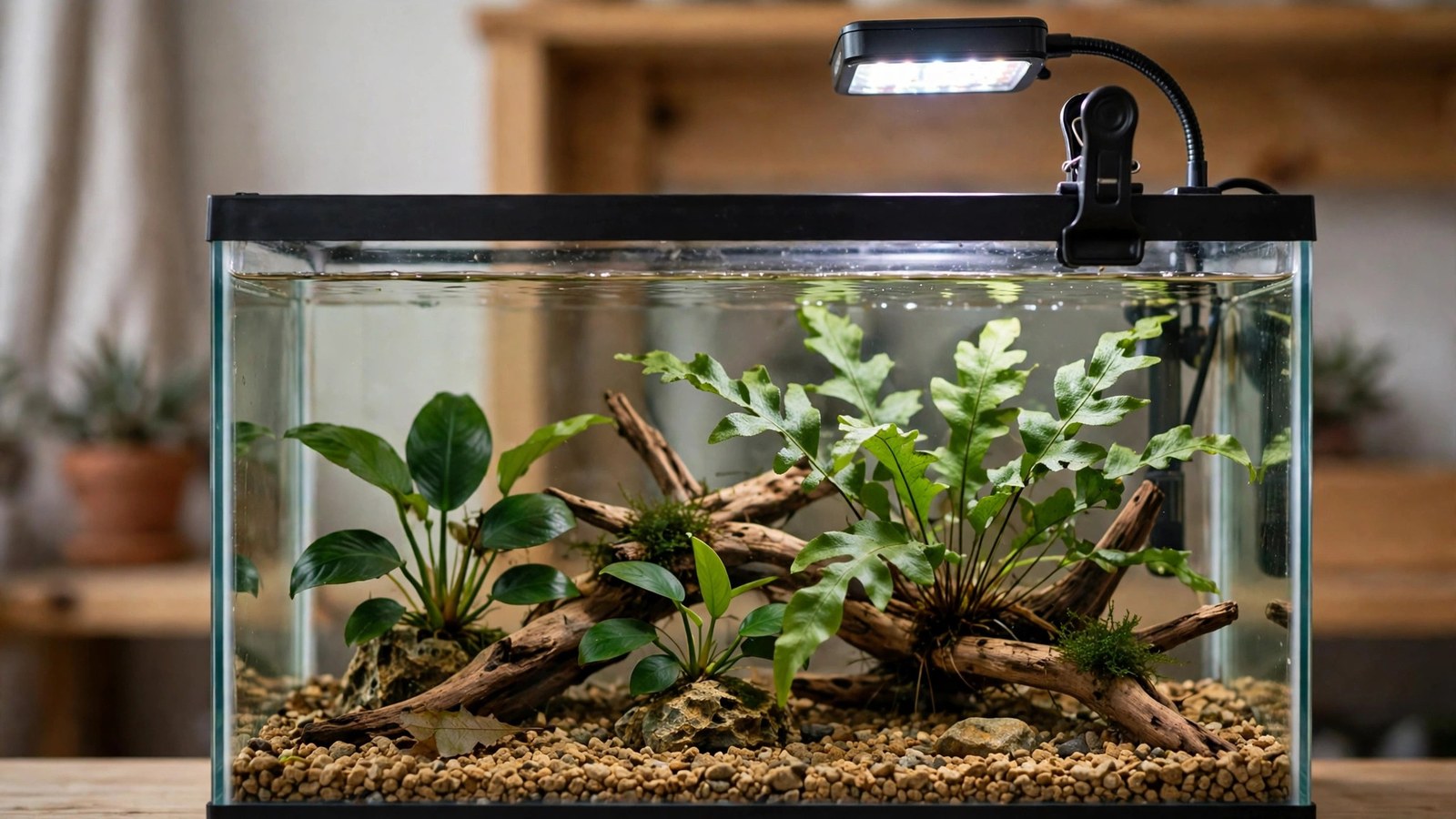
Most low-tech tanks I see online are running lights worth three or four times what they actually need — and the owners usually learn that when the algae arrives. Do you need an expensive light for a low-tech tank? Honestly: no. A simple, dimmable full-spectrum LED grows every easy plant worth keeping, while a pricey high-PAR fixture on a tank with no CO2 mostly grows algae. By the end of this guide you'll know exactly when a light is "good enough" and which features are worth paying for.
The real question isn't price — it's what the light does
Expensive and budget LEDs both produce light; what differs is intensity, controllability, and spectrum finesse. In a low-tech setup — no injected CO2, easy plants like Anubias, Java fern, and Cryptocoryne — plants hit their growth ceiling from CO2 and nutrients long before light becomes the bottleneck, making raw intensity the least important thing a light provides.
What drives results is spectrum, photoperiod (a steady 6–8 hour day), and dimmability (the ability to turn intensity down until plants and algae balance). A cheap fixture with all three beats a flagship running blind at full blast. For the full fixture landscape, see our guide to the best aquarium lighting for planted tanks — but the low-tech sweet spot is basic full-spectrum bars and clip-on lights.
Why expensive lights can actually make a low-tech tank worse
High-end fixtures are engineered to push 100+ PAR — levels built for CO2-injected tanks where plants photosynthesize fast enough to use all that energy. In a low-tech tank, plants grow slowly by design, and light energy they can't use doesn't vanish: algae will happily use it instead. Mount a premium light at full power over a no-CO2 tank and you've built a very expensive algae farm.
The pattern is predictable. Week one: everything looks stunning. Week two: a faint green film on the glass. Weeks three to four: hair algae on leaf edges and black beard algae on the hardscape. The fix is always the same — dim the light, cut the photoperiod — which means paying flagship prices to run the fixture at 40%.
What a low-tech tank actually needs from a light
Easy plants need surprisingly little. Most thrive at 30–60 PAR at the substrate — levels a basic full-spectrum LED bar hits in a standard 18–24 inch deep tank. The features that genuinely earn their keep:
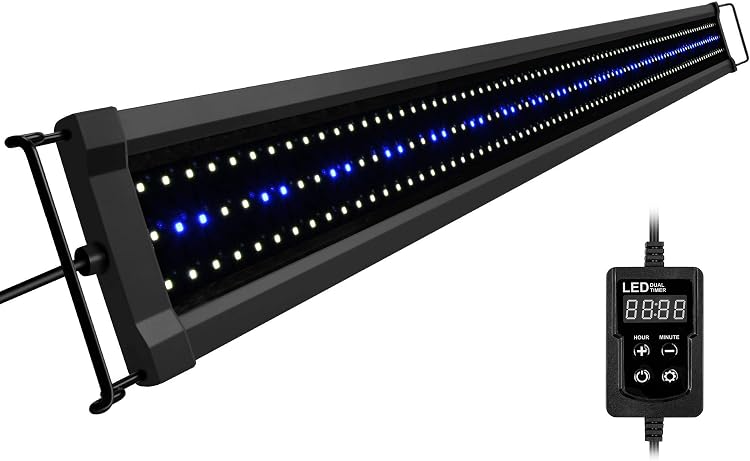
- A dimmer or intensity control. The feature most worth paying for — it prevents the algae spiral described above.
- A timer. Consistency beats duration; a light timer holds your photoperiod steady at 6–8 hours without you remembering to flip a switch.
- Balanced full spectrum. A full-spectrum output covering the reds and blues plants use most, with natural color rendering.
- Decent spread. One bar covering the full tank length beats two overpowered spots with dark corners.
That combination covers what easy aquarium plants actually require — for far less than most beginners assume.
 ★4.6
NICREW ClassicLED Gen 2
Check Price on Amazon ★4.6Light tiers compared: what's justified on a low-tech tank
How the three price tiers compare on a no-CO2 setup:
| Tier | PAR at substrate | Strengths | Justified when… |
|---|---|---|---|
| Budget bar / clip-on — basic full-spectrum LED | 30–60 | Cheap, simple, often timer-ready | You run easy plants with no CO2 — this tier does the whole job. |
| Mid-range — dimmable full-spectrum fixture with timer | 40–90 (adjustable) | Dimmability, good color rendering, even spread | You want the best balance of control and price, or the tank is deep (20+ inches). |
| High-end — premium fixture, app control | 80–150+ | Precision spectrum, scheduling, extreme output | You're adding CO2 soon, or keeping demanding carpeting plants. |
Each tier up buys headroom for a more demanding setup, not better results for the one you have. Without CO2 plans, a mid-range fixture at 50% is functionally identical to a high-end fixture at 30% — minus the money.
The two cases where spending more makes sense
There are two honest reasons to buy beyond the budget tier. First, you're on the path from low light to high light — this tank is going high-tech within the next year, and you'd rather buy once than buy twice. Second, your tank is unusually deep or long, and a budget bar leaves dark corners where nothing grows.
Both share a trait: you're paying for a future or a specific physical problem, not for "better growth" today. If neither applies, a budget fixture on a timer is the correct purchase. And if money is tight, secondhand fixtures and simple height adjustments go a lot further than most hobbyists expect.
How to set any light correctly on a low-tech tank
The fixture matters less than the routine. Start at 50–60% intensity (or a raised, non-dimmable bar) with a 6-hour photoperiod for the first month while the tank matures. If plants grow steadily and algae stays minimal, extend toward 7–8 hours before touching intensity. If algae appears, dim first, shorten second.
Consistency is the hidden variable: plants adapt to any light regime, but not to one that changes daily. Lock the balance in with a timer and stop fiddling. The best low-tech light is the cheapest one you can set and forget — which is why the best LED lights for low-tech planted tanks are budget and mid-range fixtures, not flagships. The University of Georgia Extension's aquatic plant growth guide and Tropica's plant growth reference both confirm that light is the variable plants adapt to, not the limiting factor, in low-tech systems.
Frequently Asked Questions
Can plants grow well under a cheap LED light?
Yes — for easy, low-tech plants, absolutely. Anubias, Java fern, Cryptocoryne, Vallisneria, and Amazon swords all thrive under a basic full-spectrum LED bar delivering 30–60 PAR, since these plants evolved for shaded streams. Keep the photoperiod at 6–8 hours, and a budget fixture will grow them just as well as anything pricier.
What light features are actually worth paying for?
Dimmability first — it lets you tune intensity to the algae/plant balance point, the most valuable control in a low-tech tank. A timer comes second for day-to-day consistency. Balanced full-spectrum output is third, since it supports plant health and makes the tank look natural. Raw wattage and app-controlled RGB modes are the features least worth paying for.
Is there any risk to using an expensive light on a low-tech tank?
The main risk is algae. High-PAR fixtures running near full power on a no-CO2 tank give algae more energy than slow-growing plants can absorb, and green spot, hair, or black beard algae often appear within 2–4 weeks. Dimming and shortening the photoperiod manage the risk fully — but that leaves the expensive output unused.
When should I upgrade my low-tech light?
Upgrade when a specific problem demands it: dark corners nothing will grow in, a tank deeper than 24 inches where PAR falls off, or a genuine plan to add CO2 and demanding plants within the year. Don't upgrade because growth feels slow — in low tech that's usually a CO2 or nutrient limit, not a light limit. Address the real bottleneck first.
Do aquarium plants need CO2 with an expensive light?
They don't need CO2 injection to live under it, but intense light without extra CO2 creates the classic imbalance that breeds algae. High light drives photosynthesis demand that a low-tech tank's natural CO2 can't supply. If you want to run a premium fixture near its potential, adding CO2 — see our explainer on whether aquarium plants need CO2 — turns the risk into actual growth.
The honest answer, summed up
No, you don't need an expensive light for a low-tech tank. A basic dimmable full-spectrum LED on a timer, run 6–8 hours a day, grows every easy plant worth keeping — without the algae battles high-PAR fixtures bring to no-CO2 setups. Spend the savings on good substrate, quality plants, or a fertilizer routine; those move the needle far more. Buy the flagship when you're ready for CO2, not before.