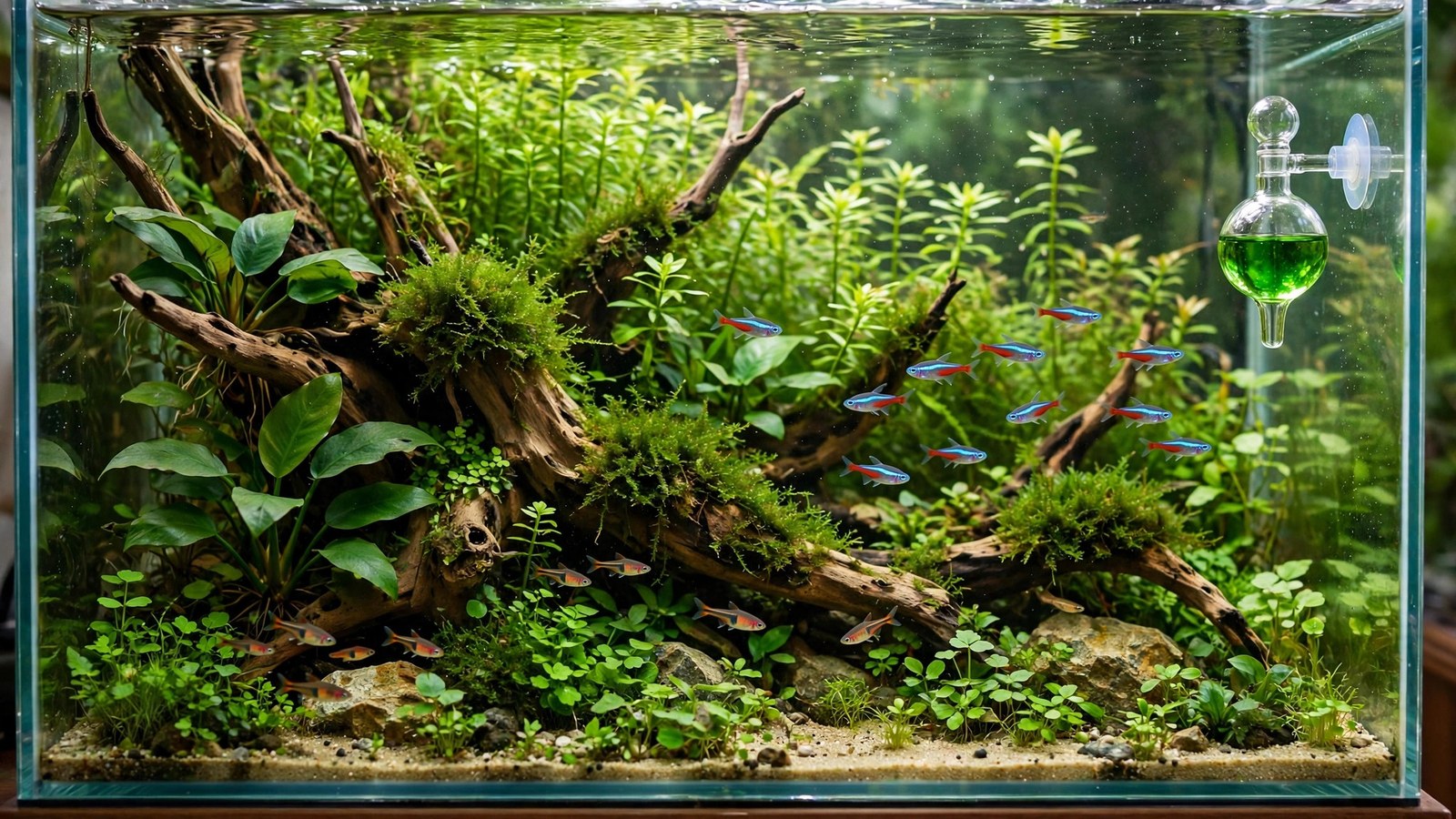
So, does CO2 lower aquarium pH? Yes — and in a high-tech planted tank it's one of the most visible things you'll see on your test kit. The moment you start injecting pressurized CO2, your pH begins to slide downward, sometimes by a full point or more. That drop is completely normal and, when managed well, harmless to your fish. The trouble starts when aquarists chase a number on a test strip, ignore the relationship between CO2, pH, and KH, and end up either starving their plants of carbon or gassing their fish. This guide explains exactly why injected CO2 lowers pH, how far yours should fall, and how to manage the drop so both plants and livestock thrive.
Why Injected CO2 Lowers pH
The chemistry is straightforward. When carbon dioxide dissolves in water, a portion of it reacts to form carbonic acid (H2CO3), which releases hydrogen ions into the water. More hydrogen ions means lower pH — that's all a pH drop really is. In a planted tank, you're dissolving far more CO2 than the atmosphere could ever provide, so the effect is far stronger than in a low-tech tank.
Here's the reassuring part: carbonic acid is a weak acid. Unlike mineral acids (the kind in "pH Down" bottles), it doesn't permanently change your water chemistry. When the CO2 degasses at the surface or gets absorbed by plants, the pH drifts right back up. This reversibility is the whole secret of safe CO2 management — your pH moves on a daily cycle, and as long as the cycle is predictable and moderate, fish handle it effortlessly. Wild habitats like blackwater streams swing more than most CO2-injected tanks ever will.
If you want the pure math behind this relationship — how pH and KH pin down your dissolved CO2 — our pH/KH/CO2 chart method walks through the calculations. But you don't need the math to manage your tank safely; you need a method. That's what the rest of this guide is about.
How Far Should Your pH Drop?
The most practical target used by experienced planted-tank keepers is a pH drop of about 1.0 between your fully degassed baseline and your peak CO2 level. In other words: measure your pH first thing in the morning before CO2 has been running (or after CO2 has been off for several hours), then measure again during the photoperiod once levels have stabilized. A one-point drop roughly corresponds to 30 ppm of dissolved CO2 — the widely accepted sweet spot for plant growth with a comfortable safety margin for fish.
Your carbonate hardness (KH) controls how dramatic the drop looks:
- Low KH (0–3 dKH): pH falls easily and far. You can hit your target CO2 at a smaller drop, but the water has little buffering, so mistakes bite harder. Many RO-water users sit naturally around pH 5.5–6.0 with CO2 on — fine for plants and soft-water fish.
- Medium KH (4–6 dKH): the easiest range to manage. A steady, predictable drop that's easy to read on a pH pen.
- High KH (7+ dKH): the drop looks smaller even at the same CO2 level. You may need a bigger injection rate to reach 30 ppm, and your baseline pH stays higher.
A drop larger than about 1.2–1.3 points from baseline is your warning that CO2 levels may be running high — time to check on your livestock and consider backing the needle valve down slightly. A drop of 0.5 or less usually means your plants are still CO2-limited and you're not getting the growth you paid for.
The pH/KH/CO2 Relationship (Without the Headache)
You can think of pH, KH, and CO2 as three corners of a triangle: fix any two and the third is determined. KH sets your buffering capacity — how much acid your water can absorb before pH moves. CO2 sets how much carbonic acid is being produced. pH is just the result showing on your meter.
Two practical consequences of this:
- Don't try to "fix" the pH number directly. Chasing a textbook pH of 7.0 with chemical buffers while injecting CO2 is a losing battle — the CO2 keeps producing acid, the buffer keeps fighting it, and you get instability plus phosphate-laden water. Instead, set a CO2 level your plants need and let pH land where the triangle says it lands.
- KH is the lever you actually control. If your pH crashes too easily, raising KH slightly (for example with potassium bicarbonate) gives the water more buffering. If your water is liquid rock and you want softer conditions, cutting tap water with RO water lowers KH. Adjust KH, then re-measure your CO2 level — never adjust CO2 by pH alone.
One caveat: in real tanks, other acids — tannins from driftwood, organic waste, aquasoil that actively lowers pH — also push pH down. That's why pure pH/KH chart readings can overestimate CO2. Cross-check with a drop checker rather than trusting the numbers blindly.
A pH controller automates the whole balancing act: a pH controller like Milwaukee's MC122.
Dialing In CO2 Safely: The Drop Method
Forget bubble counts as a measurement — a "bubble" differs between every bubble counter on the market. Instead, dial in your injection by measuring the actual pH drop. Here's the step-by-step method:
1. Establish your degassed baseline
Turn CO2 off for several hours (overnight works well, especially since you should be shutting CO2 off at night anyway) and let the tank fully degas with normal surface agitation. Measure pH with a calibrated pen — liquid test kits and strips are too coarse and too easily skewed by tank water chemistry for this job. Write the number down; this is your baseline.
2. Set your CO2 to come on early
CO2 takes time to build to full concentration — typically 1 to 2 hours depending on tank size and surface agitation. Put the solenoid on a timer so it starts 1–2 hours before lights on, and aim for full CO2 (and maximum pH drop) right as the photoperiod begins. Plants can only use CO2 while photosynthesizing, so levels peaking at lights-on is the goal.
3. Raise injection slowly, over days
Start with a modest bubble rate and increase it in small steps — no more than a quarter-turn of the needle valve per day. Each afternoon, measure the pH drop from baseline. Stop increasing when you reach roughly a 1.0-point drop, then watch your fish and your drop checker (below) for confirmation before pushing further.
4. Confirm with a drop checker
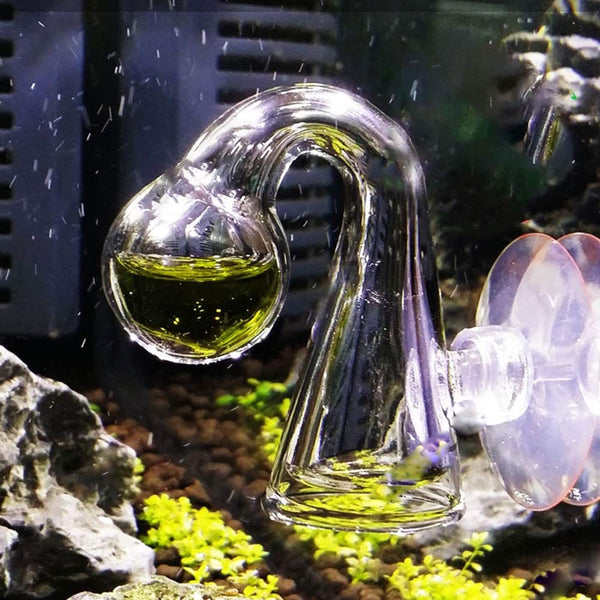
A drop checker isolates the CO2 measurement from everything else in your water by using a known 4 dKH reference solution and bromothymol blue indicator. It should sit at a steady lime green during the photoperiod — that color means roughly 30 ppm. Yellow means too much; blue means too little. Keep in mind it lags about 2 hours behind actual tank conditions, so read it as a trend, not a live meter. Our full drop checker guide covers placement, solution prep, and troubleshooting.
A drop checker is the simplest way to read CO2 at a glance: a drop checker like FZONE's glass kit.
 ★4.6
FZONE Glass CO2 Drop Checker Kit
Check Price on Amazon ★4.6Reading Your Fish: Warning Signs of Too Much CO2
Fish always tell the truth before any test kit does. Carbon dioxide is an asphyxiant — at excessive levels it interferes with the blood's ability to carry oxygen, and fish will show distress well before concentrations become lethal. Learn these signs:
- Gasping at the surface — the classic red flag. Fish hover at the top, mouths working at the waterline.
- Rapid gill movement — gills pumping hard even in calm, well-oxygenated water.
- Lethargy and loss of color — fish that were active yesterday now sit motionless or hide.
- Shrimp climbing out — shrimp and snails heading for the waterline or trying to leave the tank is an emergency signal.
- Fish near filter outflow — congregating where oxygen is highest, avoiding the rest of the tank.
If you see these, act immediately: turn off CO2, add surface agitation (aim the filter output at the surface, add an airstone), and do a partial water change with temperature-matched water. Symptoms usually reverse within an hour once CO2 falls. For a deeper dive into stocking, species sensitivity, and safe limits, read our CO2 fish safety guide.
Also note: not all livestock tolerates CO2 equally. Small tetras and rasboras are fairly forgiving; hillstream loaches, goldfish, and many invertebrates are more sensitive. If you keep sensitive species, target 20–25 ppm rather than 30, and weight your observations toward the most delicate animals in the tank.
Avoiding pH Swings
The pH drop from CO2 is not itself a "pH swing" — a swing is an uncontrolled change. A smooth, repeatable daily cycle (up overnight, down during the day) is what stability looks like in a planted tank. Real problems come from irregularity:
- Inconsistent injection. DIY CO2 systems that surge and fade create bigger swings than any pressurized setup. If swings are your problem, a pressurized cylinder with a solenoid on a timer is the fix, not a different acid buffer.
- Big, infrequent water changes. Swapping 50% of CO2-saturated water for fresh tap water causes a sudden pH jump. Change smaller amounts more often, and schedule changes outside the photoperiod so the tank re-equilibrates before lights-on.
- End-of-tank dump. As a CO2 cylinder nears empty, some single-stage regulators release a surge of gas — a sudden, dangerous pH crash. Learn to recognize and prevent end-of-tank dump; a dual-stage regulator or a cylinder-weight routine eliminates the risk.
- Running CO2 around the clock. Plants don't use CO2 in the dark — they actually consume oxygen at night. Continuous injection wastes gas and depresses pH (and oxygen) when nothing benefits from it. Shutting CO2 off at night is one of the simplest safety upgrades you can make.
- pH controller misconfigurations. A pH controller can hold pH rock-steady by switching the solenoid on and off — but a miscalibrated probe or a failed solenoid can dump CO2 or starve plants silently. Controllers are a convenience layer on top of a well-dialed manual setup, never a replacement for one.
Quick-Reference: Safe CO2/pH Targets
| Parameter | Safe Target | Why |
|---|---|---|
| pH drop from degassed baseline | ~1.0 point | Approximately 30 ppm dissolved CO2 |
| KH (buffering) | 2–6 dKH | Enough buffering for predictable drops; workable for most livestock |
| Drop checker color (photoperiod) | Lime green | Roughly 30 ppm in a 4 dKH reference solution |
| CO2 on/off timing | On 1–2 hrs before lights, off 1 hr before lights-out | Full CO2 at lights-on; none wasted at night |
| Adjustment pace | Small increases, one per day max | Lets fish and drop checker catch up with changes |
| Livestock distress response | CO2 off + surface agitation + water change | Drops CO2 fastest; symptoms reverse quickly |
Worked Examples: Running the Numbers Yourself
Let us verify the formula with concrete numbers. The pattern to internalize: at a fixed KH, each 0.2 step down in pH multiplies the CO2 estimate by about 1.58.
| pH | KH (dKH) | Calculation | ≈ CO2 (ppm) |
|---|---|---|---|
| 7.0 | 4 | 3 × 4 × 100 = 3 × 4 × 1 | 12 |
| 6.8 | 4 | 3 × 4 × 100.2 = 3 × 4 × 1.585 | 19 |
| 6.6 | 4 | 3 × 4 × 100.4 = 3 × 4 × 2.512 | 30 |
| 6.4 | 3 | 3 × 3 × 100.6 = 3 × 3 × 3.981 | 36 |
| 7.0 | 3 | 3 × 3 × 100 = 9 × 1 | 9 |
| 6.8 | 3 | 3 × 3 × 100.2 = 9 × 1.585 | 14 |
| 6.6 | 2 | 3 × 2 × 100.4 = 6 × 2.512 | 15 |
Check the arithmetic on the flagship examples: 3 × 4 × 1 = 12 ppm. 3 × 4 × 1.585 = 19.02, so ≈ 19 ppm. 3 × 4 × 2.512 = 30.14, so ≈ 30 ppm. 3 × 3 × 3.981 = 35.83, so ≈ 36 ppm. Most high-tech planted tanks target roughly 25–35 ppm of dissolved CO2; fish stress symptoms typically begin well above 40 ppm. But a number is a reference point, not a goal — never chase it blindly, which we will cover in the safety routine below.
Where the Chart Lies to You
This is the section that actually matters. The chart's math assumes carbonate is the only thing buffering your water. In many real tanks, it is not. When other acids or buffers are present, the formula reads their pH effect as CO2 and hands you a fantasy number.
Buffering/active aquasoils
Active soils like ADA Amazonia are designed to strip KH toward zero while pulling pH down. This breaks the chart completely: with KH near zero, the formula's output is meaningless, and the lowered pH produces enormous phantom CO2 values that do not exist. If you run aquasoil, do not use the chart at all. Rely on a drop checker instead, and watch your livestock.
Driftwood tannins and peat
Tannic and humic acids from driftwood, leaf litter, and peat filtration lower pH without adding any CO2. The chart reads the lowered pH and multiplies it by your KH, inflating the estimate — sometimes dramatically in blackwater-style tanks. If your tank is tea-colored, treat chart readings as overestimates.
Phosphate buffers
Some pH-adjusting products and certain fertilizers use phosphate buffers, which affect pH in ways the carbonate-only formula cannot account for. If you dose pH Up / pH Down style products or heavy phosphate buffers, the chart is unreliable.
KH near zero and RO water
With reverse-osmosis or very soft water where KH reads at or near zero, the formula degenerates and unstable pH makes readings noisy. KH must be a real, measurable number (ideally 2 dKH or more) for the method to have any meaning.
The pattern across all four cases is the same: the chart answers the question "how much CO2 is implied by this pH and KH if carbonate were the only buffer?" — and reality often ignores the "if." Knowing when your water violates the assumption is what separates a useful tool from a dangerous one.
Frequently Asked Questions
Does CO2 lower aquarium pH permanently?
No. Dissolved CO2 forms carbonic acid, a weak acid that only lowers pH while the CO2 is present. Once the gas degasses at the surface or is absorbed by plants, pH rises again — this reversibility is why the daily pH cycle in a CO2-injected tank is normal and safe, unlike permanent shifts from mineral acids or buffers.
How much does CO2 drop pH in a planted tank?
A well-tuned pressurized setup typically drops pH about 1.0 point below the fully degassed baseline, which corresponds to roughly 30 ppm of dissolved CO2. The exact number depends on your KH: low-KH water drops further and faster, while high-KH water shows a smaller drop for the same CO2 level.
Is a daily pH swing from CO2 harmful to fish?
A smooth, predictable daily cycle of about one pH point is harmless to the vast majority of aquarium fish — wild habitats swing more. What harms fish is uncontrolled CO2: end-of-tank dump surges, 24/7 injection without a solenoid, or cranking the needle valve until fish gasp. Manage the CO2 level and the pH takes care of itself.
Should I use a pH controller with CO2?
A pH controller can add convenience by holding pH steady through a solenoid, but it should only be layered on top of a manually dialed-in setup. Miscalibrated probes or failed solenoids can cause exactly the problems a controller is meant to prevent. Dial in with a drop checker and the 1.0-point-drop method first, then add a controller if you want automation.
Why is my drop checker yellow but my fish look fine?
Because the checker lags about two hours behind the tank — it may still reflect yesterday's peak, or it may be placed in a high-CO2 dead spot. Also, fish tolerate mildly elevated CO2 for a while before showing distress, which is not an excuse to ignore the reading. Recheck placement and timing, trim the needle valve slightly, and trust the checker over the fish: by the time fish gasp, you've overshot.
Can I inject CO2 in a tank with very low KH?
Yes, but carefully. Low-KH water has little buffering, so pH drops fast and mistakes escalate quickly — start with a smaller pH-drop target and increase very gradually. Many aquarists add a small amount of potassium bicarbonate to raise KH to 2–3 dKH for a wider safety margin. RO users with active aquasoil should watch pH especially closely in the first weeks.
Is the pH/KH/CO2 chart accurate?
It is accurate only when its core assumption holds: carbonate must be the only buffer in the water. In plain tap-water tanks with measurable KH and no aquasoil, tannins, or phosphate buffers, it gives a genuinely useful estimate within the error of your test kits. In tanks that violate the assumption, it can be wrong by large margins — treat it as a sanity check, not a scientific instrument.
Why does the chart give a huge CO2 reading in my aquasoil tank?
Active aquasoils strip KH toward zero while dragging pH down. With near-zero KH and a low pH, the formula produces enormous phantom CO2 numbers that reflect soil chemistry, not dissolved gas. This is the chart's most famous failure mode. In aquasoil tanks, ignore the chart entirely and use a drop checker plus careful livestock observation instead.
What CO2 level should I aim for in a planted tank?
Most high-tech planted tanks target roughly 25–35 ppm of dissolved CO2, where plant growth is strong and the risk to fish stays low. Fish stress symptoms typically begin well above 40 ppm. But treat these as reference ranges, not targets to chase — livestock behavior outranks any number. If fish gasp or slow down, reduce CO2 regardless of what the chart claims.
How often should I test pH and KH for the chart?
Test both at the same time of day, mid-photoperiod, whenever you are adjusting your CO2 — daily while dialing in a new setup, then weekly or whenever you change something (new fertilizer, new driftwood, different water source). There is no need to chart daily once levels are stable; a drop checker covers continuous monitoring better than repeated test kits do.
Can I use the chart if my KH is 1 dKH or lower?
Not reliably. Near-zero KH makes the formula's output meaningless and your pH readings unstable enough that small errors swing the estimate wildly. You need a real, measurable KH — ideally 2 dKH or more — for the chart to mean anything. With RO or very soft water, remineralize to a stable KH or switch to a drop checker with 4 dKH reference solution.
Does the chart work if I run CO2 only during the day?
Yes — the chart is a snapshot method, so just take your pH and KH readings mid-photoperiod while CO2 is running at its normal rate. The standard practice of starting CO2 an hour or two before lights-on means a reading taken a few hours into the light cycle represents your peak dissolved CO2. Avoid testing right after the CO2 switches on or off.
Manage the CO2, and the pH Manages Itself
The pH drop that comes with CO2 injection alarms a lot of new planted-tank keepers, but it's one of the least worrisome numbers on your test kit. Measure your degassed baseline, target roughly a one-point drop with a drop checker confirming lime green, keep injection on a timer, and let your fish have the final vote. Do that, and the same chemistry that feeds your plants becomes a self-regulating daily rhythm instead of something to fear. For more on reading the instruments behind this method, see our guides to the drop checker and the pH/KH/CO2 chart — and keep the fish safety checklist taped inside your cabinet door.
Further reading: the UK Aquatic Plant Society's long-running CO2 in the planted aquarium guide covers the same carbonic-acid chemistry and 25–35 ppm target ranges from the hobbyist community's experience.